Aeronautical and Astronautical Engineering Salary: The Complete 2026 Guide
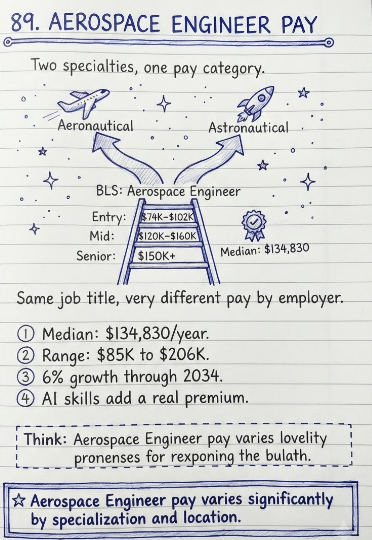
Aeronautical and astronautical engineering is a name you'll see attached to specific university departments — MIT's Department of Aeronautics and Astronautics and Stanford's AA program are two well-known examples — but in the U.S. labor market, both specialties are tracked under a single official category: aerospace engineer. Aeronautical engineering focuses on aircraft that fly within Earth's atmosphere (airplanes, helicopters, drones), while astronautical engineering focuses on vehicles and systems designed for spaceflight (satellites, launch vehicles, crewed spacecraft). The distinction matters for what you'll actually work on day to day, but it doesn't create a separate government salary category — both roll into the same Bureau of Labor Statistics data.
That combined category pays well by any national standard: the U.S. Bureau of Labor Statistics reports a median annual wage of $134,830 for aerospace engineers as of May 2024 — more than double the $49,500 median across all U.S. occupations. But that single median number hides a genuinely wide spread, from under $85,350 at the bottom 10% to over $205,850 at the top 10%, and where you land in that range depends heavily on experience, employer, specialization, and, increasingly, whether you've paired your core engineering skills with modern simulation and AI tools.
This guide breaks down the official BLS salary data, how pay actually changes across experience levels, which employers and states pay the most, the real difference between aeronautical and astronautical career paths, and the specific factors currently having the biggest measurable impact on pay in this field.
The Official Numbers: What BLS Data Actually Shows
| Metric | Figure (BLS, May 2024 data) |
|---|---|
| Median annual wage | $134,830 |
| Median hourly wage | ~$64.82 |
| 10th percentile (lower end) | $85,350 |
| 90th percentile (upper end) | $205,850 |
| Projected employment growth (2024–2034) | 6% — faster than the average for all occupations |
| Projected annual openings | ~4,500 per year |
| Minimum typical entry-level education | Bachelor's degree in aerospace engineering or a closely related field |
The gap between the 10th and 90th percentile — roughly $85,000 versus $206,000 — is a useful reminder that 'aerospace engineer' spans a genuinely wide range of seniority, specialization, and employer type, not a single tightly clustered pay band. A recent engineering graduate at a smaller contractor and a senior spacecraft systems lead at a major aerospace prime contractor are both technically counted in the same BLS category, but their actual pay can differ by well over $100,000.
Salary by Experience Level
| Experience Level | Typical Base Salary Range |
|---|---|
| Entry-level (0–2 years) | ~$74,000 – $102,000 |
| Early-career (2–5 years) | ~$95,000 – $130,000 |
| Mid-career (5–10 years) | ~$120,000 – $160,000 |
| Senior / specialized (10+ years) | ~$150,000 – $205,850+ |
These ranges are directional rather than exact, since actual pay depends heavily on employer, location, and specialization — but the overall pattern is consistent across most salary data sources: meaningful jumps happen roughly every few years of experience, with the steepest relative increases typically occurring in the first decade of a career as engineers move from general design and analysis work into specialized or leadership roles.
Aeronautical vs. Astronautical: Does the Specialty Actually Change Pay?
Both specialties are tracked under the same BLS 'aerospace engineer' category, so there's no official, separate government pay statistic distinguishing the two. In practice, third-party salary data suggests the two paths can differ somewhat based on employer mix rather than the specialty itself — aeronautical-focused roles skew toward traditional aviation and defense contractors (Boeing, major airlines' engineering divisions, defense primes), while astronautical-focused roles skew toward space-specific employers (SpaceX, NASA and its contractor network, satellite manufacturers, and a growing number of newer commercial space companies).
- Aeronautical engineering: works on atmospheric flight — aircraft, helicopters, and uncrewed aerial vehicles (UAVs/drones) — commonly employed by aircraft manufacturers, airlines, and defense contractors.
- Astronautical engineering: works on spaceflight — satellites, launch vehicles, and crewed or uncrewed spacecraft — commonly employed by space-focused companies, NASA and its contractor network, and satellite manufacturers.
- Aviation engineer (a related but distinct title): typically focuses on aircraft maintenance systems, airport infrastructure, or airline operations, rather than core aircraft or spacecraft design.
- In practice, pay differences between the two specialties tend to track the specific employer and sub-field (commercial aviation versus defense versus space) more than the aeronautical/astronautical label itself.
Salary by Employer
Employer choice is one of the single biggest levers on pay in this field, sometimes outweighing years of experience.
| Employer Type / Example | General Pay Positioning |
|---|---|
| Major aerospace & defense primes (Boeing, Lockheed Martin, Northrop Grumman) | Competitive, often mid-to-upper range, with strong benefits and defined advancement ladders |
| Commercial space companies (SpaceX and similar) | Can range widely — some roles offer strong base pay, others weight compensation more heavily toward equity or mission-driven lower base pay, depending on the specific company and role |
| NASA and federal research labs (including contractor-operated centers like NASA JPL) | Government-scale pay bands, generally solid but sometimes below top private-sector rates at the most senior levels, offset by strong stability and benefits |
| Specialized research and consulting firms (e.g., MITRE) | Frequently among the highest-paying employer categories for aerospace engineering talent |
| Smaller contractors and suppliers | Typically lower average pay than major primes, though this varies significantly by specific company and contract |
Beyond the specific company, the broader industry an aerospace engineer's role sits within also shapes pay — engineers working in general transportation and logistics roles, management consulting, or IT-adjacent aerospace roles have shown up in some salary surveys with pay comparable to or exceeding traditional aerospace-and-defense-specific roles, reflecting how aerospace engineering skills increasingly transfer into a broader set of industries.
Salary by State and Region
Aerospace engineering pay correlates more strongly with the presence of specific major employers than with general cost of living. States and regions with major aerospace manufacturing hubs, significant defense contractor presence, or a concentration of space industry activity tend to offer higher average pay and more job openings, while states with a smaller aerospace industry footprint may offer fewer roles even where the general cost of living is comparable. States with major military aviation bases and established aerospace manufacturing — including regions in the Pacific Northwest, Texas, California, and parts of the Southeast — tend to show up consistently among the higher-paying and higher-opportunity regions for this field, largely because that's where the major employers are concentrated.
What Actually Moves Pay Beyond Experience
- Security clearance: many roles tied to national defense programs require a security clearance, and holding one can open access to higher-paying defense-sector positions that aren't available to engineers without clearance eligibility.
- Advanced degrees: a master's degree in aerospace engineering is commonly associated with higher pay ceilings and expanded career options compared to a bachelor's degree alone, particularly for research-focused or highly specialized technical roles.
- AI and simulation fluency: recent industry analysis, including PwC's 2026 Global AI Jobs Barometer, has found a substantial wage premium — reportedly around 62% — for professionals who pair core domain expertise with AI and simulation tool fluency, compared to otherwise similar peers without those skills. In aerospace specifically, this has been associated with faster promotion timelines and better access to high-profile programs.
- Sub-field specialization: certain specialized roles — such as aircraft design engineers or airframe design engineers — have shown notably higher average pay in some industry data than more general aerospace engineering titles, reflecting the premium placed on deep, specific technical expertise.
- Employer size: larger aerospace employers have generally been associated with meaningfully higher pay than smaller companies for comparable roles, based on multiple salary-tracking sources.
Education and Entry Requirements
- Bachelor's degree: a bachelor's degree in aerospace engineering, or a closely related engineering field, is the standard minimum requirement to enter the profession, according to BLS.
- ABET accreditation: as with most engineering disciplines, degrees from ABET-accredited programs are generally the strongest foundation for entering the field and pursuing professional licensure later, where relevant.
- Security clearance eligibility: for roles tied to national defense programs, U.S. citizenship and eligibility for a security clearance are frequently required, independent of academic qualifications.
- Graduate study: while not required for most entry-level roles, a master's or doctoral degree is common among engineers pursuing research-intensive roles, highly specialized technical tracks, or academic careers within aerospace engineering.
Conclusion
Aeronautical and astronautical engineering — tracked together under the U.S. government's 'aerospace engineer' category — offers strong, well-documented pay by national standards, with a median of $134,830 and a top-decile figure well above $200,000. But the honest picture is that the specific number you'll actually earn depends far more on your employer, specialization, clearance status, and how well you've paired core engineering skills with current simulation and AI tools, than on the aeronautical-versus-astronautical label alone.
If you're evaluating this field for a career decision, the most useful next step isn't fixating on the national median — it's researching pay specifically at the type of employer (major prime, commercial space company, government lab, specialized consultancy) and sub-field you're actually targeting, since those factors explain far more of the real-world variation in pay than any single aggregate BLS figure can capture on its own.
FAQ
Frequently Asked Questions
What is the average salary for aeronautical and astronautical engineering?+
Both specialties are tracked under the U.S. Bureau of Labor Statistics' 'aerospace engineer' category, which reports a median annual wage of $134,830 as of May 2024 data. The full range spans roughly $85,350 at the 10th percentile to $205,850 at the 90th percentile, depending on experience, employer, and specialization.
What's the difference between aeronautical and astronautical engineering?+
Aeronautical engineering focuses on atmospheric flight — aircraft, helicopters, and drones. Astronautical engineering focuses on spaceflight — satellites, launch vehicles, and spacecraft. Both are tracked under the same 'aerospace engineer' category in U.S. labor statistics, so there's no separate official government salary figure distinguishing the two; pay differences tend to reflect the specific employer and sub-field more than the specialty label itself.
How much do entry-level aerospace engineers make?+
Entry-level aerospace engineers (roughly 0–2 years of experience) typically earn in the range of $74,000 to $102,000 in base salary, based on multiple industry salary data sources, though this varies by employer, location, and specific role.
Which employers pay aerospace engineers the most?+
Pay varies by specific company and role, but specialized research and consulting firms, major aerospace and defense primes, and certain commercial space companies have all shown up among the higher-paying employer categories in recent salary data. Larger employers generally pay more on average than smaller contractors and suppliers for comparable roles.
Does a master's degree increase aerospace engineering salary?+
Generally yes. A master's degree in aerospace engineering is commonly associated with a higher salary ceiling and access to more specialized or research-focused roles compared to a bachelor's degree alone, though it isn't strictly required to enter the field at the entry level.
Do you need a security clearance to work as an aerospace engineer?+
Not for every role, but many positions tied to national defense programs require a security clearance, which typically also requires U.S. citizenship. Holding clearance eligibility can open access to a segment of higher-paying defense-sector roles that aren't available to engineers without it.
What is the job outlook for aerospace engineers?+
The U.S. Bureau of Labor Statistics projects 6% employment growth for aerospace engineers from 2024 to 2034, faster than the average for all occupations, with approximately 4,500 openings projected each year, driven by factors including aircraft efficiency redesigns, lower satellite launch costs, and growing commercial demand for drones and small satellites.
Why do some aerospace engineering salary figures vary so much between sources?+
Different sources track different scopes — official BLS data reflects a broad national median across the full 'aerospace engineer' category, while third-party salary platforms may reflect self-reported figures for more specific titles (like 'aircraft design engineer'), particular employers, or particular regions, which naturally produces different numbers. It's worth checking exactly which title, employer type, and region a given salary figure actually covers before comparing sources directly.
Is aerospace engineering a good career financially?+
By national wage comparisons, yes — the BLS-reported median of $134,830 is more than double the median across all U.S. occupations, with continued faster-than-average projected job growth through 2034. That said, actual outcomes vary significantly based on employer, specialization, location, and additional factors like security clearance and advanced technical skills, so individual results can differ meaningfully from the aggregate national figures.
What skills currently increase pay the most in aerospace engineering?+
Beyond core aerospace engineering fundamentals, recent industry analysis points specifically to AI and simulation tool fluency as a significant pay differentiator, with one 2026 industry report citing a wage premium of around 62% for professionals who combine domain expertise with these skills compared to otherwise similar peers. Security clearance eligibility and advanced degrees are also commonly associated with expanded access to higher-paying roles.