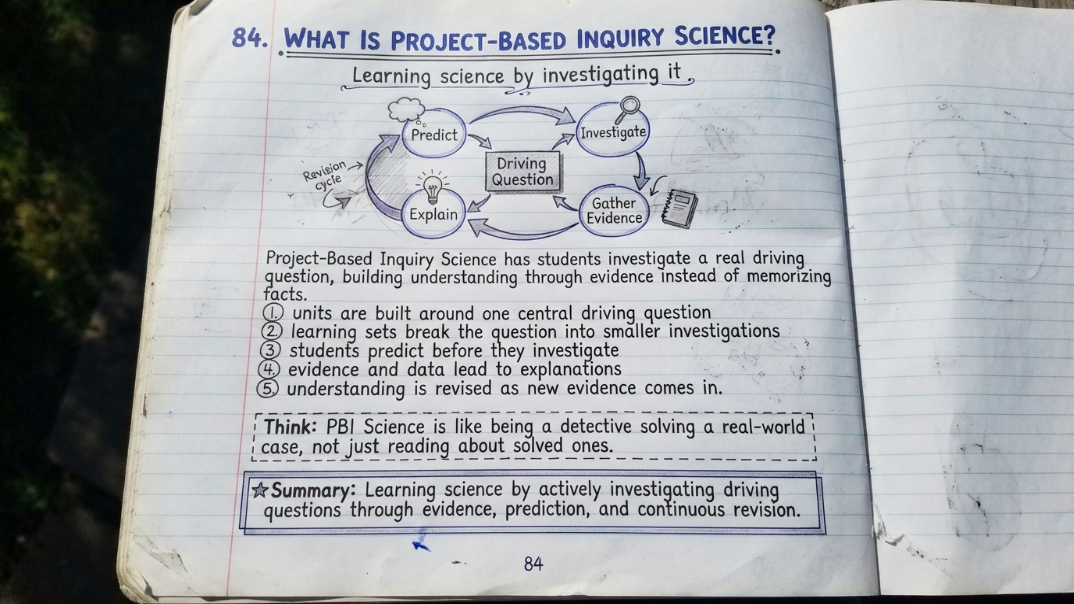
Traditional science classes have long followed a familiar pattern: read the chapter, memorize the vocabulary, take the test. Project-Based Inquiry Science flips that pattern around. Instead of starting with facts to memorize, students start with a real-world driving question — why do bridges collapse, why does a local pond turn green in summer, how do vaccines actually work — and build the underlying science understanding by investigating it directly. Developed initially for middle school science and now used in various forms across grade levels, this approach asks students to think and work the way scientists actually do: asking questions, designing investigations, gathering evidence, and revising their thinking as new data comes in. This guide breaks down what Project-Based Inquiry Science is, how it's structured, and how to teach or learn through it effectively.
What Is Project-Based Inquiry Science
Project-Based Inquiry Science (PBIS) is a science curriculum and teaching approach built around sustained investigation of real-world questions rather than sequential coverage of textbook topics. Rather than being told the answer and then doing a confirming experiment, students in a PBIS classroom investigate a genuine, often open-ended question, collect and analyze evidence, and construct scientific explanations largely on their own, with the teacher guiding rather than lecturing. The approach is rooted in how working scientists actually build knowledge — through iterative questioning, evidence-gathering, and revision — rather than through memorization of already-settled conclusions.
How PBIS Differs From Traditional Science Instruction
In a traditional science classroom, the typical sequence is lecture, then vocabulary, then a lab that confirms what was already taught, then a test. In a PBIS classroom, that sequence is largely reversed: students start with a driving question and a real-world phenomenon, then work through investigations that build the concepts they need along the way, with formal vocabulary and explanation introduced as tools to make sense of what they're observing rather than as the starting point. The content coverage can end up similar, but the order and the ownership of the thinking are fundamentally different.
Core Structure of a PBIS Unit
A typical PBIS unit is organized around a single overarching driving question that anchors weeks of instruction, broken into smaller learning sets that each investigate a piece of that larger question. Each learning set typically follows a consistent internal rhythm — asking a sub-question, predicting an answer, investigating through hands-on activities or data analysis, and then synthesizing findings into an explanation — before moving to the next learning set that builds on it. By the end of the unit, students typically apply everything they've learned to a final project or performance task that demonstrates their understanding of the original driving question.
- A unit-level driving question that anchors the entire investigation
- Multiple learning sets, each focused on a sub-question that builds toward the driving question
- Hands-on investigations and data collection within each learning set
- Regular opportunities for students to revise their explanations as evidence accumulates
- A culminating project or performance task synthesizing the full unit
The Role of the Driving Question
The driving question is the engine of a PBIS unit, and a well-designed one is specific enough to give students a clear investigative target while open-ended enough to require real inquiry rather than a quick lookup. A strong driving question is grounded in a genuine phenomenon students can observe or relate to — 'why did the fish in the local pond die last summer' works better than 'what is eutrophication' — because it gives students a reason to want the underlying scientific concept, rather than presenting the concept as something to memorize for its own sake.
Learning Sets and Investigations
Learning sets are the building blocks that break a large driving question into manageable, sequenced pieces of investigation. Each one typically opens with a smaller question that students predict an answer to before investigating, which surfaces students' existing (and sometimes incorrect) assumptions early, making the eventual evidence more meaningful when it confirms or contradicts what they expected. Investigations within a learning set can include hands-on experiments, data analysis of real or provided datasets, model-building, or structured research, depending on what the underlying science concept requires.
The Teacher's Role in a PBIS Classroom
Teaching PBIS well requires a different skill set than delivering a traditional lecture-based unit. Rather than presenting information directly, the teacher's main job becomes facilitation: asking probing questions that push student thinking without supplying the answer, managing small-group investigations happening in parallel, and knowing when to intervene with direct instruction versus when to let productive struggle continue. This role shift is often the hardest transition for teachers moving from a traditional curriculum, since it requires trusting the process even when students take longer to reach a conclusion than a lecture would.
Assessment in Project-Based Inquiry Science
Assessment in a PBIS classroom typically blends formative and summative approaches more heavily than a traditional unit test alone. Ongoing formative assessment happens through student notebooks, class discussions, and checkpoints within each learning set, giving teachers a continuous read on understanding rather than waiting until a single end-of-unit exam. Summative assessment often includes a final project or performance task tied directly to the driving question, evaluated against a rubric that looks at both content understanding and the quality of the scientific reasoning and evidence used to support conclusions.
Benefits of Project-Based Inquiry Science
Research and classroom experience consistently point to a few recurring advantages of the PBIS approach over purely lecture-based science instruction.
- Deeper conceptual understanding, since students construct explanations rather than memorize them
- Stronger retention, because concepts are tied to a memorable investigation rather than an isolated fact
- Development of real scientific practices — questioning, evidence use, and argumentation — not just content knowledge
- Higher engagement, particularly for students who struggle with passive, lecture-heavy instruction
- Better preparation for open-ended, real-world problem-solving beyond the classroom
Common Challenges for Teachers and Students
A few recurring difficulties show up when a classroom first transitions to a PBIS approach.
- Teachers underestimating the planning time needed to design or adapt strong driving questions and learning sets
- Students accustomed to being told the answer struggling initially with open-ended investigation
- Uneven participation within small-group investigations if roles aren't clearly structured
- Difficulty pacing units within a fixed school calendar, since inquiry can take longer than a lecture
- Assessing understanding fairly when students arrive at different explanations through different evidence paths
How to Succeed as a Student in a PBIS Classroom
Students who do well in a PBIS classroom generally approach it differently than they would a traditional lecture course.
- Take the driving question seriously as a real question, not a rhetorical lead-in to a lecture
- Write down predictions before an investigation, even if they turn out to be wrong
- Keep a thorough investigation notebook, since it becomes the evidence base for the final explanation
- Engage actively in group investigations rather than letting one student do the hands-on work
- Revisit and revise earlier explanations as new evidence comes in, instead of treating first answers as final
Future of Project-Based Inquiry Science
As science standards continue to emphasize practices like modeling, argumentation, and evidence-based reasoning over rote content recall, approaches like Project-Based Inquiry Science are likely to keep expanding beyond their original middle-school roots into elementary and high school settings. Digital tools — simulations, real-time data collection sensors, and collaborative platforms — are also making it easier for classrooms with limited lab resources to run genuine investigations, which should make the approach more accessible to schools that previously found it too resource-intensive to implement well.
FAQs
What grade level is Project-Based Inquiry Science designed for?
PBIS was originally developed for middle school science, though the underlying inquiry-based approach has since been adapted in various forms for elementary and high school science instruction as well.
How is PBIS different from a regular science fair project?
A science fair project is typically a single, student-chosen investigation completed independently, while PBIS is a structured curriculum where an entire class investigates a shared driving question together across multiple connected learning sets over several weeks.
Does Project-Based Inquiry Science cover the same content as a traditional curriculum?
Generally yes — PBIS units are designed to meet the same core science standards as traditional instruction, but students build that content understanding through investigation rather than through direct lecture and memorization.
What is a driving question in PBIS?
A driving question is the central, real-world question that anchors an entire PBIS unit, framed to be specific enough to guide investigation but open-ended enough to require genuine inquiry rather than a quick factual lookup.
Is Project-Based Inquiry Science effective for struggling students?
Many educators report that PBIS increases engagement for students who struggle with passive, lecture-heavy instruction, since the hands-on, question-driven structure gives them a more active role in building understanding.
What skills do students develop through PBIS beyond science content?
Students typically build stronger skills in questioning, evidence-based reasoning, collaboration, and revising their own thinking based on new information, alongside the specific science content covered in each unit.