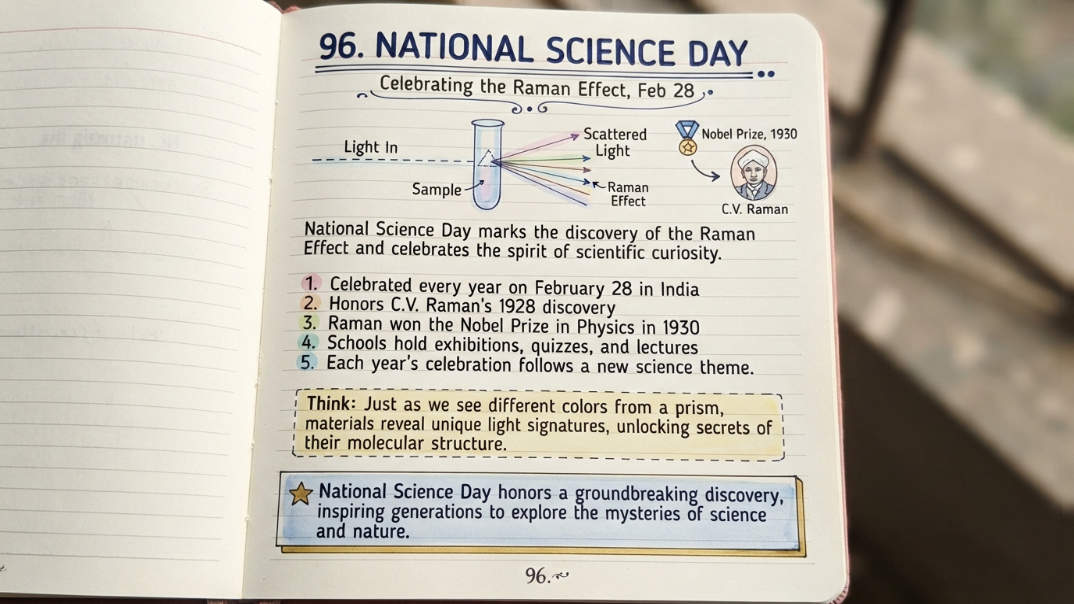
Every year on February 28, India observes National Science Day, a nationwide occasion dedicated to celebrating scientific achievement and encouraging public interest in science. The date isn't arbitrary — it marks the anniversary of one of India's most significant scientific discoveries, made by a physicist working with remarkably simple equipment and going on to win the country's first Nobel Prize in the sciences. This guide breaks down the history behind Science Day, why it matters, and how schools, universities, and research institutions across the country mark the occasion each year.
What Is National Science Day
National Science Day is an annual observance in India held on February 28, dedicated to promoting scientific temper and recognizing the contributions of Indian scientists to global scientific knowledge. It's marked across schools, colleges, universities, and research institutions nationwide through lectures, exhibitions, science fairs, and public outreach events aimed at making science more accessible and engaging, particularly for students.
The Discovery Behind the Date
February 28 was chosen specifically because it marks the anniversary of the discovery of the Raman Effect, announced by physicist Sir Chandrasekhara Venkata Raman on that date in 1928. The Raman Effect describes what happens when light passes through a transparent material and a small portion of it scatters at a different wavelength than the original light — a phenomenon that revealed new information about the molecular structure of the material the light passed through, and one that could be observed and measured using deceptively simple laboratory equipment for the time.
C.V. Raman: The Scientist Behind the Day
Sir C.V. Raman's discovery earned him the Nobel Prize in Physics in 1930, making him the first Asian and the first non-white scientist to win a Nobel Prize in any of the sciences. His work has remained influential well beyond its original discovery, since Raman spectroscopy — the analytical technique built directly on his findings — is still widely used today across chemistry, materials science, pharmaceuticals, and even art authentication and forensic analysis, illustrating how a single foundational discovery can continue generating practical applications for nearly a century afterward.
Why the Day Was Officially Established
India's National Council for Science and Technology Communication proposed February 28 as National Science Day in 1986, and the Indian government formally adopted the observance starting in 1987. The goal, beyond honoring Raman's specific achievement, was broader: to spread awareness of the importance of science in everyday life, to encourage scientific thinking and curiosity among the public, and to recognize the contributions of Indian scientists and researchers more generally, not just Raman alone.
Annual Themes for Science Day
Each year's National Science Day observance is organized around a specific theme, chosen to focus public attention and institutional programming on a current area of scientific relevance or concern, ranging from sustainable development and climate science to public health and technology access.
| Focus Area | Typical Theme Direction | Common Activities |
|---|---|---|
| Sustainability | Science for a sustainable future | Renewable energy exhibits, environmental science projects |
| Public Health | Science and public wellbeing | Health awareness camps, biology and medicine demonstrations |
| Technology Access | Science for everyone / inclusive science | Outreach in rural or underserved schools, accessible science kits |
| Basic Research | Curiosity-driven science and discovery | Lectures on foundational research, lab open days |
How Schools and Colleges Celebrate
Educational institutions are typically the most active participants in National Science Day celebrations, organizing a mix of hands-on and lecture-based programming. Common activities include student-led science exhibitions and model displays, quiz competitions covering general science and current scientific developments, guest lectures from scientists or researchers, and open lab demonstrations that let students see practical applications of concepts they've studied in textbooks. Many schools also use the day specifically to introduce younger students to the story of the Raman Effect itself, since it offers an accessible, homegrown example of how a curious question and a simple experiment can lead to major scientific recognition.
How Research Institutions Participate
Universities, national laboratories, and research institutes typically use National Science Day for broader public outreach, since much of their regular work happens outside public visibility. Common institutional activities include open house events where the public can tour research facilities and labs, public lectures explaining ongoing research in accessible terms, award ceremonies recognizing scientific achievement or public science communication, and outreach programs specifically aimed at bringing students from schools with limited science resources into contact with active researchers and equipment.
- Open house lab tours for students and the public
- Public lectures translating current research into accessible language
- Science communication and journalism awards
- Outreach programs for underserved schools and communities
- Exhibitions showcasing institutional research achievements
Why Science Day Still Matters
Beyond honoring a specific historical achievement, National Science Day serves an ongoing practical purpose: building public comfort with scientific thinking in a world increasingly shaped by scientific and technological change. Encouraging scientific temper — the habit of asking evidence-based questions rather than accepting claims at face value — has value well beyond the classroom, particularly as misinformation and pseudoscientific claims circulate widely online. A yearly, nationally recognized occasion focused on science gives schools, media, and institutions a natural, recurring opportunity to reinforce that habit publicly.
Ideas for Celebrating Science Day
Whether organizing an event for a classroom, an institution, or simply marking the day personally, a few approaches consistently work well.
- Host a simple, safe hands-on experiment demonstration relevant to the day's theme
- Organize a student quiz or trivia session on Indian scientific achievements
- Invite a local scientist, researcher, or science teacher for a short talk
- Visit a science museum, planetarium, or open research lab event if available locally
- Share the story of the Raman Effect with younger students as an accessible entry point into the history of science
FAQs
Why is National Science Day celebrated on February 28?
February 28 marks the anniversary of the discovery of the Raman Effect, announced by physicist Sir C.V. Raman on that date in 1928, a discovery that later earned him the 1930 Nobel Prize in Physics.
Who discovered the Raman Effect?
The Raman Effect was discovered by Indian physicist Sir Chandrasekhara Venkata Raman, who became the first Asian and first non-white scientist to win a Nobel Prize in any scientific field.
When did National Science Day officially begin?
India's National Council for Science and Technology Communication proposed the observance in 1986, and it was formally adopted and first celebrated nationally starting in 1987.
What is the Raman Effect in simple terms?
It's the phenomenon where a small portion of light scatters at a different wavelength when it passes through a transparent material, revealing information about that material's molecular structure — a principle still used today in Raman spectroscopy.
How do schools typically celebrate Science Day?
Common activities include student science exhibitions, quiz competitions, guest lectures from scientists, and hands-on lab demonstrations, often paired with lessons on the history behind the Raman Effect discovery.
Does National Science Day have a different theme each year?
Yes. Each year's observance is organized around a specific theme related to a current area of scientific relevance, such as sustainability, public health, or inclusive access to science and technology.