Most people can name plenty of things science has produced — vaccines, smartphones, weather forecasts, the periodic table — but struggle to define what science actually is. That gap matters, because misunderstanding science as simply 'a list of facts' rather than a process leaves people vulnerable to mistaking confident-sounding claims for scientific ones, or dismissing genuine science because a conclusion later changed. Science is best understood not as a body of settled knowledge but as an ongoing, self-correcting process for asking questions about the natural world and testing possible answers against evidence. This guide breaks down what that process actually involves, how it differs from other ways of knowing, and why its willingness to be wrong is exactly what makes it reliable.
What Is Science, Really
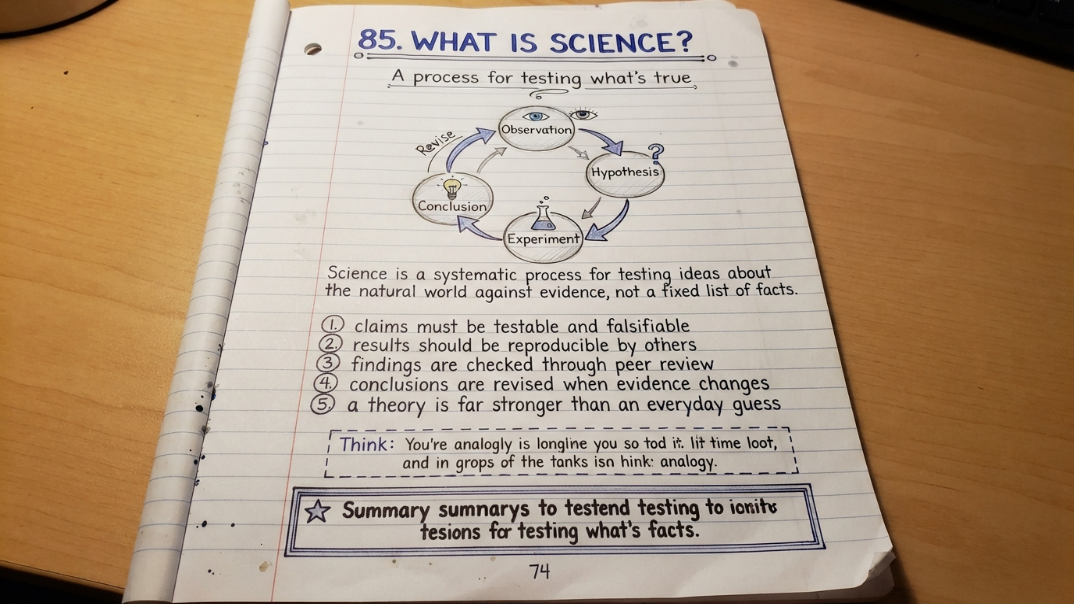
Science is a systematic method for investigating the natural world by asking testable questions, gathering evidence through observation or experiment, and drawing conclusions that can be checked and challenged by others. It's less a fixed collection of facts and more an ongoing process — a way of figuring things out that prioritizes evidence over authority, intuition, or tradition. The facts science produces (gravity causes objects to fall, vaccines train the immune system, DNA carries genetic information) are the output of that process, not the definition of science itself.
The Core Features That Define Science
Not every organized investigation counts as science — a few core features consistently separate scientific inquiry from other ways of exploring the world.
- Testability — a scientific claim must be checkable against real-world evidence
- Falsifiability — there must be some possible observation that could prove the claim wrong
- Reproducibility — results should be repeatable by others under similar conditions
- Peer review — findings are scrutinized by other experts before being widely accepted
- Revisability — conclusions are updated or discarded when new evidence contradicts them
The Scientific Method Explained
The scientific method is the general procedure scientists use to move from a question to a supported conclusion, though in practice it's rarely as linear as the textbook diagram suggests. It typically starts with an observation that raises a question, followed by a hypothesis — a specific, testable explanation — and a designed experiment or study meant to test that hypothesis directly. Data collected from the experiment is analyzed, and the results either support the hypothesis, contradict it, or point toward a more refined question, at which point the cycle often repeats with an adjusted hypothesis rather than ending in a single pass.
Hypotheses, Theories, and Laws
These three terms get routinely confused in everyday language, but they mean specific and different things in science. A hypothesis is a single, testable, tentative explanation for a specific observation, narrow in scope and meant to be tested directly. A scientific theory is far broader and stronger than the everyday meaning of 'theory' as a guess — it's a well-substantiated explanation for a wide range of observations, built up and repeatedly tested over time, such as the theory of evolution or germ theory. A scientific law, distinct from both, typically describes a consistent pattern or relationship observed in nature — like the law of gravity — without necessarily explaining why that pattern occurs, which is the job a theory does.
Why Science Is Self-Correcting
One of science's most important features is also the one most often mistaken for a weakness: it changes its conclusions when new evidence demands it. A scientific claim that gets revised or overturned isn't a sign the process failed — it's a sign the process is working exactly as intended, since the whole point of testability and peer scrutiny is to catch errors that a purely authority-based system would never surface. This is fundamentally different from fields where a claim, once stated by an authority, tends to remain fixed regardless of new evidence; science's willingness to be proven wrong is precisely what makes its surviving conclusions more trustworthy over time, not less.
Science vs Pseudoscience
Pseudoscience refers to claims or practices that present themselves as scientific without actually following the core features that define genuine scientific inquiry. The clearest warning signs include claims that are framed so vaguely they can't actually be tested or falsified, reliance on anecdote and testimonial rather than controlled evidence, resistance to peer review or independent replication, and a pattern of reinterpreting contradicting evidence to fit the original claim rather than revising the claim itself. Astrology, most forms of alternative medicine lacking clinical trial evidence, and various conspiracy-adjacent claims about established science are commonly cited examples where the language of science is borrowed without the underlying process being followed.
Branches of Science
Science is typically organized into a few broad branches, each applying the same core scientific process to a different domain of the natural or formal world.
| Branch | Focus | Examples |
|---|---|---|
| Natural Sciences | The physical and biological world | Physics, chemistry, biology, earth science |
| Social Sciences | Human behavior and society | Psychology, sociology, economics |
| Formal Sciences | Abstract systems and logic | Mathematics, logic, computer science |
| Applied Sciences | Practical application of scientific knowledge | Engineering, medicine, agricultural science |
Common Misconceptions About Science
A few misunderstandings about how science works show up repeatedly, both in casual conversation and in public debates about scientific topics.
- Treating 'it's just a theory' as if it means an unproven guess, rather than a well-substantiated explanation
- Assuming science claims absolute certainty rather than the best current explanation supported by evidence
- Expecting a single study to settle a question rather than understanding that scientific consensus builds over many studies
- Confusing correlation with causation when interpreting scientific findings
- Dismissing an entire field because one past finding was later revised or overturned
Why Understanding Science Matters
Scientific literacy isn't just relevant to people working in a lab — it shapes how effectively anyone can evaluate health claims, understand policy debates involving climate or public health, and avoid being misled by confidently stated but poorly supported claims. Understanding science as a process, rather than a static list of facts to accept or reject, makes it easier to distinguish a genuinely well-supported finding from an isolated study, a misrepresented statistic, or an outright pseudoscientific claim dressed up in scientific-sounding language.
How to Think More Scientifically
Thinking scientifically doesn't require a lab or a degree — it's a set of habits anyone can apply to everyday claims and decisions.
- Ask what evidence would prove a claim wrong, not just what evidence supports it
- Look for the underlying study or data behind a claim rather than accepting a summary at face value
- Notice the difference between a single study and a broad scientific consensus built over many studies
- Stay open to updating a conclusion when credible new evidence contradicts it
- Be skeptical of claims that can't, even in principle, be tested or falsified
FAQs
What is the simplest definition of science?
Science is a systematic process for asking testable questions about the natural world, gathering evidence through observation or experiment, and drawing conclusions that can be checked and revised by others.
Is science just a collection of facts?
No. Facts are the output of the scientific process, but science itself refers to the ongoing method of testing, evidence-gathering, and revision used to arrive at and refine those facts.
What's the difference between a scientific theory and a hypothesis?
A hypothesis is a single, narrow, testable explanation for a specific observation, while a scientific theory is a much broader, well-substantiated explanation for a wide range of observations that has been repeatedly tested over time.
Why does science change its conclusions over time?
Science is designed to be self-correcting — conclusions are updated when new evidence contradicts them, which is a sign the process is working correctly rather than a flaw in the system.
How can I tell the difference between science and pseudoscience?
Genuine science makes testable, falsifiable claims that hold up under peer review and independent replication, while pseudoscience typically relies on vague, untestable claims, anecdote, and resistance to independent scrutiny.
What are the main branches of science?
Science is generally organized into natural sciences (like physics and biology), social sciences (like psychology and economics), formal sciences (like mathematics and logic), and applied sciences (like engineering and medicine).