Computer Science Engineering: The Complete 2026 Guide to Curriculum, Specializations, and Career Scope
Computer Science Engineering (CSE) is a four-year undergraduate engineering degree focused on the theory, design, and application of computing systems — covering programming, algorithms, data structures, computer architecture, networks, databases, and software engineering, along with newer specialized tracks like artificial intelligence and cybersecurity. It remains one of the most heavily chosen engineering branches in India, and the data explains why: according to the India Skills Report 2026, published by ETS in collaboration with CII and AICTE, CSE and IT graduates lead all other engineering streams in employability, at over 80%.
But the aggregate numbers tell only part of the story. A fresher in computer science engineering can realistically expect anywhere from roughly ₹3.5 LPA to ₹15 LPA, and that gap has less to do with which college you attended than it used to. What you specialized in, what you actually built, and whether you have real certifications and project work to show for it now matter more than degree pedigree alone for a growing share of hiring decisions.
This guide covers what CSE actually involves — the core curriculum, the specializations reshaping the field, realistic entry requirements, genuine salary data across experience levels, the industries and companies actually hiring, and what meaningfully separates a strong outcome from an average one in the current job market.
What Computer Science Engineering Actually Covers
CSE sits at the intersection of computer science theory and engineering application — it's not purely abstract computer science, and it's not purely software development training either. The degree is built to give students a foundation in how computing systems work at every layer, from low-level hardware and architecture up through algorithms, software design, and large-scale systems, so graduates can move into a wide range of roles rather than being narrowly trained for one specific job title.
Core CSE Curriculum: What You'll Actually Study
| Year | Typical Focus | Core Subjects |
|---|---|---|
| Year 1–2 | Foundations | Programming fundamentals (C, Python, Java), data structures and algorithms, discrete mathematics, digital logic and computer organization, object-oriented programming |
| Year 2–3 | Core Computer Science | Database management systems (DBMS), operating systems, computer networks, theory of computation, software engineering, design and analysis of algorithms |
| Year 3–4 | Advanced & Applied Topics | Web technologies, artificial intelligence and machine learning fundamentals, cloud computing, cybersecurity basics, compiler design, and electives in specialized areas |
| Year 4 | Capstone & Specialization | Major project (often industry- or research-aligned), internship, and specialization-track electives depending on the student's chosen focus area |
The exact sequencing and elective options vary by university, but this general progression — fundamentals, core CS theory, applied and specialized topics, then a capstone project — is broadly consistent across most accredited CSE programs.
The Specializations Actually Driving Demand
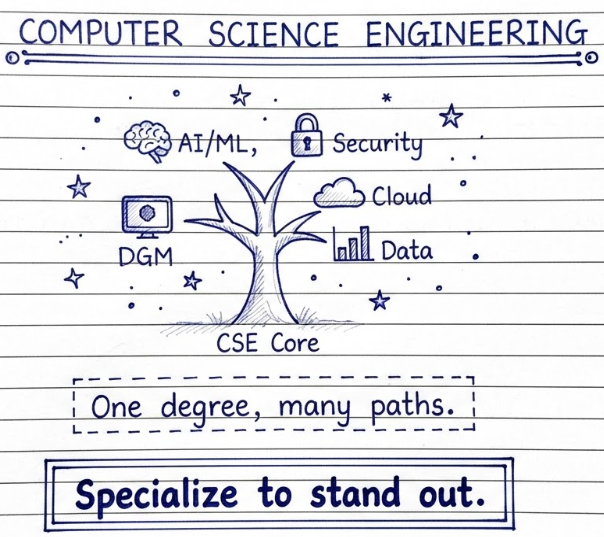
This is the part of CSE that's changed the most in recent years. A plain CSE degree with no specific specialization or demonstrated skill focus increasingly competes in a more saturated segment of the job market, while a small set of specialized tracks are seeing outsized demand and pay.
| Specialization | What It Covers | Why Demand Is High |
|---|---|---|
| Artificial Intelligence & Machine Learning | Machine learning models, neural networks, natural language processing, applied AI systems | Consistently cited as commanding some of the highest starting packages among CSE specializations, driven by AI adoption across nearly every industry |
| Data Science / Data Engineering | Data pipelines, large-scale data processing, analytics, and infrastructure supporting data-driven products | High value specifically in fintech, healthcare, and e-commerce, where data infrastructure is a core competitive need |
| Cybersecurity | Network security, threat detection, penetration testing, security architecture | An estimated 3.5 million cybersecurity roles remain unfilled globally, with India positioned as a primary talent source for this gap |
| Cloud Computing / DevOps | Cloud infrastructure (AWS, Azure, GCP), CI/CD pipelines, infrastructure automation | Virtually every modern product company now needs dedicated cloud and DevOps expertise, with contract-based roles rising quickly |
| Core Software Development | Full-stack development, systems programming, application architecture | Remains the largest overall category by job volume, though increasingly competitive without a demonstrated specialization or strong project portfolio layered on top |
Eligibility and How to Get Into a CSE Program
- Academic background: a Class 12 pass with Physics, Chemistry, and Mathematics (PCM) is the standard prerequisite for most CSE programs in India, generally with a minimum aggregate percentage requirement set by the specific institution.
- Entrance exams: admission to most engineering colleges runs through JEE Main (and JEE Advanced for the IITs specifically), or through state-level engineering entrance exams and counselling processes, depending on the specific state and institution type.
- Private and deemed universities: many private institutions run their own entrance tests or admit based on a combination of board exam scores and, in some cases, a national-level exam score like JEE Main or CUET.
- Duration: the standard CSE program is a 4-year Bachelor of Technology (B.Tech) or Bachelor of Engineering (B.E.) degree, divided into 8 semesters.
- Lateral entry: diploma holders in a relevant discipline can often enter directly into the second year of a CSE program through lateral entry admission, where offered by the specific institution.
Real Salary Data: Freshers to Experienced Professionals
| Career Stage | Typical Salary Range (India) |
|---|---|
| Fresher (0–1 year) | ₹3.5 LPA – ₹8 LPA (up to ₹15 LPA with strong specialization, certifications, and a demonstrated project portfolio) |
| Early-career (1–3 years) | ₹6 LPA – ₹12 LPA, varying significantly by specialization and company type |
| Mid-career (3–7 years) | ₹9 LPA – ₹15 LPA and above, particularly with specialized skills in AI, cloud, or cybersecurity |
| Monthly range (early-career) | Roughly ₹30,000 – ₹70,000 per month, depending on skills, company type, and location |
These figures vary meaningfully by source, company type, and specific role, but the consistent theme across multiple current salary reports is this: the gap between a modest offer and a strong offer for freshers from the exact same graduation year is increasingly explained by specialization and demonstrated skills, not primarily by college tier. Service-based mass recruiters have generally kept entry-level packages relatively flat, while product-based companies and roles requiring specific certifications (particularly in cloud platforms or data engineering) offer meaningfully higher starting pay and faster growth.
Global Scope: CSE Salaries Outside India
A CSE degree also supports a genuinely global career path, with several countries offering both strong entry-level pay and structured post-study work options for international graduates.
| Country | Typical Fresher Range | Notable Path |
|---|---|---|
| United States | $80,000 – $100,000+ (higher in hubs like Silicon Valley and Seattle) | H-1B visa route, valid for up to 6 years, with potential Green Card pathways |
| United Kingdom | $35,000 – $60,000 for IT and data science roles | 2–3 year post-study work permit available |
| Canada | CAD 60,000 – 85,000 | Relatively relaxed immigration rules; 3-year Post-Graduation Work Permit (PGWP) available |
| Australia | Varies by role and city | 2–4 year temporary graduate visa available |
Given the strong global demand, many CSE graduates specifically build skills and certifications with international mobility in mind, though pursuing an overseas career path generally requires additional planning around visas, further qualifications, and, in many cases, a master's degree from the destination country.
Who's Actually Hiring: Industries and Top Recruiters
- IT and software services: TCS, Infosys, Wipro, and HCLTech remain among the largest mass recruiters of CSE graduates in India, though entry-level packages at these firms have generally stayed flatter compared to product-based companies.
- Global technology and product companies: Google, Microsoft, Amazon, and similar firms recruit CSE graduates for product engineering, infrastructure, and research-adjacent roles, typically at meaningfully higher compensation than mass service-sector recruiters.
- Beyond traditional IT: CSE graduates are increasingly hired directly into banking and finance, e-commerce, healthcare, automotive, aerospace, fintech, and defense sectors, reflecting how deeply software and digital systems now run through nearly every industry rather than being confined to dedicated IT companies.
- Startups and product companies: a growing share of strong CSE graduates, particularly those with specialized skills, are choosing startups and mid-sized product companies over traditional mass recruiters, often trading initial brand recognition for faster growth and more hands-on technical ownership.
Is CSE Still Worth It in 2026?
The honest answer, based on current data, is a qualified yes — strong for the right approach, weaker for a passive one. India's IT sector crossed $300 billion in exports in 2026, total IT job demand reached 1.8 million roles in 2025 (up 16% year-on-year), and top firms planned to onboard 82,000 fresh graduates in FY2026 alone, with entry-level hiring described as recovering after two comparatively slower years. Those are genuinely strong macro signals.
But the field has also become more stratified. A CSE degree reliably gets a graduate in the door, but it doesn't guarantee a premium outcome the way it once did, especially outside the most selective institutions. For most students, the realistic path to a stronger outcome runs through specific specialization (AI/ML, cybersecurity, cloud, or data engineering), real project work and internships, and industry-recognized certifications — not simply completing the degree itself and waiting for a strong offer to follow automatically.
How to Maximize CSE Career Outcomes
- Choose a specialization deliberately, rather than drifting through generalist coursework — AI/ML, cybersecurity, cloud computing, and data engineering are consistently cited among the highest-demand, highest-paying tracks in current hiring data.
- Build a genuine project portfolio, not just coursework assignments — real, demonstrable projects (ideally something you can show working, not just describe) are repeatedly cited as a key differentiator between average and strong fresher offers.
- Pursue relevant certifications alongside your degree, particularly in cloud platforms (AWS, Azure) or data-specific tools, since these have been directly linked to faster salary growth, including the ability to significantly increase entry-level pay within just a couple of years of graduating.
- Actively seek internships and off-campus opportunities, rather than relying solely on campus placement, especially outside Tier 1 institutions, where a strong personal portfolio and off-campus applications increasingly matter more than campus placement drives alone.
- Keep learning continuously after graduation — the field's fastest-growing sub-areas (AI, cybersecurity, cloud) are also among its fastest-evolving, and staying current with new tools and techniques is consistently linked to stronger long-term career growth in this field.
Conclusion
Computer Science Engineering remains one of the strongest engineering branches by nearly every current employability and demand metric — leading all engineering streams in employability, backed by a genuinely large and growing IT sector, and offering a viable global career path on top of strong domestic demand. But 2026's job market rewards specificity over generality: the same degree, from the same college, in the same graduating batch, is now producing meaningfully different outcomes depending on specialization, demonstrated project work, and certifications.
If you're choosing CSE, or already partway through the degree, the most useful takeaway from the current data isn't just that the field has strong overall demand — it's that a deliberate, specialized approach to your final two years genuinely changes your realistic outcome range, potentially by several lakhs in starting salary alone. The degree opens the door; what you build and specialize in during it determines which door you actually walk through.
FAQ
Frequently Asked Questions
What is Computer Science Engineering (CSE)?+
CSE is a four-year undergraduate engineering degree (B.Tech or B.E.) covering the theory, design, and application of computing systems — including programming, data structures and algorithms, computer architecture, operating systems, databases, networks, and software engineering, along with specialized tracks like AI, cybersecurity, and cloud computing.
What is the average salary for a CSE fresher in India?+
Fresher salaries typically range from ₹3.5 LPA to ₹8 LPA, with strong specialization, certifications, and a demonstrated project portfolio pushing offers up to ₹15 LPA at some companies. The gap between offers from the same graduating batch is increasingly explained by specialization and demonstrated skills rather than college tier alone.
Which CSE specialization has the highest salary potential?+
Artificial Intelligence and Machine Learning, along with Data Science, are consistently cited as commanding some of the highest starting packages among CSE specializations, driven by AI adoption across nearly every industry. Cybersecurity and Cloud/DevOps roles are also seeing particularly fast-growing demand and pay.
Is CSE still a good career choice in 2026?+
By most current data, yes — CSE and IT graduates lead all engineering streams in employability at over 80%, and India's IT sector and job demand both grew significantly through 2026. However, outcomes have become more stratified: a degree alone increasingly gets a graduate in the door rather than guaranteeing a premium package, making specialization, projects, and certifications more important than in previous years.
What is the eligibility criteria for CSE admission?+
Most CSE programs in India require a Class 12 pass with Physics, Chemistry, and Mathematics (PCM), along with a qualifying score in JEE Main (and JEE Advanced for IITs), a relevant state-level engineering entrance exam, or a private university's own entrance process, depending on the specific institution.
What subjects are covered in the CSE curriculum?+
Core subjects generally include programming fundamentals, data structures and algorithms, computer organization, database management systems, operating systems, computer networks, theory of computation, and software engineering, with later-year electives in specialized areas like AI/ML, cloud computing, and cybersecurity.
What jobs can you get with a CSE degree?+
Common roles include Software Developer/Engineer, Data Analyst or Data Engineer, AI/ML Engineer, Cybersecurity Analyst, Cloud Engineer, and DevOps Engineer, spanning industries including IT services, product companies, banking and finance, e-commerce, healthcare, and defense.
Do CSE graduates have good opportunities abroad?+
Yes. Countries including the United States, United Kingdom, Canada, and Australia all offer strong entry-level opportunities and structured post-study work visa pathways for CSE graduates, with fresher pay in hubs like Silicon Valley commonly cited in the $80,000–$100,000+ range, though pursuing an international career typically requires additional planning around visas and qualifications.
Which companies hire the most CSE graduates in India?+
Large IT services firms including TCS, Infosys, Wipro, and HCLTech remain among the largest mass recruiters, planning to onboard 82,000 fresh graduates combined in FY2026. Global technology companies like Google, Microsoft, and Amazon, along with a growing number of startups and product companies across banking, healthcare, and e-commerce, also actively recruit CSE graduates, generally at higher average compensation.
How can I improve my chances of a high-paying CSE job?+
Choose a deliberate specialization (AI/ML, cybersecurity, cloud, or data engineering), build a genuine project portfolio beyond coursework, pursue relevant industry certifications, actively seek internships and off-campus opportunities rather than relying only on campus placement, and continue learning after graduation, since the field's highest-demand areas also evolve quickly.