Engineering Systems Division (ESD): What It Was, Why MIT Built It, and What Replaced It
If you're searching 'Engineering Systems Division,' you've most likely run into references to a specific academic unit at MIT that operated from 1998 to 2015 — usually shortened to ESD. It's not a term with one universal, standardized meaning across every institution; some universities, government agencies, and engineering firms use similar phrasing informally for internal organizational units focused on systems engineering. But the proper-noun 'Engineering Systems Division' most people are actually looking for is MIT's, and it's worth understanding both because of what it accomplished and because of what happened when MIT decided to dissolve it.
ESD's core idea was, at the time, genuinely unusual for an engineering school: the biggest engineering challenges of the era — power grids, global supply chains, multi-modal transportation networks, healthcare systems — couldn't be adequately addressed by engineering expertise alone. They needed engineering blended deliberately with management thinking and social science, because these large-scale systems ultimately involve people, organizations, and policy just as much as they involve technical design.
This guide covers how ESD came to exist, what it actually did during its 17 years of operation, the specific academic programs it ran, why MIT ultimately dissolved it, and where its legacy continues today through the institutions that absorbed its work.
How ESD Came to Exist
ESD's origins trace back to a 1996 report led by Professor Thomas Eager, then Department Head of Materials Science and Engineering at MIT, working alongside figures including Institute Professor Thomas Magnanti. That report — produced by what became known as the Eager Committee — recommended creating a dedicated Division of Engineering Systems within MIT's School of Engineering, spanning across all eight engineering departments rather than sitting inside any single one.
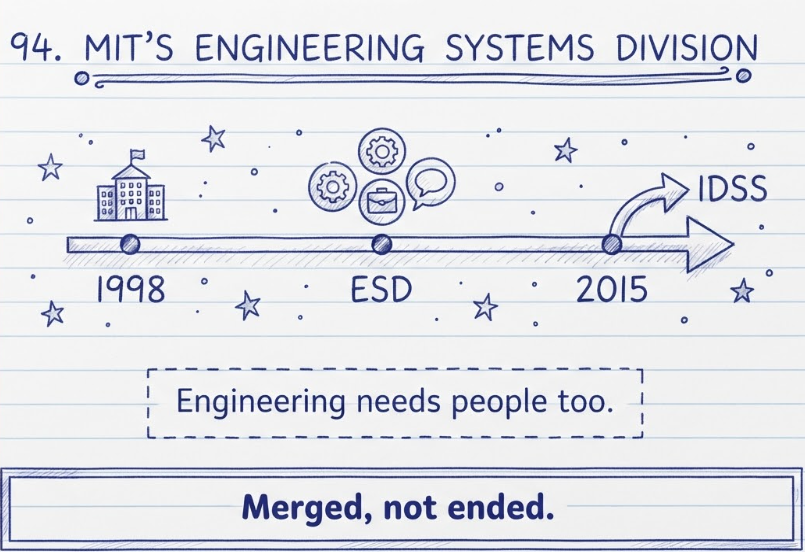
That recommendation led to ESD's formal establishment on December 1, 1998, under then Dean of Engineering Bob Brown. The founding motivation was specific: MIT recognized that large-scale, complex systems — the kind that underpin modern infrastructure and industry — required a genuinely interdisciplinary home, distinct from any single traditional engineering department, to be studied and taught properly.
What ESD Actually Studied and Taught
ESD organized its work around the concept of 'engineering systems' — large-scale, complex socio-technical systems where the technical and the human/organizational dimensions are genuinely inseparable. Concretely, this included research and coursework focused on areas such as:
- Global manufacturing and supply chains
- Multi-modal transportation networks
- Electrical power grids and critical infrastructure
- Healthcare systems
- Aviation and airspace resource allocation
Faculty involved with ESD were deliberately drawn from across MIT's School of Engineering, the MIT Sloan School of Management, and the School of Humanities, Arts, and Social Sciences — reflecting the division's core premise that solving problems at this scale required combining engineering methodology with management thinking and social science perspective, rather than treating any one of those lenses as sufficient on its own.
Key Academic Programs Under ESD
| Program | Focus |
|---|---|
| System Design and Management (SDM) | A joint program combining engineering and management for working professionals, focused on leading complex technical projects and organizations |
| Technology and Policy Program (TPP) | Focused on the intersection of technology and public policy, training engineers to work at that interface |
| Leaders for Global Operations (LGO) | A dual-degree program combining an MIT Sloan MBA with an engineering master's degree, focused on operations leadership |
| PhD in Engineering Systems | A doctoral track for research specifically focused on the theory and methodology of complex socio-technical systems |
Why ESD Was Dissolved in 2015
In 2014, MIT Provost Martin A. Schmidt announced plans to create a new institutional entity that would incorporate ESD's work along with the Laboratory for Information and Decision Systems (LIDS), building a center focused on complex and socio-technical systems, information and decision systems, and statistics. This proposal followed roughly five months of deliberation across four separate committees.
As part of that transition, ESD was formally dissolved, with its core faculty drawn into the new entity — which became the Institute for Data, Systems, and Society (IDSS) — alongside LIDS, whose existing structure remained largely unchanged. Professor Munther Dahleh, who had been serving as ESD's acting director, became the new entity's director. The restructuring wasn't a shutdown of ESD's underlying mission so much as a consolidation and evolution of it — combining ESD's socio-technical systems focus with LIDS's information and decision systems expertise into a single, more statistically and data-oriented institute better aligned with where the field had moved by 2014.
Where ESD's Legacy Lives On Today
ESD's official closure date was June 30, 2015, but its influence didn't disappear with it. Many subjects and areas of research formerly housed under ESD continue today across several MIT units:
- Institute for Data, Systems, and Society (IDSS): the primary successor entity, now offering programs including a PhD in complex systems (built on the kind of systems-level research ESD pioneered) and a PhD in statistics, reflecting the field's continued evolution toward data-driven methods.
- Engineering Management (EM): continuing ESD's tradition of blending engineering and management education for working professionals.
- Supply Chain Management (SCM): continuing ESD's supply chain and logistics-focused research and education track.
- MIT OpenCourseWare archive: ESD's original course materials remain publicly available on MIT OCW as an archival record of the program, including course notes and content from the division's 17 years of operation.
In that sense, 'Engineering Systems Division' today refers to a historical academic unit rather than a currently operating one — but it also refers, informally, to a genuinely influential approach to engineering education that shaped how several current MIT programs still teach students to think about complex, large-scale systems.
'Engineering Systems Division' Outside MIT
Because 'engineering systems' and 'systems engineering' are also established, broader terms in the engineering field generally — referring to an interdisciplinary approach to designing and managing complex systems throughout their life cycle — some other organizations, including government agencies and large engineering or aerospace firms, use similar internal naming conventions for their own systems-engineering-focused departments or divisions. These are typically distinct, unrelated organizational units rather than connected to MIT's specific ESD program, so if you've encountered the phrase in a different organizational context, it's worth confirming which specific entity is actually being referenced rather than assuming a connection to MIT's division.
Conclusion
MIT's Engineering Systems Division existed for just under 17 years, but it represented a genuinely ambitious bet: that some of the era's hardest engineering challenges couldn't be solved by engineering thinking alone, and needed a dedicated academic home combining engineering, management, and social science from the ground up. Its 2015 dissolution wasn't an admission that the idea failed — it was largely a restructuring that folded ESD's socio-technical systems focus into a new, more explicitly data- and statistics-oriented institute, IDSS, better matched to where the field had moved.
If you're researching ESD today, whether for academic history, as a prospective student exploring MIT's current systems-focused programs, or simply out of curiosity about the name, the most useful next step is looking at IDSS, Engineering Management, and Supply Chain Management directly — since that's where ESD's actual living legacy, its people, courses, and research directions, is genuinely continuing today.
FAQ
Frequently Asked Questions
What was MIT's Engineering Systems Division (ESD)?+
ESD was an academic division at MIT that operated from December 1, 1998 to June 30, 2015, dedicated to studying and teaching 'engineering systems' — large-scale, complex socio-technical systems like power grids, supply chains, and transportation networks — by combining engineering, management, and social science into a genuinely interdisciplinary approach.
When was ESD established, and why?+
ESD was formally established on December 1, 1998, under then Dean of Engineering Bob Brown, following a 1996 report from a committee led by Professor Thomas Eager that recommended creating a dedicated, cross-departmental division at MIT focused specifically on large-scale, complex engineering systems.
Why was ESD dissolved?+
In 2014, MIT's provost announced plans to combine ESD with the Laboratory for Information and Decision Systems (LIDS) into a new institutional entity focused on complex socio-technical systems, information and decision systems, and statistics. ESD was formally dissolved as part of that transition, with its faculty and mission largely absorbed into the resulting Institute for Data, Systems, and Society (IDSS).
What replaced ESD at MIT?+
The Institute for Data, Systems, and Society (IDSS) is ESD's primary successor, incorporating much of ESD's faculty and socio-technical systems focus alongside the Laboratory for Information and Decision Systems (LIDS). Engineering Management (EM) and Supply Chain Management (SCM) also continue specific threads of ESD's earlier work.
What academic programs did ESD run?+
Key programs included System Design and Management (SDM), the Technology and Policy Program (TPP), Leaders for Global Operations (LGO), and a PhD track specifically in Engineering Systems, alongside a broad range of interdisciplinary courses spanning engineering, management, and social science perspectives on complex systems.
Can I still access ESD's course materials?+
Yes. ESD's original course content remains publicly available through MIT OpenCourseWare (OCW) as an archival record of the program, even though the division itself no longer operates and new courses aren't being added under the ESD name.
Is 'Engineering Systems Division' used anywhere outside MIT?+
The specific proper-noun 'Engineering Systems Division' most commonly refers to MIT's historical program, but the broader field of 'systems engineering' is well established across many industries, and some government agencies and engineering or aerospace firms use similar internal naming for their own, unrelated systems-engineering-focused departments. These are generally distinct organizations from MIT's ESD.
Who led MIT's transition from ESD to IDSS?+
Professor Munther A. Dahleh, who was serving as ESD's acting director at the time, became the director-designate of the new entity that would become IDSS, guiding the transition that combined ESD's faculty and mission with the Laboratory for Information and Decision Systems (LIDS).
What kinds of problems did ESD research focus on?+
ESD's research spanned large-scale, complex socio-technical systems, including global manufacturing and supply chains, multi-modal transportation networks, electrical power grids and critical infrastructure, healthcare systems, and mechanisms for allocating airport and airspace resources.
Is ESD's approach to engineering education still relevant today?+
Yes, in the sense that its core premise — that large-scale, complex systems require genuinely interdisciplinary engineering, management, and social-science thinking, not engineering expertise alone — continues to shape programs at IDSS and elsewhere at MIT. The field has also evolved toward a stronger data and statistics orientation since ESD's era, reflected in IDSS's current focus areas.