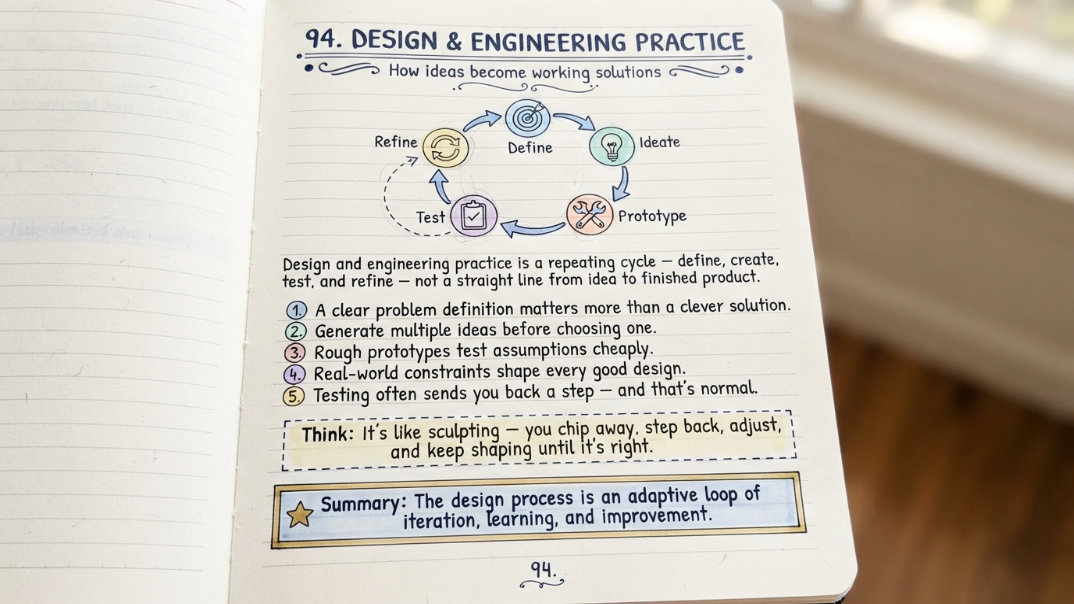
Every physical or digital product a person interacts with — a bridge, a bottle, an app, a chair — started as a problem someone needed to solve, not as a finished object. Design and engineering practice is the structured discipline that carries an idea from that initial problem through to something that actually works reliably, safely, and at scale. It's not one skill but a blend of several: creative problem-framing, technical analysis, hands-on prototyping, and rigorous testing, cycling repeatedly rather than moving in a straight line. This guide breaks down what design and engineering practice actually involves at each stage, the skills it draws on, and where teams commonly go wrong.
What Design and Engineering Practice Actually Means
Design and engineering practice refers to the structured, repeatable process of identifying a problem, generating and evaluating possible solutions, and developing one of them into a working, tested outcome. It applies across a huge range of fields — mechanical and civil engineering, product design, software engineering, industrial design — but the underlying pattern is consistent: understand the problem deeply before jumping to a solution, generate multiple possible approaches rather than committing to the first idea, and test early and often rather than waiting until the end to find out if something works.
Design Thinking vs Engineering Design
These two terms are often used almost interchangeably, but they emphasize slightly different things. Design thinking, as popularized in product and UX fields, puts heavy emphasis on empathizing with the end user and reframing the problem before jumping to solutions. Engineering design, more common in traditional STEM fields, puts more explicit weight on technical constraints, quantitative analysis, and formal testing against defined specifications. In practice, strong design and engineering work blends both — genuine user understanding paired with rigorous technical validation — rather than treating them as competing approaches.
The Core Stages of the Process
While the exact terminology varies by field and organization, most design and engineering practice follows a broadly consistent sequence of stages, even though real projects loop back through them repeatedly rather than moving straight through once.
| Stage | Core Question | Typical Output |
|---|---|---|
| Define | What problem are we actually solving? | A clear problem statement and success criteria |
| Ideate | What are the possible ways to solve it? | A range of candidate concepts or approaches |
| Prototype | What does a rough version of this look like? | A low- or high-fidelity working model |
| Test | Does this actually work as intended? | Data on performance, failure points, and user feedback |
| Refine | What needs to change based on testing? | An improved next iteration of the design |
Defining the Problem
Weak design and engineering outcomes very often trace back to a poorly defined problem, not a poorly executed solution. A strong problem definition specifies who the solution is for, what constraints it has to work within (budget, materials, timeline, regulations), and what specific, measurable outcome would count as success. Teams that skip this step and jump straight to building frequently end up with a technically impressive solution to the wrong problem, discovered only after significant time and resources have already been spent.
Ideation and Concept Generation
Once a problem is clearly defined, the next stage is deliberately generating a wide range of possible solutions before narrowing down, rather than committing early to the first workable idea. Common techniques include brainstorming with an explicit rule against criticizing ideas early, sketching or rough mockups to make abstract ideas concrete enough to evaluate, and researching how other fields or products have solved analogous problems. The goal at this stage isn't finding the perfect solution — it's generating enough real options that the eventual choice is a genuine comparison rather than a default.
Prototyping and Testing
A prototype exists to answer a specific question cheaply and quickly, not to be a polished version of the final product. Early prototypes are often deliberately rough — cardboard, basic code, a simple sketch — built just well enough to test a specific assumption, like whether a mechanism physically fits or whether a user understands an interface without instructions. As a design moves toward completion, prototypes typically become higher-fidelity and are tested against more rigorous, quantitative criteria: load limits, failure rates, performance benchmarks, or formal user testing protocols, depending on the field.
- Low-fidelity prototypes — rough, fast, and cheap, meant to test a single specific assumption
- Functional prototypes — working models that test performance under realistic conditions
- Pilot or beta versions — near-final versions tested with real users or in real environments
- Formal validation testing — rigorous testing against defined specifications, especially in safety-critical fields
Constraints Every Engineer Has to Balance
Good design and engineering practice rarely means finding the objectively "best" solution in isolation — it means finding the best solution given a set of real, often competing constraints. Cost, available materials, manufacturability at scale, safety and regulatory requirements, timeline, and environmental impact all pull in different directions, and part of the discipline's craft is knowing which constraints are truly fixed and which have some genuine flexibility. A solution that's technically elegant but impossible to manufacture affordably, or that meets every functional requirement but fails a safety standard, isn't actually a successful outcome of the process.
Iteration: Why the Process Isn't Linear
Despite how the process is often diagrammed as a clean, one-directional sequence, real design and engineering work loops back constantly — testing frequently reveals that the original problem definition was incomplete, or that an assumption made during ideation doesn't hold up under real conditions. This isn't a sign of failure; it's the expected, healthy shape of the process. Teams that treat early stages as permanently locked in, rather than open to revision based on what testing reveals, tend to ship solutions that technically meet the original brief but fail to actually solve the underlying problem well.
Skills That Matter Most
Strong design and engineering practitioners draw on a blend of technical, creative, and collaborative skills, and rarely excel at only one category alone.
- Technical analysis and quantitative reasoning to evaluate whether a design will actually work
- Creative ideation and the ability to generate genuinely varied concepts, not just variations on one idea
- Hands-on prototyping skills relevant to the specific field (CAD, coding, physical fabrication)
- Clear communication to explain tradeoffs and decisions to non-technical stakeholders
- Comfort with ambiguity and iteration, rather than needing a fully certain path forward before starting
Common Mistakes in Design and Engineering Practice
A few recurring patterns show up across fields when design and engineering practice breaks down.
- Jumping straight to a solution before the problem is clearly and specifically defined
- Committing to the first workable idea instead of generating and comparing real alternatives
- Skipping low-fidelity prototyping and building a costly, high-fidelity version too early
- Treating early-stage decisions as fixed instead of open to revision based on later testing
- Underweighting real-world constraints like manufacturability, cost, or regulation until late in the process
FAQs
What is the difference between design and engineering?
Design typically emphasizes user needs, creativity, and problem-framing, while engineering emphasizes technical feasibility, quantitative analysis, and rigorous testing against defined specifications; strong practice blends both rather than treating them as separate disciplines.
What are the main stages of the design and engineering process?
Most processes follow a broadly consistent sequence of defining the problem, generating ideas, prototyping, testing, and refining, though real projects loop back through these stages repeatedly rather than moving through them once in a straight line.
Why is prototyping important in engineering practice?
Prototyping lets teams test specific assumptions cheaply and quickly before committing significant time or resources to a full, polished version, which helps catch design flaws early when they're far less costly to fix.
What constraints do engineers have to balance in design work?
Common constraints include cost, available materials, manufacturability at scale, safety and regulatory requirements, timeline, and environmental impact, and good design and engineering practice means finding the best solution given all of these together, not optimizing for just one.
Why does the engineering design process loop back on itself?
Testing frequently reveals that an earlier assumption or problem definition was incomplete, so revisiting and revising earlier stages based on what testing shows is a normal, expected part of the process rather than a sign of failure.
What skills are most important for design and engineering practice?
A blend of technical analysis, creative ideation, hands-on prototyping skills, clear communication, and comfort with ambiguity and iteration tends to matter more than deep expertise in any single one of these areas alone.