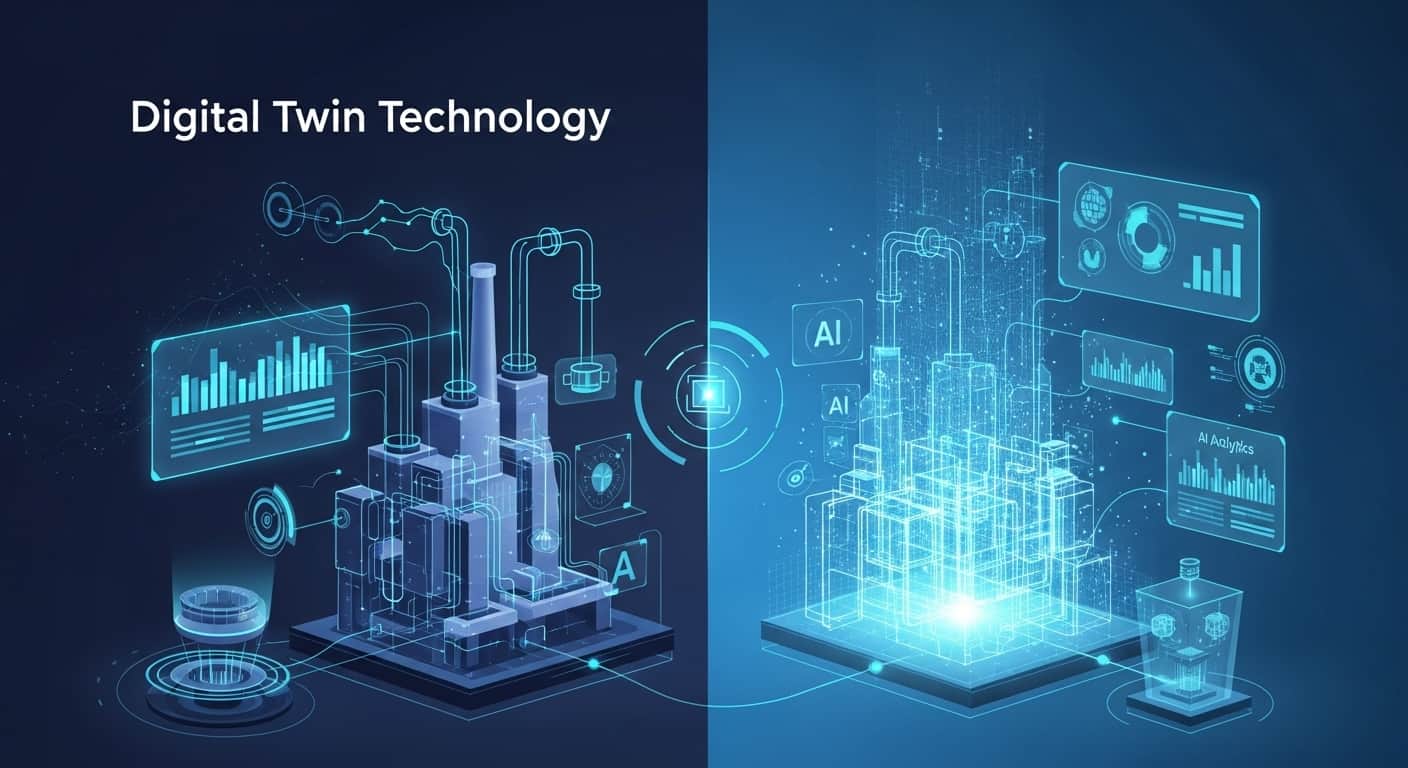
A jet engine that tells maintenance crews it's going to fail three weeks before it does. A hospital that tests a surgery on a virtual heart before touching the real one. A city that simulates a flood before the rain ever falls. That's digital twin technology in practice: a live virtual replica of a physical object, process, or system, kept in sync with reality through a constant stream of sensor data. Analysts disagree sharply on exactly how big the market is — estimates for 2026 alone range from roughly $26 billion to over $50 billion, depending on the research firm and what they count — but every major forecast agrees on the direction: rapid, sustained growth driven by cheaper sensors, better AI, and industrial pressure to cut downtime. This guide walks through what a digital twin actually is, how it differs from a plain simulation, where it's earning its keep today, and what tends to go wrong when organizations adopt it.
What Is Digital Twin Technology
A digital twin is a virtual model of a physical object, process, or system that stays synchronized with its real-world counterpart through continuous data. Unlike a static CAD model or a one-off simulation, a digital twin is a living representation: as the physical asset changes state — wears down, heats up, slows down — the twin updates in near real time. That connection is what lets teams monitor performance, catch problems early, and test changes virtually before committing resources to the physical system.
How Digital Twins Work
A digital twin runs on a three-part loop. First, sensors embedded in or attached to the physical asset (temperature, vibration, pressure, location, usage data) stream information continuously. Second, that data is processed — often in the cloud, sometimes at the edge for latency-sensitive cases — and used to update a virtual model that mirrors the asset's current condition. Third, analytics and AI models interpret the data to flag anomalies, predict failures, or recommend actions, which can then be fed back to the physical system or to a human operator. The tighter and faster that loop runs, the more useful the twin becomes.
Digital Twin vs Simulation vs Digital Model
These three terms get used interchangeably, but they're not the same thing. A digital model is a static, manually-updated representation with no automatic data connection to the physical object — think of an as-built CAD file that never changes after the asset ships. A simulation uses predefined scenarios and assumptions to explore 'what if' questions, but it doesn't reflect the real-time state of any specific physical asset. A digital twin is the only one of the three with a live, continuous, bidirectional (or at least one-way real-time) data connection to a specific physical instance — which is what makes it useful for ongoing monitoring and decision support rather than one-time analysis.
Core Technologies Behind Digital Twins
Digital twins aren't a single technology — they're an integration of several, working together.
- IoT sensors and connectivity — collect real-time condition and usage data from the physical asset
- Cloud computing — stores and processes large volumes of sensor data at scale
- Edge computing — handles time-critical processing close to the asset, reducing latency
- AI and machine learning — detect anomalies, forecast failures, and recommend optimizations
- 3D modeling and visualization — renders the twin so humans can interpret it intuitively
- APIs and data integration layers — connect the twin to ERP, CMMS, and other enterprise systems
Types of Digital Twins
Digital twins scale from a single part up to an entire organization, and the right level depends on the decision you're trying to support.
- Component twins — model a single part, like a bearing or a valve
- Asset twins — model a complete piece of equipment, like a pump or a wind turbine
- System or process twins — model how multiple assets interact, like a production line
- Enterprise twins — model an entire facility or organization, aggregating data across many system twins
Popular Digital Twin Platforms
Most organizations don't build digital twin infrastructure from scratch — they build on an existing platform. Microsoft Azure Digital Twins provides a modeling and data-orchestration layer for IoT-driven twins. Siemens Xcelerator (built on the Teamcenter and NX toolset) is widely used in manufacturing and product lifecycle management. NVIDIA Omniverse focuses on physically accurate, real-time 3D simulation for industrial and robotics use cases. Dassault Systèmes' 3DEXPERIENCE platform is common in aerospace, automotive, and healthcare. AWS IoT TwinMaker and PTC's ThingWorx round out the field. Which one fits depends heavily on your existing CAD/PLM stack and whether the priority is visualization, simulation fidelity, or enterprise data integration.
Digital Twins in Manufacturing
Manufacturing remains the largest and most mature use case for digital twins. On the factory floor, twins of individual machines and entire production lines let engineers spot early signs of wear, simulate layout changes before physically moving equipment, and run predictive maintenance so parts are replaced on a data-driven schedule rather than a fixed calendar or after a breakdown. Predictive maintenance in particular has become the single largest application segment in the market, since unplanned downtime is one of the most direct and easily quantified costs a plant manager can point to.
Digital Twins in Healthcare
Healthcare digital twins operate at several scales: twins of individual organs (used in cardiology to test how a specific patient's heart might respond to a device or procedure), twins of medical equipment (like MRI machines, to predict maintenance needs), and twins of hospital workflows (to model patient flow, staffing, and bed capacity). The organ- and patient-level use cases are the most technically demanding, since they require personalized models built from a specific patient's imaging and physiological data rather than a generic template — but they're also where the potential impact on treatment planning is highest.
Digital Twins in Smart Cities
City-scale digital twins model traffic flow, utility networks, building energy use, and public infrastructure, letting planners test interventions — a new transit line, a zoning change, a flood-response plan — virtually before committing public funds. Singapore's Virtual Singapore and similar national-scale projects in Europe and China are among the most cited examples of this approach, combining IoT sensor networks with 3D geospatial models to support urban planning and emergency response.
Digital Twins in Energy and Infrastructure
Energy providers use digital twins to monitor power plants, transmission grids, and renewable assets like wind farms, catching equipment degradation before it causes an outage. Transportation and infrastructure operators apply the same approach to bridges, rail networks, and pipelines, where the cost of an unplanned failure is measured not just in dollars but in public safety. Grid operators in particular are using twins to manage the added complexity of integrating variable renewable generation.
Benefits of Digital Twin Technology
The business case for digital twins rests on a handful of measurable outcomes.
- Real-time visibility into asset condition and performance
- Predictive maintenance that reduces unplanned downtime
- Faster, lower-risk testing of design or process changes
- Better-informed decisions backed by live data rather than assumptions
- Lower lifecycle costs through earlier problem detection
Challenges and Limitations
Digital twins aren't a plug-and-play solution, and most failed rollouts trace back to one of a few recurring issues.
- High upfront cost for sensors, integration, and platform licensing
- Data integration complexity across legacy systems that were never designed to share data
- Security and privacy risk, since a twin often exposes detailed operational data about a physical asset
- Talent and infrastructure gaps — few organizations have in-house staff who understand both the physical domain and the data/AI side
- Unclear ROI when a twin is built without a specific business question it's meant to answer
Best Practices for Implementing Digital Twins
Organizations that succeed with digital twins tend to follow a similar playbook.
- Start with one clear, measurable business objective rather than a general 'digital transformation' goal
- Invest in clean, reliable sensor data before investing in analytics — bad inputs make even good AI useless
- Pilot on a single asset or process twin before attempting a system- or enterprise-level twin
- Build in security and access controls from day one, not as an afterthought
- Scale gradually, expanding to new assets or processes only after the pilot demonstrates measurable value
Future of Digital Twin Technology
The next phase of digital twin adoption is being shaped by generative AI and more autonomous decision-making: twins that don't just flag a problem but simulate several fixes and recommend the best one. Industry watchers also expect digital twin capability to become a standard, built-in feature of IoT platforms rather than a separate purchase — several analyses project that the large majority of industrial IoT platforms will ship with native digital twin support within the next couple of years. As that happens, the technology moves from being a specialized, expensive initiative to something closer to a default expectation for any connected physical asset.
FAQs
What is a digital twin, in simple terms?
It's a virtual copy of a real object or system that updates itself using live data from sensors on the physical thing, so the virtual version always reflects the current real-world state.
How is a digital twin different from a simulation?
A simulation explores hypothetical 'what if' scenarios using assumptions, without a live data link to a specific physical asset. A digital twin is continuously updated with real data from one specific real-world object.
Which industries use digital twin technology the most?
Manufacturing is currently the largest adopter, especially for predictive maintenance, followed by energy, healthcare, automotive, and aerospace. Smart-city and infrastructure use cases are growing quickly as well.
Is digital twin technology expensive to implement?
Initial costs can be significant — sensors, integration work, and platform licensing all add up — which is why most successful deployments start with a single asset or process rather than an entire facility, and expand only once ROI is proven.
Do I need IoT sensors to build a digital twin?
Yes, in some form. Without a live data feed from the physical asset, what you have is a static digital model or a simulation, not a true digital twin — the continuous data connection is the defining feature.
What platforms are commonly used to build digital twins?
Common choices include Microsoft Azure Digital Twins, Siemens Xcelerator, NVIDIA Omniverse, Dassault Systèmes 3DEXPERIENCE, AWS IoT TwinMaker, and PTC ThingWorx, with the right choice depending on your existing CAD/PLM tools and use case.