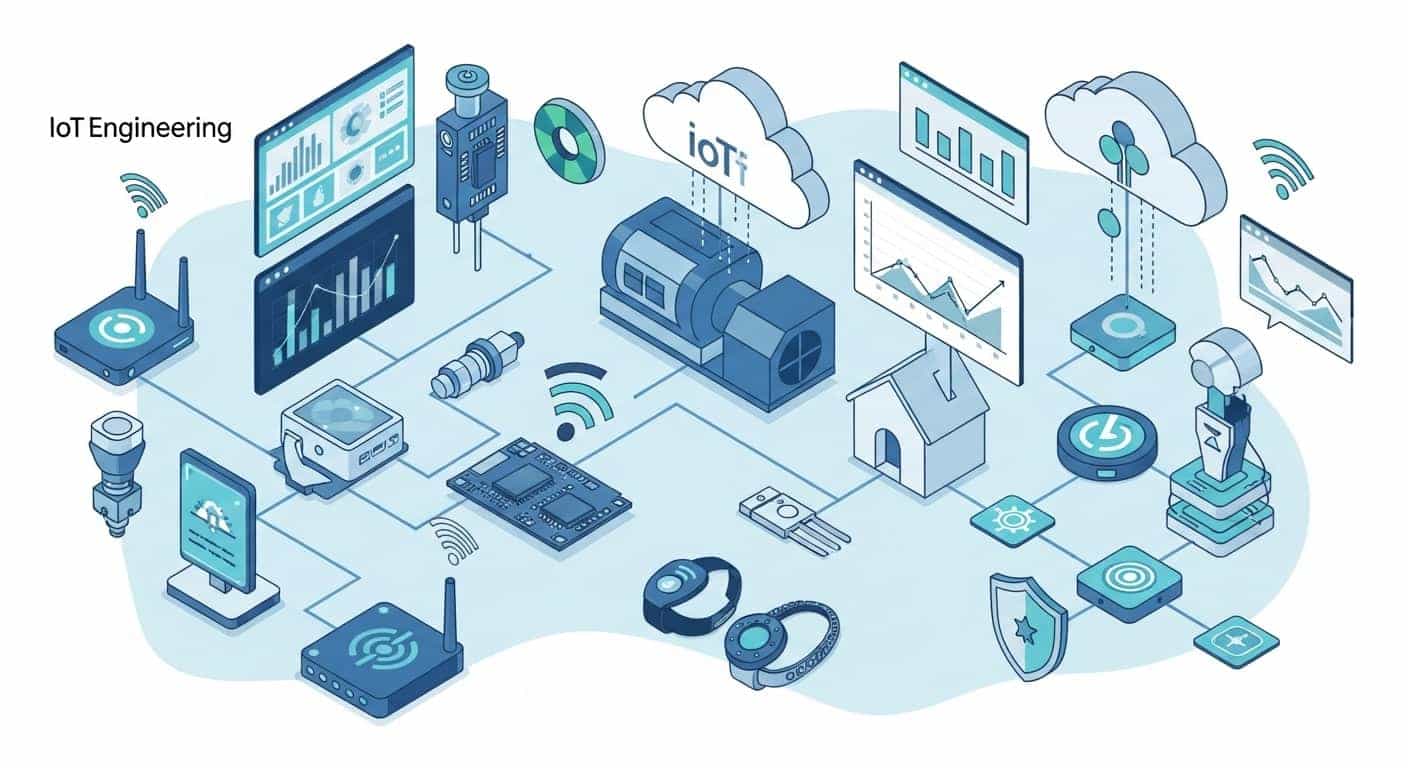
Every smart thermostat, fitness tracker, and factory sensor that 'phones home' with data relies on IoT engineering — the discipline of connecting physical devices to the internet so they can sense, communicate, and act. It sits at the intersection of hardware, embedded software, networking, and cloud computing, which is what makes it both a demanding field to learn and a well-paid one to work in. This guide walks through how IoT systems are structured, the protocols and components that make them work, where they're used in practice, and what it actually takes to build a career in it.
What Is IoT Engineering
IoT engineering is the practice of designing systems where physical devices — sensors, actuators, machines — connect to the internet to collect data, communicate with each other, and respond automatically. It's a genuinely cross-disciplinary field: an IoT engineer might write low-level C for a microcontroller in the morning and configure a cloud data pipeline in the afternoon. That breadth is what makes the role both harder to learn than a typical software job and harder for companies to hire for.
How IoT Systems Work
Every IoT system follows the same basic loop, regardless of scale. Sensors capture data from the physical world — temperature, motion, location, pressure. That data travels over a network (Wi-Fi, cellular, or a low-power protocol built for constrained devices) to a gateway or directly to the cloud. Once there, it's stored, processed, and analyzed — sometimes by simple rule-based logic, increasingly by machine learning models. Based on that analysis, the system can trigger an action automatically, like shutting off a valve, adjusting a thermostat, or alerting a technician. The whole loop, from sensing to action, can happen in milliseconds for latency-sensitive applications or over minutes for things like routine equipment monitoring.
IoT Architecture Layers
Most IoT systems are organized into four layers, each with a distinct job. Separating these concerns makes it possible to swap out a sensor vendor, change cloud providers, or redesign a dashboard without rebuilding the entire system.
IoT Architecture Layers Table
| Layer | Description | Examples |
|---|---|---|
| Device Layer | Physical devices and sensors that sense or act on the environment | Temperature sensors, cameras, GPS trackers, industrial actuators |
| Network Layer | Moves data between devices and processing systems | Wi-Fi, LTE/5G, LoRaWAN, Zigbee, Bluetooth Low Energy |
| Processing Layer | Stores, processes, and analyzes incoming data | AWS IoT Core, Azure IoT Hub, Google Cloud IoT, edge gateways |
| Application Layer | Presents data and controls to end users | Mobile apps, web dashboards, alerting systems |
Core Components of IoT Engineering
Behind every IoT deployment is a set of hardware and software building blocks that engineers combine and configure for the specific use case.
IoT Components Table
| Component | Purpose |
|---|---|
| Sensors | Collect environmental or physical data (temperature, motion, humidity, light, pressure) |
| Actuators | Convert digital commands into physical actions (motors, valves, relays, switches) |
| Microcontrollers | Process data locally on the device (e.g. ESP32, Arduino, STM32) |
| Gateways | Aggregate data from multiple devices and route it to the cloud |
| Cloud Platforms | Store, process, and expose IoT data to applications (AWS IoT, Azure IoT Hub, Google Cloud IoT) |
IoT Communication Protocols
Because many IoT devices run on limited power and bandwidth, they need protocols designed for efficiency rather than the general-purpose web protocols used by browsers and servers. Choosing the right one is one of the first architectural decisions in any IoT project.
IoT Protocols Table
| Protocol | Use Case | Characteristics |
|---|---|---|
| MQTT | Real-time telemetry and messaging | Lightweight publish-subscribe model; low bandwidth overhead; the most common choice for device-to-cloud messaging |
| HTTP/HTTPS | Simple request-response communication | Widely supported and easy to debug, but heavier overhead than MQTT for constrained devices |
| CoAP | Low-power, constrained networks | UDP-based, designed to mirror HTTP semantics for devices too limited to run a full HTTP stack |
| AMQP | Enterprise-grade messaging | Reliable delivery with queuing, commonly used when integrating IoT data into existing enterprise message brokers |
| Zigbee / Z-Wave | Local mesh networking in smart homes | Short-range, low-power mesh protocols built for battery-powered sensors and switches |
| LoRaWAN | Long-range, low-power wide-area networking | Kilometers of range at very low power, used for agriculture, utility metering, and asset tracking |
IoT Engineering Technology Stack
Because an IoT system spans from a physical sensor to a cloud dashboard, engineers typically need working knowledge across several distinct layers of the stack, even if they specialize in one.
- Embedded programming — writing firmware in C/C++ or MicroPython for resource-constrained devices
- Networking and protocols — configuring and troubleshooting MQTT, CoAP, and wireless connectivity
- Cloud computing — provisioning device fleets and data pipelines on platforms like AWS IoT or Azure IoT Hub
- Data analytics and AI — turning raw sensor streams into predictions and alerts
- Security engineering — securing devices, network traffic, and cloud endpoints against attack
IoT Use Cases
IoT engineering shows up anywhere a physical process benefits from real-time data and automation — the applications below are among the most mature and widely deployed today.
IoT Use Cases Table
| Industry | Use Case |
|---|---|
| Smart Homes | Energy management, automated lighting and HVAC, security systems |
| Healthcare | Remote patient monitoring, wearable vitals tracking, connected medical equipment |
| Manufacturing | Predictive maintenance, production line monitoring, asset tracking |
| Transportation | Fleet and vehicle tracking, cold-chain monitoring, driver behavior analytics |
| Smart Cities | Traffic management, smart waste collection, air quality monitoring |
| Agriculture | Soil moisture sensing, irrigation automation, livestock tracking |
IoT Engineering Skills
Job postings for IoT engineers tend to ask for a combination of skills that rarely all live in one candidate — which is exactly why the field pays well for people who can credibly cover more than one column below.
IoT Engineer Skills Table
| Skill Area | Examples |
|---|---|
| Programming | C, C++, Python, JavaScript/TypeScript for dashboards and backends |
| Hardware | Microcontrollers, sensor integration, PCB basics, debugging with a multimeter/logic analyzer |
| Networking | TCP/IP, MQTT, REST APIs, wireless protocol selection and troubleshooting |
| Cloud | Device provisioning, data pipelines, and dashboards on major IoT cloud platforms |
| Security | Encryption, device authentication, secure boot, over-the-air update integrity |
IoT Engineer Salaries and Career Path
Compensation data for IoT engineers varies widely by source, seniority, and whether the role leans embedded/firmware or cloud/data — in the US, 2026 figures range from roughly $85,000 for aggregate averages that include junior and contract roles, up to $150,000+ for mid-to-senior hybrid engineers on sites like Glassdoor, with senior specialists in high-demand metro areas exceeding $185,000. The widest pay premiums go to engineers who can credibly work both ends of the stack — writing power-optimized firmware and also architecting a cloud ingestion pipeline for tens of thousands of devices — since that combination is genuinely rare. A typical path runs from a junior embedded or firmware role, through a mid-level position specializing in either hardware or cloud integration, to a senior or IoT architect role designing full end-to-end systems; that progression commonly takes five to eight years, faster for engineers who deliberately build cross-stack experience early.
Security in IoT Engineering
IoT devices are attractive attack targets precisely because they're often deployed in large numbers with minimal oversight, weak default credentials, and infrequent updates. A single compromised device can become an entry point into an entire network, or get conscripted into a botnet. Security has to be designed into every layer: unique device identities and credentials (never shared default passwords), encrypted communication in transit, secure boot to prevent malicious firmware, and a reliable over-the-air update mechanism so vulnerabilities can actually be patched after deployment — something a surprising number of consumer IoT products still lack.
Challenges in IoT Engineering
Building IoT systems that hold up in the real world — not just in a demo — means designing around a recurring set of constraints.
- Device scalability — managing provisioning, updates, and monitoring across thousands or millions of devices
- Security vulnerabilities — weak default credentials and infrequent patching make IoT a common attack target
- Network reliability — devices operating in the field face intermittent or low-bandwidth connections
- Power and battery limitations — many devices must run for months or years on limited power
- Data management complexity — filtering signal from noise across massive, continuous sensor streams
Best Practices
Teams that ship reliable IoT products consistently follow a similar set of disciplines.
- Design for security from day one, not as a bolt-on before launch
- Use scalable cloud architectures that can handle device fleets growing by orders of magnitude
- Implement device health monitoring so failures are caught before they cascade
- Plan for firmware updates from the start — devices without an update path become permanent liabilities
Future of IoT Engineering
The next wave of IoT engineering is being shaped by AI models moving onto the device itself (tinyML and edge inference), tighter integration with digital twin systems for predictive maintenance, and a continued shift toward 5G and low-power wide-area networks that make large-scale, long-range deployments more practical. As connected devices grow into the tens of billions worldwide, the engineers who can move fluidly between the hardware and cloud sides of the stack will remain the most in-demand — and the hardest to hire for.
FAQs
What does an IoT engineer actually do day to day?
It depends on specialization: firmware-focused engineers spend their time writing and debugging embedded C/C++ for microcontrollers and sensors, while cloud-focused engineers spend more time on device provisioning, data pipelines, and dashboards. Many mid-career engineers do a mix of both.
Is IoT Engineering difficult to learn?
It's demanding because it spans multiple domains — embedded programming, networking, and cloud — rather than being difficult in any one area. Most people start with one layer (often embedded programming or a specific cloud platform) and expand outward.
What industries use IoT Engineering?
Manufacturing and healthcare are currently the largest adopters, alongside smart homes, transportation and logistics, agriculture, and smart city infrastructure.
Is IoT Engineering a good career in 2026?
Demand remains strong, especially for engineers who can work across both the embedded/firmware and cloud sides of the stack — that combination commands the highest salaries because genuinely cross-stack candidates are hard to find.
Which protocol should I learn first: MQTT or HTTP?
MQTT is worth learning first for IoT specifically — it's the most widely used protocol for device-to-cloud messaging and is lighter weight than HTTP for constrained devices, even though HTTP skills transfer more broadly to general web development.
What is the future of IoT Engineering?
Expect more AI processing to move onto the device itself (edge inference), closer integration with digital twin systems, and continued growth in low-power, long-range connectivity as device counts keep scaling.