Enneagram Types: The Complete Guide to All 9 Types, Wings, and What They Actually Mean
Most personality frameworks describe what you do. The Enneagram is built specifically to explain why — the underlying fear, desire, or motivation driving a behavior, since two people can act identically for completely different underlying reasons. That focus on motivation rather than just behavior is a big part of why the system has stayed popular across such different settings: therapy offices, corporate leadership training, and casual social media alike. One widely used Enneagram test alone has been completed by more than 10 million people, with over a million tests now taken monthly on that platform.
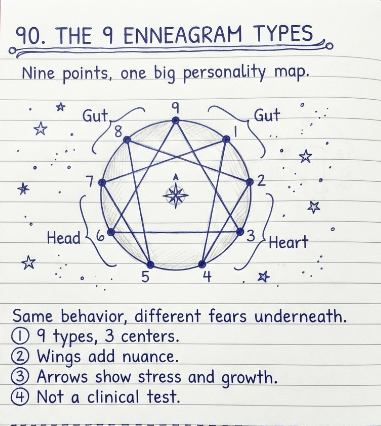
The name itself comes from the Greek 'ennea' (nine) and 'gramma' (something written or drawn) — the system maps nine personality types onto a nine-pointed geometric figure, with lines connecting the points to show how each type's behavior shifts under stress and under growth. It's a genuinely more dynamic model than most typologies, which is part of its appeal, but also part of why it takes longer to actually understand than a simple nine-item checklist.
This guide covers each of the nine core types in detail, the three underlying 'centers of intelligence' they group into, how wings and integration/disintegration arrows add nuance beyond a single number, how to actually figure out your own type, and an honest look at what the scientific research does and doesn't support about the system.
The Three Centers of Intelligence
Before looking at individual types, it helps to understand the three broader groupings they fall into, since each center shares a common core emotion and way of processing the world.
| Center | Types Included | Core Emotion | General Focus |
|---|---|---|---|
| Gut / Body Center | 8, 9, 1 | Anger (expressed, suppressed, or channeled into control/rightness) | Instinct, control, autonomy, and a sense of being right or in charge of one's own space |
| Heart Center | 2, 3, 4 | Shame (avoided through image, achievement, or identity) | Relationships, image, emotional connection, and how one is perceived by others |
| Head Center | 5, 6, 7 | Fear (managed through knowledge, planning, or distraction) | Security, certainty, and managing anxiety through thinking, planning, or possibility |
The 9 Enneagram Types, In Detail
Type 1: The Reformer (Perfectionist)
Core fear: being wrong, corrupt, or defective. Core desire: to be good, right, and have integrity. Type 1s are principled, self-disciplined, and driven by a strong internal sense of how things should be — often experienced as an inner critic constantly evaluating whether they and the world around them are measuring up. At their best, Type 1s are wise, fair, and genuinely improve the systems and people around them; under stress, that same drive can tip into rigidity, harsh self-criticism, or resentment at others' perceived carelessness.
Type 2: The Helper (Giver)
Core fear: being unloved or unwanted. Core desire: to feel loved and needed. Type 2s are warm, generous, and attuned to other people's needs, often before their own. At their healthiest, this generosity is genuine and freely given; under stress, it can shift into a subtler pattern of giving in order to earn love or approval, with difficulty acknowledging their own needs directly, and resentment building when that giving isn't reciprocated or recognized.
Type 3: The Achiever (Performer)
Core fear: being worthless without achievement. Core desire: to feel valuable and worthwhile. Type 3s are driven, adaptable, and image-conscious in the sense of wanting to succeed visibly, often excelling in competitive or performance-oriented environments. At their best, they're genuinely effective, inspiring, and able to channel ambition productively; under stress, the drive to appear successful can crowd out genuine self-reflection, leading to burnout or a fragile sense of identity built too heavily on external validation.
Type 4: The Individualist (Romantic)
Core fear: having no identity or personal significance. Core desire: to find and express a unique personal identity. Type 4s are introspective, emotionally attuned, and drawn to authenticity and depth, often experiencing emotions more intensely than other types. At their best, they bring genuine creativity, emotional honesty, and depth to relationships and work; under stress, that intensity can turn into melancholy, self-absorption, or a persistent feeling of being fundamentally different from and misunderstood by others.
Type 5: The Investigator (Observer)
Core fear: being useless, incapable, or overwhelmed by others' demands. Core desire: to be capable and competent. Type 5s are analytical, private, and driven to understand things deeply before acting, often preferring to observe and gather information rather than engage impulsively. At their best, they're genuinely insightful, innovative, and calm under pressure; under stress, that need for independence and understanding can turn into excessive withdrawal, hoarding of time and resources, or difficulty engaging emotionally with others.
Type 6: The Loyalist (Skeptic)
Core fear: being without support or guidance, and unable to handle life alone. Core desire: to have security and support. Type 6s are responsible, loyal, and attentive to potential risks, often serving as the person who anticipates problems before others notice them. At their best, they're genuinely trustworthy, prepared, and a stabilizing presence for others; under stress, that vigilance can tip into persistent anxiety, second-guessing, or difficulty trusting one's own judgment (or, in the counterphobic variant, an overcorrection into confrontational risk-taking).
Type 7: The Enthusiast (Epicurean)
Core fear: being trapped in pain, limitation, or boredom. Core desire: to be satisfied, content, and free to pursue enjoyable experiences. Type 7s are energetic, spontaneous, and drawn toward possibility and new experiences, often reframing difficulty quickly in order to keep moving forward. At their best, they bring genuine optimism, resilience, and creative energy to whatever they're involved in; under stress, that same forward momentum can become a way of avoiding difficult emotions altogether, leading to scattered follow-through or restlessness.
Type 8: The Challenger (Protector)
Core fear: being controlled, harmed, or violated by others. Core desire: to be self-reliant and in control of one's own life. Type 8s are direct, decisive, and protective, often taking charge instinctively in situations that feel unstructured or unfair. At their best, they're genuinely powerful advocates for others, courageous, and willing to take on responsibility that others avoid; under stress, that protective instinct can tip into confrontational excess, difficulty showing vulnerability, or a tendency to dominate rather than collaborate.
Type 9: The Peacemaker (Mediator)
Core fear: loss of connection, and conflict fragmenting relationships or inner peace. Core desire: to maintain inner and outer peace and stability. Type 9s are easygoing, accommodating, and genuinely able to see multiple sides of a situation, often serving as a natural mediator in group conflict. At their best, they're deeply stabilizing, accepting, and able to bring genuinely different perspectives together; under stress, that desire to keep the peace can tip into conflict avoidance, difficulty asserting their own needs and opinions, or a kind of passive disengagement from decisions that matter to them.
Wings: The Type Next Door
Very few people are a 'pure' single type with no other influence — the Enneagram accounts for this with 'wings,' the two types adjacent to your core type on the nine-pointed figure. Most people lean toward one of their two possible wings more than the other, which is typically written as, for example, '4w3' or '4w5' (a Type 4 with a Three-wing or a Five-wing). The wing adds real texture: a Type 4 with a strong Three-wing tends to channel their emotional depth into more outward, achievement-oriented expression, while a Type 4 with a strong Five-wing tends to channel that same depth into more withdrawn, analytical introspection — same core type, genuinely different day-to-day presentation.
Levels of Development: The Range Within Each Type
One of the more sophisticated parts of the Enneagram, and one that's often left out of quick online quizzes, is the concept of 'levels of development' — a spectrum, generally described from healthy to average to unhealthy, showing how the same core type can manifest very differently depending on someone's overall level of psychological health and self-awareness at a given time. This matters because two people with the same core type and the same wing can look genuinely different day to day, depending on whether they're currently operating from a healthier or more stressed version of that type — the system isn't meant to freeze people into a single fixed description.
Growth and Stress Arrows: How Types Shift Under Pressure
The lines connecting points on the nine-pointed Enneagram figure represent how each type tends to shift, temporarily, in two specific directions:
- Stress (disintegration) direction: under significant stress, a type tends to take on some of the less healthy characteristics of another specific type — for example, a stressed Type 9 may temporarily take on the more critical, agitated tendencies associated with an unhealthy Type 6.
- Growth (integration) direction: as a person becomes more self-aware and psychologically healthy, they tend to naturally take on some of the healthier characteristics of a different specific type — for example, a growing Type 9 may take on some of the decisive, self-initiating energy associated with a healthy Type 3.
- These connections are fixed and specific to each type (not random), which is part of what makes the Enneagram's geometric figure genuinely functional rather than purely decorative — each line represents a real, mapped relationship between two types.
How to Actually Figure Out Your Type
- Take a reputable test as a starting point, not a final answer — free and paid Enneagram assessments can offer a useful first hypothesis about your type, but self-report tests are inherently limited by how accurately someone can assess their own underlying motivations in the moment.
- Focus on motivation, not behavior — since the Enneagram is built around why you do things rather than what you do, read the full type descriptions (not just headline traits) and ask which core fear and core desire genuinely resonate, rather than which type's surface behaviors sound most flattering.
- Consider your patterns under stress and growth, not just your everyday baseline — since the system's stress and growth arrows describe temporary shifts, noticing what you're like specifically under pressure versus when things are going well can help confirm or rule out a type.
- Read multiple type descriptions, not just your top result — many people initially misidentify their type because a wing, a stress pattern, or a superficially similar type description resonates more than their actual core type on first read.
- Treat it as an evolving hypothesis — many practitioners suggest revisiting your type understanding over time, since self-awareness genuinely develops, and an initial self-typing can sometimes shift as someone reflects further or works with a coach or therapist familiar with the system.
What the Science Actually Says
It's worth being straightforward about this: the Enneagram does not have the same level of peer-reviewed, psychometric validation as the Big Five personality model, which remains the most extensively researched personality framework in academic psychology. The Enneagram's origins are more philosophical and spiritual than empirical, developed and popularized through the 20th century by figures blending psychological, spiritual, and esoteric traditions rather than through the kind of large-scale factor-analytic research underlying the Big Five.
That doesn't mean the framework is without value — plenty of widely used tools in coaching, therapy-adjacent settings, and organizational development aren't held to strict psychometric validation standards, and many people report genuine, practical insight from working with the Enneagram's focus on underlying motivation. The most balanced way to approach it is as a structured, reflective framework for exploring your own patterns and motivations — genuinely useful for that purpose — rather than as a scientifically validated diagnostic instrument in the way something like a clinical psychological assessment would be.
How the Enneagram Gets Used in Practice
- Personal self-reflection and therapy-adjacent work: understanding your own core fears and default coping patterns can support therapeutic or coaching work focused on personal growth, though it's generally used as a complement to, not a replacement for, clinical mental health care.
- Relationships: understanding a partner, family member, or friend's core motivations — rather than just their behavior — can help make sense of recurring relationship dynamics and reduce the tendency to interpret someone else's coping patterns as a personal attack.
- Workplace and leadership development: some organizations use the Enneagram (often alongside other tools) in team-building and leadership training, on the premise that understanding team members' underlying motivations can improve communication and reduce friction.
- Spiritual and contemplative traditions: the Enneagram has historically been used in some spiritual and contemplative settings as a framework for self-examination, reflecting its philosophical and spiritual roots alongside its more recent popular psychology use.
Conclusion
The Enneagram's real value isn't in a single number — it's in the layered structure underneath it: nine types grouped into three centers of intelligence, each with a wing that adds nuance, a range of healthier-to-less-healthy expressions, and specific, mapped patterns of how behavior shifts under stress and growth. That structure is genuinely more sophisticated than a simple nine-category quiz result suggests, and it's part of why the system has remained useful to such a wide range of people for such different purposes, from personal reflection to workplace team-building.
It's not a scientifically validated clinical tool the way the Big Five is, and it's worth holding that distinction honestly rather than treating an Enneagram type as a fixed, definitive label. Used as intended — as a structured lens for reflecting on your own underlying motivations, rather than a box to permanently place yourself or others in — it can offer genuinely useful self-insight, which is ultimately what most people are actually looking for when they take the test in the first place.
FAQ
Frequently Asked Questions
What are the 9 Enneagram types?+
Type 1 (The Reformer), Type 2 (The Helper), Type 3 (The Achiever), Type 4 (The Individualist), Type 5 (The Investigator), Type 6 (The Loyalist), Type 7 (The Enthusiast), Type 8 (The Challenger), and Type 9 (The Peacemaker). Each type is defined by a distinct core fear, core desire, and characteristic pattern of coping, rather than just a set of surface behaviors.
What is a 'wing' in the Enneagram?+
A wing is one of the two types adjacent to your core type on the nine-pointed Enneagram figure, which adds nuance and flavor to how your core type actually shows up. Most people lean toward one of their two possible wings more than the other, written as, for example, '4w3' (a Type 4 with a Three-wing).
What is the most common Enneagram type?+
Type 9 (the Peacemaker) is frequently reported as the most common type in population surveys, while Type 5 (the Investigator) tends to appear as one of the rarer types. That said, Enneagram theory generally holds that all nine types are, in principle, evenly distributed, so reported distributions may partly reflect who chooses to take an Enneagram test rather than the true underlying population split.
Is the Enneagram scientifically validated?+
Not to the same degree as the Big Five personality model, which remains the most extensively peer-reviewed and psychometrically validated framework in academic personality psychology. The Enneagram's origins are more philosophical and spiritual than empirical, and it's best approached as a structured, widely used tool for self-reflection rather than a clinically validated diagnostic instrument.
What are the three centers of intelligence in the Enneagram?+
The Gut/Body center (types 8, 9, 1), organized around anger and control; the Heart center (types 2, 3, 4), organized around shame and image; and the Head center (types 5, 6, 7), organized around fear and security. Each center shares a common underlying emotion that shapes how its three types process the world.
What are growth and stress arrows?+
They're the lines connecting each type to two other specific types on the nine-pointed Enneagram figure, representing how a person's behavior tends to shift temporarily — taking on less healthy traits of a connected type under significant stress (the disintegration direction), or taking on healthier traits of a different connected type as they grow in self-awareness (the integration direction).
How do I find out my Enneagram type?+
Start with a reputable free or paid test as an initial hypothesis, but go further by reading full type descriptions and focusing on which core fear and core desire genuinely resonate, rather than which surface behaviors sound most appealing. Considering your patterns specifically under stress and during periods of growth, and reading multiple type descriptions rather than just your top result, both help refine an initial self-typing that a quick quiz alone often gets only partially right.
Can your Enneagram type change over time?+
Most Enneagram theory holds that your core type is stable throughout life, but how that type is expressed can shift significantly based on your level of psychological health and self-awareness at a given time — described through the system's 'levels of development.' It's also common for people to initially misidentify their type and refine their understanding over time through further reflection.
What's the difference between the Enneagram and MBTI or the Big Five?+
The Enneagram focuses specifically on underlying motivation — the core fear and desire driving behavior — while MBTI focuses on cognitive preferences (like how you process information and make decisions) and the Big Five measures five broad, empirically derived personality trait dimensions (Openness, Conscientiousness, Extraversion, Agreeableness, Neuroticism). The Big Five has the strongest scientific validation of the three; the Enneagram and MBTI are more commonly used as reflective and developmental tools than as clinically validated psychometric instruments.
Is the Enneagram used in therapy?+
Some therapists and coaches incorporate Enneagram concepts into their work as a complementary framework for exploring a client's underlying motivations and coping patterns, but it isn't a standard, clinically validated diagnostic tool in mainstream psychology or psychiatry. It's generally best understood as a supportive, reflective framework rather than a replacement for evidence-based clinical assessment or treatment.