Most students today will take a professional certification exam, a standardized test, or a university entrance exam on a screen rather than on paper at some point in their academic or career journey. Computer based exams, often shortened to CBT (computer-based testing) or CBE (computer-based examination), have moved from a niche option to the default format for everything from driving theory tests to bar exams to national entrance exams. This shift brings real advantages — faster scoring, tighter security, and more flexible scheduling — but it also changes how students need to prepare, since the skills a screen-based test rewards aren't identical to the skills a paper test rewards. This guide breaks down what computer based exams are, how they work, and how to walk in prepared.
What Are Computer Based Exams
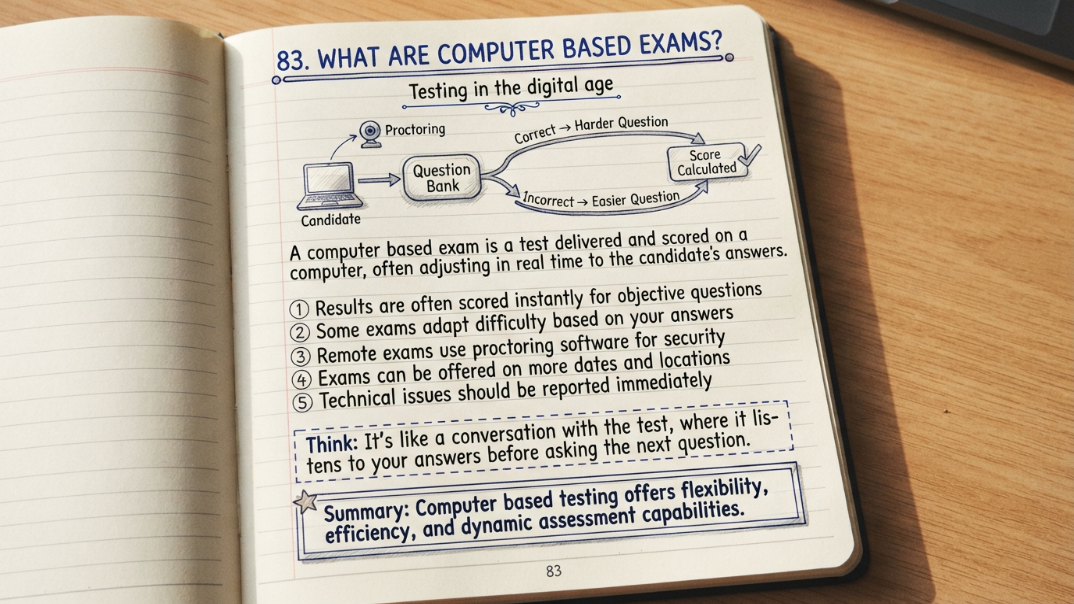
A computer based exam is any test delivered and taken on a computer or tablet rather than on paper, ranging from a simple digitized version of a paper test to a fully adaptive exam that changes in real time based on a candidate's answers. They're used across nearly every kind of assessment — school and university exams, professional licensing and certification tests, standardized entrance exams, and workplace skills assessments — and are typically administered either at a dedicated testing center or remotely through a proctoring platform.
Why Institutions Are Moving to Computer Based Exams
Most testing organizations didn't switch to computer based exams for novelty; they switched because the format solves several longstanding operational problems at once. Results can be scored and released in minutes or days instead of weeks, since multiple-choice and many short-answer formats can be graded automatically. Test security improves too, since each candidate can receive a different, randomized version of the exam pulled from a larger question bank, making it far harder for answers to circulate in advance. And logistically, computer based exams can be offered on more dates and in more locations, including remotely, since they don't require printing, shipping, and manually collecting paper booklets.
Types of Computer Based Exams
Not all computer based exams work the same way, and understanding which type you're taking changes how you should prepare.
- Linear computer based tests — a fixed set of questions delivered in the same order to every candidate, functioning much like a digitized paper exam
- Computer adaptive tests (CAT) — question difficulty adjusts in real time based on how a candidate is performing
- Item-based testing with randomized banks — each candidate receives a different set of questions drawn from a larger pool covering the same content areas
- Performance-based or simulation exams — candidates complete tasks in a simulated environment rather than answering multiple-choice questions
How Computer Based Exams Are Scored
Objective question types — multiple choice, matching, fill-in-the-blank with a defined answer key, and similar formats — are typically scored instantly by the testing software the moment a candidate submits. Written or essay-style responses on a computer based exam are usually either scored by human graders working from a digital submission, evaluated by an automated scoring engine trained on large sets of sample responses, or scored using a hybrid of both, with automated scoring flagging responses for human review when confidence is low. This is part of why many high-stakes computer based exams still take days rather than minutes to release full results, even though the objective portions are graded instantly.
Adaptive Testing Explained
Computer adaptive tests work by adjusting the difficulty of each question based on whether the candidate answered the previous question correctly — a correct answer typically triggers a harder follow-up question, while an incorrect answer triggers an easier one. The exam continues narrowing in on a precise estimate of the candidate's ability level with fewer total questions than a fixed-length test would need to reach the same level of confidence. The tradeoff for candidates is that adaptive exams don't allow going back to change previous answers, since each question's difficulty was chosen specifically based on the prior response, and skipping around isn't possible the way it often is on a paper test.
Remote Proctoring and Exam Security
As more computer based exams move to remote, at-home delivery, testing organizations rely on proctoring software to preserve exam integrity outside a physical testing center. Common approaches include live human proctors monitoring via webcam, AI-based monitoring that flags unusual behavior like extended eye movement away from the screen or a second voice in the room, browser lockdown software that prevents opening other applications or tabs during the test, and identity verification steps like a photo ID scan and a room scan before the exam begins. These systems reduce cheating risk but also introduce new friction — unstable internet, webcam or microphone requirements, and a quiet, private testing space all become prerequisites a candidate has to arrange themselves.
Computer Based Exams vs Paper Exams
Neither format is universally better — each comes with a different set of tradeoffs for candidates and institutions.
| Aspect | Computer Based Exams | Paper Exams |
|---|---|---|
| Scoring speed | Often instant for objective questions | Manual grading, typically slower |
| Scheduling | More dates, locations, and often remote options | Fixed dates, usually in-person only |
| Question format | Supports adaptive difficulty and simulations | Fixed question set for all candidates |
| Technical risk | Dependent on hardware, software, and internet | No technical dependency |
| Annotation | Limited on-screen highlighting/notes tools | Free-form margin notes and diagrams |
Common Challenges Students Face
A few recurring difficulties show up across most students' first experiences with computer based exams.
- Reading comprehension and fatigue differ on a screen compared to paper, especially for long passages
- Inability to freely annotate, underline, or sketch diagrams the way a paper exam allows
- Technical issues — software freezes, connectivity drops, or unfamiliar navigation — eating into exam time
- Adaptive formats not allowing candidates to skip a hard question and return to it later
- Underestimating the setup requirements for remote proctored exams until exam day
How to Prepare for a Computer Based Exam
Most of the preparation gap between paper and computer based exams comes down to unfamiliarity with the interface, not the underlying subject knowledge.
- Take at least one full practice test in the actual exam software or a close simulation of it before exam day
- Practice reading longer passages on a screen to build comfort with digital reading before test day
- Learn the specific on-screen tools available (calculator, flagging questions, highlighter) well before the exam
- For adaptive exams, practice committing to an answer rather than expecting to revisit questions later
- For remote exams, test your internet connection, webcam, and testing space at least a day in advance
What to Do If Something Goes Wrong During the Exam
Technical issues during a computer based exam are stressful but usually recoverable if handled correctly in the moment. Most testing platforms have a documented process for reporting a technical problem immediately rather than after the fact, since delayed reporting can make it harder to verify what happened and harder to get lost time restored. Candidates should know, before the exam starts, exactly how to contact support during the test — whether that's a chat function, a phone number, or a proctor directly — rather than trying to find that information while already mid-crisis. Most testing organizations also have a policy for rescheduling or extending time when a verified technical failure occurs, so staying calm and documenting the issue (screenshots, timestamps) usually matters more than panicking.
Future of Computer Based Exams
As AI-based proctoring and automated essay scoring improve, computer based exams are likely to keep expanding into subject areas that were previously considered too subjective or too hands-on for digital delivery, including more simulation-based and performance-based assessment. At the same time, growing awareness of accessibility and equity concerns — reliable internet access, quiet testing space, and comfort with screen-based reading not being equally distributed — means institutions will likely keep offering paper or hybrid alternatives for the foreseeable future rather than eliminating them outright.
FAQs
Are computer based exams harder than paper exams?
Not inherently — the content and difficulty are typically designed to be equivalent. The added difficulty most candidates experience comes from unfamiliarity with the interface and reduced ability to freely annotate, not from the underlying questions being harder.
Can you go back and change answers on a computer based exam?
It depends on the exam type. Linear computer based tests often allow reviewing and changing answers before final submission, while computer adaptive tests typically do not, since each question's difficulty is chosen based on the previous answer.
What is remote proctoring for computer based exams?
Remote proctoring uses a combination of live human monitors, AI behavior tracking, browser lockdown software, and identity verification to preserve exam integrity when a candidate takes a computer based exam from home rather than a testing center.
How should I prepare differently for a computer based exam versus a paper exam?
Focus on practicing in the actual test software or a close simulation, building comfort reading long passages on screen, and learning the exam's specific on-screen tools in advance, since most of the difference is interface familiarity rather than subject knowledge.
What happens if my computer crashes during a computer based exam?
Most testing organizations have a process for reporting technical issues immediately during the exam and a policy for rescheduling or restoring lost time once a technical failure is verified, so reporting the issue right away matters more than trying to work around it alone.
Do computer based exams use adaptive testing?
Some do and some don't. Computer adaptive tests (CAT) adjust question difficulty in real time based on performance, while many computer based exams are simply a fixed, linear set of questions delivered digitally rather than on paper.