Google Data Analytics Professional Certificate: The Complete 2026 Guide
Google Data Analytics Professional Certificate: The Complete 2026 Guide
Over 3.7 million people have enrolled in the Google Data Analytics Professional Certificate since it launched in 2021, making it one of the most-taken professional credentials on the internet. It's also one of the most misunderstood. Some people treat it as a golden ticket to a six-figure data job. Others dismiss it as a resume filler that recruiters ignore. Neither view holds up against what the program actually is: a structured, beginner-friendly on-ramp into the analytical thinking, tools, and workflow that entry-level data analysts use every day — nothing more, nothing less.
The program has also changed meaningfully since it launched. As of the current curriculum, Google has swapped R programming for Python, added a ninth course built around Gemini-powered job searching, and folded AI-assisted workflows into nearly every module. If you looked into this certificate a year or two ago and are revisiting it now, several of the details you remember are out of date.
This guide covers the complete, current 9-course curriculum, exactly what it costs and how to reduce that cost, the tools and skills you'll actually walk away with, the real job market outcomes, how it compares to other data analytics credentials, and an honest breakdown of who it's genuinely worth it for.
What the Google Data Analytics Professional Certificate Actually Is
The certificate is part of Google's Career Certificates program — the same initiative behind Google's IT Support, Cybersecurity, Project Management, UX Design, and Digital Marketing certificates. It's hosted entirely on Coursera, built and taught by Google employees who work in data analytics, and designed for people with zero prior experience in the field. There's no application, no prerequisite degree, and no technical background required to start.
The structure is asynchronous and self-paced: video lessons, readings, quizzes, and hands-on labs inside each course, followed by a graded assessment before you move to the next course. Everything is auto-graded, which is how Coursera keeps the price accessible for a program with millions of learners — but it also means you won't get personalized feedback on your reasoning the way you would in an instructor-led bootcamp.
| Detail | Current Figure |
|---|---|
| Number of courses | 9 courses (previously 8, before the AI job-search course was added) |
| Total instructional content | 180+ hours plus hundreds of hands-on assessments |
| Typical completion time | Under 6 months at under 10 hours a week |
| Learners enrolled | 3,717,010+ |
| Course rating | 4.8 out of 5 from 179,962+ reviews |
| Cost | $49/month on Coursera after a 7-day free trial (most finish for under $300 total) |
| Open U.S. data analytics jobs cited | 270,000+ |
| Median entry-level salary cited | $97,000 (U.S., Lightcast Job Postings data) |
| Positive career outcome rate | 75% of graduates report a new job, promotion, or raise within 6 months |
| College credit | Up to 12 ACE college credits, or 7 ECTS credits, via Credly |
The Full 9-Course Curriculum, Course by Course
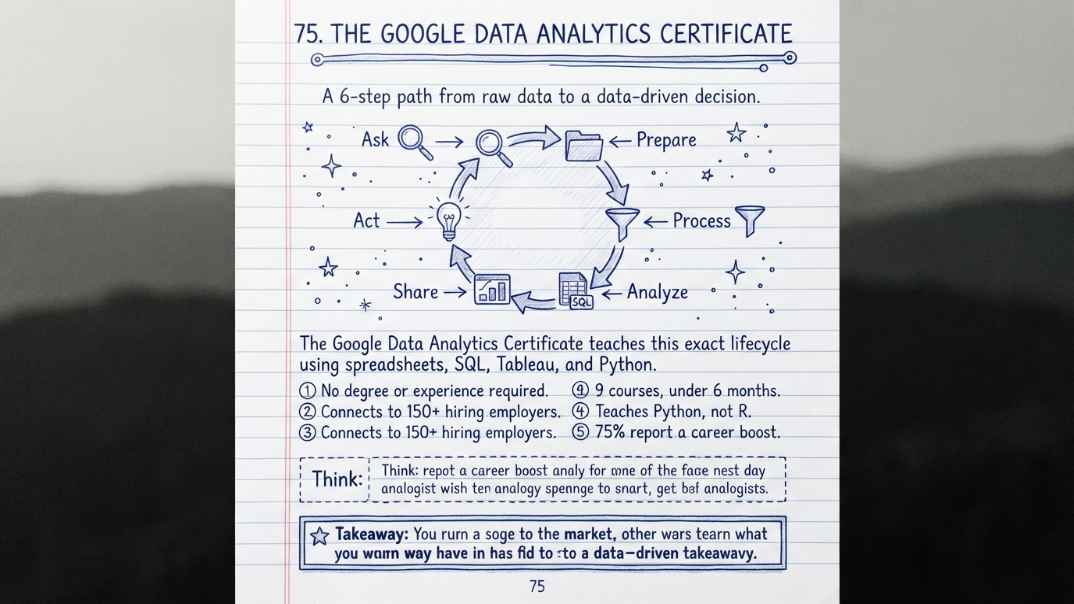
The nine courses build on each other in sequence, following the same lifecycle a working data analyst actually follows: ask a question, prepare the data, clean it, analyze it, share the findings, and act on them. Google recommends taking them in order, since later courses assume the tools and vocabulary from earlier ones.
| # | Course | Length | What You'll Do |
|---|---|---|---|
| 1 | Foundations: Data, Data, Everywhere | 13 hours | Learn what data analytics is, the analytics lifecycle, and the role of spreadsheets, SQL, and visualization tools. Mostly conceptual — this is the orientation course. |
| 2 | Ask Questions to Make Data-Driven Decisions | 15 hours | Learn structured thinking and how analysts scope a business question before touching any data. First hands-on spreadsheet work. |
| 3 | Prepare Data for Exploration | 19 hours | Understand data collection, bias, database structure, and file organization. Introduces SQL and Google Sheets. |
| 4 | Process Data from Dirty to Clean | 16 hours | Learn data integrity concepts and apply SQL functions and spreadsheet formulas to clean messy, real-world datasets. |
| 5 | Analyze Data to Answer Questions | 26 hours | The heaviest course. Sorting, filtering, pivot tables, and multi-table SQL queries to combine and analyze real datasets. |
| 6 | Share Data Through the Art of Visualization | 19 hours | Build dashboards and charts in Tableau, learn data storytelling principles, and practice presenting findings to stakeholders. |
| 7 | Introduction to Data Analysis Using Python | 27 hours | Python syntax, loops, data structures, and the Pandas/NumPy libraries. This course replaced the old R programming course in the current curriculum. |
| 8 | Google Data Analytics Capstone: Complete a Case Study | 11 hours | Apply everything to a self-directed case study you can add directly to a portfolio and show to employers. |
| 9 | Accelerate Your Job Search with AI | 6 hours | A newer addition. Uses Google's Career Dreamer and Gemini to build a resume, organize applications in Sheets, and practice interviews via Gemini Live. |
Tools and Skills You'll Actually Walk Away With
By the end of the program, you'll have hands-on repetition — not just conceptual familiarity — with a specific toolkit. This is the part employers actually check for in interviews and take-home assignments, so it's worth being precise about what's covered versus what's only mentioned in passing.
- Spreadsheets (Google Sheets and Excel): formulas, pivot tables, lookup functions, sorting, filtering, and data cleaning — used throughout nearly every course.
- SQL: writing queries, joining multiple tables, filtering and aggregating data, and cleaning string data directly inside a database.
- Python: core syntax, loops, control statements, data structures, and the Pandas and NumPy libraries for data manipulation — introduced in course 7.
- Tableau: building interactive dashboards and visualizations, and structuring a data story for a non-technical audience.
- Presentation tools: PowerPoint and Google Slides for communicating findings to stakeholders, developed mainly in the visualization and capstone courses.
- AI-assisted workflows: using Gemini for data cleaning suggestions, formula-building, sharpening analytical questions, and — in the newest course — resume writing and interview practice.
- Portfolio-building: a completed capstone case study designed specifically to be shown to recruiters, plus a Credly badge with an ACE credit recommendation attached.
How Much It Actually Costs (And How to Pay Less)
There's no separate certificate fee — you're paying for a Coursera subscription, and the certificate is what you earn by completing all nine courses inside it. In the U.S. and Canada, Coursera charges $49 per month after an initial 7-day free trial. Since the program is designed to take under six months at under 10 hours a week, most learners complete it for under $300 total — and often less if they move faster than the estimated pace.
- Use the 7-day free trial strategically: front-load the first course during the trial window so your paid months start from course 2 onward.
- Move faster than the suggested 10 hours/week if your schedule allows. The monthly fee is time-based, not per-course, so finishing in 3 months instead of 6 roughly halves the total cost.
- Check for financial aid: Coursera offers financial assistance for the underlying courses, and Google periodically funds scholarships through partner organizations and workforce programs — worth searching for locally before paying full price.
- Consider Coursera Plus only if you'll use it for more than this one certificate: at $59/month or $399/year, it unlocks 7,000+ other courses, which is better value if you're planning to stack additional certificates or specializations afterward.
- Outside the U.S. and Canada, pricing is often localized and lower — check the certificate page directly for your region's rate before assuming the U.S. price applies.
Is It Actually Worth It? What the Outcomes Data Shows
The honest answer depends heavily on what you're comparing it against and what you do with it afterward. Here's what the certificate does and doesn't do, based on Google's own published data and how the hiring pathway actually works.
What It Does
Google reports that 75% of certificate graduates experience a positive career outcome — a new job, a promotion, or a raise — within six months of completion, based on a graduate survey. Graduates also get access to Google's Employer Consortium: over 150 U.S. companies, including Deloitte, Target, Verizon, and Google itself, that specifically review Google Career Certificate graduates for open entry-level roles. That consortium is currently active in the U.S., Canada, India, Singapore, and Indonesia, with more countries planned. Separately, the certificate carries an American Council on Education (ACE) recommendation worth up to 12 college credits (or 7 ECTS credits internationally) if you're pursuing a degree afterward — a real, transferable credential outcome that not every online certificate offers.
What It Doesn't Do
The certificate alone does not guarantee an interview, and it is not equivalent to a computer science or statistics degree in the eyes of employers hiring for anything beyond entry-level roles. The auto-graded assessments mean your analytical reasoning is never reviewed by a human during the course — which is why the capstone project and an independent portfolio matter so much for actually landing interviews. Some employers, particularly outside the specific hiring consortium, treat the certificate as a signal of initiative and baseline competence rather than a hard qualification. The realistic framing: it's a well-built floor, not a ceiling.
Pros and Cons
| Pros | Cons |
|---|---|
| No prior experience or degree required to start | Auto-graded assessments give limited feedback on analytical reasoning |
| Affordable relative to bootcamps — most finish for under $300 | Entry-level ceiling; doesn't substitute for a degree in competitive senior roles |
| Built and taught directly by Google's own data analytics employees | Self-paced format requires real self-discipline to finish in 6 months |
| Direct pathway to 150+ hiring employers via Google's consortium | Consortium access currently limited to a handful of countries |
| Curriculum kept current — Python replaced R as the industry shifted | Portfolio still needs to be built independently to stand out in applications |
| ACE-recommended college credit if you're pursuing a degree afterward | Credit acceptance is decided institution by institution, not guaranteed |
How It Compares to Other Data Analytics Certificates
| Program | Typical Cost | Typical Duration | Best For |
|---|---|---|---|
| Google Data Analytics Professional Certificate | ~$150–$300 total | Under 6 months | Complete beginners wanting the broadest, most job-market-recognized foundational path |
| IBM Data Analyst Professional Certificate | ~$150–$300 total | 3–6 months | Learners who want slightly heavier Excel/Cognos/IBM tool exposure alongside SQL and Python |
| Microsoft Power BI Data Analyst Certificate | ~$100–$200 total | 2–4 months | Learners targeting roles specifically built around Power BI dashboards, especially in Microsoft-centric companies |
| University data analytics bootcamps | $3,000–$15,000+ | 3–6 months intensive | Learners who want live instruction, mentorship, and cohort accountability and can afford the higher cost |
| Self-taught (freeCodeCamp, Kaggle Learn, YouTube) | Free | Variable, self-directed | Highly self-motivated learners who don't need a structured pathway or the employer consortium access |
Who Should Take This Certificate — and Who Shouldn't
This program tends to work best for a specific set of people, and it's worth being honest about who it's a weaker fit for before you commit six months to it.
- Good fit: career changers moving into data from an unrelated field who need structured, tool-based training rather than theory.
- Good fit: recent graduates in unrelated majors who want a fast, credible way to demonstrate applied data skills to recruiters.
- Good fit: people already working adjacent to data (marketing, operations, finance, HR) who want to formalize skills they're already using informally.
- Good fit: international learners in regions with an active employer consortium who want a direct, low-cost bridge to interviews.
- Weaker fit: people who already have a statistics, computer science, or economics degree — the content will be largely redundant.
- Weaker fit: anyone targeting data science, machine learning, or research-heavy analytics roles — this certificate is deliberately scoped to entry-level analyst work, not advanced modeling (Google's separate Advanced Data Analytics Certificate covers that ground).
- Weaker fit: anyone who can't realistically sustain 8–10 hours a week for months — the self-paced format has no external accountability built in beyond your own schedule.
How to Actually Succeed in the Program
- Don't just complete assessments — rebuild the case study datasets from scratch on your own afterward. Repetition on new data is what actually cements the SQL and Python skills.
- Start a portfolio from day one, not after the capstone. Take screenshots of dashboards, save SQL queries, and write short explanations of your process for every course, not just course 8.
- Join a study community. Coursera's course discussion forums and independent communities like r/GoogleDataAnalytics exist specifically because the auto-grading gives limited feedback — peer review fills that gap.
- Treat course 9 (the AI job-search course) as seriously as the technical courses. It's new, it's short, and many learners skip or rush it — but it's specifically built around using Gemini to build the application materials that get you interviews.
- Apply for jobs before you finish all nine courses if you're job-hunting urgently. Many roles list 'SQL, spreadsheets, and data visualization' as core requirements — you'll have those skills well before course 9.
Conclusion
The Google Data Analytics Professional Certificate isn't magic, and it isn't a scam either — it's a well-built, continuously updated on-ramp into a genuinely in-demand field, priced low enough that the real barrier is time and follow-through rather than money. The curriculum has clearly kept pace with the industry: swapping R for Python, adding a Gemini-powered job search course, and folding AI-assisted workflows into nearly every module reflects what employers are actually asking analysts to know how to use in 2026.
What determines whether it's worth it for you isn't the certificate itself — it's what you build alongside it. Graduates who treat the nine courses as the floor, not the finish line, and who leave with an independent portfolio and a handful of real projects, are the ones most likely to be part of that 75% reporting a positive career outcome. Graduates who complete the courses and stop there, without applying the skills to anything beyond the assigned case studies, tend to get far less out of it. The program gives you the tools. What you build with them is still up to you.
FAQ
Frequently Asked Questions
Does the Google Data Analytics Professional Certificate teach Python or R?
As of the current curriculum, it teaches Python. Google replaced the previous R programming course with 'Introduction to Data Analysis Using Python,' covering Python syntax, data structures, and the Pandas and NumPy libraries. Google states this reflects Python's position as the industry-standard language for data analysis, though it encourages learners to explore R independently afterward if they're interested.
How much does the Google Data Analytics Professional Certificate cost?
There's no separate certificate fee. You pay Coursera's standard subscription — $49 per month in the U.S. and Canada after a 7-day free trial. Since the program is designed to take under 6 months at under 10 hours a week, most learners complete it for under $300 total. Pricing is often lower in other countries, and financial aid is available for eligible learners.
How long does it take to complete the Google Data Analytics Certificate?
Google estimates under 6 months at under 10 hours of study per week across all nine courses, totaling over 180 hours of instruction. It's entirely self-paced, so motivated learners studying more intensively regularly finish faster, while others take longer without penalty.
Is the Google Data Analytics Professional Certificate worth it in 2026?
For complete beginners targeting entry-level data analyst roles, it's generally worth it: it's inexpensive relative to bootcamps, built directly by Google's own analytics employees, and connects graduates to a consortium of 150+ hiring employers. Google reports 75% of graduates see a positive career outcome within six months. It's a weaker fit for those who already hold a related degree or are targeting advanced data science and machine learning roles, which require more depth than this entry-level program provides.
How many courses are in the Google Data Analytics Certificate?
Nine. The program was originally eight courses; Google added a ninth course, 'Accelerate Your Job Search with AI,' which uses tools like Career Dreamer and Gemini to help graduates build resumes, organize job applications, and practice interviews.
Can I get college credit for the Google Data Analytics Certificate?
Yes, potentially. The certificate carries an American Council on Education (ACE) recommendation of up to 12 college credits in the U.S., or 7 ECTS credits internationally, delivered via a Credly badge upon completion. Whether a specific college or university actually accepts that recommendation is decided institution by institution and isn't guaranteed.
What jobs can I get with the Google Data Analytics Certificate?
It's designed for entry-level roles such as Junior Data Analyst, Junior Data Scientist, HR/Payroll Analyst, Finance Analyst, Operations Analyst, Business Intelligence Analyst, and Healthcare Analyst. Google cites over 270,000 open U.S. data analytics job postings and a median entry-level salary of $97,000, based on Lightcast job postings data — though actual salary and role availability vary significantly by location and prior experience.
Do I need a degree or experience to enroll?
No. The certificate is explicitly designed for people with no prior experience or degree in data, technology, or a related field. It's part of Google's Career Certificates program, built originally to create pathways into technical roles for people without a traditional four-year degree.
What's the difference between the Google Data Analytics Certificate and the Google Advanced Data Analytics Certificate?
The standard certificate covers entry-level, foundational skills — spreadsheets, SQL, Python basics, and Tableau visualization — aimed at junior analyst roles. The Advanced Data Analytics Certificate is a separate, follow-up program that assumes you've completed the foundational certificate (or have equivalent experience) and goes further into statistical analysis, regression models, and machine learning, aimed at roles like senior data analyst or junior data scientist.
Does the certificate include any AI training?
Yes, extensively. AI-assisted workflows are built into multiple courses — using Gemini for data cleaning suggestions, formula-building, and sharpening analytical questions — and the ninth course is dedicated entirely to using AI tools like Gemini and Career Dreamer for resume building, job search organization, and interview practice.