Graduate Marine Engineering (GME): The Complete 2026 Guide for Mechanical Engineers
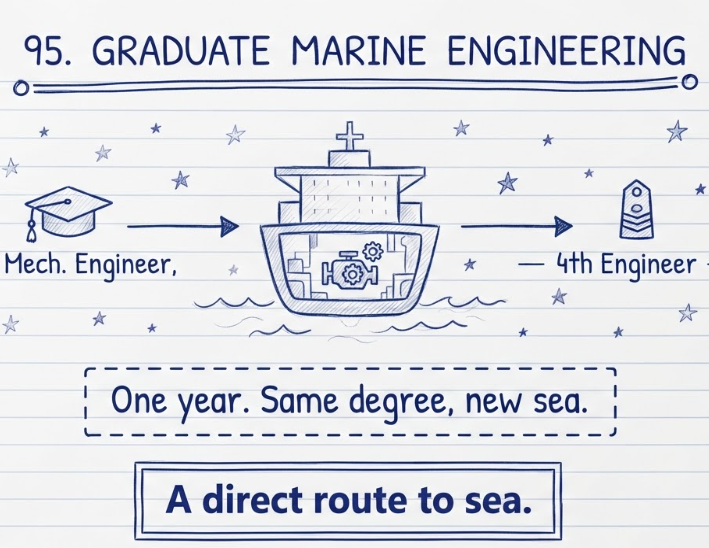
Graduate Marine Engineering, almost always shortened to GME, is a one-year, DG Shipping-approved pre-sea training programme built specifically for graduates who already hold a Bachelor's degree in Mechanical Engineering or Naval Architecture and want to become engineering officers in India's Merchant Navy. It exists precisely because starting from scratch with a full 4-year B.E. in Marine Engineering isn't necessary for someone who's already covered core mechanical engineering fundamentals — GME takes that existing technical foundation and adds the specific maritime knowledge, sea time, and certification needed to work in a ship's engine department.
It's regulated by the Directorate General of Shipping (DG Shipping), Government of India, which monitors which colleges are permitted to offer the programme and sets the admission framework individual maritime institutes build their specific eligibility criteria around. That's an important detail for anyone comparing institutes: the core DG Shipping framework is consistent, but specific numbers (age cutoffs, minimum marks) can vary somewhat from one approved institute to another.
This guide covers exactly what GME involves — eligibility requirements, the course structure and syllabus, fees, the MEO Class IV competency exam that follows it, where GME graduates typically get hired, and the realistic career progression from a fresh GME graduate to a senior engineering officer.
What GME Actually Is
GME is best understood as a bridge programme: it applies the technical knowledge a mechanical engineering graduate already has — thermodynamics, fluid mechanics, machine design — to the specialized environment of shipboard engineering, rather than teaching mechanical engineering fundamentals from zero. The course covers marine propulsion systems, auxiliary machinery, maintenance systems, and general engineering operations specific to vessels, preparing graduates for roles within a merchant ship's engine department.
As one industry guide puts it plainly: your mechanical engineering degree is genuinely relevant onboard ships, since a ship's main engines are among the largest diesel engines in the world — some two-stroke, slow-speed main engines exceed 100,000 horsepower — meaning core mechanical engineering fundamentals apply directly, just at a scale most graduates haven't encountered in a classroom setting.
GME Eligibility Criteria
Because individual DG Shipping-approved institutes set their own specific cutoffs within the broader regulatory framework, exact numbers vary somewhat between colleges. The ranges below reflect what's commonly required across most institutes — always confirm the exact current requirements with your specific target institute before applying.
- Academic qualification: a Bachelor's degree (B.E./B.Tech) in Mechanical Engineering or Naval Architecture from an AICTE-approved institute, or an equivalent recognized qualification, generally with a minimum aggregate ranging from 50% to 70% depending on the specific institute.
- Age limit: typically a maximum of 24 to 28 years at the start of the course, with the exact cutoff varying by institute — some set a lower ceiling around 24, others allow up to 28.
- English proficiency: a minimum English score, commonly in the 50% to 70% range, from either Class 10, Class 12, or the qualifying degree exam, depending on the specific institute's policy.
- Physical and medical standards: candidates must meet DG Shipping's medical fitness standards, generally including minimum height (commonly around 160 cm), a BMI within a specified range, normal speech and hearing, and passing a full eyesight test — with most institutes not accepting color blindness given the nature of shipboard engineering work.
- Marital and personal status: some institutes and sponsoring shipping companies specifically require candidates to be unmarried at the time of admission, though this varies by institute and sponsorship arrangement.
Course Structure: What the Year Actually Looks Like
| Phase | Duration | What Happens |
|---|---|---|
| Pre-sea classroom training | Approximately 8 months, split into 2 semesters | Classroom-based instruction covering marine engineering theory, ship construction and stability, safety, and applied maritime knowledge, conducted at the maritime training institute |
| Onboard training | Approximately 4 months | Practical, supervised training aboard a vessel, during which cadets are typically entitled to a stipend along with free boarding and lodging |
The overall course structure combines theoretical grounding with genuinely hands-on exposure to a ship's engine room relatively early in the process, which is part of why it's positioned as a fast, focused route into the field for candidates who already have a strong mechanical engineering foundation to build on.
What the Syllabus Covers
- Marine propulsion systems and ship engine technology, including main and auxiliary engines
- Thermodynamics and applied engineering principles specific to marine machinery
- Ship construction and stability
- Auxiliary machinery and shipboard maintenance systems
- Safety procedures and standards specific to maritime operations
- Basic nautical engineering systems and electronic components used onboard
GME Fees and Entrance Exams
Fees for the GME programme at most Indian colleges commonly range from roughly ₹4,00,000 to ₹7,00,000 for the full one-year course, though this varies by specific institute, and some candidates enter through company sponsorship arrangements that can offset a meaningful portion of this cost in exchange for a service commitment. Admission generally runs through entrance exams — commonly cited exams include IMU CET (Indian Maritime University Common Entrance Test) and AP EAMCET — alongside direct applications to DG Shipping-approved institutes and campus recruitment drives run directly by shipping companies looking to sponsor cadets.
After GME: The MEO Class IV Exam and Your First Rank
Completing GME itself doesn't automatically make you a certified officer — the next step is the Marine Engineer Officer (MEO) Class IV Certificate of Competency (COC) examination, conducted as per DG Shipping's META Manual. This is where GME's structure genuinely benefits mechanical engineering graduates specifically:
- Part A exemption: ME/GME candidates are generally exempted from Part A of the MEO Class IV examination, moving directly to Part B — a benefit not automatically available through every entry pathway into marine engineering.
- Part B structure: Part B covers four functional areas (functions 3, 4, 5, and 6), broken into a total of 6 written papers (including Ship Construction and Stability, Safety, and both general and motor-specific Marine Engineering Knowledge papers) plus 4 oral examination papers.
- Format: the MEO Class IV written examination is objective-type rather than requiring long-form detailed written answers, though the oral component tests practical and applied understanding directly.
- What passing gets you: successfully clearing MEO Class IV allows a candidate to join as a 4th Engineer, qualified to stand an unsupervised engineering watch — the entry rank for a certified marine engineering officer.
Career Path: From GME Cadet to Chief Engineer
- GME Cadet / Junior Engineer: immediately after completing the GME course and required sea time, before clearing MEO Class IV.
- 4th Engineer: achieved after passing the MEO Class IV (FG) exam, qualifying you to stand an unsupervised engineering watch as a certified officer.
- 3rd Engineer, 2nd Engineer, and Chief Engineer: progression through these ranks requires accumulating further sea time and passing subsequent, progressively advanced Certificate of Competency examinations (including MEO Class II and MEO Class I), along with completing required advanced modular courses along the way.
- Ongoing modular courses: beyond the core COC exams, engineers are required to complete a set of advanced modular courses as part of career progression, in line with DG Shipping's training framework.
Who Hires GME Graduates
Several established shipping companies run structured GME cadet programs and actively recruit through this specific pathway, commonly through campus placement drives at engineering colleges, direct applications through company career portals, and partnerships with DG Shipping-approved pre-sea training institutes.
- Anglo-Eastern Ship Management — runs a large annual GME intake
- Fleet Management Limited (FML) — maintains an active GME program
- V.Ships — accepts GME applications through both campus drives and direct applications
- Synergy Marine Group — runs a structured GME program
How GME Compares to a Direct B.E. Marine Engineering Degree
| Factor | GME (Conversion Route) | Direct B.E. Marine Engineering |
|---|---|---|
| Total duration to entry-level officer eligibility | Existing 4-year mechanical engineering degree + 1-year GME | 4 years, purpose-built marine engineering curriculum from the start |
| Best suited for | Mechanical Engineering or Naval Architecture graduates who decided on a maritime career after completing their degree | Students who know they want a marine engineering career before starting undergraduate study |
| MEO Class IV exam | Part A exempted; Part B required | Full examination structure, following the standard marine engineering degree track |
| Flexibility | Preserves the option to pursue a general mechanical engineering career if plans change before committing to GME | Committed to a maritime-specific path from the start of undergraduate study |
Conclusion
Graduate Marine Engineering exists to solve a specific, practical problem: a genuine and growing global demand for skilled marine engineers, met by giving mechanical engineering and naval architecture graduates a focused, DG Shipping-approved one-year path into the Merchant Navy, rather than requiring them to restart their technical education from scratch. The structure — roughly 8 months of classroom training followed by 4 months onboard, an MEO Class IV exam with a genuine head start built in for mechanical engineering graduates, and a clear rank-by-rank progression toward Chief Engineer — makes it one of the more direct lateral-entry routes available in Indian maritime education.
If you're a mechanical engineering or naval architecture graduate weighing this path, the most useful next steps are confirming the exact eligibility criteria and fee structure at your specific target institute (since both vary meaningfully across DG Shipping-approved colleges), and looking directly at company-sponsored GME programs, which can meaningfully change both the cost and the post-course placement picture compared to a fully self-funded route.
FAQ
Frequently Asked Questions
What is Graduate Marine Engineering (GME)?+
GME is a one-year, DG Shipping-approved pre-sea training programme that allows graduates with a Bachelor's degree in Mechanical Engineering or Naval Architecture to become engineering officers in India's Merchant Navy, without needing to complete a separate 4-year marine engineering degree from scratch.
What is the eligibility criteria for GME?+
Requirements vary somewhat by institute, but generally include a B.E./B.Tech in Mechanical Engineering or Naval Architecture with a minimum aggregate commonly between 50% and 70%, an age limit typically between 24 and 28 years, minimum English proficiency requirements, and meeting DG Shipping's medical and physical fitness standards, including eyesight requirements.
How much does the GME course cost?+
Fees at most Indian colleges commonly range from roughly ₹4,00,000 to ₹7,00,000 for the full one-year course, though this varies by specific institute. Some candidates enter through company-sponsored programs, which can reduce upfront costs in exchange for a post-training service commitment.
How long does the GME course take?+
GME is a one-year programme, generally structured as approximately 8 months of classroom-based pre-sea training (split into two semesters) followed by approximately 4 months of onboard training aboard a vessel.
What exam do I need to pass after GME?+
After completing GME and required sea time, candidates take the MEO (Marine Engineer Officer) Class IV Certificate of Competency examination. ME/GME candidates are generally exempted from Part A of this exam and need to clear Part B, which covers four functional areas across 6 written papers and 4 oral examination papers.
What rank can I join at after passing MEO Class IV?+
Passing the MEO Class IV (FG) examination allows a candidate to join as a 4th Engineer, the entry rank for a certified marine engineering officer qualified to stand an unsupervised engineering watch.
Which entrance exams are used for GME admission?+
Commonly cited entrance exams for GME admission include IMU CET (Indian Maritime University Common Entrance Test) and AP EAMCET, alongside direct applications to DG Shipping-approved institutes and company-run campus recruitment and sponsorship drives.
Which shipping companies hire GME graduates?+
Several established shipping management companies run structured GME cadet programs, including Anglo-Eastern Ship Management, Fleet Management Limited (FML), V.Ships, and Synergy Marine Group, typically recruiting through campus drives, direct applications, and partnerships with DG Shipping-approved training institutes.
Is GME a good option for mechanical engineering graduates?+
For mechanical engineering or naval architecture graduates specifically interested in a maritime career, GME offers a comparatively direct, one-year lateral-entry pathway that leverages their existing technical degree, along with a partial exemption on the MEO Class IV exam not automatically available through every entry route. Whether it's the right choice depends on individual interest in life at sea, career goals, and the specific institute's cost and placement track record.
Is seafarer income really tax-free?+
Income earned while working on foreign-going vessels is commonly cited as tax-free under Indian tax rules for seafarers who meet the required NRI status conditions, based on the number of days spent outside India in a given financial year. Specific eligibility depends on individual circumstances, so it's worth confirming your exact situation with a qualified tax professional rather than assuming automatic tax-free status.