How Much Is It Worth? The Complete Guide to Figuring Out What Your Stuff Is Actually Worth
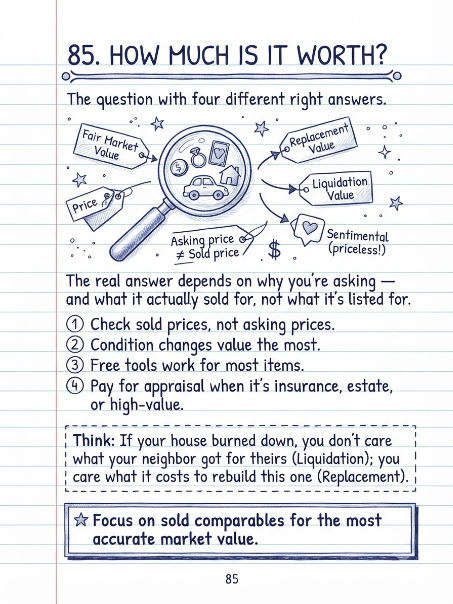
'How much is it worth?' is one of those questions that sounds simple but almost never has a single right answer. The same item — a coin, a painting, a car, a piece of furniture — can genuinely be worth different amounts depending on who's asking, why they're asking, and what kind of value they actually need to know. An insurance company, a buyer at a garage sale, and a probate court would each calculate a different number for the exact same object, and all three could be correct for their specific purpose.
This matters because most people asking this question aren't actually confused about the item — they're confused about which kind of value they need, and which method actually produces a trustworthy answer for that purpose. Someone inheriting a coin collection needs a different process than someone deciding whether to insure a piece of jewelry, and both need a different process than someone just curious what an old comic book might fetch on eBay.
This guide walks through the different types of value, how to actually research an item's worth across the most commonly searched categories — coins, antiques, cars, jewelry, sports cards and comics, and real estate — the free tools that genuinely help, when it's worth paying for a professional appraisal, and the red flags that separate a fair, honest estimate from a scam.
The 4 Types of 'Worth' — And Why the Answer Changes Depending on Which One You Need
Before researching a specific item, it helps to know which kind of value you're actually trying to find, since the number can differ significantly between them.
| Value Type | What It Measures | When You Need It |
|---|---|---|
| Fair Market Value | What a willing buyer would reasonably pay a willing seller, neither under pressure, both reasonably informed | Selling privately, estate settlement, charitable donation, tax purposes |
| Replacement Value | What it would cost to buy a comparable new or equivalent item today, often higher than fair market value | Insurance coverage on jewelry, art, or collectibles |
| Liquidation Value | What you'd likely get selling quickly, often to a dealer or at auction, typically the lowest of the four | Needing cash fast, selling to a pawn shop or dealer, estate liquidation sales |
| Sentimental/Personal Value | What the item means to you personally, unrelated to market price | Not usable for insurance, resale, or tax purposes — but worth acknowledging separately from the financial number |
A ring your grandmother gave you might have a $200 fair market value, a $600 replacement value at a jewelry store, and be effectively priceless to you personally — all three of those can be true at once. Knowing which number you actually need before you start researching saves a lot of confusion later.
The Core Principle Behind Every Valuation: Comparable Sales, Not Asking Prices
The single most important concept in valuing almost anything — coins, cars, furniture, collectibles — is the difference between an asking price and a sold price. Anyone can list an item for any amount they want; that tells you what the seller hopes to get, not what the item is actually worth. A reliable estimate comes from looking at what similar items in similar condition have actually sold for recently, not what's currently listed for sale.
- Recency matters: prices for many categories (collectibles, cars, certain commodities) shift over time, so a sale from several years ago is a weaker data point than one from the past few months.
- Condition matters enormously: a coin, card, or piece of furniture in pristine condition can be worth several times more than the same item with visible wear, damage, or missing components — condition differences are the single biggest reason two 'identical' items sell for very different prices.
- Look for multiple comparable sales, not just one: a single unusually high or low sale can be an outlier (a bidding war, a motivated seller, an error) rather than representative of typical value.
- Provenance and documentation add real value in some categories: original packaging, paperwork, certificates of authenticity, or a documented ownership history can meaningfully increase an item's value, particularly for art, collectibles, and vintage items.
How to Value Specific Categories
The general principle above (comparable recent sales, adjusted for condition) applies everywhere, but each category has its own specific tools and quirks worth knowing.
Coins and Currency
- Identify the exact coin first: year, mint mark, denomination, and any known variety or error, since these details can dramatically change value even between coins that look nearly identical.
- Check third-party price guides such as the PCGS Price Guide or NGC's coin value resources, which track values based on standardized condition grades rather than casual descriptions like 'good condition.'
- For potentially valuable coins, consider professional grading (through PCGS or NGC) before selling, since a certified grade removes buyer uncertainty and can significantly affect the price a serious collector is willing to pay.
- Be realistic about common coins: the overwhelming majority of old coins in circulation are worth close to face value or a modest premium, not the dramatic sums occasionally reported for rare error coins — verify against an actual price guide rather than assuming rarity.
Antiques and Vintage Furniture
- Look for maker's marks, labels, or stamps, often on the underside or back of furniture, which can identify the manufacturer or era and significantly narrow your research.
- Search completed/sold listings on marketplaces like eBay (filtered specifically to 'sold' items, not active listings) and specialty auction house archives for comparable pieces.
- Understand that trends shift: certain styles of antique furniture that were highly valued decades ago have seen significant value declines as tastes have changed, while other categories (mid-century modern, for example) have risen — don't assume 'old' automatically means valuable.
- For higher-value or uncertain pieces, a regional antiques appraiser or a submission to a well-known appraisal event can provide a credentialed opinion worth more than an online guess.
Cars
- For standard used vehicles, tools like Kelley Blue Book and Edmunds provide value ranges based on make, model, year, mileage, condition, and your specific region.
- For classic or collector cars, standard used-car valuation tools don't apply well — instead, check specialty auction results (from houses like Bring a Trailer, Barrett-Jackson, or Mecum) for actual recent sale prices of comparable makes and models.
- Mileage, accident history, and maintenance records meaningfully affect value beyond just the model year — a vehicle report (like Carfax) can be a worthwhile check before finalizing an estimate.
- Regional demand matters: certain vehicle types (four-wheel-drive trucks, convertibles) can be worth noticeably more or less depending on regional climate and driving conditions.
Jewelry and Precious Metals
- Separate the metal value from the craftsmanship/design value: gold and silver have a real-time spot price you can check directly, which sets a reliable floor value for the raw metal content, independent of the piece's design or brand.
- Gemstone value depends heavily on the 'four Cs' (cut, color, clarity, carat) for diamonds, and analogous quality factors for other stones — a professional gemological appraisal is genuinely necessary for anything beyond a rough estimate on valuable stones.
- Designer or branded jewelry can carry significant value beyond raw materials — verify hallmarks, stamps, or maker's marks, and research the specific brand and line rather than valuing purely by metal weight.
- For insurance purposes specifically, get a written appraisal from a certified gemologist appraiser (look for GIA or similar credentials) rather than relying on an informal estimate, since insurers typically require documented appraisals for coverage above a certain value.
Sports Cards, Comics, and Trading Cards
- Use dedicated price-tracking tools such as PriceCharting or 130point, which aggregate actual sold prices specifically for cards and collectibles rather than general marketplace listings.
- Grading matters enormously in this category — a card graded by PSA, BGS, or CGC in top condition can be worth many multiples of the same card ungraded or in visibly lower condition.
- Check recently completed eBay sales (again, sold listings specifically, not active 'Buy It Now' asking prices) for the closest match to your exact card or comic, including its specific edition and grade.
- Be cautious of hype-driven spikes: certain cards and comics see short-term price surges tied to a player's current performance or a movie release, which can reverse — a long-term price history is a more reliable indicator than a single recent spike.
Real Estate
- Online estimate tools (like Zillow's Zestimate or Redfin's estimate) provide a fast, free starting point, but are automated estimates based on public data and comparable sales — they can differ meaningfully from an actual appraised or sold value, particularly for unique properties.
- A Comparative Market Analysis (CMA) from a local real estate agent, based on recent comparable sales in your specific neighborhood, is typically more accurate than an automated online estimate.
- A formal, licensed appraisal — required for most mortgage transactions — is the most rigorous and legally recognized valuation method, conducted by a certified appraiser who physically inspects the property.
- Local market conditions can shift a home's value meaningfully within a single year, so any estimate should be checked against genuinely recent comparable sales, not sales from several years prior.
Free Tools Worth Actually Using
| Category | Free Tool/Method | What It's Good For |
|---|---|---|
| General items | eBay 'Sold Listings' filter | Seeing actual recent sale prices, not just asking prices, for almost any physical item |
| Coins | PCGS / NGC online price guides | Standardized value estimates based on official condition grades |
| Used cars | Kelley Blue Book, Edmunds | Value ranges adjusted for mileage, condition, and region |
| Sports cards & collectibles | PriceCharting, 130point | Aggregated sold-price history specific to cards and collectibles |
| Gold & silver | Live spot price trackers | The current raw metal value as a baseline floor price |
| Real estate | Zillow, Redfin automated estimates | A fast starting-point estimate, best paired with a local agent's CMA |
| General photo identification | Reverse image search (Google Lens, TinEye) | Identifying an unmarked or unfamiliar item before researching its value |
When It's Actually Worth Paying for a Professional Appraisal
Free tools get most people a reasonable ballpark, but there are specific situations where a paid, credentialed appraisal is genuinely worth the cost rather than an unnecessary expense.
- Insurance coverage: insurers typically require a written, credentialed appraisal to insure jewelry, art, or collectibles above a certain value threshold — an online estimate generally won't satisfy this requirement.
- Estate settlement and probate: dividing an estate fairly, or settling tax obligations tied to inherited property, often legally requires a qualified appraisal rather than an informal valuation.
- High-value or uncertain items: if an item could plausibly be worth a significant sum and you genuinely don't know, the cost of a professional appraisal is usually small relative to the risk of underselling (or overinsuring) something valuable.
- Legal disputes or charitable donations: formal appraisals are often specifically required for tax-deductible donations above a certain value, or as evidence in legal proceedings like divorce settlements.
When seeking a professional appraiser, look for relevant credentials specific to the category — for example, membership in the American Society of Appraisers (ASA) or the International Society of Appraisers (ISA) for general personal property, GIA credentials for gemstones, or PCGS/NGC-affiliated experts for coins — rather than choosing based purely on price or convenience.
Red Flags: How to Spot a Bad Estimate or a Scam
- An appraiser who also wants to buy the item: this is a direct conflict of interest — the same person benefits from telling you it's worth less than it is. For anything of real potential value, get an independent appraisal from someone who isn't also making an offer to purchase.
- 'Too good to be true' online valuations from unverified sources or social media posts, especially ones claiming an ordinary item is secretly worth a huge sum — cross-check any dramatic claim against an actual price guide or completed-sales data before believing it.
- Pressure to sell immediately, before you've had time to get a second opinion or research comparable sales — a legitimate buyer or appraiser won't need you to decide on the spot.
- Vague, undocumented 'expert opinions' with no cited comparable sales, grading standard, or methodology behind the number — a trustworthy valuation should be able to show you what it's based on.
- Free online 'instant appraisal' tools or apps that ask for payment information before revealing a value, or that give suspiciously specific numbers for items with no serial number, maker's mark, or identifying detail provided.
Conclusion
'How much is it worth?' rarely has one clean answer, and that's not a frustrating quirk of the process — it's actually the most useful thing to understand before you start. The real question underneath it is almost always more specific: what would this actually sell for right now, what would it cost to replace, or what do I need this number to be for (insurance, taxes, a sale, an estate)? Once you know which of those you're really asking, researching genuine comparable sales — not asking prices, not one-off anecdotes — will get most people a reasonably accurate estimate for free, using the category-specific tools covered in this guide.
Save the cost of a professional appraisal for where it actually matters: insurance documentation, estate and legal situations, or genuinely high-value or uncertain items where getting the number wrong has real consequences. And whenever a valuation — free or paid — comes from someone who also wants to buy the item from you, treat that number with appropriate skepticism and get a second, independent opinion before deciding anything.
FAQ
Frequently Asked Questions
How do I find out how much something is really worth?+
Research actual recent sold prices for comparable items in similar condition, rather than relying on asking prices or single anecdotes. Category-specific tools — eBay's sold-listings filter, PCGS/NGC for coins, Kelley Blue Book for cars, PriceCharting for collectibles — are the most reliable free starting points, with condition and documentation adjusted for accordingly.
What's the difference between fair market value and replacement value?+
Fair market value is what a willing buyer would reasonably pay a willing seller — used for selling, estate settlement, and tax purposes. Replacement value is what it would cost to buy a comparable new or equivalent item today, which is typically higher and is the figure insurers use to determine coverage amounts.
Are online valuation tools like Zillow's Zestimate accurate?+
They provide a reasonable, free starting-point estimate based on public data and comparable sales, but automated tools can differ meaningfully from a formal appraisal or actual sale price, particularly for unique properties or items. They're most useful as a first check, ideally paired with a local professional's opinion for anything significant.
Is it worth paying for a professional appraisal?+
It's worth it specifically for insurance documentation, estate and legal purposes, high-value or genuinely uncertain items, and situations like charitable donations that legally require a qualified appraisal. For everyday items with modest expected value, free comparable-sales research is usually sufficient.
Why is condition so important in determining value?+
Condition is often the single biggest factor separating two otherwise similar items in price — a coin, card, or piece of furniture in pristine, well-documented condition can be worth several times more than the same item with visible wear or damage. This is why professional grading (for coins, cards, and comics specifically) exists: it standardizes condition assessment so buyers and sellers can trust the comparison.
How can I tell if an appraisal or valuation is trustworthy?+
A trustworthy valuation should reference specific, comparable recent sales or a recognized grading/pricing standard, come from someone without a conflict of interest (ideally not also offering to buy the item), and not pressure you into an immediate decision. Be especially cautious of dramatic, unverified value claims and appraisers who benefit directly from a low valuation.
Do old items automatically become more valuable over time?+
No. Age alone doesn't guarantee value — demand, condition, rarity, and shifting collector or design trends matter far more. Some categories of antiques have actually declined in value as tastes have changed, while other more recent items have appreciated due to renewed demand, so it's important to check actual current comparable sales rather than assuming age equals value.
What should I do before selling something I think might be valuable?+
Research comparable recent sold prices in the relevant category-specific tool, check for any maker's marks, hallmarks, or identifying features that could affect value, and consider a professional appraisal if the item could plausibly be worth a significant amount. Avoid selling to the first person who offers to appraise and buy it in the same conversation, since that's a direct conflict of interest.