How to Learn New Skills: The Complete 2026 Guide (Backed by How Learning Actually Works)
The way most people try to learn a new skill — read a book, watch a few tutorials, hope it sinks in — is roughly the least efficient approach available, and it's also the default nearly everyone reaches for. That gap matters more now than it used to. Research on skill obsolescence puts the current 'half-life' of a professional skill at around five years, down from ten to fifteen years just a decade ago, and the World Economic Forum estimates that 39% of the core skills held by today's workforce will be transformed or made outdated by 2030. Learning quickly and effectively isn't just a nice personal trait anymore — it's become a genuinely practical necessity.
The good news is that how people actually acquire skills has been studied extensively, and the findings are consistent enough to build a real, practical process around — not vague motivational advice, but specific techniques that measurably speed up how fast a skill goes from unfamiliar to genuinely usable. Most people just aren't using them, because the intuitive way to learn (passive review, cramming, practicing without feedback) feels productive without actually being efficient.
This guide covers what the research actually says about how skills get built, how long learning something realistically takes (and why the '10,000 hours' idea gets misapplied constantly), a step-by-step framework for learning any new skill faster, the mistakes that quietly stall most people's progress, and how to build a learning habit that survives beyond the first two weeks of motivation.
Why Learning How to Learn Matters More in 2026
This isn't an abstract concern. Fuel50's 2026 research across more than 800 HR leaders found that 53% of organizations say critical skills in their industry become obsolete within three years or less, and 15% put that window at under a year. Separately, PwC's 2026 Global AI Jobs Barometer found that skills needed for the most AI-exposed jobs are now changing 66% faster than for the least-exposed roles — a gap that grew 75% in just the past year. At the same time, there's a genuine upside to being someone who learns well: 94% of employees say they'd stay longer at a company that invests in their learning, and the World Economic Forum reports that 50% of the global workforce is now completing training as part of a long-term learning strategy, up from 41% just a couple of years earlier.
Put together, this points to a fairly clear reality: the specific skills that matter will keep shifting faster than they used to, but the meta-skill of learning efficiently doesn't expire the same way. Getting genuinely good at how you learn is one of the few investments that keeps paying off regardless of which specific skill you're applying it to next.
The Science: How Skills Actually Get Built
Decades of research on expertise and skill acquisition converge on a few consistent findings that matter far more than most popular advice on 'learning fast.'
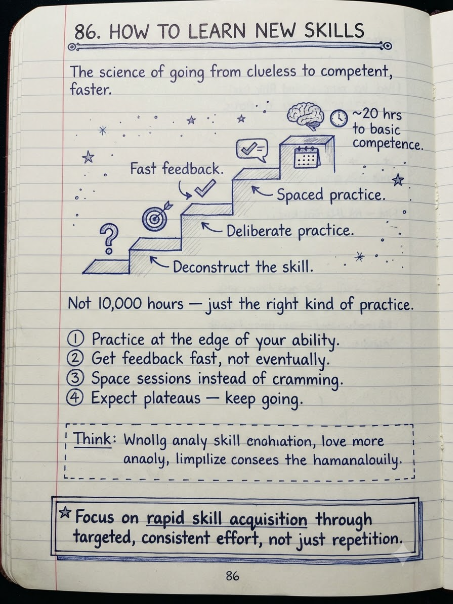
- Deliberate practice, not just repetition: simply doing a task over and over doesn't reliably build skill — what matters is focused practice specifically targeting your current weaknesses, just past your current comfort level, with clear feedback on whether you're improving. This is the core finding behind decades of expertise research: raw hours matter far less than the quality and structure of those hours.
- Active recall beats passive review: actively trying to retrieve information or perform a skill from memory (quizzing yourself, practicing without notes, attempting a task before looking up the answer) builds much stronger retention than passively re-reading, re-watching, or re-listening to material.
- Spaced repetition beats cramming: reviewing material at increasing intervals over time — a day later, then a few days later, then a week later — produces dramatically better long-term retention than reviewing the same material repeatedly in one sitting, even though cramming can feel more productive in the moment.
- Fast feedback loops accelerate everything: skills improve fastest when you find out quickly whether an attempt worked or didn't, and specifically why. This is a big part of why languages, instruments, and sports taught with a coach or structured feedback tend to progress faster than fully self-directed practice with no external check.
- The 'desirable difficulty' principle: learning that feels a little effortful and slightly uncomfortable — retrieving something from memory instead of re-reading it, practicing a skill slightly beyond your current level — tends to produce better long-term learning than practice that feels smooth and easy, even though the smoother practice often feels like it's working better in the moment.
How Long Does It Actually Take to Learn a New Skill?
The '10,000 hours' idea — popularized from research on elite performers like world-class musicians and chess players — gets misapplied constantly to mean that any new skill requires 10,000 hours before it's worth anything. That's not what the original research measured, and it's not a useful target for most people learning a practical skill for personal or professional use rather than aiming for world-class elite performance.
A more useful and widely cited framework, popularized by author Josh Kaufman, suggests that around 20 hours of focused, deliberate practice is enough to take most people from complete beginner to noticeably, usably competent at a new skill — not expert-level, but functional and no longer frustrating to attempt. The key qualifier is that those 20 hours need to be genuinely focused, deliberate practice, not passive exposure — 20 hours of half-attentive video-watching won't produce the same result as 20 hours of actively attempting and correcting the skill itself.
| Practice Type | What It Actually Builds |
|---|---|
| ~20 hours of deliberate, focused practice | Basic functional competence — no longer a total beginner, able to perform the skill without constant confusion |
| ~100 hours of consistent, feedback-driven practice | Solid working proficiency — able to perform the skill reliably in real, practical situations |
| 1,000+ hours over an extended period | Genuine advanced skill, often the point where you can teach or mentor others effectively |
| 10,000+ hours (the popularized, often misapplied figure) | The range associated with elite, world-class performance in highly competitive fields — not a realistic or necessary target for most practical, everyday skill goals |
A Step-by-Step Framework for Learning Any New Skill Faster
- Define a specific, real-world target, not a vague goal: 'get better at Spanish' is vague and hard to practice against. 'Be able to hold a basic restaurant-ordering conversation in Spanish' is specific, testable, and tells you exactly what to practice.
- Deconstruct the skill into its actual sub-skills: most 'skills' are really a bundle of smaller sub-skills. Learning to cook well, for example, bundles knife technique, seasoning judgment, timing, and heat control — identifying the specific sub-skills lets you practice the ones that matter most for your specific goal first, rather than treating the whole thing as one undifferentiated blob.
- Find the 20% of the skill that gets you 80% of the practical result, and start there: for most practical goals, a relatively small core of techniques or knowledge covers the large majority of real-world use cases. Identify that core first, rather than trying to comprehensively master every aspect of a skill before you've even tested whether you can use the basics.
- Practice with immediate, honest feedback: whether that's a coach, a more experienced peer, a structured course with graded exercises, or simply comparing your own attempt against a clear reference example, build in a way to know quickly whether an attempt actually worked, not just whether it felt like it worked.
- Remove the barrier to practicing badly: the biggest hidden obstacle for most adult learners isn't lack of time — it's the discomfort of being visibly bad at something new. Give yourself explicit permission to be genuinely bad during the first practice sessions; that discomfort is a normal, necessary part of the process, not a sign you're approaching it wrong.
- Space your practice sessions rather than binging one long session: several shorter, spaced sessions across multiple days build stronger retention than the same total hours compressed into one or two long sessions, thanks to the spacing effect described above.
- Periodically test yourself under real conditions, not just practice conditions: at intervals, try to actually use the skill in a real, slightly higher-stakes situation than your comfortable practice environment — this reveals gaps that comfortable, low-stakes practice alone won't expose.
Common Mistakes That Quietly Stall Learning
- Confusing familiarity with competence: after repeated exposure to material, it starts to feel familiar and easy to follow — which can be mistaken for actually being able to perform the skill. The real test is whether you can produce or perform it without the material in front of you, not whether you can follow along with it.
- Staying too long in your comfort zone: repeating practice at a level you've already mastered feels productive and low-stress, but doesn't build new skill — meaningful improvement requires practicing just past your current ability, where mistakes are more frequent.
- Skipping feedback entirely: practicing in isolation without any way to check whether your attempts are actually correct allows bad habits to become deeply ingrained before anyone (including you) notices them.
- All-or-nothing scheduling: waiting for a large, uninterrupted block of free time to 'really' focus on learning something new is a common reason people never start — short, consistent, spaced sessions reliably outperform infrequent long sessions for most skills.
- Trying to master everything at once: attempting to comprehensively learn every aspect of a skill simultaneously, rather than sequencing sub-skills and building the highest-impact ones first, tends to slow overall progress and increase the odds of giving up early.
Choosing What Skill to Actually Learn
Before applying any of the techniques above, it's worth being deliberate about which skill is actually worth the investment of focused practice time, rather than picking based purely on what's currently trending.
- Relevance to a specific outcome you actually care about: a skill tied to a concrete goal (a job you want, a project you're building, a real activity you'll use it for) sustains motivation far better than a skill learned in the abstract, 'because it seems useful.'
- Durability versus rapid obsolescence: given how quickly certain technical skills are currently shifting, weigh how likely the specific skill is to still be relevant a few years out, versus a more durable underlying capability (like structured problem-solving or clear written communication) that transfers across whatever specific tools change around it.
- Genuine interest, not just perceived usefulness: skills you're at least somewhat intrinsically interested in are dramatically easier to sustain deliberate practice on than skills you're learning purely out of obligation, since sustained practice requires showing up repeatedly, including on days motivation is low.
- Realistic time budget: be honest about how much consistent time you can actually commit, and choose a skill (or a specific, narrower slice of a larger skill) that fits that realistic budget, rather than picking an ambitious goal you'll likely abandon within a month.
Building a Learning Habit That Actually Sticks
- Anchor practice to an existing routine: attaching a new practice session to something you already do consistently (after your morning coffee, during a specific commute) makes it far more likely to survive past the first few weeks than a floating, unscheduled intention to 'practice sometime today.'
- Track visible progress, not just effort: keeping a simple log of specific things you can now do that you couldn't before is more motivating over time than simply tracking hours spent, since it directly shows the payoff of the process.
- Lower the daily bar on hard days: a genuinely tiny minimum practice session (even five minutes) on days when a full session isn't realistic keeps the habit alive, which matters more for long-term consistency than any single session's length.
- Build in accountability: a study partner, a public commitment, a coach, or a structured course with deadlines all add external accountability that's considerably harder to maintain through willpower alone over an extended period.
- Expect and plan for plateaus: almost every skill involves stretches where visible progress slows or seems to stall, even with consistent deliberate practice — this is a normal part of the process, not a signal that the approach has stopped working, and pushing through it is often where the next real jump in ability happens.
Conclusion
The gap between how most people try to learn and how skills actually get built comes down to a handful of specific, well-supported differences: deliberate, feedback-driven practice instead of passive exposure; active recall instead of passive review; spaced sessions instead of cramming; and a realistic sense that meaningful competence, for most practical skills, is closer to 20 focused hours away than 10,000. None of this requires special talent or a dramatically different amount of time than most people already have available — it requires structuring the time you do have around the specific techniques that the research consistently shows actually work.
Given how fast the specific skills in demand are shifting, getting genuinely good at this process is arguably more valuable long-term than any single skill you learn with it. Pick one skill, deconstruct it into its real sub-skills, build in fast feedback, space your practice out, and give yourself explicit permission to be bad at it for the first twenty hours. That combination, more than any single trick, is what actually moves people from beginner to competent fastest.
FAQ
Frequently Asked Questions
How long does it really take to learn a new skill?+
It depends heavily on your target level. Around 20 hours of genuinely focused, deliberate practice is often enough to reach basic functional competence at many practical skills, according to the framework popularized by author Josh Kaufman. Solid working proficiency generally takes closer to 100 hours of consistent, feedback-driven practice, while advanced or expert-level skill in competitive fields is associated with the much larger, often-misapplied '10,000 hours' figure — which isn't a realistic or necessary target for most everyday skill goals.
What is deliberate practice, and why does it matter more than just repetition?+
Deliberate practice is focused, structured practice that specifically targets your current weaknesses, pushes you just past your comfort level, and includes clear feedback on whether you're actually improving. It matters more than simple repetition because raw hours of comfortable, familiar practice don't reliably build new skill — meaningful improvement requires the discomfort of attempting things you can't yet do well, with a way to know whether your attempts are working.
What is spaced repetition, and how do I use it to learn faster?+
Spaced repetition is reviewing or practicing material at increasing intervals over time — for example, a day later, then a few days later, then a week later — rather than repeating it multiple times in a single session. It produces significantly stronger long-term retention than cramming, even though cramming often feels more productive in the moment. In practice, this means spreading practice sessions across multiple days rather than compressing the same total time into one long session.
Why does practice sometimes feel like it's not working?+
This is often the 'desirable difficulty' effect — learning that feels effortful, uncomfortable, and slightly beyond your current ability tends to produce better long-term retention than practice that feels smooth and easy, even though the easier practice often feels more successful in the moment. Genuine skill-building frequently feels harder than passive review, which is part of why it works.
How do I know which skill is worth learning?+
Prioritize skills tied to a specific, real outcome you care about, weigh how durable the skill is likely to be given how quickly certain technical skills are currently shifting, factor in genuine personal interest (since it sustains consistent practice better than obligation alone), and be realistic about the time you can actually commit consistently, rather than picking an ambitious goal you're likely to abandon.
What's the biggest mistake people make when trying to learn something new?+
Confusing familiarity with actual competence is one of the most common — repeated exposure to material makes it feel easier to follow, which can be mistaken for genuinely being able to perform the skill independently. Practicing without any feedback, staying too long in comfortable, already-mastered territory, and waiting for large blocks of free time instead of practicing in short, consistent sessions are also common obstacles.
Is it true that skills become obsolete faster now than in the past?+
Yes, according to recent workforce research. The estimated half-life of a professional skill has dropped to around five years, down from ten to fifteen years roughly a decade ago, and separate research found that 53% of organizations report critical industry skills becoming obsolete within three years or less. This is a significant part of why learning efficiently, rather than relying on skills staying relevant indefinitely, has become more practically important.
How can I stay motivated to keep practicing a new skill?+
Anchor practice sessions to an existing daily routine so they're less dependent on willpower alone, track specific, visible progress rather than just hours spent, keep a genuinely tiny minimum practice option for low-motivation days, and build in some form of external accountability, such as a study partner or structured course with deadlines. Expecting and planning for plateaus — rather than treating them as a sign to quit — also helps sustain motivation through the normal dips in visible progress.
Do I need a teacher or coach to learn a new skill effectively?+
Not necessarily, but you do need some reliable source of fast, honest feedback on whether your practice attempts are actually correct — this can come from a coach, a more experienced peer, a structured course with graded exercises, or a clear reference standard you can compare your own attempts against. Practicing entirely without any feedback mechanism is one of the more common ways bad habits become ingrained unnoticed.
What's the difference between upskilling and reskilling?+
Upskilling means learning additional skills to perform better within your current role or field, while reskilling means learning a new set of skills to move into a substantially different role or career path. Both rely on the same underlying learning techniques — deliberate practice, active recall, spaced repetition, and fast feedback — but are aimed at different end goals.