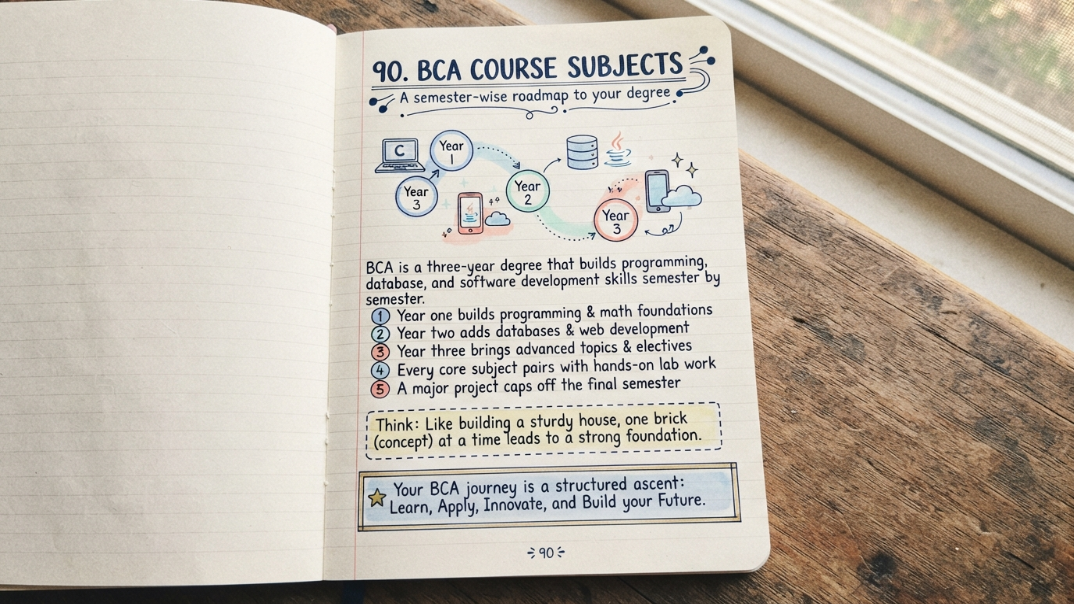
BCA, or Bachelor of Computer Applications, is one of the most popular three-year undergraduate degrees in India for students aiming to build a career in software development, IT services, or further study through an MCA or related master's program. Unlike a general computer science degree, BCA leans more applied and practical, mixing programming fundamentals with real-world software tools, though the exact syllabus varies somewhat by university. This guide breaks down what a typical BCA course covers semester by semester, the electives students commonly choose, and how the subjects map to real career skills.
What Is a BCA Course
BCA is a three-year, six-semester undergraduate degree focused on computer applications, programming, and software development, designed to prepare students for entry-level roles in IT or further postgraduate study. It sits alongside B.Sc. Computer Science and B.Tech./B.E. Computer Science as one of the three most common undergraduate paths into a tech career in India, generally seen as more application- and industry-tool focused than the more theory-heavy B.Tech route.
BCA Course Structure Overview
Most BCA programs are structured around a mix of core programming subjects, supporting mathematics and theory subjects, and practical lab components, spread evenly across six semesters. The first year typically builds programming fundamentals and foundational math, the second year introduces data structures, databases, and web technologies, and the final year shifts toward more advanced and specialized subjects along with a major project.
| Year | Semesters | General Focus |
|---|---|---|
| First Year | Semester 1–2 | Programming fundamentals, math foundations, computer basics |
| Second Year | Semester 3–4 | Data structures, databases, web development, OOP |
| Third Year | Semester 5–6 | Advanced programming, networking, electives, final project |
Semester 1 and 2 Subjects
The first year is designed to build a base in programming logic, computer fundamentals, and the mathematics needed for later, more advanced subjects.
| Semester | Core Subjects |
|---|---|
| Semester 1 | Programming in C, Computer Fundamentals & Organization, Mathematics I (Discrete Structures/Algebra), Communication Skills, Digital Electronics |
| Semester 2 | Object-Oriented Programming (C++), Mathematics II (Statistics/Calculus), Data Structures, Operating Systems Concepts, Environmental Studies |
Semester 3 and 4 Subjects
The second year builds on programming fundamentals with database management, structured software development practices, and early web technologies.
| Semester | Core Subjects |
|---|---|
| Semester 3 | Database Management Systems, Java Programming, Computer Networks, Software Engineering, Financial Accounting |
| Semester 4 | Web Technologies (HTML/CSS/JavaScript), Advanced Java/Python Programming, Operating Systems, Design and Analysis of Algorithms, Numerical Methods |
Semester 5 and 6 Subjects
The final year typically shifts toward more advanced, specialized, and elective subjects, along with the culminating major project most universities require for graduation.
| Semester | Core Subjects |
|---|---|
| Semester 5 | Python Programming, Mobile Application Development, Cloud Computing Basics, E-Commerce, Elective I |
| Semester 6 | Major Project, .NET Programming or equivalent, Artificial Intelligence Basics, Cyber Security Fundamentals, Elective II |
Common BCA Electives
Most BCA programs include one or two elective slots, usually in the fifth and sixth semesters, letting students specialize somewhat based on interest or career direction. Common elective options include:
- Data Science and Machine Learning fundamentals
- Mobile App Development (Android/iOS)
- Cyber Security and Ethical Hacking
- Cloud Computing and DevOps basics
- Game Development fundamentals
- Digital Marketing and E-Commerce technologies
Practical Labs and Projects
Nearly every core subject in a BCA program is paired with a corresponding practical lab component, since the degree is built around hands-on coding and tool proficiency rather than theory alone. Students typically complete labs in C and C++ programming, database query writing (SQL), web development projects, and Java or Python application-building throughout the second and third years. Most programs also require a substantial final-year major project, where students design and build a working application — often a web or mobile app — individually or in a small group, frequently serving as a key talking point in later job interviews.
How BCA Differs From B.Sc. Computer Science
Students choosing between BCA and B.Sc. Computer Science often find the subjects overlap more than expected, but the emphasis differs in a few consistent ways.
| Aspect | BCA | B.Sc. Computer Science |
|---|---|---|
| Focus | Application development and industry tools | Theoretical computer science foundations |
| Math intensity | Applied math relevant to programming | Often includes deeper pure math and theory |
| Typical next step | Industry job or MCA | Industry job, MCA, or M.Sc. |
| Course style | More hands-on lab and project work | More balanced theory-to-practical ratio |
Skills You'll Actually Build
By the end of a BCA program, most students come away with a working command of at least one or two programming languages (commonly C, Java, and Python), practical database skills using SQL, an understanding of how web applications are built end to end, and basic exposure to networking, operating systems, and increasingly, cloud and AI fundamentals as universities update older syllabi to reflect current industry demand.
Career Paths After BCA
Graduates typically move in one of a few common directions after completing a BCA degree.
- Software developer or programmer roles at IT services or product companies
- Web developer or front-end/back-end developer roles
- Database administrator or data analyst roles
- Pursuing an MCA (Master of Computer Applications) for further specialization
- Pursuing an MBA for students aiming toward IT management or product roles
FAQs
What are the main subjects in BCA first year?
First-year BCA typically covers Programming in C, Computer Fundamentals, foundational Mathematics, Object-Oriented Programming (usually C++), and an introduction to Data Structures and Operating Systems.
Does BCA include mathematics?
Yes, though it's generally more applied than the pure mathematics covered in a B.Sc. or B.Tech. program — typical BCA math subjects include discrete structures, statistics, and numerical methods relevant to programming and data analysis.
What programming languages are taught in BCA?
Most BCA programs cover C in the first year, C++ and Java in the second year, and Python along with web technologies (HTML, CSS, JavaScript) in the later years, though the exact sequence varies by university.
Is BCA harder than B.Sc. Computer Science?
Neither is inherently harder — BCA tends to be more application- and tool-focused with heavier lab work, while B.Sc. Computer Science often includes deeper theoretical and pure mathematics content.
Can I do MCA after BCA?
Yes. BCA is one of the most common and directly aligned undergraduate paths into an MCA (Master of Computer Applications) program, since the core programming and computer science foundation transfers directly.
What electives are available in BCA?
Common electives include data science and machine learning basics, mobile app development, cyber security, cloud computing, game development, and digital marketing technologies, usually offered in the fifth and sixth semesters.