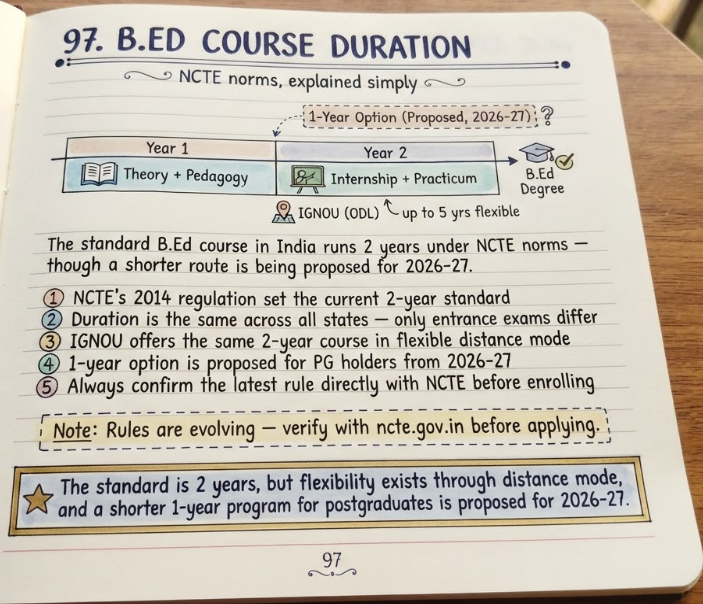
If you're planning to pursue a B.Ed in India, the duration question matters more than it might seem — it affects your admission eligibility, your fees, and how soon you can sit for the CTET or a state TET and start applying for teaching jobs. As of the 2026 academic session, the B.Ed course in India is a 2-year, NCTE-regulated programme for most candidates, but this is an area currently in transition: NCTE has drafted regulations to reintroduce a 1-year B.Ed for specific candidates starting the 2026-27 session, and the rules are still being finalized. This guide lays out the current, verified duration rules, what's changing, and what remains the same across states and modes of study.
What Is the Duration of B.Ed Course (NCTE-Prescribed Duration)
As per the National Council for Teacher Education (Recognition Norms and Procedure) Regulations, 2014, the standard Bachelor of Education (B.Ed) programme in India is prescribed to be of 2 years' duration, spread across 4 semesters. This regulation came into effect from the 2015-17 academic session onward, replacing the earlier 1-year B.Ed format that had been in place for decades before that. The 2-year structure includes theory coursework, pedagogy training, compulsory school internship (extended practice teaching in real classrooms), and, at most universities, a research project or dissertation component. This 2-year duration remains the standard, currently applicable format for the vast majority of B.Ed programmes across Indian universities as of the 2026 admission cycle, whether offered in regular (on-campus) or distance/ODL mode. A separate, newer pathway — the 4-year Integrated Teacher Education Programme (ITEP), introduced under National Education Policy (NEP) 2020 and regulated by NCTE's ITEP norms — combines an undergraduate degree (BA, B.Sc., or B.Com) with a B.Ed. into a single 4-year programme taken directly after Class 12, but this is a separate track from the traditional post-graduation-entry 2-year B.Ed.
B.Ed Course Duration from 2022: What Actually Changed
There is no specific NCTE regulation from 2022 that changed the core 2-year duration of the traditional B.Ed programme — this is an important point to clarify, since search queries around "B.Ed duration 2022" often stem from confusion with broader NEP 2020 reforms rather than an actual duration change to the existing 2-year course. What did happen around this period was the gradual rollout of NEP 2020's teacher education reforms: pilot batches of the 4-year ITEP began at select Higher Education Institutions from around the 2021-23 window, and the Central Universities Entrance Test (CUET) became the mandatory admission route for B.Ed programmes at central universities starting from the 2024 admission cycle, replacing individual university-level entrance tests for those specific institutions. Neither of these changes altered the 2-year duration of the standard B.Ed itself. The genuinely significant duration-related regulatory development is more recent — NCTE's 2025 draft regulations proposing a return to a 1-year B.Ed for specific candidate categories from the 2026-27 session, covered in detail later in this guide. Because this is an evolving regulatory area, always cross-check the latest circular on the official NCTE website (ncte.gov.in) before finalizing your admission plans.
B.Ed Course Duration and Fees Overview
B.Ed course duration is fairly standardized at 2 years across most of India, but the fees for that same 2-year duration vary enormously depending on whether you choose a government college, a state university, a private college, or a deemed university. Government and state-run B.Ed colleges are consistently the most affordable option, while private and deemed universities charge significantly more in exchange for better infrastructure, smaller batch sizes, and placement support. The table below reflects broad, commonly reported fee ranges for the full 2-year programme; always verify current fees directly with the specific college or university, since amounts are revised periodically.
| College Type | Approx. Fee Range (Full 2-Year Course) | Notes |
|---|---|---|
| Government / State University | ₹10,000 – ₹50,000 | Most affordable; limited seats, entrance-exam based admission |
| Private College (State-Affiliated) | ₹50,000 – ₹2,50,000 or more | Fees vary widely by state and college infrastructure |
| Deemed / Top Private University | ₹1.5 lakh – ₹4 lakh per year | Higher-end infrastructure, placement cells, brand value |
| IGNOU (Distance/ODL) | ₹55,000 – ₹65,000 (full course) | NCTE-recognized distance mode, flexible schedule |
B.Ed Course Duration After Graduation (Regular Route)
For the vast majority of candidates — those entering B.Ed after completing a standard 3-year undergraduate degree (BA, B.Sc., B.Com, etc.) — the current duration is 2 years, taken through the regular, on-campus route. Eligibility generally requires a minimum of 50% aggregate marks in the qualifying undergraduate degree (45% for reserved categories, as per most state norms, though exact percentage requirements can vary slightly by state and institution), followed by qualifying a relevant entrance examination such as a state-level CET, university-specific test, or CUET (for central universities). This regular 2-year route remains the most common path into the teaching profession in India and is the default assumption unless a specific university or NCTE notification states otherwise for your admission cycle.
B.Ed Course Duration After Post-Graduation
Under the current, still-applicable 2014 NCTE regulation, candidates entering B.Ed after completing a postgraduate degree (an MA, M.Sc., or M.Com, for example) also pursue the same standard 2-year B.Ed programme — postgraduate qualification does not currently shorten the duration under the regulation in force as of the 2026 session. This is a point of frequent confusion, since NCTE's 2025 draft regulations specifically propose a shorter, 1-year B.Ed route for postgraduate degree holders (and 4-year UG degree holders) starting from the 2026-27 academic session. As of this writing, that shorter route is still in the draft/approval stage for most institutions, and the standard 2-year duration continues to apply to postgraduate entrants at most universities for the current admission cycle. Postgraduate candidates should check directly with their target university and the latest NCTE notification to confirm which duration applies to their specific admission year.
IGNOU B.Ed Course Duration (Distance/ODL Mode)
The Indira Gandhi National Open University (IGNOU) offers B.Ed through Open and Distance Learning (ODL) mode, and its minimum programme duration is also 2 years, consistent with the NCTE-mandated duration for regular B.Ed programmes. IGNOU allows candidates flexibility to extend completion up to a maximum period (commonly cited as 4 to 5 years across IGNOU's own regional centre pages, so candidates should confirm the exact current maximum with their specific regional centre) if they're unable to finish within the standard 2-year window, which makes it a practical option for working teachers or candidates managing other commitments alongside their studies. Despite being a distance programme, IGNOU B.Ed is NCTE-recognized and includes mandatory components beyond self-study: periodic contact/counselling sessions, workshops, school-based internships, and term-end examinations, similar in substance to a regular B.Ed, just delivered in a more flexible format. Admission to IGNOU B.Ed is through a dedicated entrance test (not direct admission), and eligibility requires a bachelor's or master's degree with a minimum aggregate of around 50% marks, along with a few additional category-specific conditions listed on the official IGNOU admission portal.
State-Wise B.Ed Duration Notes: Bihar, Telangana, Maharashtra, Karnataka, MP
A common misconception is that B.Ed duration varies significantly by state. In practice, since B.Ed is centrally regulated by NCTE, the core 2-year duration is uniform across all Indian states — what actually differs from state to state is the entrance examination used for admission, the number of available seats, and the fee structure at government versus private colleges within that state, not the length of the course itself.
| State | Duration | State-Level Entrance Exam | Notes |
|---|---|---|---|
| Bihar | 2 years (standard NCTE norm) | Bihar B.Ed CET (conducted by a nodal university on behalf of the state, e.g., BRABU) | Recent 2026 admission cycles have been explicitly listed as '2-Year Course' sessions |
| Telangana | 2 years (standard NCTE norm) | TS EDCET (Telangana State Education Common Entrance Test) | Conducted by a designated state university on behalf of the government |
| Maharashtra | 2 years (standard NCTE norm) | MAH B.Ed CET (via the Maharashtra State CET Cell) | Centralized online entrance test and counselling process |
| Karnataka | 2 years (standard NCTE norm) | Karnataka B.Ed CET / university-specific admission | Some institutions also admit via CUET for specific university seats |
| Madhya Pradesh | 2 years (standard NCTE norm) | MP B.Ed / PET (Professional Examination Board admission route) | Government and private colleges both follow the same 2-year structure |
Is There a 1-Year B.Ed Course Option?
This is genuinely one of the most time-sensitive and frequently misunderstood questions in Indian teacher education right now, so it deserves a clear, careful answer rather than a quick yes or no. Historically, B.Ed was a 1-year course before NCTE's 2014 regulation made it mandatorily 2 years starting from the 2015 session — so if you're seeing older material online referencing a 1-year B.Ed, that reflects the pre-2015 system, which is no longer valid for current admissions. However, NCTE released Draft NCTE (Recognition Norms and Procedure) Regulations, 2025 in February 2025, proposing to reintroduce a 1-year B.Ed (and 1-year M.Ed) specifically for candidates holding either a postgraduate degree with at least 50% marks, or a 4-year undergraduate degree in a specialized subject with at least 50% marks — not for standard 3-year undergraduate degree holders, who would continue with the existing 2-year B.Ed under the draft framework. As of the most recent available reporting, this proposal has been described in some coverage as approved in principle as part of "NCTE Regulation 2025" and targeted for the 2026-27 academic session, while other, more recent reporting describes it as still pending final Gazette notification and full rollout at the institutional level. Because regulatory status can shift between drafting, approval, and actual implementation at individual universities, please verify the latest NCTE notification directly on ncte.gov.in, or confirm with your target university's admission office, before assuming a 1-year B.Ed is available for your specific admission cycle. Do not rely solely on this or any other article for a final decision on this point, since it is actively evolving.
FAQs
What is the current duration of the B.Ed course in India?
As per NCTE's 2014 Regulations, the standard B.Ed course duration is 2 years (4 semesters), applicable across regular and distance/ODL modes at most Indian universities as of the 2026 admission cycle. Always verify with your specific university, since a shorter 1-year route is being proposed for certain candidates from 2026-27.
Is B.Ed becoming a 1-year course from 2026?
NCTE has drafted regulations to reintroduce a 1-year B.Ed from the 2026-27 session, but only for candidates with a postgraduate degree or a 4-year specialized UG degree (minimum 50% marks); the standard 2-year B.Ed continues for 3-year undergraduate degree holders. This proposal's final Gazette notification status should be verified directly with NCTE before making admission plans.
How long is the B.Ed course after graduation?
For candidates entering B.Ed after a standard 3-year undergraduate degree, the current duration is 2 years under the applicable NCTE regulation, taken through regular on-campus study after clearing a relevant entrance exam.
Does B.Ed duration change if I already have a postgraduate degree?
Under the currently applicable 2014 NCTE regulation, no — postgraduate degree holders also pursue the standard 2-year B.Ed. A shorter 1-year route for postgraduates is proposed under NCTE's 2025 draft regulations starting 2026-27, but its implementation status should be confirmed with NCTE before assuming eligibility.
What is the duration of the IGNOU B.Ed programme?
IGNOU's B.Ed, offered in Open and Distance Learning (ODL) mode, has a minimum duration of 2 years, with flexibility to extend completion over a longer maximum period (commonly cited as up to 4-5 years depending on the regional centre) for candidates who need more time.
Does B.Ed course duration differ by state, like Bihar, Maharashtra, or Karnataka?
No. The 2-year duration is uniform nationwide since B.Ed is centrally regulated by NCTE. What differs by state is the entrance exam (such as Bihar B.Ed CET, MAH B.Ed CET, TS EDCET, or Karnataka B.Ed CET), seat availability, and fee structure, not the length of the course itself.
Is the 4-year ITEP the same as a 1-year or 2-year B.Ed?
No. ITEP (Integrated Teacher Education Programme) is a separate, 4-year dual-degree programme combining a UG degree with a B.Ed, taken directly after Class 12 under NEP 2020, and is distinct from both the traditional 2-year post-graduation B.Ed and the proposed 1-year route.