Professional Practice Examination (EPPP): The Complete 2026 Guide for Psychology Licensure
If a state licensing board or graduate program has told you that you need to pass the 'Professional Practice Examination' before you can practice psychology independently, they're referring to the Examination for Professional Practice in Psychology — almost always shortened to the EPPP. It's the standardized licensure exam used by psychology licensing boards across nearly every U.S. state and Canadian province, developed and maintained by the Association of State and Provincial Psychology Boards (ASPPB).
What makes this exam genuinely tricky to research right now is timing: ASPPB spent several years building toward a mandatory two-part exam structure, then reversed that plan in late 2024, and is now developing a completely different, single integrated exam expected around late 2027. A lot of study guides, prep courses, and even older official pages online still describe the exam as it was supposed to work under the paused plan — not as it actually works today. Getting this timeline straight matters, because it directly affects which exam you'll actually need to register for and pay for.
This guide covers exactly how the EPPP works right now, in mid-2026: the current Part 1 and Part 2 structure, what changed with ASPPB's 2024 pause, eligibility and registration, cost, scoring, retake rules, how to prepare, and what the upcoming integrated exam means for you depending on where you are in your licensure timeline.
What the EPPP Actually Is
The EPPP was created by ASPPB, an organization founded in 1961 specifically to make psychology licensure more consistent and portable across U.S. states and Canadian provinces. Before a standardized national exam existed, licensing requirements varied so much between jurisdictions that a psychologist moving from one state to another could face an entirely different testing process. The EPPP was built to give every jurisdiction a shared, defensible measure of core professional competency, even though each jurisdiction still sets its own additional requirements — supervised hours, jurisprudence exams, background checks, and its own specific passing score.
Nearly every psychology licensing board in the U.S. and Canada uses the EPPP as part of its licensure process, which is why it's frequently described as the single most consequential exam in a psychologist's path to independent practice.
EPPP Part 1 (Knowledge): Format and Content
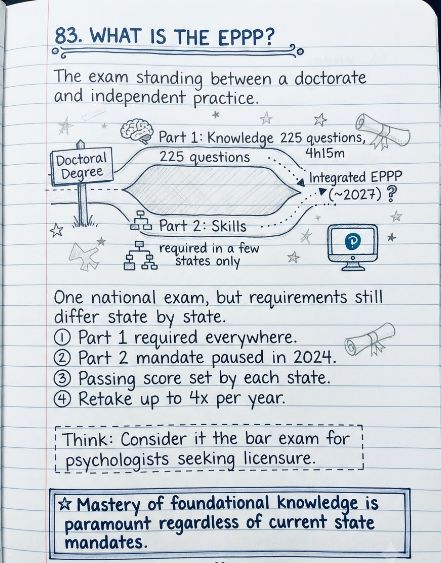
EPPP Part 1, officially the Knowledge exam, is required in every jurisdiction that uses the EPPP and has been the core of the exam since long before the current two-part structure existed.
| Detail | Specification |
|---|---|
| Total questions | 225 multiple-choice questions |
| Scored vs. unscored | 175 scored questions; 50 unscored pretest questions used to evaluate items for future exam versions (you can't tell which is which) |
| Time limit | 4 hours 15 minutes |
| Testing format | Computer-based, at an official Pearson VUE testing center |
| Score range | 200–800 |
Part 1 covers eight broad content domains that map onto the core knowledge base of professional psychology: biological bases of behavior; cognitive-affective bases of behavior; social and cultural bases of behavior; growth and lifespan development; assessment and diagnosis; treatment, intervention, and prevention; research methods and statistics; and ethical, legal, and professional issues. Because the unscored pretest questions are mixed in without any indication of which is which, the practical approach is to treat every question on the exam as if it counts.
EPPP Part 2 (Skills): What It Tests, and Its Uncertain Rollout
EPPP Part 2, the Skills exam, was developed to test something Part 1 doesn't directly measure: how a candidate applies psychological knowledge to realistic, scenario-based professional decisions, rather than recalling facts and concepts. It uses a different question format than Part 1, including multiple-response questions, scenario-based case items, point-and-click questions, and drag-and-drop questions, and candidates must pass Part 1 before they're eligible to sit for Part 2.
The rollout of Part 2 has genuinely changed direction. It was first adopted by a handful of early-adopter jurisdictions starting in 2018, and in October 2022, ASPPB announced that all jurisdictions using the EPPP would be required to adopt both Part 1 and Part 2 by January 1, 2026. Then, in October 2024, ASPPB paused that mandate in response to feedback from professional, educational, and regulatory communities, and announced it was instead developing a single integrated exam that assesses both knowledge and skills together, rather than requiring two separate exam sittings.
Looking ahead, ASPPB has publicly discussed plans for a single, integrated EPPP exam — combining knowledge and skills assessment into one sitting, reportedly planned to run around five hours — with an anticipated operational target around the fourth quarter of 2027. Pricing for the integrated exam had not been finalized as of the most recent public updates. If your own licensure timeline extends into 2027 or beyond, it's worth checking your state board periodically for updates on this transition, since it will likely change both the format and the cost structure of the exam you ultimately sit for.
Eligibility and How to Register
- Complete your qualifying degree: most jurisdictions require a doctoral degree in psychology (PhD or PsyD) from an accredited program before you're eligible to apply, though a small number of jurisdictions allow candidates with a master's degree to sit for certain license types.
- Apply through your specific state or provincial licensing board first, not directly through ASPPB — the board reviews your application, transcripts, and credentials to confirm your eligibility for their jurisdiction.
- Once approved, the board registers you into the EPPP system, which creates your ASPPB account and sends you a confirmation email along with instructions for registering to test through Certemy, ASPPB's exam registration platform.
- Review and sign the Candidate Acknowledgement Statement, then submit your examination fees and the separate test center fee.
- Schedule your exam appointment at an official Pearson VUE testing center, choosing whichever location is most convenient — there are typically multiple testing centers available within most regions.
Exact eligibility timing (for example, whether you can apply before finishing all supervised hours, or only after full licensure requirements are met) varies by jurisdiction, so confirm the specific sequence with your own state or provincial board rather than assuming another jurisdiction's process applies to you.
How Much the EPPP Costs
| Fee | Approximate Amount |
|---|---|
| EPPP Part 1 (Knowledge) exam fee | $600 |
| EPPP Part 2 (Skills) exam fee | $450, where required by your jurisdiction |
| Pearson VUE test center fee | Approximately $91.88, charged in addition to the exam fee |
| State/provincial board application and licensing fees | Varies by jurisdiction — confirm directly with your specific board |
Beyond the exam and test center fees, most candidates also budget for study materials or a structured prep course, which is a separate, optional cost not charged by ASPPB or Pearson VUE. Total out-of-pocket cost for the exam process itself commonly runs into four figures once test center fees, exam fees, and any applicable state board fees are combined — confirm exact, current figures directly with ASPPB and your licensing board before budgeting, since fees are subject to periodic change.
Passing Score: What You Actually Need
EPPP scores are reported on a scale of 200 to 800. Rather than ASPPB itself declaring a single national pass/fail cutoff, each licensing jurisdiction sets its own required passing score, which is why you'll sometimes see different numbers cited depending on the source.
- 500 is the most commonly cited recommended passing score for candidates seeking to practice independently, and is treated as a general benchmark across many jurisdictions for Part 1.
- 450 is commonly cited as the recommended passing score in jurisdictions or license categories involving supervised, rather than fully independent, practice.
- For Part 2 (Skills), where it applies, 500 is also commonly cited as the recommended passing score.
- Because each jurisdiction legally sets its own required score, always confirm the exact passing score your specific state or provincial board requires, rather than assuming a commonly cited number applies universally.
How Many Times You Can Retake the EPPP
ASPPB's general policy allows candidates to sit for the EPPP up to four times within any 12-month period, though individual jurisdictions may apply their own, sometimes more restrictive, retake rules on top of that baseline. ASPPB recommends waiting at least two months between attempts, to allow enough time for meaningful additional preparation rather than retesting on largely the same level of readiness.
Research cited by professional psychology publications has consistently found that candidates tend to score highest when they sit for the exam relatively soon after completing their doctoral training, rather than delaying significantly — since core content knowledge is freshest immediately after coursework and comprehensive exams. If your schedule allows, planning to sit for the EPPP soon after finishing your graduate training, rather than waiting an extended period afterward, is a pattern that's been repeatedly associated with stronger outcomes.
How to Prepare for the EPPP
- Start with a content review across all eight Part 1 domains, identifying which areas from your doctoral coursework feel weakest rather than reviewing everything with equal time and attention.
- Use full-length timed practice exams to build both content recall and the stamina needed for a 4-hour-15-minute testing session — pacing yourself across 225 questions is a skill in itself, separate from knowing the material.
- If your jurisdiction currently requires Part 2, seek out scenario-based and case-format practice questions specifically, since Part 2's question types (multiple-response, drag-and-drop, point-and-click) require different practice than Part 1's standard multiple-choice format.
- Review ASPPB's own official candidate resources, including the free EPPP Candidate Handbook and official sample exams, before relying heavily on third-party prep material, so you're anchored to accurate, current information about format and content.
- Confirm your specific jurisdiction's current requirements (Part 1 only, or Part 1 and Part 2) and required passing score directly with your state or provincial board before finalizing your study plan, given how much the two-part requirement has shifted since 2022.
Why Requirements Differ by State: The Key Caveat
Because ASPPB sets the exam itself but individual jurisdictions set the specific requirements around it, the EPPP genuinely works a little differently depending on where you're seeking licensure. Some jurisdictions currently require only Part 1. A small number currently require both Part 1 and Part 2. Passing scores, eligibility timing relative to supervised hours, and additional jurisdiction-specific exams (like a jurisprudence exam covering state-specific laws and regulations) all vary as well. Before finalizing your study plan or registration timeline, the single most reliable step is to check your specific state or provincial psychology board's current, official requirements directly, rather than relying on a general description of 'the EPPP process' that may not reflect your jurisdiction's actual rules.
Conclusion
The Professional Practice Examination — the EPPP — remains the central licensure hurdle for nearly every psychologist in the U.S. and Canada, but the exact shape of that hurdle has been genuinely in motion since ASPPB paused its planned nationwide two-part mandate in October 2024. Right now, in mid-2026, that means every candidate needs Part 1, a small number of specific jurisdictions still require Part 2, and a completely restructured, single integrated exam is being developed for a target of late 2027.
Given how much has shifted in just the past couple of years, the most useful thing you can do before building a study plan or budget isn't to memorize a fixed set of facts about the EPPP — it's to check your specific state or provincial board's current, official requirements directly, and revisit that check periodically as your own licensure timeline moves forward.
FAQ
Frequently Asked Questions
What is the Professional Practice Examination in psychology?+
It refers to the Examination for Professional Practice in Psychology (EPPP), the standardized licensure exam developed by the Association of State and Provincial Psychology Boards (ASPPB) and used by nearly every psychology licensing board across the U.S. and Canada as part of the path to independent practice.
Is EPPP Part 2 mandatory now?+
Not nationwide. ASPPB announced in October 2022 that Part 2 would become mandatory in every jurisdiction by January 1, 2026, but paused that mandate in October 2024 in favor of developing a single integrated exam instead. As of mid-2026, only a small number of jurisdictions — including the District of Columbia, Georgia, Guam, and Nevada — currently require both Part 1 and Part 2. Confirm your specific state or provincial board's current requirement directly.
How many questions are on the EPPP Part 1?+
225 multiple-choice questions total, of which 175 are scored and 50 are unscored pretest questions used to evaluate items for future exam versions. Candidates aren't told which questions are scored, so every question should be treated as if it counts. The time limit is 4 hours 15 minutes.
What is a passing score on the EPPP?+
Scores range from 200 to 800, and each licensing jurisdiction sets its own required passing score rather than ASPPB setting one universal cutoff. A score of 500 is commonly cited as the recommended benchmark for independent practice, and 450 is commonly cited for supervised practice roles, but always confirm the exact number your specific jurisdiction requires.
How much does the EPPP cost?+
EPPP Part 1 currently costs $600, and Part 2, where required, costs $450, both in addition to a separate Pearson VUE test center fee of approximately $91.88. Additional state or provincial board application and licensing fees apply on top of these exam-specific costs and vary by jurisdiction.
How many times can you retake the EPPP?+
ASPPB's general policy permits up to four attempts within any 12-month period, though individual jurisdictions may set additional or more restrictive retake rules. ASPPB recommends waiting at least two months between attempts to allow for meaningful additional preparation.
What degree do you need to sit for the EPPP?+
Most jurisdictions require a doctoral degree in psychology (PhD or PsyD) from an accredited program. A small number of jurisdictions allow candidates with a master's degree to sit for the exam for certain license categories. Check your specific state or provincial board's eligibility requirements directly, since this varies by jurisdiction.
Where do you take the EPPP?+
The EPPP is a computer-based exam administered at official Pearson VUE testing centers. Candidates schedule their appointment through ASPPB's Certemy registration platform after their state or provincial board confirms their eligibility and registers them into the EPPP system.
What's replacing the two-part EPPP structure?+
ASPPB is developing a single, integrated EPPP exam that combines knowledge and skills assessment into one exam sitting, reportedly planned to run around five hours, with an anticipated operational target around the fourth quarter of 2027. Final pricing and full rollout details had not been announced as of the most recent public updates, so candidates with a licensure timeline extending into 2027 or later should check their board periodically for updates.
Is the EPPP the same in every U.S. state and Canadian province?+
The exam content itself is standardized and shared across jurisdictions, but individual state and provincial boards set their own specific requirements around it — including whether Part 2 is currently required, the exact passing score, eligibility timing relative to supervised hours, and any additional jurisdiction-specific exams like a state jurisprudence test. Always confirm your specific jurisdiction's current requirements directly with its licensing board.