What Is a School Code? The Complete Guide to CEEB Codes for College Applications
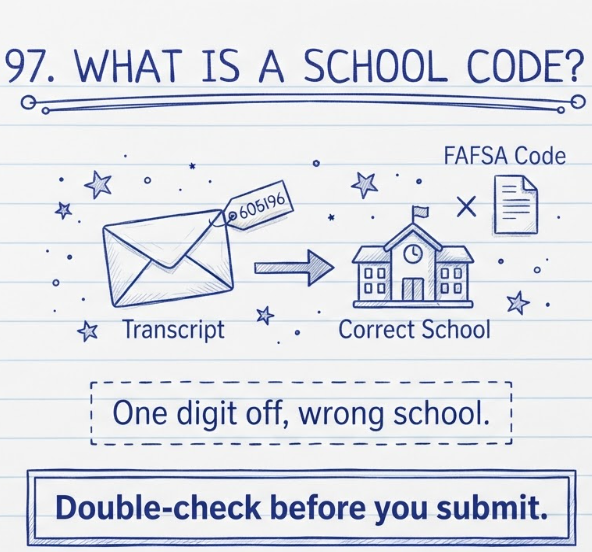
'What's my school code?' is one of the most commonly searched, and most commonly fumbled, questions in the entire college application process. In most contexts — the Common App, the SAT or ACT registration form, a direct college application — 'school code' refers to a CEEB code: a unique identification number the College Board assigns to high schools, colleges, universities, and testing centers, used to make sure your test scores, transcripts, and application materials all end up correctly matched to the right institution.
It sounds like a small, mechanical detail, and most of the time it is — until it's entered wrong, in which case it becomes the reason a transcript or score report goes to the wrong place, or an application gets flagged for manual review while admissions staff try to figure out which specific school you actually meant. This guide covers exactly what a CEEB/school code is, how to find your own school's code as a student, what to do if your school doesn't have one yet, the crucial difference between a CEEB code and a separate, similarly named FAFSA code, and the specific mistakes that most commonly cause delays.
What a School Code (CEEB Code) Actually Is
CEEB stands for College Entrance Examination Board — the College Board's former name — and a CEEB code is a unique identification number assigned to a specific institution: a high school, a college or university, a standardized testing center, or a scholarship program. High schools are generally assigned 6-digit codes, while colleges are typically assigned 4-digit codes. You may also hear it referred to as a College Board school code, or, in older references, an ATP code.
The code exists to solve a genuinely practical problem: there can be multiple schools with very similar or even identical names across different states and countries, and college admissions offices need a fast, unambiguous way to confirm that a transcript, score report, or application form is actually associated with the correct, specific institution rather than a same-named school somewhere else entirely.
Where You'll Actually Need Your School Code
- The Common Application: your high school's CEEB code allows the school to submit forms and documents, including your transcript and school report, on your behalf.
- SAT and PSAT registration: used to correctly route your score reports to the colleges and scholarship programs you designate.
- AP exam registration: helps ensure your AP scores are attributed to and sent from the correct school.
- Direct college applications: many colleges request your high school's CEEB code directly on their own application forms, separate from the Common App.
- Scholarship program applications: some scholarship programs also use CEEB codes as part of their own application and verification process.
How to Find Your High School's CEEB Code
- Ask your school counselor or administration office first — many schools provide the CEEB code directly to students, and your counselor's office is generally the fastest, most reliable source.
- Use the College Board's official K–12 School Code Search tool directly on the College Board website, searching by your school's name and location.
- Check materials you've already received from your school or district related to standardized testing, since the code is sometimes printed on registration materials or student information handouts.
- If you're searching for a college or university's code rather than your own high school's, the same K–12 School Code Search tool covers colleges and universities as well, alongside high schools.
What If Your School Doesn't Have a CEEB Code Yet?
This comes up most often for newer schools that haven't yet sent a graduating class through the college application process, or smaller and homeschool-adjacent programs that haven't previously needed one. In this situation, a school administrator or counselor — not an individual student — needs to formally request a code directly from the College Board.
- Log in or sign up for an account on the College Board's website as a school administrator or counselor.
- Submit a request through the College Board's official School Code Request Form.
- Decide between a Level 1 or Level 2 School Code before submitting the request: Level 1 School Codes allow a high school to receive score reports, while Level 2 School Codes allow a school to also administer College Board tests directly, such as the PSAT, SAT, or AP exams, on-site.
- Processing generally isn't instant, so schools anticipating their first graduating class heading into college applications should request a code well ahead of the application season, rather than waiting until students specifically need it.
CEEB Code vs. FAFSA Federal School Code: Don't Mix These Up
This is one of the single most common points of confusion, and it's worth being explicit about it: a CEEB code and a FAFSA Federal School Code are two completely different numbers, issued by two completely different organizations, used for two completely different purposes.
| CEEB Code | FAFSA Federal School Code | |
|---|---|---|
| Issued by | The College Board | The U.S. Department of Education |
| Used for | SAT, PSAT, AP registration; Common App; many direct college applications | Submitting the FAFSA (Free Application for Federal Student Aid) to specific colleges |
| Format | 4 digits (colleges) or 6 digits (high schools) | 6 characters, generally starting with a letter (often 'G' or 'B' or similar) followed by numbers |
| Where to find it | College Board's K–12 School Code Search tool | The U.S. Department of Education's official FAFSA school code search tool |
Common Mistakes to Avoid
- Leaving the field blank: some students skip the school code field entirely, assuming it's optional or that the school name alone is sufficient — this causes real processing delays, since admissions offices rely on the code for fast, unambiguous matching.
- Using an outdated code: if a school has undergone a name change, merger, or administrative restructuring, its CEEB code can change — always verify against a current, official source rather than an old document or an upperclassman's recollection.
- Confusing the CEEB code with the FAFSA Federal School Code: as covered above, these are different numbers for different purposes, and entering one where the other is required will cause processing issues.
- Entering a similar but incorrect code: since both high school and college codes are purely numeric, a single mistyped digit can misdirect materials to an entirely different, unrelated institution rather than triggering an obvious error.
- Assuming every institution automatically has a code: newer schools, some homeschool programs, and certain non-traditional educational settings may not have a CEEB code yet, and need to formally request one through a school administrator rather than assuming it already exists.
'School Code' Outside the U.S. College Admissions Context
Because 'school code' is a fairly generic phrase, it's also used to describe entirely different, unrelated identification systems in other contexts and countries. In India, for example, schools are commonly identified through a UDISE+ code (Unified District Information System for Education Plus), a government-issued identifier used for administrative and data-reporting purposes, entirely separate from the U.S.-specific CEEB system. If you've encountered 'school code' in a context outside U.S. college admissions or standardized testing, it's worth confirming which specific system is actually being referenced, since the term itself isn't tied to one single global standard.
Conclusion
A school code — more precisely, a CEEB code — is a small piece of application infrastructure that's easy to overlook until it causes a real problem: a misdirected transcript, a delayed score report, or an application flagged for manual review because two different institutions share a similar name. Finding it is usually straightforward, starting with your school counselor or the College Board's official K–12 School Code Search tool, and double-checking it against a current, official source takes only a moment compared to the delay a wrong digit can cause.
The one distinction genuinely worth remembering beyond that: your CEEB code and your school's FAFSA Federal School Code are not the same number, come from different organizations, and serve different purposes — mixing them up is one of the most avoidable, and most common, small errors in the entire college application process.
FAQ
Frequently Asked Questions
What is a school code?+
In the U.S. college admissions context, a school code most commonly refers to a CEEB code — a unique 4-to-6-digit identification number the College Board assigns to high schools, colleges, universities, and scholarship programs, used to correctly route transcripts, test scores, and application materials to the right institution.
How do I find my high school's CEEB code?+
Ask your school counselor or administration office first, since many schools provide this directly to students. You can also use the College Board's official K–12 School Code Search tool, searching by your school's name and location, or check any standardized testing materials your school has previously distributed.
Is a school code the same as a FAFSA code?+
No. A CEEB code (issued by the College Board) and a FAFSA Federal School Code (issued by the U.S. Department of Education) are two completely different numbers used for different purposes — CEEB codes are used for SAT/PSAT/AP registration, the Common App, and many direct college applications, while FAFSA codes are specifically used to submit federal financial aid applications to particular colleges.
What if my school doesn't have a CEEB code yet?+
A school administrator or counselor — not an individual student — needs to formally request one from the College Board through its official School Code Request Form, choosing between a Level 1 School Code (to receive score reports) or a Level 2 School Code (to also administer College Board tests on-site).
How many digits does a school code have?+
High schools are typically assigned 6-digit CEEB codes, while colleges and universities are typically assigned 4-digit CEEB codes.
What happens if I enter the wrong school code on an application?+
Entering an incorrect code can cause your transcript, test scores, or application materials to be misdirected to the wrong institution, or can delay processing while admissions staff manually resolve the discrepancy. Since codes are purely numeric, a single mistyped digit can send materials to an entirely different, unrelated school rather than producing an obvious error.
Do colleges have their own school codes too?+
Yes. Colleges and universities are also assigned CEEB codes (typically 4 digits), separate from high school codes (typically 6 digits), used for the same general purpose of correctly identifying the specific institution across applications and standardized testing.
Is CEEB code the same as ATP code?+
Yes, ATP code is an older, alternate term sometimes used to refer to the same CEEB code system, particularly in older reference materials.
Do I need my school code for the SAT and ACT?+
Yes. Your high school's CEEB code is used during SAT and PSAT registration to correctly identify your school and route score reports appropriately. The ACT uses a comparable school code system as well, so it's worth confirming the specific code format required for each exam you're registering for.
Is 'school code' used outside the U.S. college admissions context?+
Yes, though it refers to entirely different systems elsewhere. For example, schools in India are commonly identified through a UDISE+ code, a government-issued identifier used for administrative and data-reporting purposes, unrelated to the U.S.-specific CEEB system used in college admissions and standardized testing.