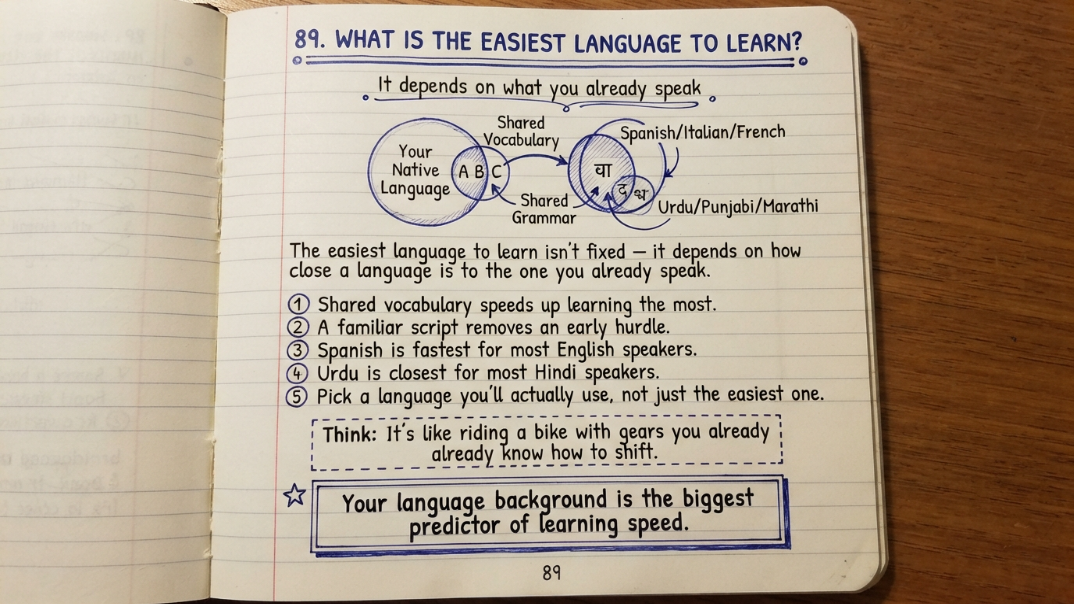
"What's the easiest language to learn?" doesn't have one universal answer — it has one answer per native language. A language is easy or hard almost entirely relative to what you already speak: shared vocabulary, similar grammar, and a familiar writing system can cut learning time by more than half, while a language with none of those overlaps can take years longer to reach the same level of comfort. The U.S. Foreign Service Institute has spent decades tracking roughly how long it takes English speakers to reach professional working proficiency in different languages, and similar patterns hold, informally, for speakers of Hindi and other Indian languages. This guide breaks down what actually makes a language easy to learn, ranks languages by difficulty for both English speakers and Indian-language speakers, and explains how to pick the right one for your goals.
What Actually Makes a Language 'Easy'
Language difficulty isn't a fixed property of a language itself — it's a measure of the distance between that language and the one you already speak fluently. A language becomes easier to learn when it shares vocabulary roots with your native language, uses a grammar structure that feels familiar (similar verb conjugation, word order, and sentence logic), and is written in a script you already recognize. The fewer of these overlaps exist, the more raw memorization and rewiring your brain has to do, regardless of how "objectively simple" a language's grammar might be on paper.
The FSI Difficulty Categories for English Speakers
The U.S. Foreign Service Institute, which trains American diplomats, has tracked for decades roughly how many classroom hours it takes an English speaker to reach professional working proficiency in various languages, sorting them into four broad categories.
| Category | Approx. Hours Needed | Example Languages |
|---|---|---|
| Category I | 600–750 hours | Spanish, French, Italian, Portuguese, Dutch |
| Category II | 900 hours | German, Indonesian, Swahili, Malay |
| Category III | 1,100 hours | Russian, Hindi, Greek, Vietnamese, Turkish |
| Category IV | 2,200 hours | Mandarin, Cantonese, Arabic, Japanese, Korean |
Easiest Languages for English Speakers (US Audience)
For native or fluent English speakers in the US, the easiest languages by a wide margin are those in Category I, largely because English shares a substantial amount of Latin- and French-derived vocabulary with Romance languages, along with a broadly similar sentence structure. Spanish is frequently the most practical choice on top of being one of the fastest to learn, given its widespread use across the United States in daily life, media, and the workplace. Among Category I languages, Spanish and Italian tend to have the most regular grammar for beginners, while French pronunciation and spelling add a bit more early friction despite the vocabulary overlap.
- Spanish — shared Latin vocabulary, phonetic spelling, widely spoken in the US
- Italian — highly regular grammar and pronunciation for beginners
- Portuguese — similar structure to Spanish with strong vocabulary overlap
- French — familiar vocabulary but trickier pronunciation and spelling rules
- Dutch — close grammatical relative of English with high vocabulary overlap
Easiest Languages for Hindi and Indian-Language Speakers
There's no official FSI-style ranking built specifically for Hindi or other Indian-language speakers, but the same underlying logic applies: languages that share vocabulary roots, grammar patterns, or script with your native language will be dramatically easier than ones that don't. For Hindi speakers specifically, Sanskrit-derived languages and neighboring Indo-Aryan languages (like Punjabi, Gujarati, Marathi, or Nepali) tend to be the fastest to pick up, since they share vocabulary, some grammatical structure, and, in several cases, a similar or related script. Urdu is a particularly close case, since it shares nearly identical spoken grammar and vocabulary with Hindi, differing mainly in script and some formal vocabulary. English, despite its global prevalence, is comparatively more work for Hindi speakers specifically because of very different grammar logic and a fully different (though widely taught) script.
- Urdu — nearly identical spoken grammar and vocabulary to Hindi, different script
- Punjabi, Gujarati, Marathi, Nepali — shared Indo-Aryan roots and grammar logic
- Sanskrit — shared vocabulary roots with Hindi, useful for classical or religious study
- Bengali, Odia — related Indo-Aryan structure with a different but learnable script
- Spanish/Portuguese — a common 'easiest foreign language' choice for career or travel goals
Why Script and Alphabet Matter So Much
Learning a new alphabet or writing system is often the single biggest early hurdle in a language, independent of how the grammar or vocabulary compares. English speakers learning Spanish, French, or Italian can start reading almost immediately since all three use the Latin alphabet with only minor additions. By contrast, a language like Japanese, Mandarin, Arabic, or Korean requires learning an entirely new writing system before basic reading becomes possible at all, which adds a meaningful delay even before grammar and vocabulary complexity come into play. This same principle applies for Hindi speakers: a language like Urdu, which is spoken almost identically to Hindi but written in a different (Perso-Arabic) script, still requires real effort specifically because of that script difference, even though the spoken language itself is nearly the same.
Grammar Complexity Compared
Beyond vocabulary and script, grammar systems vary widely in how much they diverge from what a learner already knows intuitively.
| Grammar Feature | Relatively Easy For | Relatively Hard For |
|---|---|---|
| Verb conjugation complexity | English speakers learning Spanish/Italian (regular patterns) | English speakers learning Russian (case system) |
| Gendered nouns | Hindi speakers (Hindi has gendered nouns too) | English speakers (English has no noun gender) |
| Tonal pronunciation | Speakers of tonal Indian languages, in some cases | Most English and Hindi speakers learning Mandarin |
| Word order flexibility | Hindi speakers learning other SOV languages | English speakers learning free word-order languages |
Easiest Language by Goal, Not Just Difficulty
The technically "easiest" language on paper isn't always the most useful choice, and picking based on a clear personal goal usually leads to more sustained motivation than picking based on difficulty rankings alone.
- For career mobility in the US — Spanish is both relatively easy and widely useful across most industries and regions
- For studying or working abroad from India — Spanish, French, or German are common practical choices depending on the target country
- For connecting with family or community — a related regional Indian language is often more valuable than an 'easier' foreign one
- For travel — a language spoken widely across multiple countries (Spanish, French) offers more return on the same learning investment
- For personal interest or culture — difficulty matters less than sustained motivation, so pick what you'll actually stick with
How to Choose the Right Language for You
The most reliable way to choose isn't simply picking the top of a difficulty list — it's matching a language's difficulty against your actual motivation and use case. A moderately harder language you're genuinely excited to learn will usually get you further than an "easy" language you have no real reason to use. Before committing, it's worth honestly weighing how much daily exposure you'll realistically get (a language spoken in your community or workplace is easier to reinforce than one you'll only study in isolation), how specific your goal is (a test score, a trip, a job requirement), and whether the script and grammar distance from your native language matches the time you're actually willing to invest.
FAQs
What is the easiest language for English speakers to learn?
According to the U.S. Foreign Service Institute's Category I classification, Spanish, French, Italian, Portuguese, and Dutch are generally the easiest for English speakers, largely due to shared vocabulary, familiar grammar patterns, and use of the Latin alphabet.
What is the easiest language for Hindi speakers to learn?
Urdu is often considered the easiest, since it shares nearly identical spoken grammar and vocabulary with Hindi, differing mainly in script. Other Indo-Aryan languages like Punjabi, Gujarati, and Marathi are also relatively easy due to shared grammatical roots.
Is Spanish easier than French to learn?
For most English speakers, yes — Spanish generally has more phonetic, predictable spelling and pronunciation than French, even though both share a similar level of vocabulary overlap and grammatical complexity with English.
Why is learning a new script harder than learning new grammar?
A new writing system blocks even basic reading until it's learned, adding an early hurdle before grammar or vocabulary complexity comes into play, whereas a familiar script lets a learner start reading and recognizing words almost immediately.
Should I pick the easiest language or the most useful one?
It depends on your goal — a moderately harder language that's directly useful for your career, community, or personal motivation will usually get you further than an easier language with no real reason to use it regularly.
How long does it take an English speaker to learn Spanish?
The Foreign Service Institute estimates roughly 600 to 750 classroom hours for an English speaker to reach professional working proficiency in Spanish, making it one of the fastest languages to learn for native English speakers.