"Fast" is a relative word when it comes to language learning — nobody goes from zero to fluent in a month, but the difference between a focused, well-structured approach and an unstructured one is often the difference between real progress in three months and years of stalled effort. Whether you're an immigrant or international student learning English in the United States, or a student or working professional in India improving English for school, exams, or career growth, the underlying principles are the same: consistent daily exposure, a mix of input and output practice, and a way to track whether you're actually improving. This guide lays out a practical, research-informed plan for learning English quickly, with specific resources and timelines relevant to both US-based and Indian learners.
Why 'Fast' Still Requires a Realistic Timeline
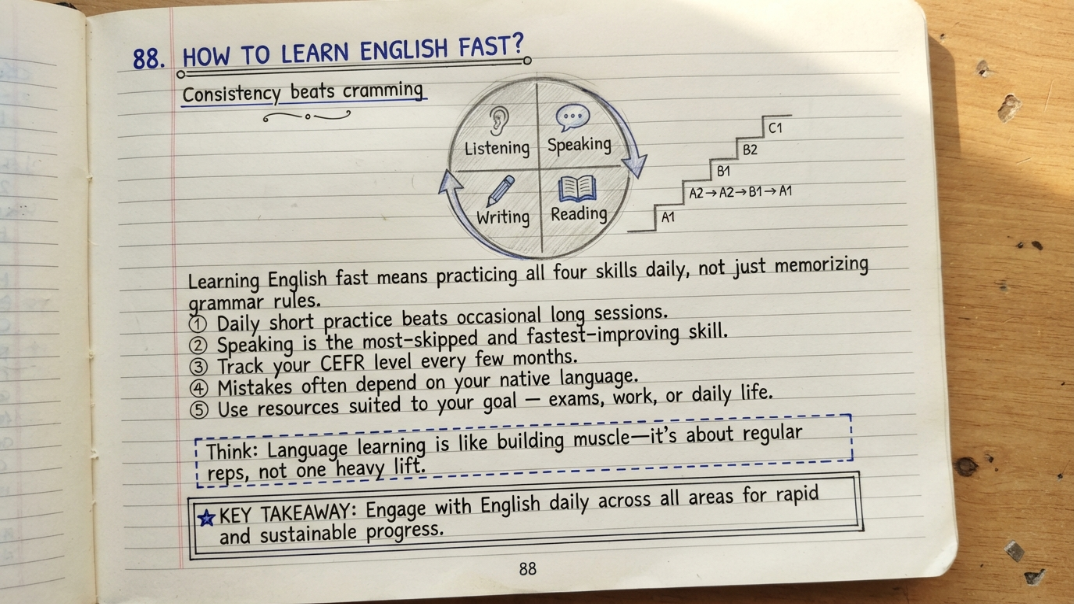
Most people who fail to learn English quickly aren't lacking effort — they're working from unrealistic expectations that lead to giving up too early. The good news is that focused, consistent practice compresses the timeline dramatically compared to occasional, unstructured study. A learner who studies with intent for 45–60 minutes a day, mixing listening, speaking, reading, and writing, will typically outpace a learner who studies for three hours once a week, even though total weekly time might be similar. Speed comes from consistency and the right mix of practice, not from cramming.
The Four Skills You Need to Practice Together
English learning breaks down into four core skills, and progress stalls when a learner focuses heavily on one while neglecting the others — a common pattern for both US-based and Indian learners who often over-invest in reading and grammar while avoiding speaking.
- Listening — understanding spoken English at natural speed and in different accents
- Speaking — producing spoken English fluently, even with imperfect grammar
- Reading — understanding written English across different formats and difficulty levels
- Writing — producing clear written English for both casual and formal contexts
English Proficiency Levels Explained
Most structured English courses and exams — including IELTS and TOEFL, both commonly used by Indian students applying abroad — are built around the CEFR (Common European Framework of Reference) scale, which breaks proficiency into six levels. Knowing where you currently sit helps set a realistic, specific goal instead of the vague target of "getting better."
| Level | Description | Typical Learner |
|---|---|---|
| A1 | Basic phrases, simple everyday expressions | Absolute beginner |
| A2 | Simple conversations on familiar topics | Elementary learner |
| B1 | Can handle most everyday situations independently | Intermediate learner |
| B2 | Comfortable in most professional and social settings | Upper-intermediate learner |
| C1 | Fluent, flexible use in complex situations | Advanced learner |
| C2 | Near-native command of the language | Mastery level |
Realistic Timeline to Fluency
The U.S. Foreign Service Institute and similar language-training research groups have long tracked roughly how many hours of focused study it typically takes to move between proficiency levels, though individual results vary based on prior language exposure, native language, and study intensity.
| Starting Point | Target Level | Approx. Study Hours | At 1 Hour/Day |
|---|---|---|---|
| A1 (Beginner) | A2 | 100–150 hours | 3–5 months |
| A2 | B1 | 150–200 hours | 5–7 months |
| B1 | B2 | 200–250 hours | 7–8 months |
| B2 | C1 | 250–300+ hours | 8–10 months |
A Weekly Practice Plan That Works
A balanced weekly plan matters more than any single app or course. The structure below assumes roughly 45–60 minutes a day and spreads practice across all four skills rather than concentrating on just one.
| Day | Focus | Activity Example |
|---|---|---|
| Monday | Listening | Podcast or short video with subtitles, then without |
| Tuesday | Speaking | Shadowing practice or a conversation exchange session |
| Wednesday | Vocabulary + Reading | Read a short article, log 10 new words with example sentences |
| Thursday | Grammar in context | Review one grammar point through example sentences, not isolated rules |
| Friday | Writing | Write a short paragraph using that week's new vocabulary |
| Saturday | Speaking | Longer conversation practice, in person or via a language app |
| Sunday | Review | Revisit the week's vocabulary and mistakes, light and low-pressure |
Best Resources for US-Based Learners
For immigrants, international students, and adult learners based in the United States, several free or low-cost programs are specifically designed for real-world English acquisition alongside daily life in an English-speaking environment.
- Local library ESL (English as a Second Language) classes — often free and available in most major cities
- USCIS-recommended citizenship and English resources for immigrants preparing for naturalization
- Community college adult education ESL programs, frequently low-cost or free for residents
- Conversation exchange meetups (in person or via apps) for real speaking practice with native speakers
- Closed-captioned US television and podcasts for natural listening practice in everyday accents
Best Resources for Indian Learners
For students and professionals in India, English learning goals often center on academic exams, competitive job interviews, or improving workplace communication, which shifts which resources are most useful.
- British Council India — offers structured courses and free resources aligned to CEFR levels
- IELTS/TOEFL-focused prep resources for students planning to study abroad
- English news channels and newspapers for reading and listening practice in a formal register
- Spoken English classes or coaching centers focused specifically on speaking confidence, not just grammar
- YouTube channels and apps focused on Indian-English learner needs, including common Hindi-to-English translation pitfalls
Common Mistakes by Native Language Background
Certain English mistakes are more common depending on a learner's native language, since grammar structures, sounds, and sentence patterns that don't exist in the native language are the hardest to internalize.
| Native Language Background | Common Challenge Areas | Why It Happens |
|---|---|---|
| Hindi and other Indic languages | Article usage (a/an/the), verb tense consistency | Many Indic languages don't use articles the same way English does |
| Spanish (common among US learners) | Word order, false cognates, gendered noun habits | Spanish sentence structure and vocabulary overlap create both shortcuts and traps |
| Mandarin and other tonal languages | Verb tense markers, plural forms | Tense and plurality are expressed differently or not at all in the native language |
| Arabic | Vowel sounds, sentence connectors | Different phonetic system and more flexible sentence linking in Arabic |
Speaking Practice: The Skill Most People Skip
Both US-based and Indian learners consistently over-invest in grammar study and under-invest in speaking, largely because speaking feels riskier and more uncomfortable than quiet, private study. But speaking is also the skill that improves fastest with direct practice and slowest with passive study alone. Shadowing (repeating audio immediately after hearing it, matching rhythm and pronunciation), regular low-stakes conversation practice, and recording yourself speaking to track pronunciation changes over time are three of the highest-leverage activities for building speaking fluency specifically, rather than just passive comprehension.
How to Track Your Progress
Vague progress ("I feel like I'm getting better") is hard to sustain motivation around, since real gains often happen too gradually to notice day to day. Concrete tracking methods keep motivation higher and make it easier to spot which skill needs more attention.
- Take a free CEFR-aligned placement test every 8–10 weeks to track level progress objectively
- Keep a running vocabulary log and review it weekly rather than only adding new words
- Record a one-minute spoken response to the same prompt every month and compare recordings over time
- Track weekly practice hours across all four skills to spot an imbalance early
- Set a specific short-term goal (a test score, a comfortable phone call, a presentation) rather than a vague fluency target
FAQs
What is the fastest way to learn English?
Consistent daily practice — roughly 45 to 60 minutes a day mixing listening, speaking, reading, and writing — produces faster results than occasional long study sessions, since language skills build through repeated, spaced exposure rather than cramming.
How long does it take to become fluent in English?
It depends on your starting point, but research from language-training programs suggests roughly 150 to 300+ hours of focused study to move up one CEFR level, which typically translates to several months to about a year per level at one hour of daily practice.
What resources are best for learning English in the US?
Local library ESL classes, community college adult education programs, and conversation exchange meetups are widely available, often free, and specifically designed for real-world English use alongside daily life in the United States.
What resources are best for learning English in India?
British Council India courses, IELTS/TOEFL-focused prep resources, English news media, and spoken English coaching centers are commonly used, particularly for students preparing for exams or professionals working on workplace communication.
Why is speaking harder to improve than reading or grammar?
Speaking requires real-time production under social pressure, which most learners avoid in favor of quieter, lower-stakes activities like reading or grammar drills — but it's also the skill that improves fastest with direct, regular practice.
What mistakes are common for Hindi-speaking English learners specifically?
Article usage (a/an/the) and verb tense consistency are common challenge areas for Hindi and other Indic-language speakers, since many of those languages structure articles and tense differently than English does.