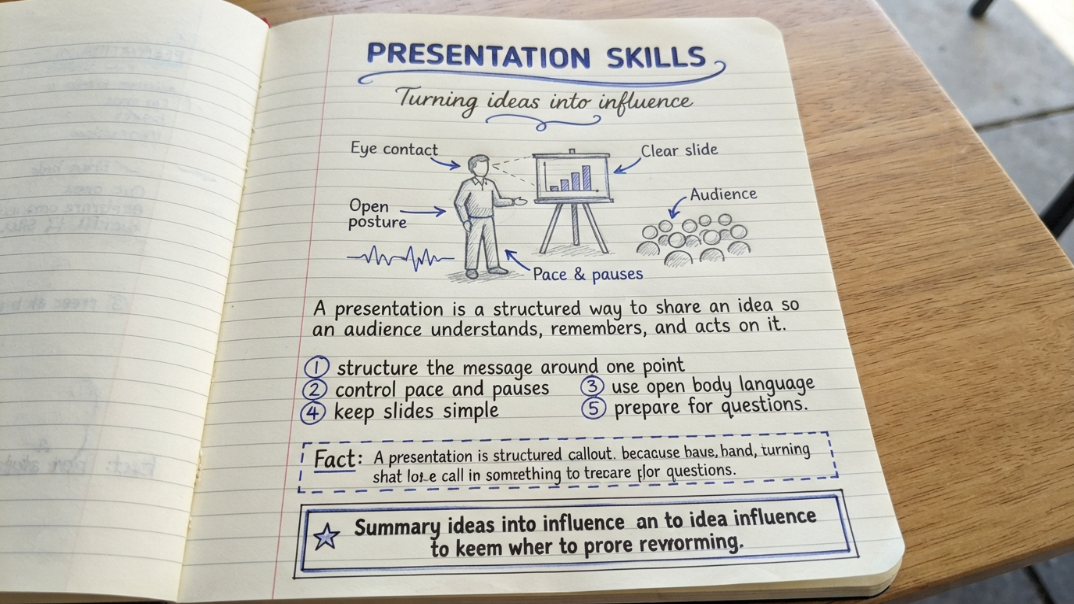
Surveys of hiring managers and executives consistently rank communication and presentation ability among the top skills separating people who advance into leadership from those who plateau — often ahead of technical expertise. Yet most professionals never receive formal training in it; they absorb bad habits from bad meetings and repeat them for a decade. Presentation skills are learnable in the same way writing or negotiation are learnable: through structure, deliberate practice, and honest feedback rather than natural talent. This guide breaks down exactly which skills make a presentation land, why each one matters, and how to start building them.
What Are Presentation Skills
Presentation skills are the practical abilities needed to organize information and deliver it in a way that a specific audience can understand, remember, and act on — distinct from simply knowing the material. A brilliant analyst who mumbles through a wall of text on a slide has a presentation skills gap, not a knowledge gap. These skills span several domains — structural, vocal, physical, visual, and psychological — and like most practical skills, they're built far more through repetition and feedback than through reading about them.
Why Presentation Skills Matter More Than the Content
Most first-time presenters overinvest in cramming in more information and underinvest in how that information will be received. But what actually determines whether a presentation succeeds is rarely the depth of the content — it's whether the audience can follow the structure, stays engaged long enough to absorb the point, and remembers the one thing you needed them to remember. A mediocre idea delivered with a clear structure and confident delivery routinely outperforms a brilliant idea buried in dense slides and a flat voice — which is why skill-building deserves at least as much attention as the research behind the talk.
Core Presentation Skills
The skills below show up, in some form, in nearly every strong presenter's toolkit and nearly every weak presentation's post-mortem. They aren't ranked by importance since the right mix depends on context — a boardroom pitch needs different emphasis than a conference keynote — but all six are relevant to almost any presentation setting.
- Structuring a message — organizing content around one clear point instead of everything you know
- Vocal delivery and pacing — using pace, pause, and tone instead of a flat monotone read-through
- Body language and stage presence — posture, eye contact, and movement that project confidence
- Visual design and slide discipline — slides that support the spoken word instead of competing with it
- Storytelling and persuasion — making the message memorable and emotionally resonant, not just accurate
- Handling questions and pushback — staying composed and credible when the plan gets interrupted
Structuring a Message
More presentations fail from disorganization than from weak content. Structuring a message doesn't mean outlining every fact you know — it means deciding on the single takeaway you need the audience to leave with, and building everything else around supporting it. A reliable default is a three-part shape: open with why this matters to the audience specifically, walk through the two or three points that prove your case, and close by restating the one action or conclusion you want remembered. Presenters who skip this step and organize by 'everything I researched, in the order I researched it' consistently lose their audience halfway through, no matter how strong the underlying material is.
Vocal Delivery and Pacing
Almost every inexperienced presenter speaks faster and flatter under pressure than they realize, which is the single fastest way to lose an audience's attention. The skill isn't about having a naturally commanding voice; it's about deliberately varying pace to signal importance, pausing after a key point instead of rushing past it, and letting your natural vocal range come through instead of flattening it out of nervousness. Presenters who record themselves and listen back are almost always surprised by how much faster and more monotone they sound than they felt in the moment, which is exactly why that feedback loop matters.
Body Language and Stage Presence
An audience reads confidence from the body well before it processes the words. What separates presenters who command a room from presenters who don't is less about being a naturally commanding personality and more about a practiced set of physical habits: standing with weight balanced instead of shifting, making eye contact with individuals across the room rather than scanning over everyone's heads, and using deliberate hand gestures instead of pockets, podiums, or crossed arms as a shield. This is also one of the most vulnerable parts of presenting in front of others, and presenters who rehearse standing up and moving through the space, rather than only rehearsing seated at a desk, tend to feel steadier when it's time to actually deliver.
Visual Design and Slide Discipline
Slides are supposed to be decided without much deliberation, but bad slide habits sabotage more good presentations than any other single factor. The skill here is discipline: one idea per slide, minimal text since the audience can't read and listen at the same time, and visuals (a chart, a photo, a diagram) that do work the words can't do as efficiently. A useful rule is to design slides so they make sense to someone glancing at them for three seconds — if a slide requires the audience to read a paragraph to understand it, the slide has become the presentation instead of supporting it.
Storytelling and Persuasion
Data convinces people intellectually; stories convince people emotionally, and people mostly act on the emotional conviction. Building this skill means anchoring abstract points in a specific example, a real customer, or a concrete before-and-after, rather than staying in the world of aggregates and averages the whole time. Persuasion also depends on genuinely understanding what the specific audience cares about and framing the message around that, rather than delivering the same pitch regardless of who's in the room. Presenters who lead with a relevant story before the data consistently hold attention longer than presenters who open with statistics.
Handling Questions and Pushback
The prepared portion of a presentation is often the easy part; the unscripted question-and-answer segment is where credibility is actually won or lost. Handling it well means restating a question before answering it to make sure you understood it, admitting directly when you don't know something instead of improvising an unconvincing answer, and staying calm when a question is genuinely hostile rather than getting defensive. This is consistently one of the hardest transitions for presenters who are comfortable with a scripted talk but haven't practiced thinking on their feet in front of an audience.
Managing Nerves and Anxiety
Nearly everyone experiences some form of anxiety before presenting — surveys of public speaking anxiety consistently place it among people's most commonly reported fears, ahead of many things people consider objectively more dangerous. Managing that anxiety is a skill in its own right: reframing physical arousal (a racing heart, sweaty palms) as excitement rather than danger, preparing enough that the opening minute is close to memorized so early nerves don't derail the whole talk, and building exposure gradually through smaller, lower-stakes audiences before a high-stakes one. Presenters who treat nerves as something to eliminate entirely tend to struggle more than presenters who accept some nervous energy as normal and learn to perform through it.
Presentation Skills by Setting
Not every skill matters equally in every setting — trying to prepare the same way for a keynote and a one-on-one pitch is a common way presenters over- or under-prepare.
| Setting | Priority Skills | Why |
|---|---|---|
| Small Meeting / Pitch | Structuring a message, handling questions | Interruption is constant and the format is closer to conversation |
| Team Presentation | Visual design, pacing | Audience attention is easily lost to email and side conversations |
| Conference / Keynote | Storytelling, stage presence | A larger, unfamiliar audience needs to be won over quickly |
| Executive Briefing | Structuring a message, composure under pushback | Senior audiences interrupt early and expect the conclusion up front |
How to Build Presentation Skills Without a Public Speaking Class
Most working presentation skill doesn't come from a formal course — it comes from structured, low-stakes practice before the stakes are high.
- Record yourself presenting on your phone and watch it back, muting the audio once to check body language alone
- Join a local Toastmasters chapter or similar practice group for regular, low-pressure repetitions
- Volunteer to present in smaller internal meetings before taking on a high-stakes external one
- Rewrite one dense, text-heavy slide into a single clear idea as a standing habit before every talk
- Ask a colleague to interrupt you with hard questions mid-rehearsal to practice staying composed
Common Mistakes First-Time Presenters Make
A few patterns show up again and again in presentations that lose their audience.
- Reading directly off slides instead of speaking to the audience, which disengages the room instantly
- Cramming too much text and data onto each slide out of fear of leaving something out
- Speaking faster and softer than intended due to nerves, without noticing it in the moment
- Treating the Q&A as an afterthought instead of rehearsing likely questions in advance
- Apologizing repeatedly for nerves or mistakes, which draws more attention to them than letting them pass
Resources for Improving Presentation Skills
Several accessible resources are specifically built to help people develop these skills without an expensive course. Toastmasters International is a widely available, low-cost club network built entirely around structured public speaking practice and peer feedback. Many employers offer internal communication or leadership training that includes presentation coaching, often underused simply because employees don't ask about it. University career centers, even for non-students, sometimes host public workshops on presentation and communication skills. For self-directed practice, recording and reviewing your own talks remains one of the most effective and completely free tools available.
Future of Presentation Skills
As AI tools take over more of the mechanical work — generating slide drafts, cleaning up data visuals, even producing a first-pass script — the presentation skills that matter most are shifting away from slide production and toward judgment: knowing what to leave out, reading a room in real time, and adapting a message on the fly for the specific people in front of you. The presenters who thrive over the next several years will likely be the ones who treat AI as a tool for the mechanical work, freeing up more time to practice the human parts of delivery that a generated slide deck can't replace.
FAQs
What are the most important presentation skills for a beginner?
Structuring a message and managing basic vocal pacing tend to matter most early on, since a disorganized talk delivered too fast is the fastest way to lose an audience. Body language and Q&A handling become more important once the basics are solid.
Can presentation skills be learned, or do you need to be a naturally confident speaker?
They're learnable. Most strong presenters built these skills through repeated practice, recorded feedback, and low-stakes rehearsal rather than natural charisma — the same way you'd build any practical skill.
Do I need to take a public speaking class to get better at presenting?
No. A class can help with structured feedback, but most of the specific skills presenting requires — pacing, structure, composure under questions — are built through direct practice, recording yourself, and low-cost peer groups like Toastmasters, not classroom instruction alone.
Why do I speak faster when I'm nervous during a presentation?
Nervousness triggers a physical stress response that tends to compress speech and breathing without the speaker noticing in the moment. Deliberately building pauses into a rehearsed structure is the most reliable way to counteract it.
What's the fastest way to start building presentation skills?
Start small and low-stakes: record yourself giving a short talk on your phone and watch it back, and volunteer for lower-pressure internal presentations before a high-stakes one.
Which presentation skill do most first-time presenters lack?
Structuring a message around a single clear takeaway and handling live questions with composure are the two most commonly underdeveloped skills, since neither is typically taught or practiced before someone is asked to present.