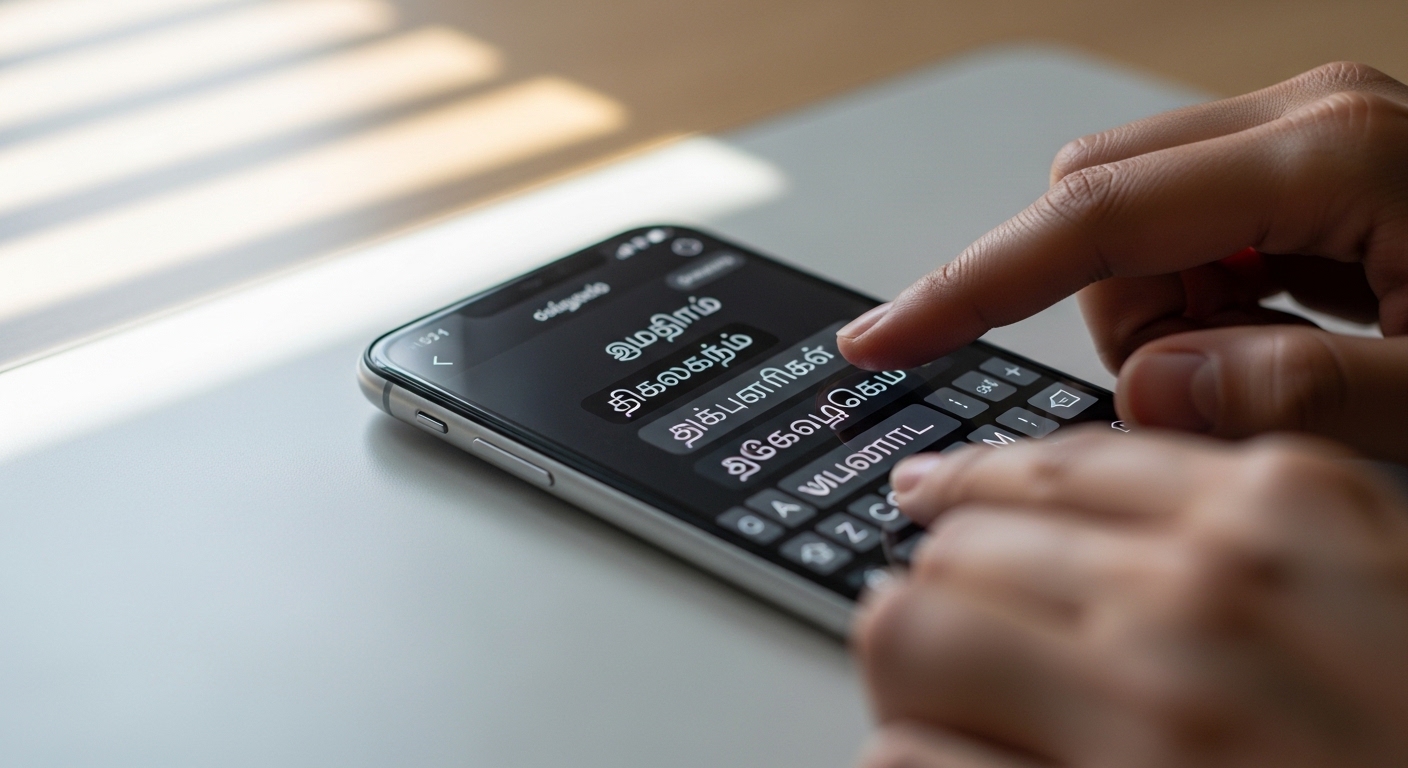
Thanglish to Tamil conversion refers to the process of converting Tamil words typed in English letters into proper Tamil script (தமிழ் எழுத்து). Thanglish is an informal way of writing Tamil using the Latin alphabet, commonly used in texting, social media, chat applications, and online comments. For example, a user may type 'vanakkam' in English letters, which represents the Tamil word 'வணக்கம்'. Converting Thanglish to Tamil ensures correct spelling, professional presentation, and proper readability in official documents, educational materials, blogs, and digital communication. In 2026, Thanglish to Tamil conversion tools are widely used by students, content creators, journalists, bloggers, and businesses. This comprehensive guide explains transliteration methods, keyboard options, mobile apps, grammar considerations, accuracy issues, and best practices for effective Tamil typing.
What Is Thanglish
Thanglish is a blend of the words 'Tamil' and 'English'. It refers to Tamil language written using English alphabets instead of Tamil script. It became popular due to the widespread use of English keyboards on computers and smartphones. Examples of Thanglish: - 'nan ungalai nesikkiren' → நான் உங்களை நேசிக்கிறேன் - 'eppadi irukeenga' → எப்படி இருக்கீங்க Thanglish is informal and not standardized. The same Tamil word may be written differently by different users.
Difference Between Translation and Transliteration
| Aspect | Transliteration | Translation |
|---|---|---|
| Meaning | Converts script only | Converts language meaning |
| Example | vanakkam → வணக்கம் | Hello → வணக்கம் |
| Purpose | Typing convenience | Language conversion |
| Usage | Tamil typing tools | Bilingual communication |
How Thanglish to Tamil Conversion Works
Thanglish to Tamil conversion uses phonetic mapping algorithms. The system analyzes English letters and predicts the closest Tamil script equivalent. For example, 'amma' is converted to 'அம்மா'. These tools rely on predefined phonetic dictionaries and predictive text models. Advanced tools use AI-based language models to improve accuracy.
Manual vs Automatic Conversion
| Method | Advantages | Limitations |
|---|---|---|
| Manual Typing (Tamil Keyboard) | Higher accuracy | Requires keyboard knowledge |
| Online Transliteration Tools | Easy and fast | May misinterpret words |
| Mobile Keyboard Apps | Convenient for chatting | Depends on prediction quality |
Popular Thanglish to Tamil Tools
Several online platforms provide Thanglish to Tamil transliteration services. Google Input Tools and built-in Tamil keyboard options in Android and iOS devices are widely used. These tools allow users to type Tamil phonetically using English letters. Users should verify spelling manually for official documents.
Tamil Keyboard Layout Options
| Keyboard Type | Description | Best For |
|---|---|---|
| Tamil99 | Government standardized layout | Formal typing |
| Phonetic Keyboard | Type Tamil using English sound | Beginners |
| Inscript Keyboard | Standard Indian layout | Professional use |
Accuracy Challenges in Thanglish Conversion
Thanglish has no fixed spelling rules. For example, 'paal' and 'pal' may represent different Tamil words. Homophones create confusion in automatic tools. Long vowels and short vowels must be typed carefully. Context-based prediction improves accuracy but is not perfect.
Common Spelling Mistakes
Incorrect vowel length (aa vs a). Missing double consonants (amma vs ama). Wrong retroflex and dental sounds. Ignoring Tamil grammar agreement.
Use Cases for Thanglish to Tamil Conversion
Social media posts in Tamil script. School and college assignments. Blog writing and content creation. Official communication in Tamil. Subtitles and media captions.
Comparison of Conversion Methods
| Criteria | Online Tool | Mobile App | Manual Keyboard |
|---|---|---|---|
| Ease of Use | High | Very High | Medium |
| Accuracy | Medium | Medium to High | High |
| Learning Curve | Low | Low | Moderate |
| Speed | Fast | Very Fast | Moderate |
Best Practices for Accurate Tamil Typing
Use standardized phonetic spelling consistently. Double-check converted text before publishing. Learn basic Tamil keyboard layout for professional typing. Avoid mixing English and Tamil in formal documents. Practice regularly to improve speed and accuracy.
Future of Tamil Digital Input
AI-powered transliteration systems are improving accuracy. Voice-to-text Tamil input is becoming more reliable. Machine learning models are enhancing contextual prediction. Tamil digital literacy continues to grow globally.
FAQs
What is Thanglish to Tamil conversion?
It is the process of converting Tamil words written in English letters into proper Tamil script.
Is Thanglish a real language?
No. Thanglish is an informal way of writing Tamil using English alphabets.
Which is the best Thanglish to Tamil tool?
Phonetic input tools like Google Input Tools and built-in Tamil keyboards are commonly used.
Is transliteration the same as translation?
No. Transliteration converts script, while translation converts meaning.
Why does automatic conversion sometimes give wrong words?
Because Thanglish has no fixed spelling and context prediction may misinterpret input.
Is Tamil99 keyboard better?
Tamil99 is standardized and suitable for formal typing.
Can I use Thanglish in exams?
No. Exams require proper Tamil script writing.
Are mobile Tamil keyboards accurate?
They are convenient but should be proofread for accuracy.
How to improve Tamil typing speed?
Practice regularly and learn keyboard layout shortcuts.
Is voice typing available in Tamil?
Yes. Many devices support Tamil voice-to-text input.