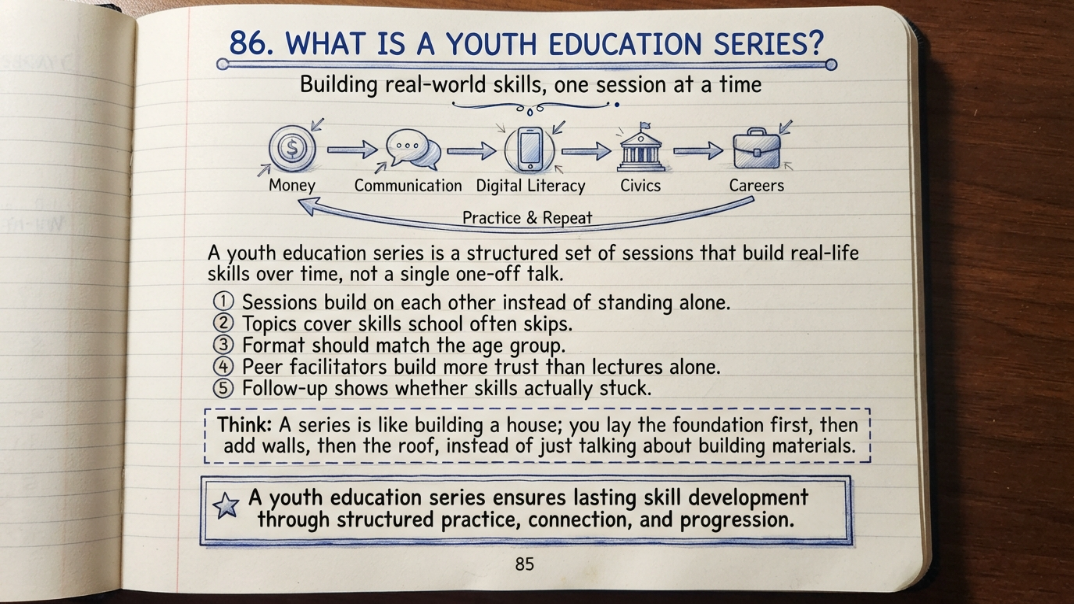
Most school curricula are built around academic standards, which leaves a real gap for the practical, life, and civic skills young people also need but rarely get taught directly — how to manage money, how to speak in public, how to think critically about media, how their community and government actually work. A youth education series is a deliberate attempt to close that gap: a structured, multi-session program, usually run outside or alongside formal schooling, that builds specific skills over time rather than in a single one-off workshop. Done well, these series can meaningfully shape how prepared young people feel for adulthood; done poorly, they turn into a string of disconnected guest speakers nobody remembers. This guide breaks down what makes a youth education series actually work, from topic selection to session structure to measuring real impact.
What Is a Youth Education Series
A youth education series is a structured, multi-session program aimed at building specific practical, life, or civic skills in young people, typically delivered outside the standard academic curriculum. Unlike a single guest lecture or a one-time assembly, a series is built around a sequence — each session builds on the last, skills are practiced and revisited rather than mentioned once, and the program has a defined start, middle, and end. These series are run by schools, nonprofits, libraries, faith organizations, and community groups, and can range from a handful of sessions over a month to a full academic-year program.
Why Structured Series Work Better Than One-Off Workshops
A single workshop on financial literacy or public speaking can spark interest, but it rarely builds lasting skill, since real competence in most practical topics comes from repeated exposure and practice rather than a single explanation. A structured series solves this by returning to core skills across multiple sessions, letting participants apply what they learned in one session before the next one builds on it. Organizers who run isolated one-off events often see high attendance and positive feedback in the moment but little measurable change in behavior afterward — the structure of a series is what turns exposure into actual skill-building.
Core Topics a Youth Education Series Should Cover
While every series should be tailored to its specific audience and community, a few topic areas consistently show up as high-value additions to what traditional schooling already covers.
- Financial literacy — budgeting, saving, credit, and understanding basic financial decisions
- Communication and public speaking — expressing ideas clearly and confidently in front of others
- Digital and media literacy — evaluating information sources and understanding online safety
- Civic engagement — how local and national government works and how to participate in it
- Career and workplace readiness — resumes, interviews, and professional communication basics
- Emotional and social skills — conflict resolution, stress management, and healthy relationships
Designing Sessions by Age Group
A youth education series aimed at 10-year-olds and one aimed at 17-year-olds need fundamentally different formats, even when covering related topics. Younger participants generally respond best to shorter sessions, hands-on activities, and concrete examples rather than abstract discussion, while older teens can handle longer discussion-based formats, more independent project work, and topics that engage directly with real-world complexity and nuance. Mixing age groups in the same session without adjusting the format is one of the most common reasons a series underperforms — content that lands well with young teens often feels condescending to older ones, and vice versa.
Choosing the Right Format
Not every topic in a youth education series should be delivered the same way, and matching the format to the goal makes a meaningful difference in how much sticks.
| Format | Best For | Limitation |
|---|---|---|
| Lecture / talk | Introducing new concepts quickly | Low retention without follow-up practice |
| Small-group discussion | Civic topics, values-based conversations | Requires a skilled facilitator to stay on track |
| Hands-on workshop | Practical skills like budgeting or resume-writing | Needs more prep time and materials |
| Project-based session | Applying multiple skills together over time | Longer time commitment per session |
Who Should Run the Sessions
The credibility and relatability of a facilitator matters as much as their expertise, especially with teenage participants who are quick to disengage from anything that feels like a lecture from an unrelatable adult. Strong series often mix credentialed experts (a financial advisor for a money session, a local official for a civics session) with peer or near-peer facilitators — young adults not far removed in age from participants — who tend to build trust faster and make the material feel more relevant to participants' actual lives.
Measuring Whether the Series Is Working
Attendance and satisfaction surveys measure whether people showed up and liked it, but they don't measure whether the series actually built the intended skill. Stronger evaluation approaches include a brief pre- and post-series skills or knowledge check to measure actual change, short follow-up check-ins weeks or months after the series ends to see whether behavior shifted, and qualitative feedback specifically asking participants what they've applied since the sessions ended rather than only how the sessions felt in the moment.
- Run a short pre-assessment before the series starts to establish a baseline
- Repeat a similar assessment at the end of the series to measure change
- Follow up with participants weeks or months later to check for lasting behavior change
- Collect specific examples of what participants applied, not just satisfaction ratings
Common Mistakes Organizers Make
A few recurring patterns show up in youth education series that struggle to have lasting impact.
- Treating the series as a string of disconnected guest speakers instead of a sequenced curriculum
- Using the same format and pacing across a wide age range of participants
- Focusing entirely on content delivery without building in practice or application time
- Skipping any form of follow-up or evaluation after the final session
- Choosing topics based on what's easy to schedule rather than what participants actually need
How to Launch a Youth Education Series
Most successful series start smaller and more focused than organizers initially plan, which makes the first iteration easier to evaluate and improve.
- Survey the target age group or their parents/teachers to identify the two or three most needed topics
- Start with a short pilot series (4–6 sessions) before committing to a full-year program
- Recruit a mix of subject-matter experts and relatable peer or near-peer facilitators
- Build in a simple pre/post assessment from the very first session
- Gather feedback after the pilot and adjust topics, pacing, and format before scaling up
Resources for Organizers
Several established organizations offer free or low-cost curricula and training materials that youth education series organizers can adapt rather than building from scratch. Financial literacy nonprofits often provide ready-made lesson plans for budgeting and credit basics. Local libraries and community centers frequently host free meeting space for youth programs and can help with outreach. Civic education organizations publish structured, age-appropriate curricula on government and civic participation, and many local Chambers of Commerce or professional associations are willing to send volunteer speakers for career-readiness sessions at little to no cost.
FAQs
How many sessions should a youth education series have?
There's no fixed number, but a short pilot series of four to six sessions is a common starting point that's easier to evaluate and refine before committing to a longer, full-semester or full-year program.
What age group is a youth education series best suited for?
Series can be designed for any age group, but the format and pacing need to change significantly between younger participants (who need shorter, hands-on sessions) and older teens (who can handle longer, more discussion-based formats).
What topics should a youth education series prioritize?
Financial literacy, communication and public speaking, digital and media literacy, civic engagement, and career readiness are consistently high-value topics that traditional academic curricula often don't cover in depth.
Who should facilitate a youth education series?
A mix of subject-matter experts and relatable peer or near-peer facilitators tends to work best, since credibility on the topic and relatability to participants both affect how much actually sticks.
How do you know if a youth education series is actually working?
Attendance and satisfaction alone don't measure impact; a simple pre- and post-series assessment, combined with a follow-up check-in weeks or months later, gives a clearer picture of whether real skill or behavior change occurred.
Is a youth education series meant to replace school curriculum?
No. It's meant to complement traditional schooling by covering practical, life, and civic skills that most academic curricula don't address directly, not to replace core academic instruction.