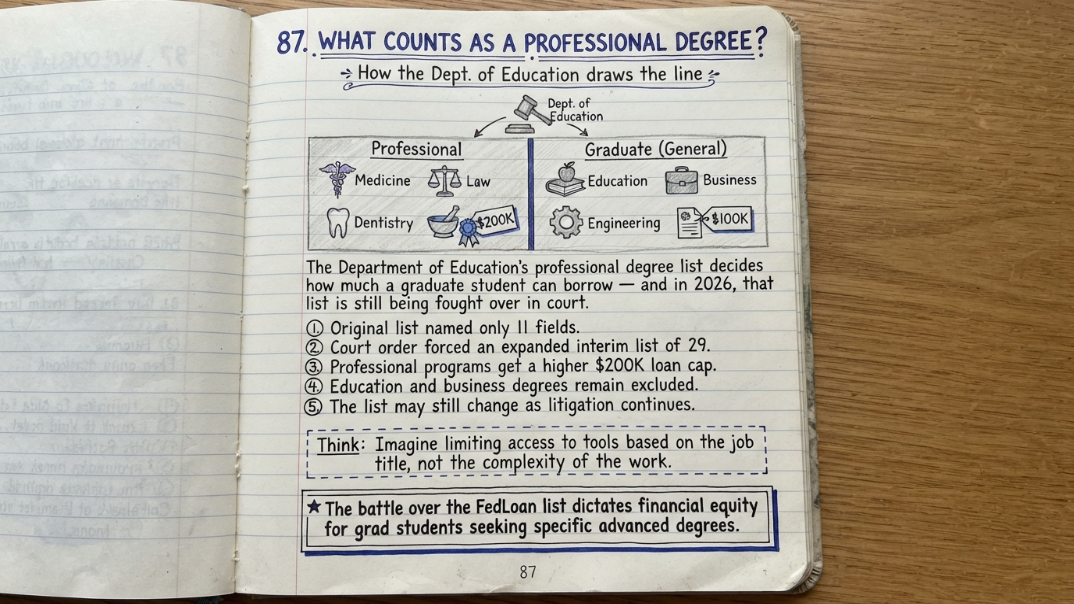
For most of the country, "professional degree" is a loose, everyday phrase covering anything from a law degree to a doctorate in physical therapy. For the U.S. Department of Education, it's now a precise regulatory category that determines exactly how much a graduate student is allowed to borrow in federal loans — and in 2026, that category has become one of the most contested pieces of federal education policy in years. A new rule narrowed the list sharply, a federal court order then forced it back open, and the list is still being litigated as of this writing. This guide breaks down what "professional degree" currently means for federal financial aid purposes, which programs are affected, and what graduate students need to know while the rules keep shifting.
Why the Department of Education's Definition Suddenly Matters
Before 2026, the term "professional degree" carried little formal weight in federal financial aid rules; most graduate and professional students borrowed under similar terms, and Grad PLUS loans allowed borrowing up to the full cost of attendance regardless of the field. New federal loan limits taking effect for loans first disbursed on or after July 1, 2026 changed that entirely. Graduate PLUS loans are being eliminated, and in their place, Congress set two separate borrowing caps — a lower one for general graduate study and a higher one specifically for programs the Department of Education classifies as "professional degrees." Whether a given master's or doctoral program falls into that professional category now has a direct, dollar-for-dollar effect on how much a student can borrow from the federal government.
What Changed: The RISE Final Rule
The Department of Education finalized its narrower professional degree definition on April 30, 2026, as part of the Reimagining and Improving Student Education (RISE) rule, published in the Federal Register on May 1, 2026. Under that rule, only a limited set of fields — traditionally the most established licensed professions like medicine, law, and dentistry — qualified for the higher "professional" loan limit, while a wide range of other graduate-level professional fields were reclassified under the lower general graduate cap.
The Original 11-Field List
As originally finalized, the Department's professional degree list included eleven fields: chiropractic, clinical psychology, dentistry, law, medicine, optometry, osteopathic medicine, pharmacy, podiatry, theology, and veterinary medicine. Notably absent from that original list were several fields many people would intuitively describe as professional degrees, including nursing, physician assistant studies, physical therapy, occupational therapy, architecture, engineering, and business — a decision that drew immediate criticism from professional associations representing those fields.
- Chiropractic
- Clinical psychology
- Dentistry
- Law
- Medicine
- Optometry
- Osteopathic medicine
- Pharmacy
- Podiatry
- Theology
- Veterinary medicine
The Court Order and the Expanded List
On June 24, 2026, the U.S. District Court for the District of Columbia preliminarily stayed part of the Department's narrower professional degree definition in a pair of consolidated lawsuits. In response, the Department issued an updated interim list on June 29, 2026, expanding the number of qualifying Classification of Instructional Programs (CIP) codes from 11 to 29, adding fields including several advanced nursing degrees, physician assistant studies, physical therapy, occupational therapy, audiology, speech-language pathology, and athletic training. The Department has been explicit that this expanded list is a temporary, interim measure required by the court order, not a change of position — it maintains that its original, narrower rule is lawful and continues to defend it in ongoing litigation.
Current Federal Loan Limits by Category
Under the new structure taking effect for loans disbursed on or after July 1, 2026, borrowing caps differ meaningfully depending on how a program is classified.
| Category | Annual Limit | Aggregate Limit |
|---|---|---|
| Undergraduate (dependent) | Up to $7,500 (varies by year) | Unchanged from prior limits |
| Graduate (non-professional) | Up to $20,500 | $100,000 |
| Professional degree programs | Program-dependent, higher cap | $200,000 |
| Grad PLUS Loans | Eliminated for new borrowers | Not applicable |
What Fields Are Still Excluded
Even with the court-ordered expansion to 29 fields, a number of graduate programs many people would consider clearly professional remain outside the Department's official definition, most notably graduate-level education and school leadership programs. Business degrees, including many MBA programs, and fields like architecture and engineering have also faced exclusion or uncertainty depending on the specific version of the rule in effect. Because the list has changed multiple times within a matter of months and remains under active litigation, students in fields near the boundary of the definition should treat their program's classification as provisional rather than fixed.
Why Education Degrees Were Left Off
The Department's stated rationale for excluding graduate education and school leadership programs from the professional degree list is that no state currently requires a master's degree as a baseline entry credential for teachers or many school administrators, unlike fields such as law or medicine where an advanced degree and licensure are mandatory entry requirements. Education sector groups have pushed back on that reasoning, pointing out that many teachers and administrators pursue advanced degrees for career advancement, licensure upgrades, or specialization even when not strictly required to enter the field, and that the exclusion could discourage graduate study in a profession already facing staffing shortages in many regions.
How Institutions Determine Program Classification
Individual colleges and universities, not the Department of Education directly on a case-by-case basis, are generally responsible for determining whether a specific program on their campus meets the criteria to be classified as a professional degree under the current rule, based on the Classification of Instructional Programs (CIP) code assigned to that program. This means two similarly named programs at different institutions could, in some cases, be classified differently depending on how each school's program is coded, which is part of why students are consistently advised to confirm classification directly with their own financial aid office rather than assuming based on the program's title alone.
What This Means for Prospective Graduate Students
For students in a field that currently sits outside the professional degree definition, the practical effect is a lower federal borrowing ceiling — a $100,000 aggregate cap on graduate loans instead of the $200,000 cap available to professional programs — combined with the loss of Grad PLUS loans, which previously allowed borrowing up to the full cost of attendance regardless of category. Since litigation is ongoing and the list has already changed twice within a few months, students currently enrolled in or applying to affected programs should plan around the possibility that their program's classification, and therefore their borrowing limit, could shift again before they finish their degree.
- Confirm your specific program's current classification directly with your school's financial aid office
- Don't assume a program qualifies as "professional" just because it requires a license to practice
- Budget conservatively, since Grad PLUS loans are no longer available to cover any remaining cost of attendance
- Research scholarships, grants, assistantships, and fellowships as alternatives to federal borrowing
- Check official Department of Education guidance periodically, since the list may change again as litigation proceeds
Where to Check the Current List
Because the professional degree list has already been revised multiple times in 2026 and remains subject to ongoing litigation, the most reliable source of current information is the Department of Education's Federal Student Aid Knowledge Center and the official StudentAid.gov site, rather than any single article or third-party summary, including this one. Prospective and current graduate students should also check directly with their institution's financial aid office, since schools are responsible for applying the current CIP code list to their own specific programs and can confirm exactly how a given degree is classified at the time of borrowing.
FAQs
What is currently classified as a professional degree by the Department of Education?
As of mid-2026, an interim, court-ordered list of 29 Classification of Instructional Programs (CIP) codes qualifies as professional degrees, including the original 11 fields (such as medicine, law, dentistry, and pharmacy) plus additions like advanced nursing, physician assistant studies, physical therapy, occupational therapy, audiology, and athletic training. This list is temporary and may change as litigation continues.
Are education degrees considered professional degrees for federal loans?
No. Graduate education and school leadership programs remain excluded from the Department of Education's professional degree definition, meaning they're subject to the lower $100,000 aggregate graduate loan cap rather than the $200,000 cap available to professional programs.
Why did the professional degree list change in 2026?
The Department of Education finalized a narrower definition in its RISE rule on April 30, 2026, but a federal court preliminarily stayed part of that definition on June 24, 2026, forcing the Department to issue an expanded interim list while litigation continues.
Are Grad PLUS loans still available?
No. Grad PLUS loans, which previously allowed borrowing up to the full cost of attendance, are being eliminated for new borrowers as of loans first disbursed on or after July 1, 2026, replaced by fixed annual and aggregate caps that differ by program classification.
How can I find out if my specific graduate program qualifies as a professional degree?
Check directly with your school's financial aid office, since institutions apply the current Classification of Instructional Programs (CIP) code list to their own programs, and confirm against official guidance on StudentAid.gov, since the list has changed more than once in 2026.
Is the professional degree list final?
No. As of mid-2026, the list remains subject to active litigation, and the Department of Education has stated the current expanded list is an interim measure that could change again depending on how the court case proceeds.