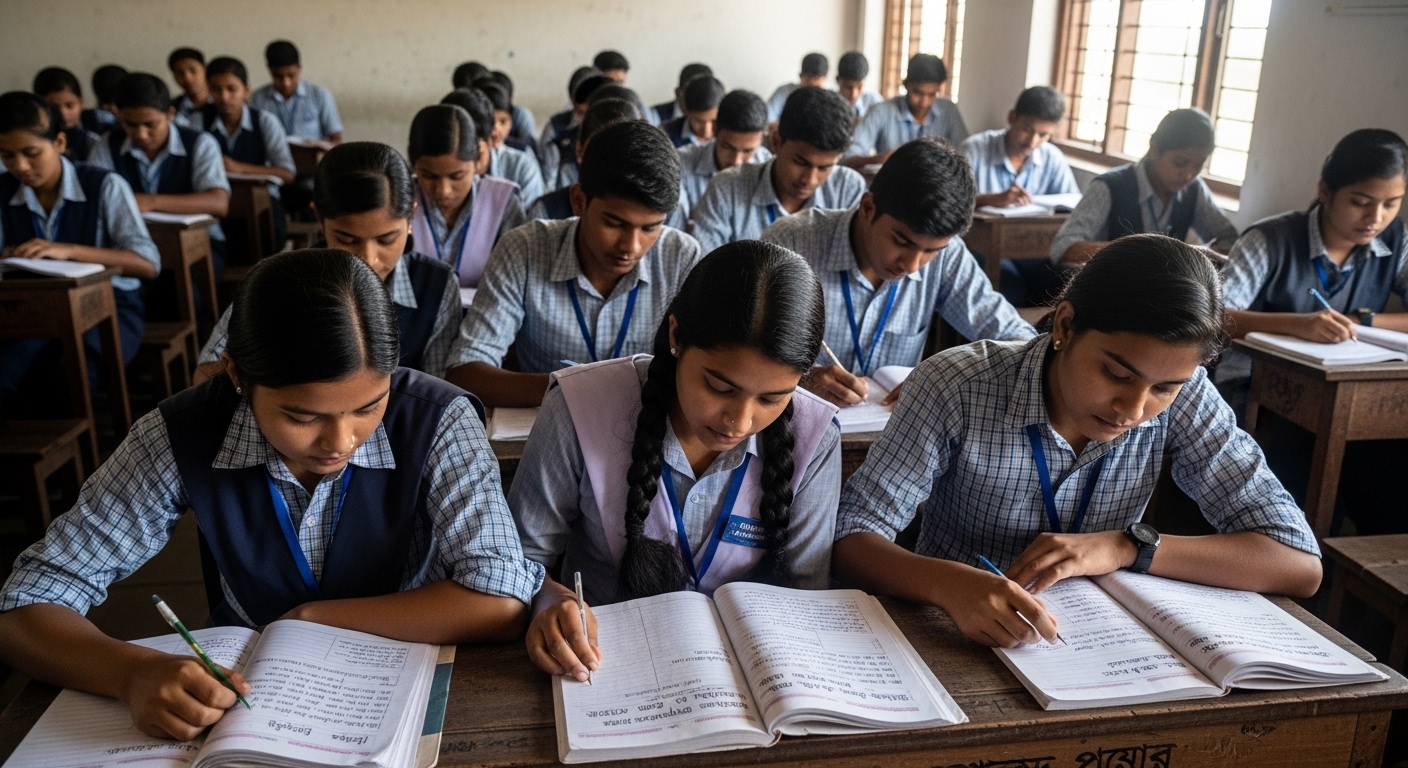
Most HS 1st Year students treat Assamese as a subject they can prepare at the last minute — after all, it's their mother tongue, and how hard can it be? That thinking costs marks every single year. The students who consistently score 80 and above in HS 1st Year Assamese are not necessarily the most talented writers. They are the ones who understood two things: the exam has a precise structure that rewards a specific preparation approach, and the grammar and composition sections — which together carry 30–40 marks — are almost entirely formula-based and can be mastered with the right practice. The Assam Higher Secondary Education Council (AHSEC) conducts HS 1st Year examinations for Arts, Science, and Commerce stream students across Assam. Assamese is a compulsory language subject for most students. The total paper carries 100 marks, runs for 3 hours, and covers four distinct components: prose (গদ্য), poetry (পদ্য), grammar (ব্যাকৰণ), and composition (ৰচনা). Each component has its own preparation logic, question types, and answer-writing approach. This guide is structured to give you everything in one place: the official AHSEC 2026 syllabus breakdown, unit-wise mark distribution, chapter-wise preparation strategy for each section, the exact question format and marking scheme, grammar topics with their weightage, a practical 6-week revision plan, and the specific answer-writing techniques that earn full marks. Whether your exam is weeks away or months away, this guide tells you exactly what to focus on and how.
Overview of HS 1st Year Assamese Subject
HS 1st Year Assamese is a core language paper under the Assam Higher Secondary Education Council (AHSEC) for students in the Arts, Science, and Commerce streams. For most students, it is either a compulsory first language or a compulsory second language, depending on their stream and medium of instruction. The subject carries 100 marks in total and is examined in a 3-hour written paper. AHSEC has confirmed there will be no OMR answer sheets for the 2026 examinations — the exam continues in the traditional pen-and-paper mode. Students must score at least 30% (30 marks) to pass the theory paper. The Assamese paper tests four distinct skill areas. Reading comprehension and literary appreciation are tested through prose and poetry questions. Language accuracy and grammatical knowledge are tested in the grammar section. Creative and practical writing ability are assessed through the composition section, which includes essay writing, letter writing, and report writing. Because the paper covers both literary and practical language skills, students cannot prepare well by focusing on only one section. A student who memorises all the prose summaries but ignores grammar will still struggle to cross 65 marks. Balanced preparation — giving appropriate attention to all four sections — is the only approach that consistently produces scores above 80.
AHSEC 2026 Exam Schedule and Key Dates
Understanding the official exam calendar is the first step in building a preparation plan that is realistic, not rushed.
| Event | Details / Date | Status |
|---|---|---|
| AHSEC HS 1st Year Exams (Theory) | March 2026 (exact date per subject as per routine) | Official routine released November 2025 |
| Exam Duration | 3 hours per paper | Confirmed |
| Exam Mode | Pen and paper (no OMR sheets) | AHSEC confirmed — no OMR in 2026 |
| Minimum Passing Marks (Theory) | 30% — minimum 30 marks out of 100 | Official AHSEC requirement |
| Minimum Passing Marks (Practical) | 40% where applicable | Official AHSEC requirement |
| Distinction Cutoff | 80% and above | AHSEC awards distinction at 80%+ |
| Official Website | ahsec.assam.gov.in | All updates, syllabus PDF, routine download |
Syllabus Structure and Unit-wise Mark Distribution
The AHSEC HS 1st Year Assamese syllabus is divided into four main components. Understanding the exact mark distribution of each section is the foundation of smart preparation — you put more time into sections that carry more marks.
| Section | Assamese Term | Content Type | Approximate Marks | Question Types |
|---|---|---|---|---|
| Prose | গদ্য বিভাগ | Short stories, essays, biographical and descriptive prose from the prescribed textbook | 25–30 Marks | Short answer (2–4 marks), Long answer (6–8 marks), character sketch, central theme |
| Poetry | পদ্য বিভাগ | Poems from prescribed textbook including classical, modern, and folk poetry | 20–25 Marks | Meaning of stanzas, critical appreciation, figures of speech, poet introduction |
| Grammar | ব্যাকৰণ বিভাগ | Sandhi, Samas, sentence types, transformation, vocabulary, antonyms/synonyms | 20–25 Marks | Fill in the blank, identify and classify, transformation exercises |
| Composition | ৰচনা বিভাগ | Essay writing, formal/informal letter writing, report writing, summary writing | 20–25 Marks | One essay from choice, one letter/application from choice, report or summary |
Prose Section (গদ্য): Chapter-wise Preparation Strategy
The prose section is typically the highest-scoring section for students who prepare systematically because the questions are predictable — the same themes, characters, and central messages are tested in slightly different formats year after year. For every prose lesson in your textbook, prepare these five components in your notes: 1. Central Summary (সাৰাংশ): Write a 100–150 word summary of the lesson in your own Assamese. Do not copy from guides word for word — examiners can identify rote answers and they reward students who show genuine understanding. 2. Author/Writer Background (লেখকৰ পৰিচয়): Three to four sentences covering the writer's full name, birth/death year, home district, major works, and their place in Assamese literature. This is frequently asked in the 2-mark short questions. 3. Character Sketch (চৰিত্ৰ বৰ্ণনা): For prose lessons with characters, prepare 100–150 word character sketches. Include the character's main traits, their role in the story, and one specific incident from the text that illustrates a key quality. 4. Central Theme and Message (কেন্দ্ৰীয় বিষয় আৰু বাৰ্তা): A focused paragraph explaining what the author is trying to communicate — social, cultural, philosophical, or personal. This is the most common 6–8 mark long answer. 5. Important Quotations (গুৰুত্বপূৰ্ণ উদ্ধৃতি): Note down 2–3 memorable lines or phrases from each lesson. Incorporating a relevant quotation in a long answer improves your score noticeably.
Poetry Section (পদ্য): How to Prepare and Write Answers
Poetry preparation requires a different approach from prose. The questions are more analytical and reward students who can explain both the literal meaning and the deeper significance of a poem. Memorisation alone is not enough — you need to understand what the poet is expressing and how. For every poem in the syllabus, prepare the following in your notes: 1. Poet Background (কবিৰ পৰিচয়): Name, period, literary style, and two or three of their most important works. Keep this to four to five sentences — exam answers for poet introduction are typically worth 2–3 marks. 2. Stanza-wise Explanation (স্তৱক ব্যাখ্যা): For each stanza, write a plain-language explanation of what the lines are saying. Then add a second layer — what is the emotional tone, what image is created, what does it symbolise? This two-layer approach is exactly what examiners look for in meaning and explanation questions. 3. Central Theme (কবিতাৰ মূল বিষয়): One to two paragraphs explaining the poem's main idea — nature, patriotism, human relationships, spirituality, or social comment. Connect specific lines from the poem to the theme. 4. Figures of Speech and Literary Devices (অলঙ্কাৰ): Identify the literary devices used — উপমা (simile), ৰূপক (metaphor), মানৱীকৰণ (personification), অনুপ্ৰাস (alliteration), etc. For each device, write the specific line from the poem and then identify the device. These are direct exam questions worth 1–2 marks each. 5. Critical Appreciation (সমালোচনাত্মক প্ৰশংসা): Practice writing a structured 150–200 word critical appreciation covering: poet background, theme, mood, literary devices, and personal response. This format, followed consistently, earns near-full marks for appreciation questions.
Grammar Section (ব্যাকৰণ): Topic-wise Guide
Grammar is the section where the most predictable marks are available — and the section most students underprepare. Every grammar topic has specific rules that, once learned and practised, produce consistent correct answers. Unlike prose or poetry, where answers require some literary judgment, grammar questions are objectively right or wrong.
| Grammar Topic | Assamese Term | Marks Weightage | Preparation Strategy | Common Exam Question Format |
|---|---|---|---|---|
| Sandhi (Word Junction) | সন্ধি | 3–5 Marks | Learn all Sandhi rules with 2 examples each; practice identifying Sandhi type and breaking compound words | Break the Sandhi / identify the rule / form the Sandhi from two given words |
| Samas (Compound Words) | সমাস | 3–5 Marks | Memorise all 6 types (দ্বন্দ্ব, তৎপুৰুষ, কৰ্মধাৰয়, বহুব্ৰীহি, দ্বিগু, অব্যয়ীভাৱ) with 3 examples each | Identify the type of Samas / break down the compound word / form a Samas |
| Sentence Transformation | বাক্য ৰূপান্তৰ | 4–6 Marks | Practice converting between simple, complex, and compound sentences; affirmative to negative and vice versa | Transform the given sentence as directed |
| Parts of Speech | শব্দৰ শ্ৰেণীবিভাজন | 2–3 Marks | Identify nouns, pronouns, verbs, adjectives, adverbs, prepositions, conjunctions, interjections in context | Underline and identify the part of speech |
| Antonyms and Synonyms | বিপৰীত আৰু সমাৰ্থক শব্দ | 3–4 Marks | Maintain a dedicated vocabulary notebook; add 5 new words daily with antonym and synonym | Write antonym/synonym of underlined words |
| Correction of Sentences | বাক্য সংশোধন | 2–3 Marks | Study common grammatical errors: subject-verb agreement, tense consistency, improper use of cases | Correct the errors in the given sentences |
| Idioms and Phrases | পদগুচ্ছ আৰু মুহাৱৰা | 2–3 Marks | Prepare 15–20 common Assamese idioms with meaning and example sentence each | Use the idiom in a sentence / explain the meaning |
Composition Section (ৰচনা): Formats and Scoring Strategy
The composition section carries 20–25 marks and is divided between essay writing, letter/application writing, and report or summary writing. This section rewards students who follow correct formats — examiners deduct marks for structural errors even when the content is good. --- ESSAY WRITING (ৰচনা) --- Essays are typically worth 10–12 marks. A well-structured Assamese essay has five sections: শিৰোনামা (title), আৰম্ভণি (introduction — 3–4 sentences creating context), মূল অংশ (body — 3–4 paragraphs with specific content), উপসংহাৰ (conclusion — restate the key message), and occasionally a relevant quotation or proverb. High-frequency essay topics from previous AHSEC papers include: সামাজিক সমস্যা (social issues like addiction, dowry), অসমৰ সংস্কৃতি আৰু পৰম্পৰা (Assam's culture and traditions), শিক্ষা আৰু প্ৰযুক্তি (education and technology), পৰিবেশ সমস্যা (environmental problems — floods, deforestation), আৰু ডিজিটেল ভাৰত (Digital India). Prepare at least five essays covering these themes — two of them will almost certainly appear on your paper. --- LETTER WRITING (পত্ৰ লিখন) --- Letters are worth 6–8 marks. AHSEC tests both formal letters (চৰকাৰী পত্ৰ) and informal letters (অনানুষ্ঠানিক পত্ৰ). Formal letters require a strict format: sender's address, date, recipient designation, subject line, salutation, body (introduction / main point / request), complimentary close, and signature. Informal letters to family or friends use a relaxed structure but still need a proper greeting and closing. Practise writing at least two formal and two informal letters in timed conditions. --- REPORT WRITING (প্ৰতিবেদন) --- Report writing appears with increasing frequency in recent AHSEC papers. A report has: heading (শিৰোনামা), date and place, introduction of the event, main body with specific details, and conclusion. School events, cultural programmes, annual sports days, and community events are the most common report topics.
Official Exam Pattern and Question Format
AHSEC has confirmed that the HS 1st Year exam pattern for 2026 follows the same structure as the previous year. The paper runs for 3 hours, carries 100 marks, and includes four question types. Understanding this structure lets you plan your time in the exam room precisely.
| Question Type | Marks per Question | Number of Questions | Section | Time Strategy |
|---|---|---|---|---|
| Very Short Answer (অতি চমু উত্তৰ) | 1–2 Marks | 8–10 questions | Prose, Poetry, Grammar | 2–3 minutes each; write in 1–2 lines; do not over-explain |
| Short Answer (চমু উত্তৰ) | 3–4 Marks | 6–8 questions | Prose, Poetry, Grammar | 5–7 minutes each; 60–80 words; structured points |
| Long Answer (দীঘলীয়া উত্তৰ) | 6–8 Marks | 3–4 questions (attempt required number) | Prose, Poetry | 12–15 minutes each; 150–200 words; use subpoints and quotations |
| Essay / Composition | 10–12 Marks | 2 questions (essay + letter/report) | Composition Section | 15–20 minutes each; follow format strictly; check for spelling before finishing |
Answer Writing Techniques That Score Full Marks
The gap between a student who scores 65 and one who scores 85 in AHSEC Assamese is often not about knowledge — it is about how answers are written. These techniques make a direct, measurable difference to your marks. 1. Start every long answer with a direct, clear opening sentence. Do not begin with 'In this answer I will discuss...' or a vague introduction. State the point directly. For a question asking about the central theme of a prose lesson, your first sentence should be the theme stated plainly: 'এই পাঠৰ মূল বিষয় হৈছে মানৱীয় সম্পৰ্কৰ গভীৰতা।' Then develop it. 2. Use a three-part structure for all long answers. Every long answer should have a brief introduction (what you are going to establish), a body (the main explanation with 2–3 specific points or examples from the text), and a concluding sentence that wraps the answer. This structure shows the examiner that your thinking is organised. 3. Include one specific textual reference per long answer. For prose and poetry long answers, reference a specific incident, line, or image from the text. Answers that stay abstract and general earn lower marks than answers grounded in the actual text. 4. For grammar questions, show your working. When answering Sandhi or Samas questions, write out the component words and then show the combination or breakdown. For sentence transformation, write the original sentence and then the transformed version clearly labelled. This step-by-step approach earns full marks even if the final answer has a minor error. 5. Manage presentation deliberately. Write headings and sub-headings where appropriate. Keep paragraphs to 3–5 sentences each. Leave a half-line gap between sections of a long answer. Use underlining for important terms. AHSEC confirmed that examiners deduct marks for spelling mistakes in language papers — proofread your composition section answers before the exam ends. 6. Allocate time before the exam starts, not during. With 100 marks in 3 hours, you have roughly 1.8 minutes per mark as a rough guide. Spend the first 5 minutes reading the paper and planning your answer order. Do composition last — it benefits most from a settled mind. Do grammar first — it requires precision and no creativity.
Chapter-wise Preparation Priority Table
Use this table to decide where to invest the most time. Chapters and topics are ranked by their frequency in previous AHSEC papers and their marks weightage.
| Component | Topic / Chapter Type | Priority | What to Prepare | Revision Frequency |
|---|---|---|---|---|
| Prose | First two and last two lessons | Very High | Full summary, character sketch, central theme, 2 quotations | Once a week |
| Prose | Middle lessons | High | Summary and central message; character names and roles | Every 10 days |
| Poetry | First and last two poems | Very High | Stanza explanation, theme, poet background, 3 literary devices | Once a week |
| Poetry | Middle poems | High | Theme, main images, one literary device per poem | Every 10 days |
| Grammar | Sandhi and Samas | Very High | All rules with examples; practice 10 exercises per topic | Daily practice |
| Grammar | Sentence transformation | High | All three sentence types; affirmative/negative/interrogative | Every 2 days |
| Grammar | Antonyms/Synonyms and Idioms | Medium | Vocabulary notebook with 20 pairs; 15 idioms minimum | Weekly revision |
| Composition | Essay writing | Very High | 5 full essays on high-frequency topics; practice format every time | Once a week (timed) |
| Composition | Letter writing | Very High | 2 formal + 2 informal letters; memorise format perfectly | Twice before exam |
| Composition | Report writing | Medium-High | 2 model reports; understand heading/date/body format | Once before exam |
How to Make Effective HS 1st Year Assamese Notes
The quality of your notes determines the quality of your revision — and revision is where marks are actually won. These note-making principles are specific to the Assamese paper and designed to make your study time as efficient as possible. 1. Use a separate notebook for each section. Keep four notebooks: one for prose summaries and answers, one for poetry explanations, one for grammar rules and exercises, and one for composition formats and sample essays. This compartmentalisation makes revision faster because you are not hunting through a single chaotic notebook for a specific grammar rule. 2. Write summaries in your own Assamese, not copied text. When you paraphrase a lesson in your own words, you force yourself to truly understand it. Examiners can recognise notes copied wholesale from published guides — and answers written in a student's natural voice score better than stylised literary paraphrasing that doesn't match the student's level. 3. Create a grammar quick-reference sheet. For each grammar topic (Sandhi, Samas, sentence transformation), make a single-page reference card with: the rule stated simply, two examples, and the most common mistake students make. This single-page format is ideal for the day before the exam. 4. Build a vocabulary notebook with context. Do not just list antonyms and synonyms in isolation. Write each word in a sentence. This helps you remember the word's meaning and usage, which matters for the composition section as much as the grammar section. 5. Use colour-coding for literary devices in poetry notes. When writing out a poem's stanzas for explanation, underline similes in one colour, metaphors in another, and alliteration in a third. This visual coding makes the figures of speech impossible to overlook during revision. 6. Date your notes and review them on a schedule. The most effective revision system is a rolling schedule: review prose notes on Week 1, poetry notes on Week 2, grammar on Week 3, then restart. This spaced repetition is far more effective than a single marathon revision session the night before the exam.
6-Week Revision Plan Before HS 1st Year Exams
This plan assumes you have already studied the syllabus at least once. If your exam is less than six weeks away, compress the timeline but maintain the sequence — the order matters.
| Week | Focus Area | Daily Tasks | Weekly Target |
|---|---|---|---|
| Week 1 | Prose Section | 1 lesson summary per day; write model answers for central theme and character sketch of 2 lessons | All prose lessons summarised; 3 model long answers written |
| Week 2 | Poetry Section | 1 poem stanza explanation per day; identify literary devices; write 2 critical appreciation answers | All poems covered; figures of speech noted for each; poet backgrounds written |
| Week 3 | Grammar Section | Sandhi practice (Mon–Tue), Samas practice (Wed–Thu), Sentence transformation (Fri), Vocabulary/Idioms (Sat) | 20 Sandhi exercises, 20 Samas exercises, 15 transformations completed and self-checked |
| Week 4 | Composition Section | Write one full essay every alternate day (timed — 20 minutes); practise one letter format daily | 5 complete essays written; 2 formal letters and 2 informal letters drafted; 1 report practised |
| Week 5 | Previous Year Papers | Solve one full previous year Assamese paper per day under timed conditions (3 hours); analyse errors the same day | 5 full papers solved; weak areas identified and targeted with focused revision |
| Week 6 (Final Week) | Rapid Revision Only | Grammar quick-reference cards (Mon), Prose key points (Tue), Poetry key points (Wed), Composition formats (Thu), Rest and light review (Fri) | No new material; only consolidation of existing notes; check spelling in composition drafts; sleep 7–8 hours nightly |
Common Mistakes Students Make (And How to Avoid Them)
These are the specific, avoidable errors that cost AHSEC Assamese students the most marks year after year. Each one has a straightforward fix. 1. Memorising answers from published guides without understanding Published Assamese guide books circulate in every school in Assam. Examiners who have marked thousands of papers know these answers by heart. When they see a memorised guide answer, they give passing marks — not full marks. The fix: use guides to understand, then write answers in your own words. 2. Ignoring grammar because it feels less interesting than literature Grammar carries 20–25 marks. A student who ignores grammar will struggle to exceed 70–72 marks no matter how well they know the prose and poetry. Thirty minutes of daily grammar practice is enough to secure most of these marks consistently. The fix: make grammar practice the first thing you do in every study session — not the last. 3. Not following composition formats Essays submitted without a title, letters without a proper heading and date format, reports without a subject line — these structural errors cause mark deductions even when the content is excellent. The fix: practise the formats until they are automatic. Write the format skeleton (heading → date → salutation → body → closing) before writing any content in practice sessions. 4. Poor time management in the exam hall Many students spend 40 minutes on a prose long answer worth 8 marks and then rush through the composition section worth 20 marks. The fix: allocate time before the exam starts. Stick to the allocation strictly — an incomplete composition answer costs more marks than an imperfect long answer. 5. Spelling errors in composition and grammar sections AHSEC has confirmed that examiners deduct marks for spelling mistakes in language papers. Common errors include inconsistent spellings of Assamese words and incorrect use of matras (vowel markers). The fix: keep a list of words you commonly misspell and review it every day for the two weeks before the exam. 6. Skipping unseen passages or comprehension questions if they appear Some students panic at unseen passages and leave them blank, assuming they cannot answer. Unseen comprehension answers are almost entirely based on the given passage — you do not need memorised content. The fix: practice reading unfamiliar Assamese texts and answering factual questions from the passage. Five minutes of practice daily builds this skill quickly.
Career Importance of Assamese Language Proficiency
Strong Assamese language skills are not just important for the HS board paper — they create lasting academic and career advantages for students across multiple fields in Assam and beyond. In government competitive examinations — particularly APSC (Assam Public Service Commission) and PNRD examinations — Assamese language proficiency is directly tested. Candidates who developed strong grammar and composition skills in HS often have a measurable advantage in language papers years later. In teaching and education, Assamese medium schools across the state constantly need teachers with strong subject knowledge. A foundation built in HS 1st and 2nd Year — understanding literary texts, grammatical rules, and composition formats — is the same foundation that makes an excellent Assamese language teacher. In journalism, media, and content creation, Assamese digital media has expanded dramatically. News channels, YouTube channels, podcasts, online publications, and social media platforms in Assamese all require writers and communicators who can use the language precisely and expressively. Students who invest in strong Assamese skills during HS have a ready professional market for those skills. For civil services (IAS/IPS), candidates from Assam frequently choose Assamese literature as their optional subject in UPSC Mains — a strategic choice that rewards deep engagement with the language from the HS level onward. Finally, language is cultural identity. Assamese is one of the 22 officially recognized languages of India, with a literary tradition stretching back to the 13th century. Students who develop genuine proficiency in their language are not just earning marks — they are carrying forward something that belongs to their region and their history.
FAQs
What is the AHSEC HS 1st Year Assamese exam pattern for 2026?
The HS 1st Year Assamese paper carries 100 marks and runs for 3 hours in pen-and-paper mode (AHSEC confirmed no OMR sheets for 2026). The paper covers four sections: Prose (গদ্য) — 25–30 marks, Poetry (পদ্য) — 20–25 marks, Grammar (ব্যাকৰণ) — 20–25 marks, and Composition (ৰচনা) — 20–25 marks. Question types include very short answer (1–2 marks), short answer (3–4 marks), long answer (6–8 marks), and essay/composition (10–12 marks). Students must score at least 30 marks to pass.
Where can I find HS 1st Year Assamese notes for 2026?
The most effective notes are the ones you prepare yourself from the prescribed AHSEC textbook — using published guides only to cross-check understanding, not to copy answers. For the official syllabus PDF, visit ahsec.assam.gov.in and download the HS 1st Year syllabus for 2025–26. Your school teachers are also the best primary resource for chapter-specific guidance. Supplement with previous year question papers, which are available on Careers360 and Shiksha under the AHSEC section.
Is Assamese compulsory in HS 1st Year for all streams?
For most students enrolled in AHSEC-affiliated institutions in Assam, Assamese is a compulsory language subject regardless of stream (Arts, Science, or Commerce). The exam structure includes two language subjects, one of which is English, and Assamese typically fills the second language slot for most students. Students from non-Assamese medium schools or specific linguistic backgrounds may have alternative arrangements — check with your institution's administration for your specific requirement.
How to score 80 or above in HS 1st Year Assamese?
Scoring 80+ requires strong performance in all four sections — not just prose and poetry. Secure the grammar marks (20–25 marks) through consistent daily practice, especially on Sandhi, Samas, and sentence transformation. In composition, follow format structures perfectly — structural errors lose marks even with good content. For prose and poetry, write answers in your own Assamese rather than memorised guide text — examiners reward genuine understanding. Solve at least three previous year papers under timed conditions before the exam.
What are the most important grammar topics for AHSEC Assamese?
Sandhi (সন্ধি) and Samas (সমাস) are the highest-weightage grammar topics and appear in every AHSEC Assamese paper without exception. Sentence transformation (বাক্য ৰূপান্তৰ) between simple, complex, and compound sentences is the second most frequent topic. Antonyms and synonyms (বিপৰীত আৰু সমাৰ্থক শব্দ) appear as a dedicated vocabulary section. Idioms (মুহাৱৰা) and parts of speech identification are also regularly tested. Together these five areas account for most of the 20–25 grammar marks.
Are previous year question papers important for HS 1st Year Assamese?
Yes — they are one of the most valuable preparation tools available. Previous AHSEC Assamese papers reveal which prose lessons and poems are asked most frequently, which grammar topics appear every year, what essay themes recur regularly, and the exact question formats for each section. Solving five or more previous papers under timed conditions also builds the time management skills needed to complete the 100-mark paper in three hours. Papers from the last five years are the most relevant and are available on ahsec.assam.gov.in.
How much time should I spend daily on HS 1st Year Assamese?
A daily investment of 45–60 minutes is sufficient for most students — provided that time is structured. Spend the first 15 minutes on grammar exercises (the most important and most neglected section). Use the next 20 minutes on prose or poetry revision — summaries, themes, literary devices. Use the final 15 minutes on composition practice — writing one paragraph of an essay or reviewing a letter format. Six weeks of this routine, combined with full previous paper practice in the final two weeks, is enough to achieve 70–80+.
Does handwriting affect marks in the AHSEC Assamese exam?
Directly? No — AHSEC does not award separate marks for handwriting. Indirectly? Yes, significantly. Illegible handwriting forces the examiner to spend extra time deciphering your answers, which affects their impression of your response. Clear, readable handwriting with proper spacing and margins ensures every word you write is counted. More importantly, AHSEC has confirmed that spelling mistakes in language papers attract mark deductions — and neat handwriting reduces the likelihood of spelling errors going unnoticed.
What are the best essay topics to prepare for HS 1st Year Assamese?
Based on the frequency of topics across previous AHSEC Assamese papers, prepare essays on: environmental issues in Assam (floods, deforestation, pollution) — this has appeared nearly every year; social problems (drug abuse, dowry system, child marriage); cultural heritage and festivals of Assam (Bihu, Sattriya dance, Vaishnavite tradition); digital technology and its impact on society; importance of education; and youth and national development. Prepare complete, structured essays — title, introduction, 3-paragraph body, conclusion — on at least five of these topics.
What is the minimum passing marks for HS 1st Year Assamese?
Students must score a minimum of 30% — that is, 30 marks out of 100 — in the theory paper to pass HS 1st Year Assamese, as per AHSEC's official requirements. This is the same minimum passing criterion that applies across all theory subjects under AHSEC. AHSEC awards distinction to students who score 80% or above (80 marks and above). The result is announced on the official website ahsec.assam.gov.in and students need 75% attendance in their institution to be eligible to appear in the final examination.