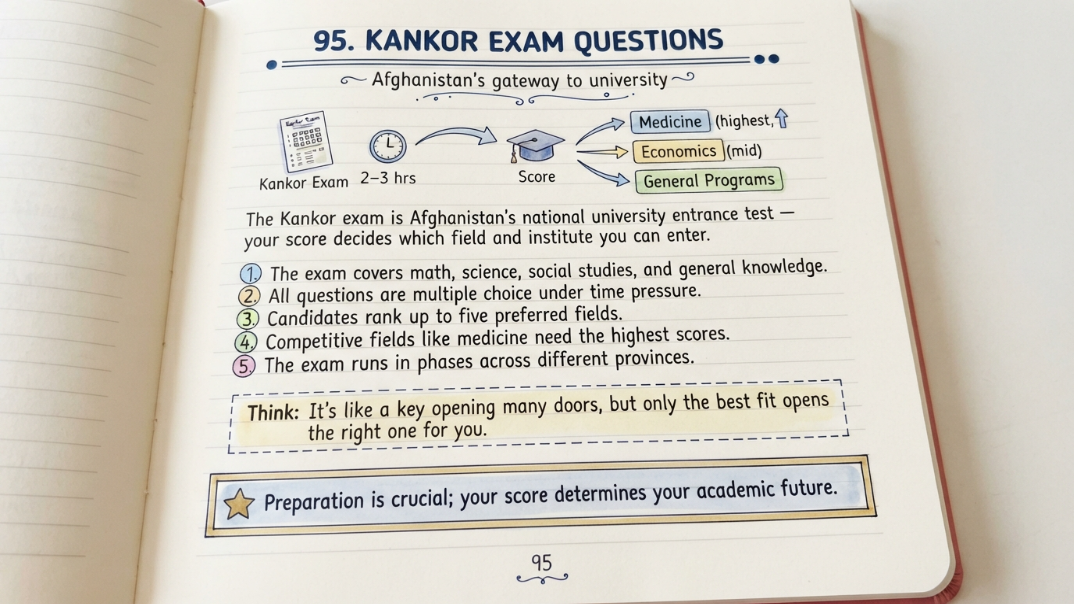
For Afghan students, the Kankor exam is the single biggest gate standing between finishing school and entering university — a nationwide, multiple-choice entrance test that determines not just whether a student is admitted to higher education, but which specific field and institute they qualify for. Scoring well enough for a competitive field like medicine or engineering, especially at an institute in Kabul or another major city, generally requires a meaningfully higher score than admission into less competitive fields or regional institutes. With registration, preparation, and scoring rules that can be confusing for first-time candidates (and for the many Afghan students and families now living outside the country, including in India, who are helping younger family members prepare remotely), this guide breaks down how the Kankor exam actually works and how to prepare for its questions effectively.
What Is the Kankor Exam
The Kankor exam (also spelled Konkur) is Afghanistan's national university entrance examination, taken by students who have completed secondary school and wish to continue into higher education. It's a high-stakes, multiple-choice test covering a broad range of subjects, and a candidate's score directly determines which university, institute, and specific field of study they're eligible to enter — making it one of the most consequential single exams in a young Afghan student's academic life.
Who Administers It and How It's Evolved
The Kankor exam is administered by Afghanistan's National Examination Authority, operating under the Ministry of Higher Education. Over the past decade, the exam process has gone through several rounds of reform aimed at improving fairness and reducing cheating, including the introduction of separate, individualized question booklets for each candidate and the adoption of Optical Mark Reader technology to scan and score answer sheets more accurately and consistently than earlier manual processes allowed.
Exam Structure and Subjects Covered
The Kankor exam draws questions from a broad academic base rather than testing only one subject area, reflecting its role as a general entrance test rather than a subject-specific one.
- Mathematics
- Natural sciences (physics, chemistry, biology)
- Social sciences (history, geography, civics)
- General knowledge and current affairs
- Language sections, provided in both Pashto and Dari depending on region
Question Format and Scoring
All Kankor exam questions are multiple choice, and candidates are typically given roughly two to three hours to complete the test and select their answers. Correct answers are generally worth between one and three points depending on the specific question, with the maximum possible score falling somewhere between roughly 320 and 370 points across the full exam. What matters most for admission purposes isn't the raw maximum score but the minimum score threshold required for a particular field of study, which varies significantly depending on how competitive that field and institute are.
How Field and Institute Placement Works
Candidates are typically asked to list several preferred fields of study in order of preference — commonly up to five choices — rather than applying to a single fixed program. Placement into a specific field then depends on how a candidate's score compares against the minimum threshold set for that field at that particular institute. Highly sought-after fields like medicine, engineering, computer science, economics, and political science, especially at institutes located in Kabul or other major cities, generally require substantially higher scores to qualify than less competitive fields or more regional institutes.
| Field Competitiveness | Typical Score Requirement | Example Fields |
|---|---|---|
| High competition | Highest score thresholds | Medicine, engineering, computer science |
| Moderate competition | Mid-range score thresholds | Economics, political science, education |
| Lower competition | Lower score thresholds | Various regional or less in-demand programs |
Exam Phases by Province
The Kankor exam isn't administered to the entire country on a single day; it's typically rolled out in multiple phases across different groups of provinces over several weeks, with the capital, Kabul, generally hosting its own dedicated phase. A separate, later phase is often reserved specifically for candidates in special categories — including graduates of religious schools, candidates who missed their scheduled exam date, overseas graduates, and evening university students — reflecting the range of educational backgrounds among Kankor candidates each year.
How to Prepare for Kankor Exam Questions
Because the exam covers such a wide academic base under real time pressure, most successful preparation strategies focus heavily on practicing past and sample questions rather than only reviewing textbook content in isolation.
- Work through past years' Kankor question sets to get familiar with question style and difficulty
- Practice full-length timed mock exams to build comfort with the two-to-three-hour time pressure
- Prioritize weaker subject areas identified through practice tests rather than reviewing everything equally
- Use province-specific past papers where available, since some content can vary regionally
- Review general knowledge and current affairs regularly, since this section changes from year to year
Sample Mock Questions to Practice With
The sample questions below are original practice items, not reproductions of any official past paper, built to reflect the general style, subject spread, and difficulty level of the Kankor exam's four core areas. Use them as a quick self-check: try answering each one under light time pressure before checking the answer key, and treat any section where you consistently miss questions as a priority area for deeper review.
Mock Questions: Mathematics
Mathematics questions on the Kankor exam typically test core algebra, geometry, and arithmetic reasoning rather than highly advanced topics, so speed and accuracy on fundamentals matter more than obscure formulas.
| # | Question | Options | Answer |
|---|---|---|---|
| 1 | If 3x + 7 = 22, what is the value of x? | A) 3 B) 5 C) 7 D) 9 | B) 5 |
| 2 | What is the area of a rectangle with length 12 and width 5? | A) 17 B) 34 C) 60 D) 72 | C) 60 |
| 3 | What is 15% of 240? | A) 24 B) 30 C) 36 D) 42 | C) 36 |
| 4 | If a triangle has angles of 40° and 70°, what is the third angle? | A) 60° B) 70° C) 80° D) 90° | B) 70° |
| 5 | What is the value of (2³ × 2²)? | A) 16 B) 32 C) 64 D) 128 | B) 32 |
Mock Questions: Natural Sciences
Natural science questions draw from basic physics, chemistry, and biology concepts typically covered by the end of secondary school, often framed as short, direct factual or conceptual questions.
| # | Question | Options | Answer |
|---|---|---|---|
| 1 | What is the chemical symbol for sodium? | A) So B) Sd C) Na D) S | C) Na |
| 2 | Which organ in the human body is primarily responsible for pumping blood? | A) Lungs B) Liver C) Heart D) Kidney | C) Heart |
| 3 | What force pulls objects toward the Earth? | A) Magnetism B) Gravity C) Friction D) Tension | B) Gravity |
| 4 | Which gas do plants primarily absorb during photosynthesis? | A) Oxygen B) Nitrogen C) Carbon dioxide D) Hydrogen | C) Carbon dioxide |
| 5 | What is the boiling point of water at sea level in Celsius? | A) 90°C B) 100°C C) 110°C D) 120°C | B) 100°C |
Mock Questions: General Knowledge and Current Affairs
This section changes the most from year to year, so treat these as examples of question style rather than content to memorize directly — the real exam's general knowledge questions will reflect more current events at the time.
| # | Question | Options | Answer |
|---|---|---|---|
| 1 | Which international organization is primarily focused on global health issues? | A) UNESCO B) WHO C) IMF D) WTO | B) WHO |
| 2 | What does 'GDP' stand for in economics? | A) General Domestic Product B) Gross Domestic Product C) Global Development Plan D) Gross Development Product | B) Gross Domestic Product |
| 3 | Which of the following is generally considered a renewable energy source? | A) Coal B) Natural gas C) Solar power D) Petroleum | C) Solar power |
| 4 | What is the primary purpose of a national census? | A) Collect taxes B) Count and record population data C) Elect officials D) Set national holidays | B) Count and record population data |
| 5 | Which of these is an example of a landlocked country? | A) Afghanistan B) Pakistan C) Iran D) India | A) Afghanistan |
Recommended Study Resources
A mix of dedicated Kankor preparation apps and general knowledge and subject reference books tends to serve candidates best. Mobile apps built specifically for Kankor preparation typically offer practice questions organized by subject, simulated timed tests, and access to previous years' exam questions by province, making them useful for both structured study and quick practice sessions on the go. Broader general knowledge references covering history, geography, science, and current affairs are also commonly used to strengthen the general knowledge and social science portions of the exam, alongside more traditional subject-specific textbooks for mathematics and the natural sciences.
Common Mistakes Candidates Make
A few recurring patterns show up among candidates who underperform relative to their actual preparation level.
- Studying subject content deeply without practicing enough full-length timed mock exams
- Listing preferred fields without realistically checking their own practice scores against past year thresholds
- Neglecting the general knowledge and current affairs section in favor of only math and science review
- Not practicing with province-specific past papers when regional content variation applies
- Underestimating how much time pressure affects performance compared to untimed practice
FAQs
What subjects are covered in the Kankor exam?
The Kankor exam covers mathematics, natural sciences (physics, chemistry, biology), social sciences (history, geography, civics), general knowledge and current affairs, and language sections provided in Pashto or Dari depending on the region.
How is the Kankor exam scored?
All questions are multiple choice, with correct answers typically worth one to three points depending on the question, and a maximum possible score generally falling between roughly 320 and 370 points across the full exam.
How many fields of study can a candidate choose on the Kankor exam?
Candidates typically list several preferred fields of study, commonly up to five, in order of preference, and are placed into a specific field based on how their score compares against that field's minimum threshold at their chosen institute.
Which fields require the highest Kankor scores?
Highly competitive fields like medicine, engineering, and computer science, particularly at institutes in Kabul and other major cities, generally require substantially higher scores than less competitive or more regional programs.
Is the Kankor exam given on the same day nationwide?
No. It's typically administered in multiple phases across different groups of provinces over several weeks, with the capital usually hosting its own dedicated phase and a separate later phase reserved for special candidate categories.
What is the best way to prepare for Kankor exam questions?
Practicing past years' question sets and full-length timed mock exams tends to be more effective than reviewing textbook content alone, since it builds both subject familiarity and comfort with the exam's strict time pressure.