What Do Engineers Do? A Complete Guide to the Job, the Disciplines, and the Path Into It
'Engineer' is one of those job titles everyone recognizes but few people outside the field could actually describe in detail. At the core, engineers apply scientific and mathematical principles to design, build, test, and improve things — physical structures, machines, electrical systems, software, chemical processes, and more — in order to solve real, practical problems within real constraints like cost, safety, materials, and time. What that looks like day to day, though, varies enormously depending on which of dozens of engineering disciplines someone actually works in.
The scale of the field is genuinely large: the U.S. Bureau of Labor Statistics reports engineers earned a median annual wage of $97,310 in 2024, considerably higher than the $49,500 median for all U.S. occupations, and projects the field will add roughly 186,500 job openings a year through 2034, driven by both new growth and the ongoing need to replace engineers who leave the workforce. But those aggregate numbers hide a lot of variation — a civil engineer inspecting a bridge, a chemical engineer optimizing a manufacturing process, and a software engineer architecting a mobile app are all 'engineers' doing genuinely different work.
This guide breaks down what engineers actually do on a typical day, the structured design process most engineering work follows regardless of discipline, how the major engineering disciplines differ in focus, pay, and job outlook, the education and licensure path into the field, the core skills the work actually requires, and how engineering differs from science.
What Engineers Actually Do, Day to Day
Regardless of discipline, most engineering work falls into a handful of recurring activities, even though the specific subject matter differs enormously between, say, a civil engineer and a computer engineer.
- Identifying and defining problems: understanding what a client, employer, or end user actually needs, and translating that into specific, measurable technical requirements before any design work starts.
- Designing solutions: creating detailed plans, models, or prototypes — using tools like CAD (computer-aided design) software, simulations, and calculations — that meet the defined requirements within real constraints like budget, materials, timeline, and safety standards.
- Testing and analysis: evaluating whether a design actually works as intended, through physical prototyping, simulation, stress testing, or code testing, and identifying weaknesses or failure points before a design goes into production or construction.
- Building, overseeing, or coding the solution: depending on the discipline, this might mean overseeing physical construction or manufacturing, writing and deploying software, or supervising the fabrication of a physical component.
- Troubleshooting and improving existing systems: a significant share of engineering work isn't building something new from scratch — it's diagnosing why an existing structure, machine, process, or system isn't performing as expected, and improving or fixing it.
- Collaborating across teams: engineers routinely work alongside other engineers from different disciplines, project managers, technicians, and non-technical stakeholders, which makes clear communication and documentation a genuinely core part of the job, not a side skill.
- Documentation and compliance: recording designs, decisions, and test results, and ensuring work meets relevant industry codes, safety regulations, and standards — especially critical in disciplines tied to public safety and infrastructure.
The Engineering Design Process
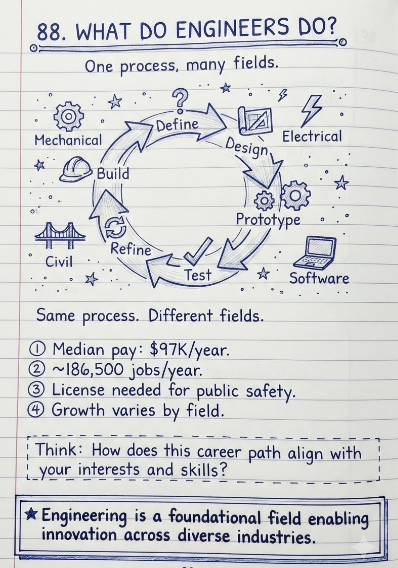
Most engineering projects, regardless of discipline, follow some version of a structured design process — not because it's a rigid rulebook, but because it's a genuinely effective way to avoid costly mistakes discovered too late.
- Define the problem: clarify exactly what needs to be solved, for whom, and under what constraints (budget, timeline, safety requirements, available materials or technology).
- Research and gather requirements: investigate existing solutions, relevant regulations, and any technical or scientific principles that apply to the specific problem.
- Brainstorm and design concepts: generate multiple possible approaches before committing to one, since the first idea isn't always the best one.
- Build a prototype or model: create a physical prototype, a scaled model, a simulation, or (for software) a working minimum version, to test the concept in practice rather than purely in theory.
- Test and evaluate: identify where the design succeeds and where it fails, under realistic conditions rather than only ideal ones.
- Refine and iterate: use test results to improve the design, often cycling back through several rounds of prototyping and testing before finalizing anything.
- Implement and monitor: build, manufacture, construct, or deploy the finished solution, and continue monitoring its real-world performance afterward, since problems can surface only once something is in actual use.
The Major Engineering Disciplines: What Each One Actually Focuses On
'Engineer' branches into dozens of specific disciplines, each applying the same general design process to a genuinely different domain of problems.
| Discipline | What They Actually Work On | U.S. Median Annual Wage (BLS, 2024) | Projected Job Growth (2024–2034) |
|---|---|---|---|
| Mechanical Engineering | Physical machines, engines, tools, HVAC systems, and mechanical components across manufacturing, automotive, and energy industries | $102,320 | 9% (much faster than average) |
| Electrical Engineering | Power generation and distribution systems, electrical equipment, and large-scale electrical infrastructure | $111,910 | 7% (faster than average) |
| Electronics Engineering | Circuit boards, communication equipment, consumer electronics, and semiconductor-based devices | $127,590 | 7% (faster than average, grouped with electrical engineers) |
| Civil Engineering | Roads, bridges, buildings, water systems, and other public infrastructure | ~$95,890 (BLS) | Faster than average, driven by infrastructure investment and maintenance needs |
| Chemical Engineering | Industrial chemical processes, manufacturing, pharmaceuticals, and materials production | $112,100 | Faster than average |
| Aerospace Engineering | Aircraft, spacecraft, satellites, and related systems and components | $130,720 | Faster than average |
| Industrial Engineering | Optimizing processes, workflows, and systems across manufacturing, logistics, and operations | $104,920 | 11% (much faster than average — one of the fastest-growing engineering disciplines) |
| Computer/Software Engineering | Designing, building, and maintaining software systems, applications, and computing hardware | $105,990 (computer occupations, broadly) | Faster than average, particularly for software-focused roles |
| Nuclear Engineering | Nuclear power systems, reactor design and safety, and related regulatory compliance | Comparable to other engineering disciplines | -1.1% (declining, one of the few engineering disciplines projected to shrink) |
This is far from an exhaustive list — biomedical, environmental, agricultural, petroleum, and materials engineering are just a few of the many other recognized disciplines — but it illustrates the range: engineering spans everything from optimizing a factory floor to designing a satellite component, and pay and job growth genuinely differ by specific discipline rather than being uniform across 'engineering' as a single category.
Education and Licensure: What It Actually Takes
- Bachelor's degree: nearly all engineering disciplines require at minimum a bachelor's degree in engineering or a closely related field, typically from a program accredited by ABET (Accreditation Board for Engineering and Technology) in the U.S.
- Fundamentals of Engineering (FE) exam: often taken near graduation or shortly after, this is typically the first step toward professional licensure, testing broad engineering fundamentals.
- Work experience: most licensure paths require several years of supervised, practical experience working under a licensed Professional Engineer before you're eligible to sit for the next licensing exam.
- Professional Engineer (PE) license: required in disciplines where an engineer's work directly affects public safety — most notably civil, structural, and certain other infrastructure-related fields — obtained by passing the Principles and Practice of Engineering (PE) exam after meeting the experience requirement. A PE license allows an engineer to legally sign off on and take responsibility for public-facing engineering work.
- Graduate study (optional but common in some paths): a master's or doctoral degree is common for engineers pursuing research-focused roles, specialized technical leadership, or academic careers, though it isn't required for the majority of practicing engineering roles.
- Continuing education: many licensed engineers are required to complete ongoing professional development to maintain their license and stay current as materials, codes, and technology evolve.
Core Skills Engineers Actually Use
- Mathematical and analytical reasoning: engineering work is fundamentally grounded in applying mathematical and scientific principles to real, physical or technical problems.
- Problem-solving under real constraints: unlike purely academic problem-solving, engineering work always has to account for cost, available materials, safety standards, and time — the 'best' theoretical solution isn't useful if it's not practically achievable.
- Technical tools and software: proficiency in discipline-specific tools — CAD software for mechanical and civil engineers, circuit simulation software for electrical engineers, programming languages for software and computer engineers — is a genuinely core, hands-on part of the job.
- Communication and documentation: translating complex technical work into clear explanations for non-technical stakeholders, clients, and team members is a routine, essential part of nearly every engineering role, not a rare exception.
- Attention to detail: in disciplines tied to public safety and infrastructure especially, small errors in calculations or design can have serious real-world consequences, which makes rigor and careful checking a genuinely non-negotiable habit.
- Adaptability to evolving technology: engineers routinely need to learn new tools, materials, regulations, and — increasingly — AI-assisted design and analysis tools, throughout their careers, not just during their initial education.
Engineer vs. Scientist: What's Actually Different
The two fields are closely related and often confused, but they're generally distinguished by their core goal. Scientists primarily aim to discover and understand how the natural world works — generating new knowledge through research, experimentation, and theory. Engineers primarily aim to apply existing scientific and mathematical knowledge to design, build, and improve practical solutions to specific problems. In practice, the line blurs considerably in research-heavy engineering roles and applied-science roles, but the general distinction — discovering knowledge versus applying it to build something functional — holds as a useful starting point for understanding how the two fields typically differ in focus and day-to-day work.
Where Engineers Actually Work
- Manufacturing and industrial companies, designing and improving physical products and production processes
- Construction and infrastructure firms, particularly for civil and structural engineers overseeing public and private construction projects
- Technology companies, especially for software, computer, and electronics engineers building digital products and hardware
- Energy companies, including traditional utilities and increasingly renewable energy and power infrastructure, particularly relevant for electrical engineers given rising demand tied to data center and grid expansion
- Government agencies, working on public infrastructure, regulatory compliance, defense, and public safety projects
- Consulting firms, providing specialized engineering expertise to clients across multiple industries on a project basis
- Research institutions and universities, particularly for engineers pursuing more research-focused or academic career paths
Conclusion
'What do engineers do?' doesn't have one single answer, because engineering isn't one single job — it's a broad category of disciplines united by a shared approach: apply math, science, and structured problem-solving to design, build, test, and improve real things, within real-world constraints of cost, safety, and practicality. A mechanical engineer prototyping a physical part, an electrical engineer designing power infrastructure, and a software engineer architecting a system are all following recognizably the same underlying process, even though their daily tools and subject matter look completely different.
If you're considering the field, the most useful next step isn't researching 'engineering' broadly — it's researching your specific discipline of interest directly, since pay, job growth, required licensure, and daily work genuinely differ from one engineering discipline to the next, sometimes significantly. The overall field's strong median pay and projected job growth are a reasonable general signal, but the discipline-specific details are what will actually shape your day-to-day work and career trajectory.
FAQ
Frequently Asked Questions
What do engineers do on a typical day?+
Most engineers spend their time on some combination of defining technical problems, designing solutions using specialized software or tools, testing and analyzing whether a design works as intended, troubleshooting existing systems, documenting their work, and collaborating with other engineers, technicians, and non-technical stakeholders. The specific subject matter varies enormously by discipline, but this general mix of activities is common across most engineering roles.
What's the difference between an engineer and a scientist?+
Scientists primarily aim to discover and understand how the natural world works through research and experimentation. Engineers primarily apply existing scientific and mathematical knowledge to design, build, and improve practical solutions to specific problems. The two fields overlap significantly in research-heavy roles, but this discovery-versus-application distinction is a useful general starting point.
How much do engineers make?+
The U.S. Bureau of Labor Statistics reported a median annual wage of $97,310 for engineers in 2024, considerably higher than the $49,500 median for all U.S. occupations. Pay varies significantly by specific discipline — for example, mechanical engineers had a median of $102,320, electrical engineers $111,910, and aerospace engineers $130,720, based on the same BLS data.
Do all engineers need a license?+
No, but it's required in disciplines where an engineer's work directly affects public safety, most notably civil and structural engineering. Engineers in those fields typically need to pass the Fundamentals of Engineering (FE) exam, complete a period of supervised professional experience, and then pass the Principles and Practice of Engineering (PE) exam to become licensed. Many other engineering disciplines, including much of software and industrial engineering, don't require this formal licensure to practice.
What degree do you need to become an engineer?+
Nearly all engineering disciplines require at minimum a bachelor's degree in engineering or a closely related field, typically from an ABET-accredited program in the U.S. A master's or doctoral degree is common for research-focused, highly specialized, or academic engineering career paths, but isn't required for most practicing engineering roles.
Which engineering discipline has the best job outlook?+
Based on recent BLS projections, industrial engineering stands out with an 11% projected growth rate through the next decade, among the fastest of the major engineering disciplines, driven by demand for professionals who can optimize processes and systems across manufacturing and operations. However, most engineering disciplines are projected to grow faster than the average for all U.S. occupations, with nuclear engineering as a notable exception currently projected to decline.
Is engineering a good career choice in 2026?+
By the available data, the field overall looks strong: a median wage nearly double the national average across all occupations, and roughly 186,500 projected annual job openings through 2034 across engineering occupations broadly. That said, outlook and pay vary meaningfully by specific discipline, so it's worth researching your particular field of interest rather than relying only on the aggregate figures for 'engineering' as a whole.
What skills do you need to succeed as an engineer?+
Strong mathematical and analytical reasoning, practical problem-solving within real-world constraints like cost and safety, proficiency in discipline-specific technical tools and software, clear communication for translating technical work to non-technical stakeholders, careful attention to detail, and adaptability to continually evolving tools, materials, and technology throughout a career.
What is the engineering design process?+
It's the structured sequence most engineering projects follow: defining the problem, researching requirements, brainstorming multiple design concepts, building a prototype or model, testing and evaluating it under realistic conditions, refining the design based on those results, and finally implementing and monitoring the finished solution in real-world use.
Can you become an engineer without a traditional engineering degree?+
It depends heavily on the discipline. Software engineering has more flexible entry paths in practice, including self-taught or bootcamp routes for some roles, since it doesn't universally require formal licensure. Most other engineering disciplines, especially those requiring Professional Engineer licensure like civil and structural engineering, generally require a degree from an accredited engineering program as part of the formal licensure path.