What Type of Questions Are Asked in BBA Entrance Exam? A Section-by-Section Breakdown
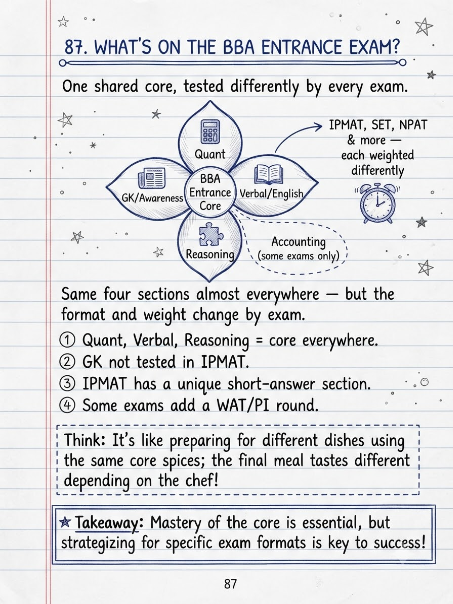
'What questions come in the BBA entrance exam?' sounds like it should have one clean answer, but there isn't a single national BBA entrance exam in India the way JEE exists for engineering. Different universities and management schools run their own separate tests — IPMAT for the IIMs' integrated programs, SET for Symbiosis, NPAT for NMIMS, Christ University's own entrance test, state-level exams like MAH BBA CET, and CUET for Delhi University's BMS and BBA-style programs since DU JAT was discontinued. The good news is that despite running independently, these exams draw from a genuinely small, overlapping set of core sections — so understanding that shared structure gets you most of the way to being prepared for whichever specific exam you're actually taking.
This guide breaks down exactly what each core section tests, how the format and difficulty actually differ between the major exams, what sample questions in each category look like, and how to build a preparation plan around the real structure rather than generic advice.
The 4–5 Core Sections Almost Every BBA Entrance Exam Shares
| Section | What It Actually Tests | Common in Which Exams |
|---|---|---|
| Quantitative Aptitude / Numerical Ability | Arithmetic, percentages, ratios, profit & loss, basic algebra, number systems, data interpretation from tables and charts | Nearly all major BBA exams — IPMAT, SET, NPAT, Christ, MAH BBA CET |
| Verbal / English Ability | Reading comprehension, grammar and sentence correction, vocabulary, para-jumbles, fill-in-the-blanks | Nearly all major BBA exams |
| Logical / Analytical Reasoning | Puzzles, seating arrangements, blood relations, coding-decoding, syllogisms, logical sequences, data sufficiency | Nearly all major BBA exams |
| General Knowledge / General Awareness | Current affairs, business and economic news, static GK, basic awareness of companies and business terms | SET, NPAT, MAH BBA CET, Christ (less emphasized or absent in IPMAT) |
| Fundamental Accounting / Business Aptitude | Basic accounting concepts, business terminology, elementary case-based business judgment | Christ University Entrance Test, some state and private university exams |
The pattern worth noticing here: Quant, Verbal, and Reasoning form the backbone of virtually every BBA entrance exam, while General Knowledge and Business/Accounting content are the sections most likely to be present in one exam and absent (or minimized) in another. That's exactly why checking your specific target exam's official pattern matters — a strong GK-focused prep plan is wasted effort if you're specifically targeting IPMAT, which barely touches it.
Section-Wise Question Types, With Examples
Quantitative Aptitude / Numerical Ability
This section tests whether you can work confidently with numbers under time pressure, generally at a level built on strong Class 10–12 mathematics rather than requiring anything beyond that. Typical question types include:
- Percentage, profit-loss, and ratio-proportion problems set in everyday or business-style scenarios
- Time, speed, and distance, and time-and-work problems
- Number system questions (divisibility, HCF/LCM, remainders)
- Data interpretation questions built around tables, bar graphs, or pie charts, requiring quick calculation rather than deep statistical knowledge
- In IPMAT specifically, a distinct short-answer (non-MCQ) Quantitative Ability component, where you type in a numerical answer rather than choosing from options — meaning guessing or elimination strategies don't work the same way they do on MCQ sections
Verbal / English Ability
This section evaluates reading comprehension and command of English grammar and vocabulary, generally through:
- Reading comprehension passages followed by inference, vocabulary-in-context, and main-idea questions
- Grammar-based questions: error identification, sentence correction, and correct usage
- Vocabulary questions: synonyms, antonyms, and word usage in context
- Para-jumbles, where you rearrange scrambled sentences into a logically ordered paragraph
- Fill-in-the-blank questions testing both grammar and appropriate word choice
Logical / Analytical Reasoning
This section tests structured, pattern-based thinking rather than subject knowledge, through question types such as:
- Seating arrangement and puzzle-based questions (linear, circular, or grid arrangements based on given clues)
- Blood relation and family-tree questions
- Coding-decoding, where letters or numbers follow a pattern you need to decipher
- Syllogisms and logical deduction questions
- Series completion (number series, letter series) and logical sequencing
- Data sufficiency questions, which ask whether given statements are sufficient to answer a question, rather than asking you to solve it outright
General Knowledge / General Awareness
Where this section appears, it generally covers a mix of current affairs and static general knowledge, weighted toward business and economic relevance:
- Recent national and international news and current events
- Business and economic current affairs — major corporate news, government economic policy, market developments
- Basic static GK: important organizations, notable figures, geography-adjacent business facts
- Elementary awareness of well-known companies, brands, and business terminology
Fundamental Accounting / Business Aptitude (Where Applicable)
A smaller number of exams — Christ University's entrance test is a notable example — include a dedicated accounting or business-aptitude section, covering:
- Basic accounting concepts: journal entries, ledger fundamentals, and simple financial statement concepts
- Elementary business terminology and concepts (supply and demand, basic marketing and management terms)
- Short business-scenario or case-style questions testing practical judgment rather than memorized theory
How the Major BBA Entrance Exams Actually Differ
| Exam | Core Sections | Format Notes |
|---|---|---|
| IPMAT (IIM Indore) | Quantitative Ability (MCQ), Quantitative Ability (Short Answer), Verbal Ability (MCQ) | No GK section; includes a unique short-answer Quant component; fixed section order for all candidates; typically +4 for correct, −1 for incorrect (no negative marking on the short-answer section) |
| IPMAT (IIM Rohtak) | Quantitative Ability, Logical Reasoning, Verbal Ability | Format and question count can differ from the Indore version — always check the specific year's official pattern |
| SET (Symbiosis, for BBA) | Analytical & Logical Reasoning, General Awareness, Quantitative Aptitude, General English | All MCQ, no negative marking; typically followed by a Writing Ability Test/Personal Interaction (WAT/PI) round for shortlisted candidates |
| NPAT (NMIMS) | Quantitative & Numerical Ability, Reasoning & General Intelligence, Proficiency in English | No dedicated GK section in the core test; MCQ format |
| Christ University Entrance Test | Fundamental Accounting, English, General Knowledge, Mathematics, Reasoning, Data Analysis and Interpretation | One of the broader section lists among major BBA exams, including a distinct accounting component |
| MAH BBA/BMS CET (Maharashtra) | Reasoning (Verbal and Arithmetic), General Knowledge and Awareness, plus additional sections per official notification | State-level exam; check the current year's official notification for the complete, current section list |
| CUET (for DU BMS/BBA-style programs) | General Test (Quantitative, Reasoning, General Awareness) plus relevant domain subject papers | Conducted by NTA; replaced Delhi University's earlier standalone DU JAT exam for these programs |
How Difficult Are BBA Entrance Exams, Really?
Across most sources and past-year feedback, BBA entrance exams are generally considered easy-to-moderate in difficulty — built primarily around strong Class 12-level concepts rather than the kind of advanced, specialized material found in postgraduate management entrance exams like CAT. This doesn't mean the exams are trivial: competition for seats at well-regarded institutions can still be significant, since a large applicant pool is competing for a comparatively small number of seats. In practice, this means the differentiator for most candidates isn't raw difficulty — it's consistency, accuracy under time pressure, and thorough, section-wise practice, rather than needing exceptionally advanced subject knowledge.
How to Prepare for Each Section
- Start with your specific target exam's official pattern, not a generic 'BBA exam' pattern — confirm the exact sections, question count, and marking scheme directly from the official website before building your study plan.
- For Quant, drill fundamentals first (percentages, ratios, basic algebra) before moving to timed practice sets, and if you're targeting IPMAT specifically, practice short-answer (non-MCQ) numerical questions separately, since you can't rely on elimination strategies there.
- For Verbal, read consistently (newspapers, editorials, varied short articles) to build both vocabulary and comprehension speed, alongside dedicated grammar review.
- For Reasoning, practice puzzle and arrangement questions repeatedly under timed conditions — this section rewards pattern recognition built through repetition more than any single trick or shortcut.
- For General Knowledge, build a consistent daily habit of reading current affairs, with particular attention to business and economic news, rather than last-minute cramming, since GK retention compounds over weeks and months far better than it does over days.
- If your target exam includes an interview or writing round (like SET's WAT/PI), don't neglect that stage in your preparation — practice structured, concise written arguments and comfortable, clear verbal communication on current business topics.
- Take full-length, timed mock tests specific to your target exam as your preparation progresses, since section order, time pressure, and question style genuinely differ between exams, and a mock built for one exam won't fully prepare you for another's specific format.
Conclusion
There's no single, universal answer to 'what questions are asked in the BBA entrance exam,' because there's no single BBA entrance exam — but there is a shared core worth understanding regardless of which specific test you're targeting: Quantitative Aptitude, Verbal Ability, and Logical Reasoning form the backbone of nearly every major exam, with General Knowledge and Business/Accounting content layered on top in some, and IPMAT's distinct short-answer Quant format setting it apart from the mostly-MCQ pack.
The most efficient path forward is building general strength across those shared core sections first, then confirming and adapting to your specific target exam's exact pattern, marking scheme, and any additional rounds (like a WAT/PI) well before exam day — rather than assuming one generic BBA prep plan covers every exam equally well.
FAQ
Frequently Asked Questions
What are the main sections in a BBA entrance exam?+
Most major BBA entrance exams in India are built around four core sections: Quantitative Aptitude/Numerical Ability, Verbal/English Ability, Logical/Analytical Reasoning, and General Knowledge/General Awareness. Some exams, including Christ University's entrance test, add a Fundamental Accounting or Business Aptitude section as well.
Is BBA entrance exam maths hard?+
Generally no — the Quantitative Aptitude sections in most BBA entrance exams are built on strong Class 10–12 level mathematics (percentages, ratios, basic algebra, time-speed-distance) rather than advanced, specialized topics. IPMAT is a partial exception, since it includes a distinct short-answer Quant component that requires typing in a numerical answer rather than selecting from multiple-choice options.
Does every BBA entrance exam include a General Knowledge section?+
No. GK/General Awareness appears in exams like SET, NPAT-adjacent programs, MAH BBA CET, and Christ University's test, but IPMAT does not include a dedicated GK section, focusing instead on Quantitative and Verbal Ability. Always check your specific target exam's official pattern rather than assuming GK is universal.
What is the difference between IPMAT and other BBA entrance exams?+
IPMAT (conducted separately by IIM Indore and IIM Rohtak) is distinct in a few ways: it doesn't include a General Knowledge section, it follows a fixed section order for all candidates, and — specifically for the Indore version — it includes a unique short-answer (non-MCQ) Quantitative Ability component alongside the more typical MCQ sections.
Is there negative marking in BBA entrance exams?+
It varies by exam. IPMAT typically applies negative marking on its MCQ sections (commonly -1 for an incorrect answer against +4 for correct), while exams like SET are commonly structured with no negative marking at all. Always confirm the exact marking scheme from your specific exam's official notification before test day.
Do BBA entrance exams include an interview round?+
Several do. SET, for example, typically follows its written exam with a Writing Ability Test and Personal Interaction (WAT/PI) round for shortlisted candidates. Not every BBA entrance exam includes this stage, so check your specific target institution's complete selection process, not just the written exam pattern.
How should I prepare differently for IPMAT versus SET or NPAT?+
For IPMAT, prioritize Quantitative Ability (including dedicated short-answer, non-MCQ practice) and Verbal Ability, since General Knowledge isn't tested. For SET and NPAT, build a more even preparation across Quant, Verbal, Reasoning, and General Knowledge/Current Affairs, since these exams weight GK more heavily, and for SET specifically, also prepare for the WAT/PI round that follows the written test.
Has DU JAT been replaced?+
Yes. Delhi University's earlier standalone DU JAT exam has been discontinued, and admission to DU's BMS and similar BBA-style programs now runs through CUET (Common University Entrance Test), conducted by the National Testing Agency (NTA), combined with the relevant domain subject papers.
How difficult are BBA entrance exams compared to exams like CAT?+
BBA entrance exams are generally considered easier and more accessible than postgraduate management entrance exams like CAT, built primarily on strong Class 12-level concepts rather than advanced, specialized material. That said, competition for seats at well-regarded institutions can still be significant given the large applicant pool relative to available seats, so thorough, consistent preparation still matters.
What is the best way to prepare for the Logical Reasoning section?+
Consistent, timed practice with puzzle-based question types — seating arrangements, blood relations, coding-decoding, and syllogisms — is the most effective approach, since this section rewards pattern recognition built through repeated exposure rather than any single formula or shortcut. Reviewing your mistakes on practice sets to identify recurring error patterns is generally more valuable than simply attempting a high volume of questions without review.