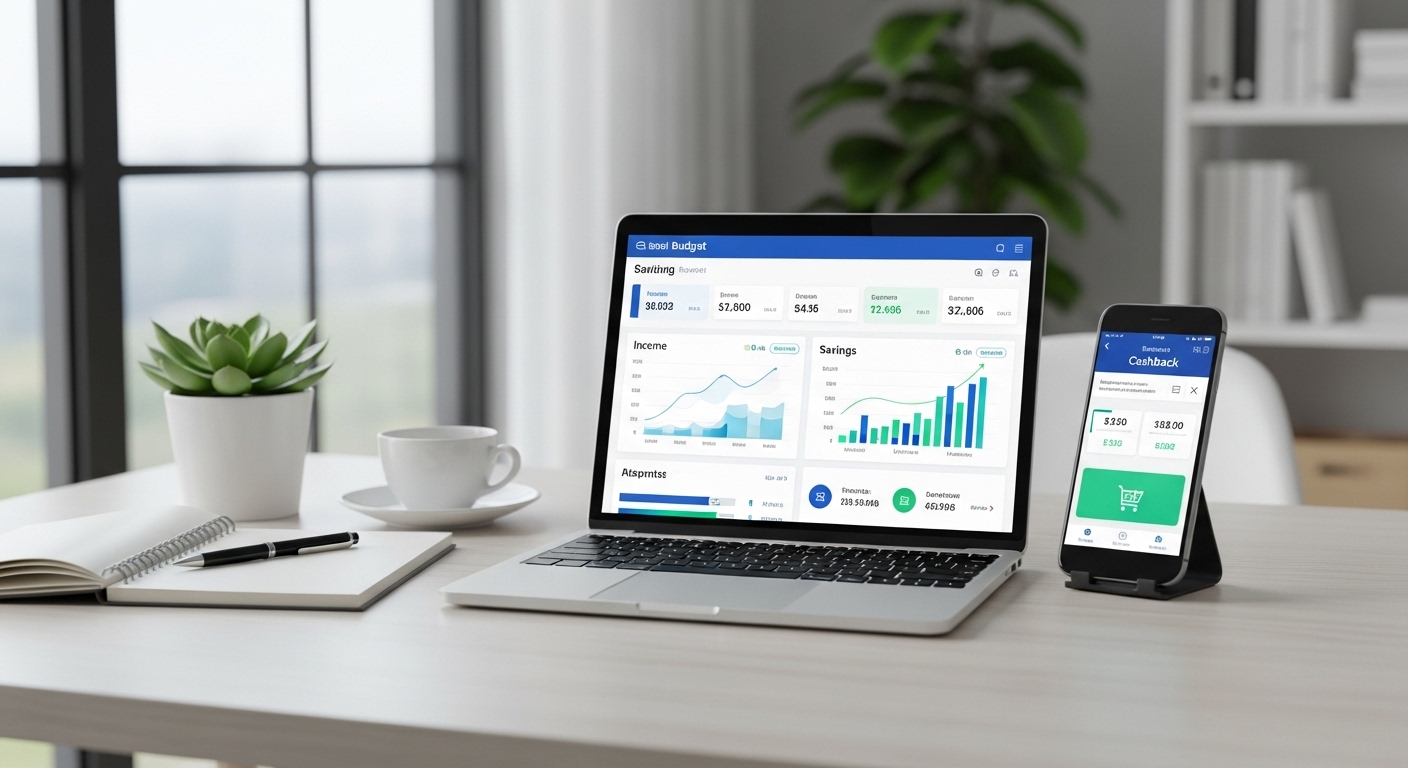
Here is a number that might surprise you: the average Indian household with two UPI-active smartphones is subscribed to between 8 and 12 paid digital services simultaneously — streaming platforms, cloud storage, fitness apps, music subscriptions, gaming passes. Many of those subscriptions were signed up for during a free trial and never cancelled. At ₹150 to ₹800 per service per month, that is anywhere from ₹1,200 to nearly ₹10,000 leaving your account every month for services you may barely use. That is the modern money problem in a nutshell. The digital economy makes spending invisible. A ₹49 Spotify charge barely registers. A ₹199 Prime renewal goes unnoticed. A ₹99 cloud storage upgrade feels trivial. But these small, forgotten charges compound into a serious financial leak — one that budgeting apps, cashback platforms, and a handful of smart digital habits can completely plug. Learning how to save money online is not about extreme frugality or giving up things you enjoy. It is about building digital awareness — knowing exactly where your money goes, capturing cashback you are already entitled to, switching to accounts that pay you better interest, and automating savings so they happen whether you remember or not. Done right, these habits can recover ₹20,000 to ₹80,000 per year for a typical Indian household — money that was already being earned, just silently lost. This guide moves from absolute beginner steps to advanced wealth-building strategies. It covers real Indian apps with actual pricing, verified savings account interest rates for 2026, proven cashback platforms, and the specific mistakes that cause most people's online savings efforts to fail. Whether you are a college student managing ₹10,000 a month or a working professional handling multiple income streams, this guide has a system that fits your situation.
What Does It Mean to Save Money Online?
Saving money online refers to the deliberate use of digital tools and platforms to reduce expenses, capture savings opportunities, automate wealth-building habits, and grow money more efficiently than traditional methods allow. This is different from the old concept of saving money, which involved physical envelopes, handwritten ledgers, or mentally tracking expenses. Online money management works in real time — every UPI payment, every card swipe, every subscription renewal is logged, categorized, and visible the moment it happens. The first principle of saving money online is visibility. Most people who feel they "can never save" are not actually spending too much — they are spending without awareness. When you cannot see that you spent ₹3,400 on food delivery last month, you cannot make a conscious choice to reduce it. The moment an app shows you that number clearly, behavior starts to shift almost automatically. The second principle is automation. Human psychology is not naturally wired for consistent saving. We intend to transfer money to savings at the end of the month, but life gets in the way. Automating a savings transfer on payday — before the money is visible in your spending account — removes this friction entirely. Research consistently shows that people who automate savings accumulate significantly more than those who try to save from what is left over. The third principle, specific to the digital economy, is capture. Cashback platforms, reward credit cards, coupon extensions, and price comparison tools allow you to recover 2–15% of spending you were going to do anyway. This is not extra effort — it is simply routing the same purchase through a smarter channel that gives you money back. Together, these three principles — visibility, automation, and capture — form the complete system for how to save money online effectively in 2026.
Beginner Strategies: Build Your Digital Savings Foundation
If you are starting from zero — no budget, no tracking, no savings habit — these five steps will create more financial improvement in 30 days than most people achieve in a year of vague intentions. Work through them in order.
Types of Online Saving Methods — Full Comparison
Online savings strategies range from zero-effort passive methods to more active approaches requiring regular attention. Understanding each category helps you build a system matched to your time, discipline level, and financial goals.
| Saving Method | How It Works | Savings Potential | Effort Required | Risk Level |
|---|---|---|---|---|
| Cashback Programs | Earn a percentage of purchase value back through partnered platforms like CashKaro, GoPaisa, Hyyzo | 2–50% per transaction depending on retailer | Low — install app, shop normally | Very Low |
| Coupon Stacking | Combine promo codes + seasonal offers + cashback + credit card rewards in one purchase | 5–40% per purchase when all layers applied | Medium — requires checking multiple sources | Low |
| High-Yield Savings Accounts | Move money to accounts offering 5–7.5% annual interest instead of 2.5% at SBI | Up to ₹4,000–₹5,000 extra per year on ₹1 lakh | Very Low — one-time account opening | Very Low (DICGC insured up to ₹5 lakh) |
| Subscription Management | Audit and cancel unused recurring digital payments | ₹500–₹3,000 monthly recovery for most households | Low — one-time audit, quarterly reviews | None |
| Automated Savings Transfers | Standing instructions to move fixed amount to savings on payday | Depends on amount set — fully controllable | Very Low — one-time setup | Very Low |
| Price Comparison Shopping | Use tools like SmartPrix (electronics), Google Shopping, JustWatch (OTT) before purchasing | 5–20% on major purchases | Low — a 2-minute search before checkout | None |
| Mutual Funds via SIP (Digital) | Invest ₹500+ monthly in index funds through ET Money, Groww, Zerodha Coin | 10–14% average long-term CAGR historically | Low after initial setup — automated SIPs | Moderate — market-linked returns |
| Reward Credit Cards | Earn points, miles, or cashback on every transaction, redeemable for travel, products, or statement credit | 1–5% effective return on spending | Low — use card normally, redeem periodically | Low — if paid in full monthly |
Best Budgeting Apps for Indians in 2026
India's budgeting app landscape in 2026 is mature and genuinely excellent — several apps are specifically designed for the Indian UPI and SMS-based transaction ecosystem, making them far more useful for Indian users than global alternatives like Mint or YNAB.
| App | Best For | Key Feature | Bank Sync | Cost | Limitation |
|---|---|---|---|---|---|
| ET Money | Salaried professionals wanting budgeting + investing in one app | Mutual fund SIPs, tax planning, net worth tracking alongside expense tracking | Yes — UPI + SMS | Free (premium features paid) | Feature-heavy for pure beginners; can feel overwhelming |
| Walnut (Axio) | Heavy UPI/SMS users wanting automatic tracking with zero manual entry | Auto-reads SMS alerts and categorizes transactions instantly | Yes — SMS-based | Free | May misread ambiguous SMS; no advanced investment features |
| Money View | Users who want expense tracking plus credit/loan insights | Auto expense tracking via SMS + basic credit score monitoring | Yes — SMS-based | Free | Loan product suggestions can feel intrusive |
| Goodbudget | Couples and families who prefer the envelope budgeting method | Virtual envelope system — allocate fixed amounts per category | No (manual entry only) | Free (basic); ₹3,300/year premium | No automation; requires manual transaction entry |
| Monefy | Minimalists who want simple, visual expense tracking | Clean UI, widget support, quick-add transactions | Manual | Free (paid version ~₹450) | No bank sync; limited to manual use |
| YNAB (You Need A Budget) | Advanced users who want strict zero-based budgeting | Every rupee gets a job — powerful for debt elimination | Yes (limited India support) | $109/year (~₹9,000) | Expensive; overkill for most Indian users |
Cashback Platforms That Actually Pay in India
Cashback platforms work on a simple affiliate model: when you shop through their link, the retailer pays the platform a commission, and the platform shares a portion of that commission with you as cashback. You get real money back on purchases you were going to make anyway. The platforms are free. The cashback is real and withdrawable directly to your bank account. Here are the verified top cashback platforms for Indian shoppers in 2026:
| Platform | Top Cashback Rate | Partner Stores | Withdrawal Method | Unique Advantage |
|---|---|---|---|---|
| CashKaro | Up to 50% on select stores | 1,500+ brands including Amazon, Flipkart, Myntra, Nykaa, MakeMyTrip | Direct bank transfer, Amazon Pay, Flipkart Gift Cards | India's largest platform — backed by Ratan Tata. Has paid ₹700+ crore to users. Average user saves ₹50,000 annually according to platform data. |
| GoPaisa | Competitive rates across 1,500+ brands | Amazon, Flipkart, Myntra, Nykaa, MMT, Boat, WOW and more | Bank transfer, wallet | Strong coupon stacking alongside cashback — combine promo codes with cashback for maximum savings |
| Hyyzo | Up to 20% on select stores | 200+ major brands including Amazon, Myntra, Flipkart | Direct UPI withdrawal | Fast-rising platform with high cashback percentages; no points — withdraws as real cash via UPI |
| CouponDunia | Varies by store | Major Indian e-commerce and service platforms | Bank transfer | Strong for finding coupon codes in addition to cashback — good for coupon stacking strategy |
| Magicpin | Varies | Online + offline — includes restaurants, physical retail | Magicpin credits, bank transfer | Unique for covering both online and offline spending — useful for dining and physical store rewards |
| Google Pay / PhonePe Rewards | Varies by offer | Partnered with major payment ecosystems | Wallet or bank credit | Built into apps most Indians already use — no extra installation required |
High-Yield Savings Accounts: Where to Park Your Money in India
One of the simplest and most overlooked ways to save money online is to simply stop leaving money in an account that pays almost nothing in interest. SBI — where most Indians have their primary salary account — currently pays 2.50% per annum on savings deposits. That is below India's average inflation rate, meaning your parked money is effectively losing purchasing power every year. Several private and small finance banks in India offer dramatically higher rates — all fully regulated by RBI, all with DICGC deposit insurance up to ₹5 lakh per account holder per bank. Here is the verified rate comparison as of early 2026:
| Bank | Savings Account Interest Rate (2026) | Zero Balance Option? | Best For |
|---|---|---|---|
| IDFC FIRST Bank | Up to 6.50% p.a. (w.e.f. January 9, 2026) | Yes — monthly interest credits | Best overall rate among mainstream private banks; zero-fee banking |
| Small Finance Banks (Ujjivan, AU, ESAF) | Up to 7.50% p.a. on higher balance slabs | Varies by variant | Highest available rates in India; ideal for emergency fund parking |
| Kotak Mahindra Bank (811 account) | Up to 4% p.a. | Yes — fully digital, zero balance | Best for fully digital zero-balance account with good mobile app |
| YES Bank | Competitive tiered rates | Varies | Mid-market customers seeking meaningful returns without FD lock-in |
| Axis Bank | 3.0–3.5% p.a. (w.e.f. June 28, 2025) | Varies by variant | Established private bank with good digital infrastructure |
| HDFC Bank | Standard rate | Varies | For those who want a leading private bank's ecosystem, not the highest rate |
| SBI | 2.50% p.a. (uniform across balances) | Yes (Jan Dhan / BSBD accounts) | Salary account; not recommended for parking savings |
Intermediate Optimization: Coupon Stacking & Smart Shopping
Once your foundational systems are in place — budgeting app tracking, cashback platform installed, high-yield account open, subscriptions audited — the next level is optimizing each purchase for maximum savings through a technique called coupon stacking. Coupon stacking means combining multiple discount mechanisms on a single transaction to maximize the total savings percentage. Done within platform policies (which permit combining discounts when the terms do not explicitly restrict it), this can reduce effective purchase prices by 20 to 40%. Here is how a complete stacked purchase looks in practice: A pair of running shoes listed at ₹4,500 on Myntra during the End of Reason Sale: — Base sale discount: ₹4,500 → ₹3,200 (29% off) — Myntra promo code applied at checkout: ₹3,200 → ₹2,880 (10% additional off) — HDFC credit card offer for Myntra: additional 10% instant discount → ₹2,592 — CashKaro cashback (8% on Myntra during sale): ₹207 back to bank account — Effective final price: ₹2,385 on a ₹4,500 product — 47% total saving The shoes were going to be bought. The only difference is the purchase was routed through three additional steps that captured discounts available to anyone who knew to look.
Advanced Wealth Building Online
Once you have implemented the foundational and intermediate strategies, you have plugged most financial leaks and are consistently capturing available savings. The next stage shifts from defensive savings to offensive wealth-building — using online platforms to make your money work harder and create additional income streams.
- Automate multiple savings buckets with specific goals: Rather than one general savings account, create named goal accounts for specific purposes — Emergency Fund, Travel, Annual Expenses (insurance premiums, car service, laptop), and Investment Overflow. ET Money, HDFC's SmartSave, and Kotak's 811 all support multiple goals-based savings accounts. Psychologically, named accounts with specific targets are significantly less likely to be raided for impulse spending than a generic 'savings' bucket.
- Start a monthly SIP in a diversified index fund: A Systematic Investment Plan in a Nifty 50 or Nifty 500 index fund through ET Money, Groww, or Zerodha Coin is the most reliably documented wealth-building tool available to Indian retail investors. Starting at ₹500 per month, SIPs benefit from rupee cost averaging and the compounding effect over 5 to 10 years. Historically, broad Indian market index funds have delivered 10 to 14% CAGR over 10-year periods — far exceeding savings account interest or fixed deposit returns.
- Implement zero-based digital budgeting monthly: Zero-based budgeting assigns every rupee of income a specific purpose before the month begins — rent, groceries, savings, investment, entertainment, each getting a defined allocation. YNAB is the most powerful tool for this internationally; in India, ET Money's budget feature or a well-structured Excel/Google Sheets template works effectively. When every rupee has a designated job, unplanned spending has nowhere to hide.
- Track your net worth monthly using a digital dashboard: Net worth is total assets minus total liabilities. Use ET Money's net worth tracker or a personal spreadsheet to log your savings balance, investment portfolio value, any property, minus outstanding loans, credit card balances, and EMIs. Reviewing this number monthly — even if it is initially negative due to student loans or a home loan — creates powerful motivation and helps you see that the daily small savings decisions are adding up to something real.
- Build one passive income stream using online platforms: Passive income does not mean zero effort — it means building something once that generates recurring income. The most accessible options for Indian digital users include: affiliate marketing through EarnKaro (share product links, earn commission on purchases your network makes), selling digital products on Instamojo or Gumroad (notes, templates, guides, presets), dividend-paying mutual funds or stocks through platforms like Groww or Zerodha, or monetizing expertise through Udemy or YouTube. Even ₹3,000 to ₹5,000 per month in passive income meaningfully changes a household savings rate.
- Optimize your credit card strategy for maximum rewards: If you use a credit card and pay it in full every month (zero interest), you are either earning rewards on your spending or you are not. Top reward cards for Indian users include the Amazon Pay ICICI card (5% cashback on Amazon, 2% on other purchases — lifetime free), the HDFC Millennia card (5% cashback on online transactions), and the Flipkart Axis Bank card (5% cashback on Flipkart, 4% on food delivery apps). Used as a debit card substitute and paid in full monthly, these cards effectively give you a 2 to 5% discount on all spending.
Common Risks & Mistakes to Avoid
Even people who actively try to save money online make predictable mistakes that undermine their progress. Understanding these pitfalls in advance protects both your finances and your digital security.
- Falling for fake cashback and phishing websites: Not every site claiming to offer cashback is legitimate. Fraudulent sites mimic the design of CashKaro or GoPaisa but exist solely to steal login credentials or banking information. Always verify you are on the correct domain before entering any personal or financial details. Bookmark legitimate cashback platforms rather than searching for them each time — search results can be manipulated with deceptive paid ads.
- Using unsecured public Wi-Fi for financial transactions: Conducting net banking, UPI transfers, or entering card details on public Wi-Fi — in cafes, airports, or malls — exposes your data to potential interception. Use mobile data or a trusted VPN for all financial transactions. This is non-negotiable if you are serious about digital financial security.
- Ignoring hidden fees on financial products: Many 'free' financial apps, robo-advisors, and investment platforms charge fees that are not prominently displayed. A 1% annual management fee on a ₹5 lakh portfolio costs ₹5,000 per year — significant over a decade. Always read the fee schedule of any financial product before committing. For mutual funds, choose Direct plans (available on Groww, Zerodha Coin, ET Money) over Regular plans — the difference in expense ratio compounds to meaningful savings over time.
- Saving without investing — the inflation erosion mistake: Money sitting in a savings account earning 3 to 4% while inflation runs at 5 to 6% is not growing — it is slowly losing value. Saving without investing is necessary for short-term goals and emergencies, but for any money you will not need for more than three years, keeping it in a savings account is genuinely suboptimal. A monthly SIP in a broad index fund is the most accessible next step for most Indian savers.
- Carrying a credit card balance month to month: Credit cards are excellent financial tools when paid in full every month. They become destructive financial instruments the moment you carry a balance. Indian credit cards charge 24 to 48% annual interest on unpaid balances — among the highest rates of any financial product available. If you currently carry a credit card balance, eliminating it takes priority over any other savings strategy mentioned in this guide.
- Over-optimizing at the expense of consistency: Some people spend more time researching the perfect budgeting app than actually using any app. Or they optimize their cashback strategy so obsessively that shopping becomes a research project. The goal is a sustainable system, not perfection. A decent budgeting app used consistently beats a perfect app used for two weeks. Start simple, build habits, and optimize gradually.
Future of Online Saving & Fintech in India
India's fintech ecosystem in 2026 is one of the most innovative in the world — driven by the UPI infrastructure that processes over 10 billion transactions per month, the Aadhaar-based digital identity system, and a young, digitally native population actively seeking better financial tools. Several developments are reshaping how Indians will save money online in the coming years.
- Account Aggregator framework expanding financial visibility: The RBI's Account Aggregator framework allows users to securely share financial data across banks, insurance companies, mutual funds, and pension accounts — with explicit consent — enabling genuinely comprehensive net worth tracking and budgeting. As more institutions join the framework, apps like ET Money and Perfios will offer increasingly powerful financial dashboards that eliminate the need to log into multiple platforms.
- AI-powered personalized savings recommendations: Budgeting apps are increasingly deploying machine learning to analyze spending patterns and provide proactive recommendations — 'You spent 40% more on food delivery this month than your average; here is ₹1,200 you could redirect to your Europe trip goal.' As of 2026, ET Money and Axio have begun piloting these features. Expect this to become standard across major platforms within 12 to 18 months.
- Unified Payments Interface evolution (UPI Lite, Credit on UPI): UPI Lite enables offline small-value payments, removing the dependency on internet connectivity for everyday transactions. Credit on UPI — which allows pre-approved credit lines to be accessed directly through UPI without a physical card — will change how Indians manage short-term liquidity needs and could reduce expensive credit card debt for some users.
- Expansion of micro-investment products: SEBI's regulatory sandbox has enabled smaller-ticket investment products — including digital gold purchases starting at ₹1, fractional shares, and daily SIP options — that make investing accessible at income levels where it was previously impractical. This democratization of investing will be one of the most significant financial developments for India's middle class over the next five years.
- Stronger regulation of fraudulent financial platforms: The RBI and SEBI have significantly increased enforcement against illegal investment schemes, fraudulent cashback platforms, and unregistered financial advisors operating online. Expect stricter KYC requirements, transaction monitoring, and consumer protection frameworks across all digital financial platforms — making the legitimate ecosystem safer while weeding out bad actors.
- Open Banking and embedded finance integration: Financial services are increasingly being embedded directly into non-financial apps — insurance sold at checkout when buying a gadget, investment products offered within a salary management interface, savings goals linked to purchase behavior. This integration reduces friction in saving and investing, which behavioral economics consistently shows leads to higher participation rates.
FAQs
What is the best way to save money online in India in 2026?
The most effective system combines five elements working together: a budgeting app (ET Money or Walnut) to make spending visible, a subscription audit to eliminate unused recurring charges, a cashback platform (CashKaro) active before every online purchase, a high-yield savings account (IDFC FIRST at 6.5% pa) for your emergency fund, and an automated savings transfer set up on payday. Most people who implement all five see a 15 to 30% improvement in monthly savings within 60 days, without any reduction in lifestyle quality. Start with whichever step feels easiest — even one change creates momentum.
How can I save money while shopping online in India?
The highest-impact strategy is coupon stacking — combining multiple discount layers on a single purchase. The sequence is: (1) check CashKaro for the cashback rate on your target retailer, (2) click through CashKaro to the retailer, (3) apply any promo codes found on CouponDunia at checkout, (4) check your credit card's merchant offers page for additional instant discounts, (5) complete the purchase. On major sales like Amazon's Great Indian Festival or Myntra's EORS, this stacking approach can reduce effective prices by 30 to 50% compared to the listed sale price.
Is CashKaro legitimate and safe to use in India?
Yes, CashKaro is a legitimate and well-established platform, backed by Ratan Tata and operating since 2013. It has paid out over ₹700 crore in cashback to Indian users and partners with 1,500+ brands including Amazon and Flipkart. The platform works on an affiliate commission model — retailers pay CashKaro for driving sales, and CashKaro shares that commission with users. The main limitation is occasional tracking delays or missed tracking for certain transactions, which the platform resolves through a claims process. Always save your order receipts until cashback is confirmed. Other reliable platforms include GoPaisa, Hyyzo, and CouponDunia.
How much money can I realistically save online each month in India?
A realistic monthly saving from implementing the strategies in this guide depends on your current spending habits, but the breakdown typically looks like this: subscription audit recovers ₹500 to ₹2,500; cashback on online shopping returns ₹200 to ₹1,500; high-yield savings account upgrade generates ₹300 to ₹700 extra interest per month on a ₹1 to 2 lakh emergency fund; impulse purchase reduction from budgeting awareness saves ₹500 to ₹3,000. Total combined improvement for a typical Indian household: ₹1,500 to ₹7,700 per month — or ₹18,000 to ₹92,000 per year, without any reduction in quality of life.
Which Indian bank offers the highest savings account interest rate in 2026?
As of early 2026, IDFC FIRST Bank offers up to 6.50% per annum on savings accounts (updated January 9, 2026) — among the highest rates from a mainstream private bank in India. Several small finance banks including Ujjivan, AU Small Finance Bank, and ESAF offer even higher rates of up to 7.50% on certain balance slabs. All deposits up to ₹5 lakh per depositor per bank are insured by DICGC, including at small finance banks — the same guarantee that covers SBI deposits. Compare this to SBI's current rate of 2.50% and the case for switching becomes clear.
Is it safe to connect my bank account to budgeting apps like ET Money or Walnut?
Reputable Indian budgeting apps like ET Money, Walnut (Axio), and Money View use bank-grade encryption and read-only access — they can view your transaction history but cannot initiate transfers or payments. However, one important security note from a 2024 Outlook Business investigation: some finance apps can access SMS messages, photos, and OTPs and may share data with third parties. Before granting permissions, review what each app actually requests access to and read their privacy policy. For maximum security, apps that read SMS alerts (rather than linking directly to bank accounts) are generally considered lower-risk. Enable two-factor authentication on both your banking app and any budgeting app you use.
What is a high-yield savings account and should I open one in India?
A high-yield savings account is simply a regular savings account that pays significantly higher interest than the national average. In India, the 'average' has been pulled down by SBI's 2.50% rate — but private and small finance banks offer 5 to 7.5%, and there is no practical trade-off in terms of safety (DICGC insures both equally up to ₹5 lakh). For most Indians, opening a second savings account at IDFC FIRST Bank or a small finance bank specifically for emergency fund and short-term savings parking is a straightforward decision that generates meaningful extra interest with zero additional effort after the one-time setup.
How do I build passive income online in India starting with small amounts?
The most accessible starting points for passive income online in India are: (1) EarnKaro — share affiliate links with your social network, earn commission on purchases they make; requires zero investment. (2) Monthly SIP in a dividend-paying mutual fund through Groww or Zerodha Coin — ₹500/month starts building a portfolio that pays dividends over time. (3) Digital product creation — notes, resume templates, Canva templates, cooking guides sold on Instamojo or Gumroad; one-time creation effort for ongoing sales. (4) YouTube or Instagram content — requires consistency over 6 to 12 months before meaningful monetization, but has no entry cost. Passive income is rarely truly passive initially — it requires upfront work, but once established, it meaningfully changes your household savings rate.
What are the biggest mistakes people make when trying to save money online?
The five most common and costly mistakes are: (1) Auditing subscriptions once and never again — services renew, trial periods end, and new subscriptions sneak in. Set a calendar reminder for quarterly subscription reviews. (2) Saving without investing — money in a savings account is losing real value to inflation; move anything with a 3+ year horizon into a diversified index fund. (3) Carrying a credit card balance — 24 to 48% annual interest eliminates any savings gains elsewhere; paying off a card balance is the highest guaranteed return available. (4) Using savings apps for two weeks then abandoning them — consistency matters more than the choice of app; any budgeting app used for 3 months builds awareness that sticks. (5) Chasing complex strategies before mastering basics — coupon stacking and robo-advisors are useful, but not before you know your monthly spending, have an emergency fund, and have cancelled unused subscriptions.
Can automation really help me save more money, or is it just marketing hype?
Automation is not hype — it is one of the most rigorously researched behavioral finance concepts available. The core finding, replicated across dozens of studies and implemented in retirement policy in the UK and US, is that default saving behavior dramatically outperforms intentional saving behavior. When a transfer happens automatically on payday, you adapt your spending to what remains. When you have to manually decide to save at month-end, competing demands almost always win. In practical terms, people who automate savings consistently accumulate 30 to 50% more over 5 years than those with the same income and intention who save manually. Set up the automation — even at ₹500 per month — and increase the amount over time as your expenses become more controlled.