Gold Rate Explained: Why Gold Prices Are Rising Continuously in 2025–2026
Gold Rate Explained: Why Gold Prices Are Rising Continuously in 2025–2026
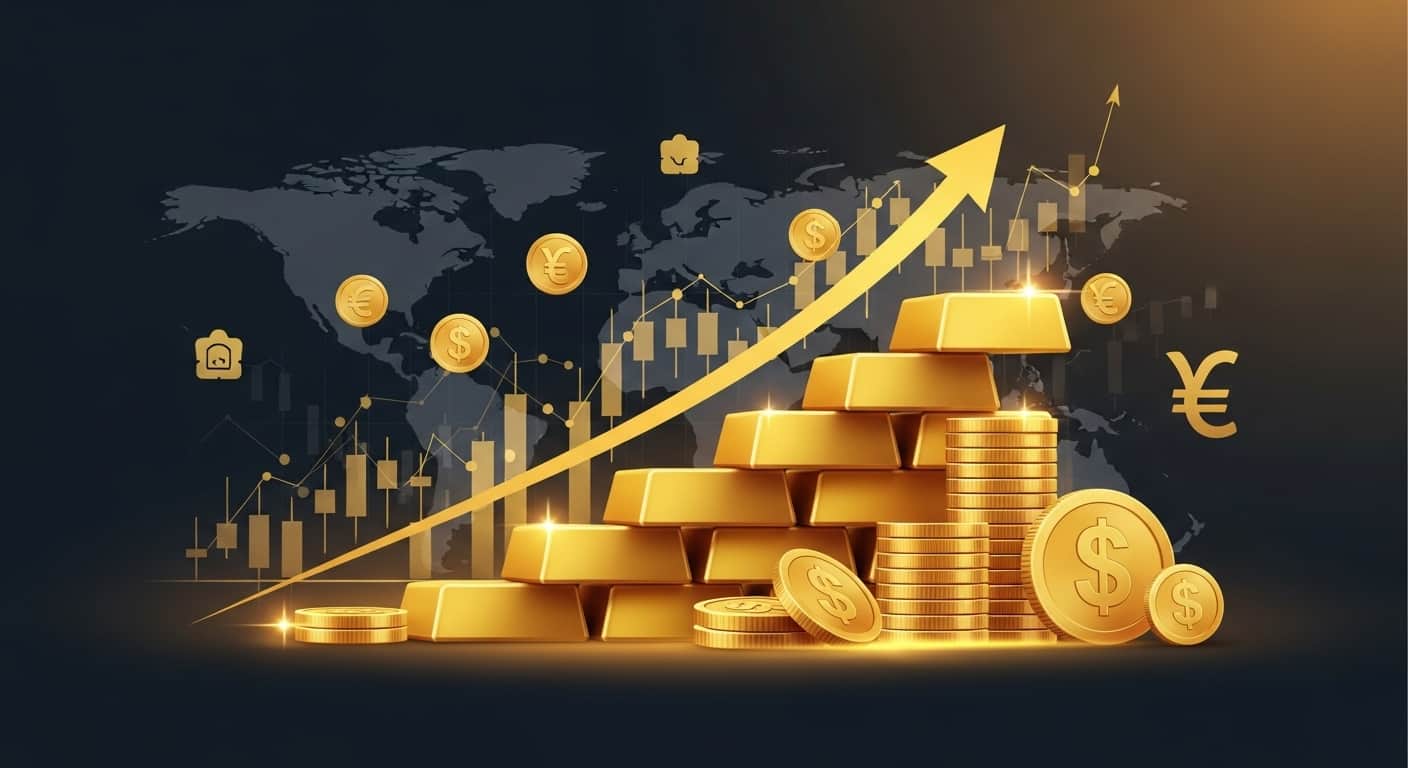
In January 2026, gold crossed $5,595 per ounce — a price nobody would have believed just two years ago. To put that in perspective, gold was trading at around $2,624 at the start of 2025. That means it nearly doubled in a single year, posting its biggest annual gain since 1979. If you've noticed gold jewelry becoming harder to afford, or heard people talking about gold like it's the only safe investment left, you're seeing the real-world effects of one of the most remarkable price rallies in financial history.
This isn't just a short-term spike driven by market noise. The forces pushing gold higher — inflation, geopolitical tension, central bank buying, and a weakening US dollar — are deeply structural. Understanding them doesn't just make you financially smarter. It helps you make better decisions about whether to buy gold, when to invest, and what these rising prices mean for your savings.
In this article, we break down everything you need to know about gold rates: what they mean, why they keep rising, who's buying gold and why, how it affects consumers and investors, and what the road ahead looks like.
What Is Gold Rate, and How Is It Set?
The gold rate is simply the current market price of gold, usually quoted per troy ounce (approximately 31.1 grams) in US dollars. It changes every second during trading hours, reflecting shifts in global supply, demand, and investor sentiment. The benchmark most markets use is the LBMA Gold Price, set twice daily in London by ICE Benchmark Administration.
When you see a price quoted at a jewelry store or on a financial app, it's derived from this global benchmark — adjusted for local taxes, import duties, and currency conversion. That's why gold may cost slightly different amounts in India versus the US versus Dubai, even on the same day.
Gold is priced in US dollars internationally, which means any movement in the dollar's value directly affects gold's price in other currencies. A weaker dollar makes gold cheaper for buyers using other currencies — which increases demand and pushes prices up further. This is one reason why dollar weakness and gold strength tend to go hand in hand.
Unlike stocks or bonds, gold doesn't pay dividends or interest. Its value is driven entirely by what people believe it is worth — as a store of value, a hedge against inflation, and a safe haven during crises. This psychological element makes gold unique among financial assets.
The Numbers Behind the Gold Rally: 2024 to 2026
To truly understand the scale of what's happened, you need to see the price journey laid out clearly. Gold's rise from 2024 to early 2026 wasn't a smooth climb — it was a series of surges, each driven by a fresh wave of fear or financial stress.
| Time Period | Approximate Gold Price (per oz) | Key Trigger |
|---|---|---|
| Start of 2024 | $2,063 | Post-pandemic inflation concerns |
| End of 2024 | $2,624 | Fed rate cut expectations, dollar weakness |
| April 2025 | $3,499 | Escalating geopolitical tensions, tariff fears |
| October 2025 | $4,000+ | Trade uncertainty, central bank buying surge |
| October 20, 2025 | $4,381 | Record high at the time, safe-haven surge |
| January 29, 2026 | $5,595 | All-time high — de-dollarization, ETF inflows |
| March 2026 (current) | ~$5,205 | Consolidation after profit-taking |
According to the World Bank's Commodity Markets Outlook, gold posted an estimated 41% gain in 2025 alone — its strongest annual performance since the late 1970s. And 2026 has already seen gold hit fresh all-time highs before pulling back slightly. The World Gold Council tracked over 40 separate record highs set during 2025, an almost unprecedented level of sustained bullish momentum.
Why Gold Prices Are Rising: The Real Reasons
There's no single cause for the gold price surge. It's the result of several powerful forces converging at the same time — each one reinforcing the others. Here are the major drivers, explained plainly.
1. Inflation and the Declining Value of Paper Money
Inflation reduces the purchasing power of money. When prices rise year after year, each dollar buys less than it used to. Gold, on the other hand, tends to hold its real value over time. An ounce of gold bought a fine Roman toga 2,000 years ago — and today, an ounce of gold still buys a high-quality suit. That consistency is why inflation almost always pushes gold higher. When investors fear their currency is losing value, they move into gold.
2. Geopolitical Tensions and Global Uncertainty
Every time the world feels more dangerous or unpredictable, gold benefits. The conflict in Ukraine, the Israel-Hamas war, US-China trade tensions, tariff threats, and concerns about US political stability all contributed to gold's surge in 2025 and 2026. Investors call this "safe-haven buying" — when fear rises, capital flows into gold because it holds value regardless of what any government does.
3. Central Bank Buying at Historic Levels
This is perhaps the single most powerful long-term driver of the current gold rally. Central banks around the world — led by China, India, Turkey, and Poland — have been aggressively buying gold and reducing their US dollar holdings. The World Bank reports that central banks' share of total gold demand rose to nearly 25% in 2024, compared to just 12% in 2015–2019. This shift reflects a global move away from dependence on the US dollar as the world's reserve currency. When major institutions are buying gold by the hundreds of tonnes, it creates a powerful structural floor under prices.
4. Weakening US Dollar
Gold is priced in dollars, so when the dollar weakens, gold automatically becomes more affordable for buyers using other currencies — which drives up demand and prices. In 2025, concerns about the US federal deficit, trade policy uncertainty, and questions about Federal Reserve independence all weighed on the dollar, providing additional support for gold.
5. Low or Falling Interest Rates
Gold doesn't pay interest or dividends. When interest rates are high, investors prefer assets that generate income — like bonds or savings accounts. But when rates fall, the "opportunity cost" of holding gold drops, making it more attractive. The Federal Reserve began cutting rates in 2024, and Morgan Stanley Research notes that gold has historically risen an average of 6% in the 60 days following the start of a Fed rate-cutting cycle.
Key Factors Affecting Gold Rates: A Complete Overview
| Factor | How It Affects Gold | Current Status (2026) | Impact Level |
|---|---|---|---|
| Inflation | Pushes investors toward gold as a value store | Above central bank targets in major economies | Very High |
| Interest Rates | Lower rates reduce opportunity cost of gold | Fed cutting cycle underway | High |
| US Dollar Strength | Weak dollar boosts gold demand globally | Dollar under pressure from deficit concerns | High |
| Central Bank Buying | Massive institutional demand supports prices | ~755 tonnes expected in 2026 (J.P. Morgan) | Very High |
| Geopolitical Tensions | Fear drives safe-haven buying | Multiple active conflicts and trade disputes | High |
| Gold ETF Inflows | Paper gold demand increases with investor interest | 250+ tonnes inflows expected in 2026 | Moderate-High |
| Mine Supply Constraints | Limited new supply tightens the market | No new US mines since 2002; regulatory hurdles | Moderate |
| Jewelry Demand | Cultural demand adds a consumption floor | Slowing at high prices, but resilient in India/China | Moderate |
How Rising Gold Rates Affect Investors
If you had invested $10,000 in gold at the start of 2025, your investment would be worth roughly $19,800 by early 2026 — nearly double in twelve months. That's an extraordinary return that outperformed most equities, bonds, and real estate markets during the same period. For investors who held gold through 2024 and 2025, this has been a genuinely life-changing rally.
But here's the nuance most financial media glosses over: buying at $5,500 is a very different decision than buying at $2,600. At current prices, the risk of a short-term correction is real. In October 2025, gold fell 6% in a single day — the biggest daily drop in 12 years — before resuming its climb. More recently, strong US employment data triggered a correction from the $5,595 peak back to around $4,400 before stabilizing.
Most seasoned financial advisors suggest that gold should make up 5–15% of a diversified investment portfolio — not your entire savings strategy. It works best as a hedge and a diversifier, not a get-rich-quick play. J.P. Morgan's research notes that around 585 tonnes per quarter of combined investor and central bank demand is expected to underpin prices through 2026, providing a strong structural floor even if speculative buyers step back.
Investment Options: Physical Gold vs. Gold ETFs vs. Digital Gold
Not all gold investments are the same. Physical gold — coins, bars, or jewelry — gives you direct ownership but comes with storage and insurance costs. Gold ETFs (Exchange-Traded Funds) let you invest in gold without physically holding it; they've seen record inflows, with European-domiciled gold ETFs attracting over €2 billion since the start of 2026 alone. Digital gold, offered through apps and platforms, allows fractional ownership and is increasingly popular among younger investors. Each option carries different risks, costs, and liquidity profiles worth understanding before you invest.
Impact on Consumers: What Rising Gold Prices Mean in Real Life
For everyday buyers — especially in India, China, and the Middle East where gold jewelry is deeply tied to culture, weddings, and family wealth — the price surge has been painful. A wedding necklace that cost the equivalent of $1,500 two years ago now costs $3,000 or more. Many families are buying lighter pieces, choosing gold-plated alternatives, or delaying purchases entirely.
India's jewelry market shows this tension clearly. Consumers have pledged more than 200 tonnes of gold jewelry through the formal sector in 2025 alone — using their gold as collateral for loans rather than selling it, hoping prices will eventually ease. This behavior has actually limited gold recycling flows and kept supply tighter than it might otherwise be.
On the positive side, anyone who already owns gold — whether as jewelry, coins, or saved investments — has seen their wealth grow substantially. Gold jewelry is increasingly being viewed as a financial asset, not just an ornament. Many families treat their gold holdings as an emergency fund that grows over time.
Common Mistakes to Avoid When Buying Gold
Rising gold prices create a very specific psychological trap: FOMO, or fear of missing out. When everyone is talking about gold and prices keep climbing, it becomes tempting to jump in without thinking clearly. Here are the mistakes that catch most people out.
- Buying at the peak out of panic: Gold's price can correct sharply even in a long-term uptrend. Chasing the price after a big spike often means buying just before a pullback. Oxford Economics has warned that some of gold's current pricing reflects FOMO-driven buying that may not be sustainable.
- Putting all savings into gold: Gold should be one part of a diversified portfolio, not your entire financial plan. It doesn't generate income, and prolonged flat periods (like 2012–2018) can frustrate investors expecting constant growth.
- Ignoring storage and insurance costs: Physical gold is expensive to store safely. Factor in vault fees, insurance, and transaction costs before calculating your actual return.
- Buying unverified gold jewelry and assuming it's pure investment: Jewelry has making charges and is rarely sold at pure gold value. If your goal is investment, bars, coins, or ETFs are usually more efficient.
- Ignoring the tax implications: Gold gains are taxable in most countries. Many investors are surprised by the tax bill after a profitable sale. Know your jurisdiction's rules before you buy.
- Treating gold as a short-term trade: Gold rewards patience. Investors who try to time the market with gold often underperform those who simply hold for the long term.
Pro Tips: How Smart Investors Are Approaching Gold in 2026
Given where prices are right now, here's what experienced investors and analysts are recommending — not promises of guaranteed returns, but practical frameworks for thinking clearly.
- Use dollar-cost averaging: Instead of buying all at once, spread purchases over 3–6 months. This smooths out the impact of short-term price swings and removes the pressure of "timing the market perfectly." Even Morningstar analysts suggest waiting for profit-taking dips of around 10% before entering if you have no exposure yet.
- Think in years, not months: The World Gold Council projects gold could rise another 5–15% in 2026 under moderate economic conditions, and 15–30% in a more severe downturn scenario. Long-term structural demand — central banks, ETF inflows, de-dollarization — remains intact.
- Watch the US dollar index (DXY): Gold and the dollar move inversely. When the DXY weakens, gold tends to strengthen. Keeping an eye on dollar trends gives you early signals about gold's next likely move.
- Consider sovereign gold bonds or government-backed schemes: In countries like India, government schemes allow you to earn interest on gold investments while being backed by the state — a more efficient alternative to physical storage.
- Balance with other assets: Gold works best alongside equities, bonds, and cash. A portfolio of only gold might miss equity rallies during calm periods. Most advisors suggest a 5–15% gold allocation as a diversification sweet spot.
Is Gold Still a Good Investment at Current Prices?
This is the question almost every investor is asking right now. The answer is genuinely nuanced — and anyone who gives you a simple yes or no without context isn't being fully honest.
The bull case for gold remains strong. J.P. Morgan forecasts gold pushing toward $5,000 per ounce by Q4 2026, with $6,000 possible in the longer term. Central bank buying is structural, not speculative — countries aren't buying gold as a short-term trade, they're repositioning their entire reserve strategy for a less dollar-centric world. That long-term demand floor is very real.
The bear case deserves equal attention. If the US dollar strengthens unexpectedly, if the Fed holds rates higher for longer, or if major geopolitical tensions suddenly ease, gold could see a significant correction. Morgan Stanley's analysts note that if the US and Europe quickly resolve major political disputes, the fear factor could vanish fast — and prices could drop sharply.
The honest answer: gold at current levels is appropriate as a long-term portfolio hedge, but it demands careful position sizing and realistic expectations. Anyone putting their emergency fund into gold at $5,200 and expecting to double it again in 12 months is taking on more risk than they probably realize.
Gold vs. Other Investments: How Does It Stack Up?
| Asset | 2025 Return (approx.) | Income Generated | Inflation Protection | Liquidity | Risk Level |
|---|---|---|---|---|---|
| Gold | ~50–60% | None | Excellent | High | Moderate |
| US Stock Market (S&P 500) | ~25% | Dividends (~1.5%) | Moderate | Very High | Moderate-High |
| US Treasury Bonds (10yr) | ~4–5% yield | Yes (coupon) | Poor | High | Low |
| Real Estate | ~8–12% (varies) | Rental income | Good | Low | Moderate |
| Bitcoin | ~100%+ (volatile) | None | Debated | High | Very High |
| Fixed Deposits / Savings | ~4–5% interest | Yes | Poor | Moderate | Very Low |
Gold's 2025 performance was genuinely exceptional and won't repeat every year. But even in a normal year, gold plays a valuable role no other asset can replicate: it tends to go up precisely when other things go down. That correlation makes it uniquely valuable in a diversified portfolio.
Future Outlook: Where Are Gold Prices Headed?
The consensus among major financial institutions is cautiously bullish. J.P. Morgan expects prices toward $5,000 by Q4 2026, with $6,000 possible longer term. The World Gold Council sees 5–15% upside from current levels in a moderate scenario, rising to 15–30% if economic conditions worsen significantly. Morgan Stanley echoes this, pointing to continued central bank accumulation and regulatory barriers to new mine supply as structural price supports.
The key variable everyone is watching is the US Federal Reserve. If new Fed leadership signals tolerance for higher inflation or accelerates rate cuts, gold could retest and exceed its January 2026 all-time high. Conversely, if inflation proves stubbornly persistent and forces the Fed to keep rates high, gold's upward momentum could stall.
One overlooked factor is mine supply. No new gold mines have opened in the US since 2002. Permitting, regulatory hurdles, and rising extraction costs make a supply surge unlikely. According to Morgan Stanley Research, a super-cycle of new production — like what happened with oil or copper at various points — is off the table for gold given these constraints. Limited supply plus sustained demand is a straightforward recipe for continued price support.
The World Bank's long-term view is that gold will likely remain elevated into 2026 and beyond. The structural forces — de-dollarization, central bank diversification, inflation hedging, geopolitical fragmentation — haven't gone anywhere. Short-term corrections will happen, but the direction of travel for gold over the medium term appears firmly upward.
Conclusion
Gold's extraordinary rise from $2,624 to $5,595 per ounce between January 2025 and January 2026 wasn't an accident or a bubble — it was the rational response of global markets to a convergence of powerful forces: persistent inflation, geopolitical instability, a weakening dollar, historic central bank buying, and a structural supply shortage. Understanding these forces isn't just intellectually satisfying — it's practically useful for making smarter financial decisions.
For investors, the message is this: gold deserves a place in your portfolio as a hedge and diversifier, but position sizing and timing matter enormously at current price levels. For consumers, especially those buying gold for cultural or family reasons, patience and strategic timing can make a meaningful difference in what you pay.
For everyone else — the message is simpler. The gold price is a barometer of global anxiety. When it rises sharply, the world's most sophisticated financial institutions and governments are telling you, with their actions rather than words, that they're worried about the future of the monetary system. That's worth paying attention to, even if you never buy a single gram.
Are you currently holding gold, thinking about investing, or navigating rising jewelry prices? Share your experience in the comments — we'd genuinely love to hear how the gold rally is affecting real people's decisions.
Frequently Asked Questions About Gold Rates
Frequently Asked Questions
Why are gold prices rising so much in 2025 and 2026?
Gold prices surged nearly 60% in 2025 and hit an all-time high of $5,595 per ounce in January 2026. The main drivers are a combination of persistent inflation, geopolitical tensions (including the Russia-Ukraine conflict, Israel-Hamas war, and US trade disputes), historic central bank buying by countries like China and India, a weakening US dollar, and strong inflows into gold-backed ETFs. These forces are structural, not temporary — which is why prices have stayed elevated.
Is gold a good investment right now in 2026?
Gold remains valuable as a long-term portfolio hedge and inflation protection tool. However, at current prices above $5,000 per ounce, the entry cost is historically high and short-term corrections are possible. Most financial advisors recommend a 5–15% allocation of gold within a diversified portfolio rather than making it your primary investment. Dollar-cost averaging — buying gradually over several months rather than all at once — is often the smartest approach at current levels.
How does inflation affect gold prices?
When inflation rises, the purchasing power of paper money falls. Investors move into gold because it maintains real value over time, unlike cash or bonds. This increased demand pushes gold prices higher. Historically, gold has been one of the most reliable hedges against sustained inflation — which is exactly why it's surged during the high-inflation environment of 2022–2026.
Why are central banks buying so much gold?
Central banks in countries like China, India, Turkey, and Poland have been aggressively buying gold and reducing US dollar holdings — a trend known as de-dollarization. According to the World Bank, central banks' share of total gold demand rose to nearly 25% in 2024, compared to just 12% in 2015–2019. They're diversifying away from US Treasuries due to concerns about US fiscal policy, geopolitical risk, and the long-term stability of the dollar as the world's reserve currency.
What is the connection between the US dollar and gold prices?
Gold is priced globally in US dollars. When the dollar weakens, gold automatically becomes cheaper for buyers using other currencies, which increases demand and pushes prices up. The two tend to move in opposite directions. In 2025 and 2026, concerns about the US federal deficit, trade policy, and Federal Reserve independence have weakened the dollar — directly supporting gold's rise.
Will gold prices fall in the future?
Short-term corrections are not only possible but likely — gold fell 6% in a single day in October 2025, its biggest daily drop in 12 years. However, the long-term structural drivers (central bank buying, de-dollarization, supply constraints, inflation) remain firmly in place. J.P. Morgan forecasts gold approaching $5,000–$6,000 per ounce by late 2026 and beyond, while the World Gold Council sees 5–30% additional upside depending on how macro conditions unfold.
How does the gold price affect jewelry buyers?
Rising gold prices directly increase the cost of gold jewelry. A piece that cost $1,500 two years ago may now cost $3,000 or more. Many buyers in India, China, and the Middle East are responding by buying lighter pieces, using exchange schemes, or delaying purchases. Despite this, gold jewelry demand remains resilient during weddings and festivals due to its deep cultural significance. Interestingly, many consumers are now pledging their jewelry as loan collateral rather than selling, expecting prices to stay high.
What's the difference between buying physical gold and gold ETFs?
Physical gold (bars, coins, jewelry) gives direct ownership but requires secure storage and insurance. Gold ETFs are financial instruments that track the gold price and trade on stock exchanges — they're more liquid, have lower transaction costs, and don't require storage. For pure investment purposes, ETFs or sovereign gold bonds are usually more efficient. Physical gold makes sense if you want direct ownership, are buying for cultural reasons, or want something completely independent of the financial system.
How much of my portfolio should be in gold?
Most financial experts recommend allocating 5–15% of your portfolio to gold, depending on your risk tolerance and investment goals. Gold works best as a portfolio diversifier and hedge — not a primary growth engine. It tends to perform well when stocks and bonds are under pressure, which is exactly when you want some protection. Putting too much into gold means missing the income and growth potential of other asset classes during calmer periods.
What could cause gold prices to drop significantly?
Several scenarios could push gold prices lower: a stronger-than-expected US dollar, the Federal Reserve keeping interest rates high longer than markets expect, a major easing of global geopolitical tensions, a significant reduction in central bank buying, or a demand-destruction effect where extremely high prices push jewelry and investment buyers away. Oxford Economics has specifically flagged FOMO-driven speculative buying as a potential source of volatility if sentiment shifts.