Medical Billing and Coding Salary in the US (2026): Pay, Certification, and Career Growth Guide
Medical Billing and Coding Salary in the US (2026): Pay, Certification, and Career Growth Guide
A healthcare career that requires no medical degree, can be done entirely from your home, and pays a competitive salary — that's a combination that's hard to find. Medical billing and coding checks all three boxes, which is why it's one of the most searched healthcare career topics in the US right now. But here's what most career guides won't tell you upfront: the salary gap in this field is enormous. The difference between a non-certified entry-level biller and a senior coder holding three certifications isn't a few thousand dollars — it's over $25,000 a year.
According to the Bureau of Labor Statistics (BLS), the national median for medical records specialists — the category that covers billers and coders — is $50,250 per year, or $24.16 per hour. But that median figure hides a wide range. The AAPC's 2025 Salary Survey found that non-certified professionals average $55,721, while those holding three or more certifications average $81,227. Certified professionals as a whole earn 20.7% more than their non-certified peers. Understanding where you fall — and where you could fall — is the entire point of this guide.
Whether you're considering this career for the first time, preparing to get certified, or looking for ways to increase your current salary, this guide gives you the real numbers, the right certifications to target, and a clear picture of where this profession is headed.
What Medical Billers and Coders Actually Do
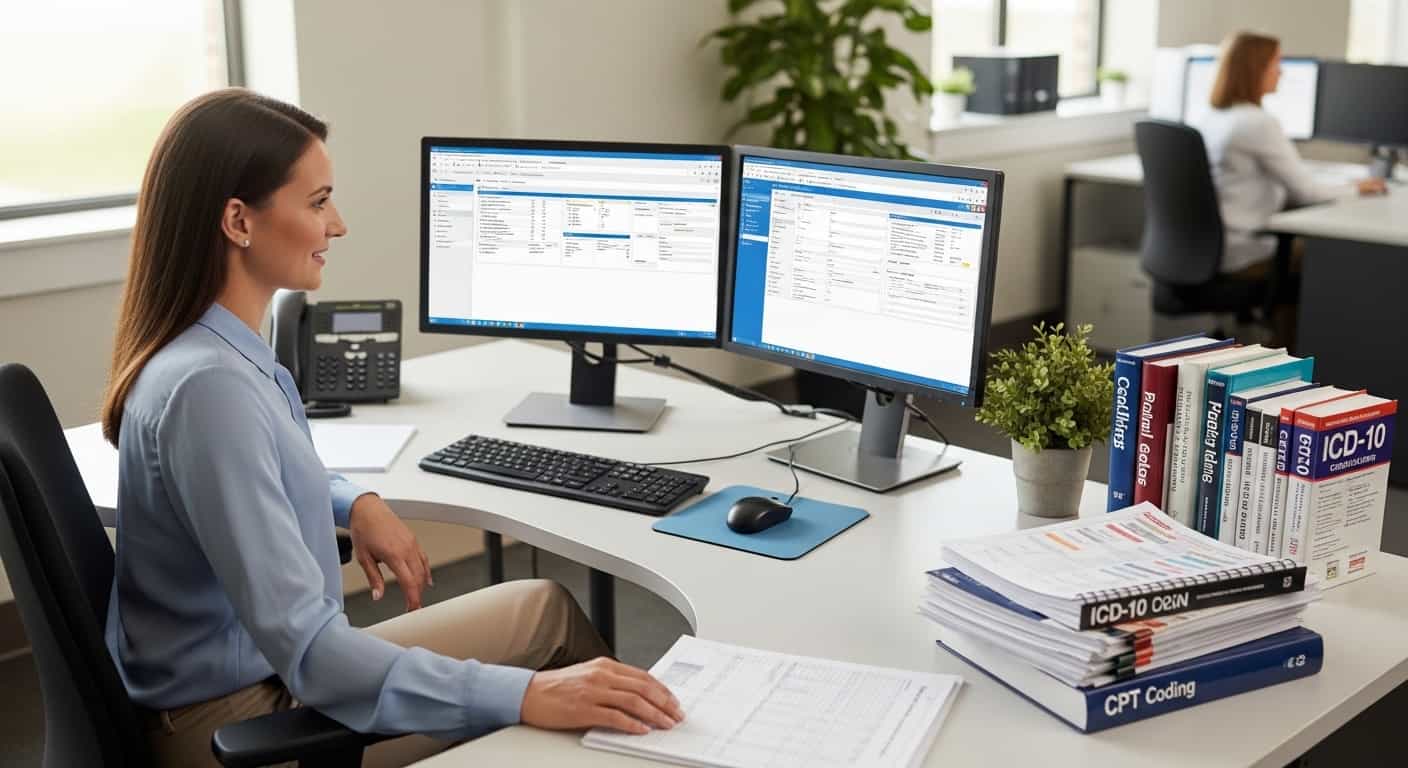
Medical coding and medical billing are two distinct but deeply connected functions — and knowing the difference matters for understanding the pay structure. Medical coders review clinical documentation (doctor's notes, lab results, procedure reports) and translate every diagnosis, treatment, and service into standardized codes. The three main coding systems are ICD-10-CM (for diagnoses), CPT (Current Procedural Terminology, for procedures and services), and HCPCS Level II (for supplies, equipment, and non-physician services).
Medical billers take those codes and use them to prepare and submit insurance claims to payers — Medicare, Medicaid, private insurers, and employer health plans. They track claim status, follow up on denials, post payments, and manage patient billing. In small practices, one person often handles both functions. In hospitals and large health systems, coding and billing are separate specialized roles.
Why does this matter for salary? Because coders — particularly those working in inpatient hospital settings or specialized areas like risk adjustment — typically earn more than billers. According to AHIMA's salary data, life science companies pay coders over $105,000 annually, while home health and long-term care settings sit at the lower end near $56,000. The role, the employer type, and the coding specialty all drive salary variation far more than most people realize before entering the field.
Medical Billing and Coding Salary in 2026: National Averages by Experience
Let's start with the baseline numbers from the most reliable sources, then build outward to the factors that move those numbers significantly.
| Experience Level | Annual Salary Range | Hourly Rate | Notes |
|---|---|---|---|
| Entry-Level (0–2 years, no certification) | $35,780 – $43,000 | $17 – $21/hr | BLS 10th percentile; typical for new hires from training programs |
| Entry-Level with Certification (CPC-A, CBCS) | $43,000 – $52,000 | $21 – $25/hr | Certification premium applies even at entry level |
| Mid-Level (3–5 years, one certification) | $55,000 – $65,000 | $26 – $31/hr | AAPC average for single-certified professionals: $62,689 |
| Senior / Specialist (5+ years, 2 certifications) | $68,000 – $76,000 | $33 – $37/hr | AAPC data: two certifications average $71,130/year |
| Expert / Leadership (3+ certifications or management) | $76,000 – $105,000+ | $37 – $50+/hr | AAPC: 3+ certifications average $81,227; life sciences top $105,000 |
The BLS mean (average) for the category is $53,690 — slightly above the $50,250 median because high earners in insurance, life sciences, and auditing pull the average upward. For most professionals in physician offices and smaller clinics, the median is the more representative figure. The people sitting well above it are almost always certified, specialized, or in high-paying employer categories.
Highest Paying States for Medical Billing and Coding (2026)
Location is one of the biggest salary variables in this field. According to BLS data, the geographic spread is wider than most people expect — Washington State coders earn nearly $30,000 more annually than their counterparts in Mississippi. That's not a small regional premium; it's a career-defining difference.
| State / Region | Median Annual Salary (BLS) | Notes |
|---|---|---|
| Washington State | $75,000+ | Consistently top-3 nationally; dense healthcare infrastructure |
| California | $68,000 – $80,000+ | Some metro markets exceed $80,000 for credentialed coders; CPC average $70,096 |
| Washington D.C. | $62,810 | BLS confirmed median; one of the highest metro figures nationally |
| Rhode Island | $60,000 – $70,000 | Strong performer due to concentrated hospital systems |
| New York | $58,000 – $75,000 | High cost-of-living adjustment; large hospital market |
| Massachusetts | $56,000 – $68,000 | Major academic medical centers drive demand |
| Texas | $48,000 – $62,000 | Large market, strong volume; lower cost of living |
| Florida | $45,000 – $58,000 | High demand from aging population; lower median |
| Alabama / Arkansas / Mississippi | $37,000 – $46,000 | Lowest nationally; cost of living partially offsets gap |
An important strategic point: remote coding jobs are narrowing the geographic salary gap. An experienced certified coder in a lower-wage state who lands a remote role with a California-based health system or insurance carrier can earn coastal salaries without relocating. This geographic arbitrage opportunity is particularly valuable for credentialed professionals in the Southeast and Midwest.
How Certification Impacts Salary: Every Major Credential Compared
This is where the real salary levers are. Certification is the single most controllable factor in your medical billing and coding salary — and the data from AAPC's 2025 Salary Survey is specific enough to show you exactly what each credential is worth.
| Certification | Issuing Body | Focus Area | Median Salary (2025) | Exam Cost (approx.) | Best For |
|---|---|---|---|---|---|
| CPC – Certified Professional Coder | AAPC | Outpatient / physician office coding | $58,895 | $425 + $222/yr membership | Clinics, private practices, outpatient settings |
| CPB – Certified Professional Biller | AAPC | Revenue cycle, claims, denial management | $56,981 | $225 + membership | Billing specialists, revenue cycle roles |
| CCS – Certified Coding Specialist | AHIMA | Hospital inpatient + outpatient coding | $65,000+ | $299–$399 | Hospital coders; highest single-cert salary potential |
| CCA – Certified Coding Associate | AHIMA | Entry-level; both inpatient and outpatient | $48,000 – $55,000 | $199–$299 | Career changers, new graduates |
| CBCS – Certified Billing & Coding Specialist | NHA | Billing and basic coding | $43,000 – $52,000 | ~$117 | Most affordable entry point; no membership fee |
| CIC – Certified Inpatient Coder | AAPC | Complex inpatient hospital coding | $70,000 – $90,000 | $325 + membership | Hospital inpatient coders seeking top pay |
| CRC – Certified Risk Adjustment Coder | AAPC | Medicare Advantage risk adjustment | $76,000+ | $325 + membership | Insurance carriers, Medicare Advantage plans |
| CPCO – Certified Professional Compliance Officer | AAPC | Compliance and regulatory oversight | $81,495 median | $325 + membership | Senior compliance and auditing roles |
The stacking effect is real and well-documented. According to AAPC's 2025 data: one certification averages $62,689 per year, two certifications average $71,130, and three or more certifications average $81,227. Each additional credential adds roughly $4,000–$10,000 in annual earning potential, and the investment typically pays for itself within the first year of employment.
For someone entirely new to the field: the CBCS from NHA is the fastest and cheapest entry point (under $120, no membership required, exam prep possible in under three months). Once working, adding the CPC — the most widely recognized outpatient credential — is the logical next step and delivers the largest single-certification salary jump.
Medical Coder vs. Medical Biller: Who Earns More?
This is one of the most common questions people entering the field ask — and the answer, based on current data, is clear: medical coders generally earn more than medical billers, particularly as careers advance. The reason is specialization. Advanced coding — especially inpatient coding, risk adjustment, and clinical documentation improvement — requires deeper technical knowledge and commands higher pay.
| Role | Average Annual Salary | Key Responsibilities | Top Certification |
|---|---|---|---|
| Medical Biller | $45,000 – $62,000 | Claims processing, denial management, patient billing, payer follow-up | CPB (AAPC) |
| Medical Coder (outpatient) | $52,000 – $70,000 | ICD-10/CPT code assignment, chart review, compliance | CPC (AAPC) |
| Medical Coder (inpatient) | $65,000 – $90,000 | Complex inpatient coding, DRG assignment, ICD-10-PCS | CCS (AHIMA) or CIC (AAPC) |
| Risk Adjustment Coder | $76,000 – $99,000+ | HCC coding, Medicare Advantage, RAF score optimization | CRC (AAPC) |
| Coding Auditor / Compliance | $75,000 – $105,000+ | Coding accuracy reviews, compliance programs, staff training | CPCO or CPMA (AAPC) |
Salary by Employer Type: Where You Work Matters as Much as What You Do
Most people focus on state and certification when thinking about salary — but employer type is equally important and often overlooked. The BLS and AHIMA data both show significant variation across work settings, and the pattern is consistent: insurance carriers and large health systems pay the most, while small physician offices and home health agencies pay the least.
| Employer Type | Approximate Salary Range | Notes |
|---|---|---|
| Life Science Companies | $90,000 – $105,000+ | AHIMA data; highest-paying employer category overall |
| Insurance Carriers / Payers | $68,000 – $90,000 | BLS confirmed as top-paying industry for this occupation |
| Large Health Systems (3–10 hospitals) | $65,000 – $85,000 | Pay up to 14% more than solo physician groups (AAPC) |
| Government / Federal Healthcare | $60,000 – $75,000 | Stable with strong benefits; VA and federal hospital systems |
| Hospitals (state, local, private) | $55,000 – $72,000 | Largest employer segment — 29% of all positions (BLS) |
| Outpatient Clinics / Physician Offices | $48,000 – $65,000 | Most common entry-level setting |
| Home Health / Long-Term Care | $50,000 – $58,000 | AHIMA confirmed as lower end of salary spectrum |
| Independent Contractor / Freelance | $55,000 – $85,000+ | Varies widely; experienced coders working multiple clients can exceed salaried peers |
One practical implication: if you're currently working in a small physician office and feeling underpaid, moving to an insurance carrier or joining a large health system could be a $10,000–$20,000 salary increase for the same skill set and certifications. Targeting employer type is one of the most underutilized salary levers in this field.
Remote Medical Coding in 2026: Pay, Opportunities, and the Freelance Option
Remote work has permanently reshaped medical coding. The AAPC's 2024 Salary Survey reports that 65.7% of certified coders now work remotely full-time — one of the highest remote work rates of any healthcare profession. This shift happened faster in coding than in almost any other clinical or administrative healthcare role because the work is inherently digital: electronic health records, coding software, and secure VPN connections are all that's needed.
Remote medical coding salaries are broadly comparable to in-office roles for credentialed professionals. According to BLS and AAPC data, remote coders earn between $48,000 and $75,000 annually on average, with certified specialists in high-demand areas like risk adjustment and inpatient coding earning at or above the national median remotely. The key nuance: entry-level remote roles without certification tend to sit slightly below the overall median, while experienced certified coders working remotely for insurance carriers can exceed $80,000.
The freelance/independent contractor route is a different calculation entirely. Experienced coders who work directly with multiple healthcare organizations can earn significantly more than salaried positions — but it requires managing your own taxes, benefits, and client pipeline. Risk adjustment coders working independently with Medicare Advantage plans report total annual earnings exceeding $90,000. Glassdoor data puts the estimated total pay for Risk Adjustment Coders at $99,214 per year, with a base salary around $76,433.
Job Outlook: Why Medical Coding Is One of Healthcare's Safest Career Bets
The BLS projects 9% job growth for medical records specialists through 2033 — significantly faster than the national average for all occupations (around 3%). With roughly 14,900 openings expected annually, this field offers consistent hiring volume, not just occasional openings. Three structural forces are driving this sustained demand.
First, the US population is aging rapidly. As Baby Boomers move deeper into their 60s and 70s, healthcare utilization — and therefore insurance claims — grows proportionally. More patients mean more clinical documentation, more codes, and more claims. Second, regulatory complexity keeps increasing. The transition toward value-based care models, ICD-11 preparation, and evolving Medicare and Medicaid billing rules all require skilled human oversight that cannot be fully automated. Third, AI-assisted coding tools are being introduced across the industry, but they require experienced coders to review, validate, and correct outputs. This creates new hybrid roles rather than eliminating existing ones.
The BLS also projects 7.1% growth specifically through 2034 in some data cuts — consistent across multiple projection periods, which indicates structural demand rather than a short-term spike. The healthcare staffing shortages that have characterized 2023–2025 are also creating competitive salary environments, with employers increasingly willing to pay premiums for experienced certified professionals.
Common Mistakes That Keep Medical Billing and Coding Salaries Low
There are specific, avoidable reasons why many people in this field earn less than they could. These aren't about talent — they're about career strategy.
- Entering the workforce without any certification: Starting without even an entry-level credential like the CBCS means accepting the lowest tier of pay from day one. The CBCS costs around $117 and can be earned in under three months. The salary premium it delivers — even at entry level — far exceeds that investment in the first year of employment.
- Staying in small physician offices long-term: Small practices are good learning environments but rarely the highest paying. Once you have 2–3 years of experience and a certification, moving to a large health system, insurance carrier, or hospital dramatically increases earning potential without requiring additional credentials.
- Ignoring specialization: General outpatient coding has a salary ceiling. Coders who specialize in cardiology, oncology, risk adjustment, or inpatient coding consistently earn $15,000–$30,000 more annually than generalists. Specialization takes time to develop but is the most reliable path to the upper income tier.
- Not stacking certifications: One certification is good. Two is significantly better. Three or more unlocks the top salary bracket. AAPC data shows each additional credential adds $4,000–$10,000 in annual earning potential, and the investment (exam fee plus study time) pays for itself within months.
- Overlooking the freelance and multi-client model: Many experienced coders assume a salaried position is the only option. Working as an independent contractor with multiple healthcare clients — particularly in remote risk adjustment or auditing — can push annual earnings above $90,000 without requiring management responsibilities.
- Accepting the first salary offer without negotiating: The AAPC reports that professionals in this field earn above their state's median annual income in most cases. Knowing the current market data for your state, certification level, and employer type gives you leverage to negotiate. Most hiring managers expect it.
Pro Tips: How to Maximize Your Medical Billing and Coding Salary
These are the strategies that experienced professionals and career advisors in this field consistently recommend — not general career advice, but specific actions with documented salary impact.
- Start with the CPC if you want the widest recognition: The CPC from AAPC is the most widely recognized credential for outpatient coding and the one most employers list in job descriptions. Its median salary of $58,895 makes it the best first certification investment for most people entering the field. Pair it with the CPB for billing roles.
- Target insurance carriers early: BLS data consistently identifies insurance carriers as the highest-paying employer category for medical billing and coding specialists — higher than hospitals. Positions at major payers like UnitedHealthcare, Anthem, Cigna, and Humana often offer remote work, strong benefits, and above-median salaries even for mid-level professionals.
- Consider CRC for the highest-paying niche: Risk Adjustment Coding (CRC certification from AAPC) is the highest-paying specialty in the field. Glassdoor estimates total pay at $99,214/year for risk adjustment coders, with a $76,433 base. Medicare Advantage plans are aggressively hiring for this specialty.
- Join AAPC and use their salary calculator: AAPC's free salary calculator gives state-specific salary benchmarks by certification type — a real-time market data tool that most professionals don't know exists. Use it before every salary negotiation and job search.
- Track ICD updates and coding changes actively: Coders who stay current with annual ICD-10 updates and CPT code changes are more valuable to employers because they reduce compliance risk. Demonstrating this currency in interviews and performance reviews is one of the simplest ways to justify higher pay.
How to Get Started: Timeline from Zero to First Paycheck
One of this career's strongest selling points is the entry timeline. You do not need a four-year degree. You do not need clinical experience. The path from no background to first job is measured in months, not years — if you're strategic about it.
- Month 1–3: Complete a training program. Health Tech Academy's Medical Billing and Coding Specialist Program is designed to prepare students for the CBCS credential in under three months. Community college associate programs (typically 12–24 months) provide broader training and qualify graduates for the CCA credential.
- Month 2–4: Sit for the CBCS or CCA certification exam. The CBCS from NHA is the fastest and most affordable option (~$117). The CCA from AHIMA ($199–$299) provides broader coding coverage and is preferred by hospital employers.
- Month 3–6: Apply for entry-level positions. Target outpatient clinics, physician offices, and hospital billing departments. Remote entry-level positions exist but are competitive — in-person experience for the first 1–2 years builds the documentation skills needed for remote roles.
- Year 1–2: Study for the CPC while working. The CPC exam costs approximately $425 plus $222/year AAPC membership. Most candidates study 3–6 months while employed. Passing the CPC is the single biggest salary leap available in the first two years.
- Year 3–5: Choose a specialty and pursue a second certification. Based on your work experience and interests, add CCS (hospital inpatient), CRC (risk adjustment), or CIC (inpatient coding) to unlock the $70,000–$90,000+ salary range.
Conclusion
Medical billing and coding is a career where the ceiling is surprisingly high — if you know which levers to pull. The BLS median of $50,250 is a starting point, not a destination. Certified professionals earn 20.7% more than non-certified peers. Three certifications push average pay to $81,227. Specializing in risk adjustment or inpatient coding can take that further still, toward the $90,000–$105,000 range in high-paying employer settings.
The remote work story is equally compelling. Nearly two-thirds of certified coders now work fully remotely — and with geographic arbitrage available, the state you live in is no longer the hard salary ceiling it once was. An experienced certified coder in Ohio can earn California salaries working for a West Coast insurer from their home office.
The career does reward deliberate action: choose certifications strategically, target the right employer types, and stay current with coding system updates. For anyone seeking a healthcare career with a fast entry timeline, strong job security, remote flexibility, and real income potential — the data makes a compelling case that medical billing and coding delivers on all four.
Are you currently working in medical billing or coding, considering entering the field, or looking to increase your salary? Share your questions or experience in the comments below.
Frequently Asked Questions About Medical Billing and Coding Salary
Frequently Asked Questions
What is the average medical billing and coding salary in 2026?
According to the Bureau of Labor Statistics (BLS), the national median for medical records specialists — which includes medical billers and coders — is $50,250 per year ($24.16/hr). The average (mean) sits at $53,690. However, certified professionals earn significantly more: AAPC's 2025 Salary Survey found that certified coders average $66,979 annually, compared to $55,721 for non-certified workers. Those holding three or more certifications average $81,227.
Does certification really increase medical billing and coding salary?
Yes — and the data is specific. According to AAPC's 2025 Salary Survey, certified professionals earn 20.7% more than non-certified workers. One certification pushes average pay to $62,689. Two certifications average $71,130. Three or more average $81,227. The CPC is the most widely recognized credential with a median salary of $58,895, while the CIC (inpatient coding) ranges from $70,000 to $90,000. The certification investment typically pays for itself within two to three months of employment.
What is the highest-paying state for medical billing and coding?
Washington State, California, and Washington D.C. are consistently among the top-paying states, according to BLS data. Washington D.C. has a confirmed BLS median of $62,810. California metro markets report median salaries above $80,000 for credentialed coders — with CPC-certified professionals in California averaging $70,096 annually (AAPC data). The geographic salary gap is wide: Washington State coders earn nearly $30,000 more per year than those in Mississippi.
Can I work remotely as a medical biller or coder?
Yes — and remote work is now the norm, not the exception. AAPC's 2024 Salary Survey found that 65.7% of certified coders work remotely full-time. Remote salaries for credentialed professionals are broadly comparable to in-office rates, ranging from $48,000 to $75,000 annually. Experienced certified coders in high-demand specialties like risk adjustment or inpatient coding can earn at or above median rates remotely. Geographic arbitrage — working remotely for a high-paying employer in a coastal state while living in a lower cost-of-living area — is a real and practical salary strategy.
Which medical coding certification pays the most?
The Certified Inpatient Coder (CIC) from AAPC ranges from $70,000 to $90,000 annually, making it one of the highest-paying single credentials. The Certified Risk Adjustment Coder (CRC) is also in the top tier, with Glassdoor estimating total pay for risk adjustment coders at $99,214/year. The CPCO (Certified Professional Compliance Officer) has the highest median salary at $81,495/year. For most people entering the field, the CPC is the best starting credential, with the CRC or CIC being the highest-payoff second credential.
How long does it take to become a medical biller or coder?
The entry timeline is faster than most healthcare careers. Entry-level training programs (like Health Tech Academy's CBCS preparation course) can be completed in under three months. Community college associate programs take 12–24 months and provide broader preparation. The CPC certification exam typically requires 3–6 months of study. Realistic timeline from zero background to first paycheck: 3–9 months for entry-level positions, 12–18 months for positions requiring certification.
Do medical coders earn more than medical billers?
Generally yes, especially at advanced levels. Entry-level salaries overlap significantly, but experienced coders — particularly those in inpatient, risk adjustment, or specialized coding roles — consistently earn more than billers. According to AHIMA and AAPC data, outpatient coders average $52,000–$70,000, inpatient coders earn $65,000–$90,000, while medical billers average $45,000–$62,000. The exception is senior billing professionals in revenue cycle management, compliance, or auditing roles, who can earn $75,000–$100,000+.
Is medical billing and coding in demand in 2026?
Yes — strongly. The BLS projects 9% job growth for medical records specialists through 2033, faster than the national average of around 3%. Approximately 14,900 positions open annually. The aging US population is increasing healthcare utilization and claims volume. The transition to value-based care and ongoing ICD updates require skilled coders for compliance. AI-assisted coding tools are being introduced but require human oversight, creating new hybrid roles rather than eliminating existing ones.
What is the highest-paying employer type for medical billing and coding?
Insurance carriers (payers) are the highest-paying employer category according to BLS data, followed by large health systems and life science companies. AHIMA data shows life science companies paying over $105,000 annually for experienced coders. Insurance carriers like UnitedHealthcare, Cigna, Anthem, and Humana offer above-median salaries, strong benefits, and remote work options. By contrast, home health and long-term care agencies and solo physician practices pay at the lower end of the scale. Targeting employer type is one of the most effective — and underutilized — salary strategies.
Do I need a college degree to become a medical biller or coder?
No — a degree is not required and most employers do not list it as a prerequisite. What matters most is certification. The CBCS requires only a high school diploma and can be earned in under three months. The CCA and CPC also do not require a college degree. However, some management, compliance, and auditing positions — particularly those paying $85,000 or more — do prefer or require a bachelor's degree in health information management or a related field. For entry and mid-level coding roles, certifications are the primary qualification, not educational credentials.