TID Medical Abbreviation: What It Means, How to Use It, and Why It Matters for Patient Safety
TID Medical Abbreviation: What It Means, How to Use It, and Why It Matters for Patient Safety
You pick up a prescription. The label says: 'Take one tablet TID with food.' You know three times a day — but you're not sure if that means every 8 hours on the clock, or just morning, afternoon, and night whenever it's convenient. You take the medication when you remember. Some days the gaps are 6 hours. Some days 10. You figure it's close enough.
For some medications, close enough is fine. For others — particularly antibiotics and blood pressure drugs — inconsistent timing means the drug level in your bloodstream never stays in the therapeutic range. The antibiotic doesn't clear the infection efficiently. The blood pressure medication has peaks and valleys instead of steady control. What looks like a treatment failure is actually a timing problem.
According to the WHO, medication errors cost an estimated $42 billion globally every year, and misunderstood prescription instructions are a significant contributor. The Institute for Safe Medication Practices (ISMP) specifically identifies prescription abbreviations — including TID — as a common source of patient confusion and dosing mistakes. Understanding exactly what TID means, when it requires strict timing and when it doesn't, and how to follow it correctly is not a minor detail. It is a genuine patient safety skill.
What Does TID Mean? Definition, Latin Origin, and Written Variations
TID is a standard medical and pharmaceutical abbreviation. It stands for 'ter in die' — a Latin phrase that translates literally to 'three in a day,' meaning a medication should be taken three times daily. You may also see it written as t.i.d. (with periods after each letter) or tid (all lowercase without periods). All three formats mean exactly the same thing. Whichever version appears on your prescription or medication label, the instruction is identical: take this medication three times within each 24-hour period.
Latin abbreviations like TID persist in modern medicine because they were the universal language of science and healthcare across Europe for centuries, before English became dominant in medical education. They created a standardized vocabulary that pharmacists, physicians, and nurses could share across different countries and languages. Despite advances in electronic prescribing and plain-language labeling, the Institute for Safe Medication Practices notes that Latin abbreviations remain embedded in clinical documentation, inpatient charts, and academic medical literature, which means patients — and healthcare students — continue to encounter them regularly.
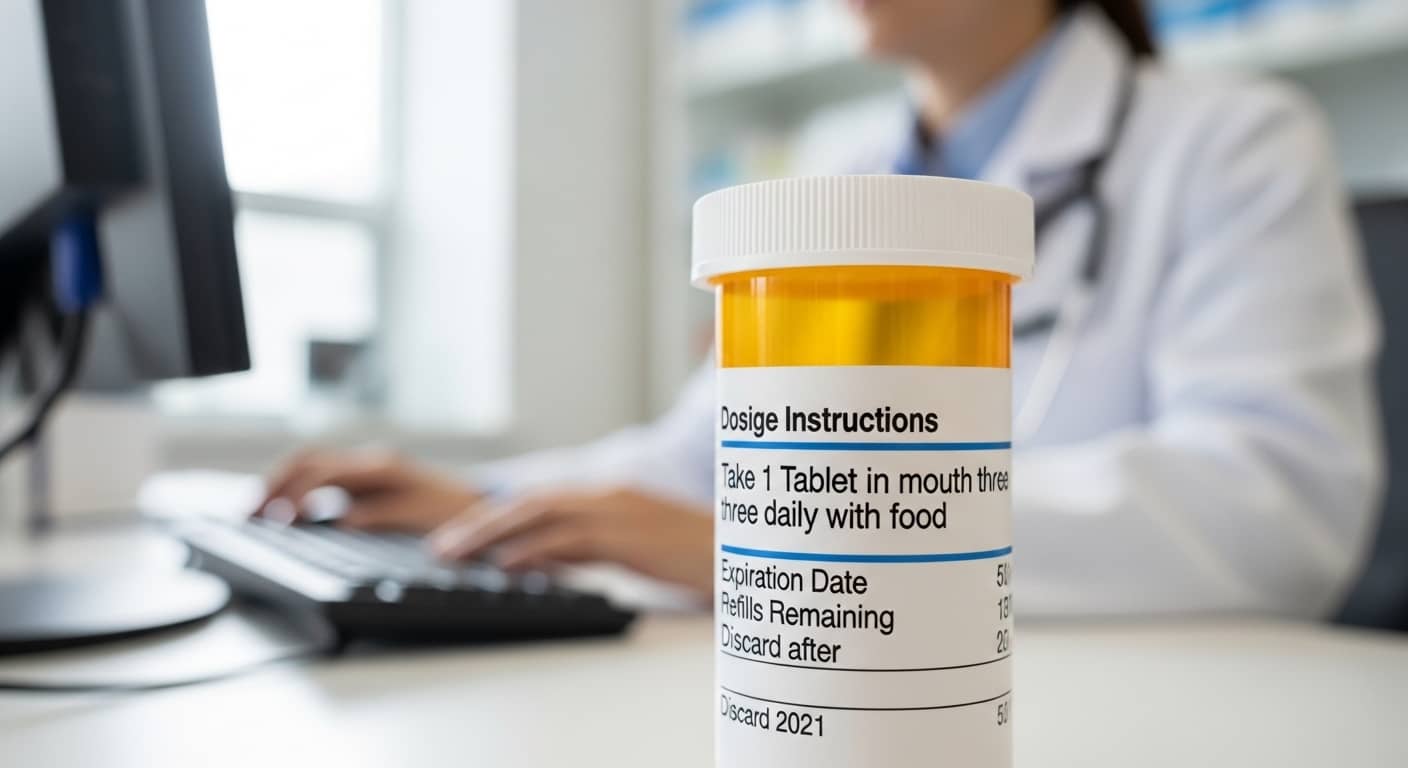
Today, most US pharmacies print plain English instructions alongside the abbreviation. A label might read 'Take 1 tablet by mouth three times daily (TID).' However, in clinical notes, hospital charts, and handwritten prescriptions, TID appears without the English translation — which is exactly why understanding it matters.
TID vs q8h: The Difference That Affects Drug Effectiveness
This distinction is one of the most clinically important nuances in prescription reading — and one that most patient guides skip entirely. TID and q8h are not the same instruction, even though both result in three doses per day.
TID (three times a day) is a flexible frequency instruction. It means three doses within your waking hours — typically morning, midday (or early afternoon), and evening. The gaps do not need to be exactly 8 hours. A schedule of 8 AM, 1 PM, and 7 PM is perfectly acceptable for most TID medications. You do not need to wake up at 2 AM to maintain an 8-hour interval.
q8h (every 8 hours) is a strict clock-based instruction. It means the medication must be taken every 8 hours precisely — 8 AM, 4 PM, and midnight, for example — regardless of whether that falls in the middle of the night. This instruction is used for medications where the drug's blood concentration must stay above a minimum therapeutic threshold at all times, most commonly for hospital-administered intravenous antibiotics and certain anticonvulsants.
| Instruction | Meaning | Timing Flexibility | Example Use | Wake at Night Required? |
|---|---|---|---|---|
| TID | Three times a day (ter in die) | Flexible — fit to waking schedule | Oral antibiotics, most chronic medications | No |
| q8h | Every 8 hours exactly | Strict — clock-based intervals | IV antibiotics, certain anticonvulsants | Often yes |
| BID | Twice a day (bis in die) | Flexible — morning and evening | Most chronic disease medications | No |
| QID | Four times a day (quater in die) | Flexible — spaced across waking hours | Short-term pain, eye drops | No |
| QD / Once daily | Once a day (quaque die) | Any consistent time daily | Many long-acting medications | No |
| PRN | As needed (pro re nata) | Only when symptom requires it | Pain medications, antacids | Not applicable |
| q6h | Every 6 hours exactly | Strict — same as QID but clock-based | Certain IV medications | Often yes |
| AC | Before meals (ante cibum) | Tied to meal schedule | Some diabetes medications | No |
If your prescription says TID and doesn't specify exact hours, a morning-midday-evening schedule is appropriate. If your doctor or pharmacist tells you to take it every 8 hours — or the label explicitly says 'q8h' — that means strict interval timing. When in doubt, ask your pharmacist directly: 'Does this medication need to be taken exactly 8 hours apart, or is a flexible waking-hours schedule okay?' That single question eliminates the ambiguity entirely.
How to Schedule TID Medication: Practical Timing Examples
Most people have different daily schedules — early risers, shift workers, students, and retirees all have different natural rhythms. The good news about TID is that it adapts to your schedule, not the other way around. The goal is simply to space three doses across your waking hours as evenly as practical.
| Wake-Up Time | Dose 1 (Morning) | Dose 2 (Midday / Afternoon) | Dose 3 (Evening) | Total Gap |
|---|---|---|---|---|
| 6:00 AM | 7:00 AM | 1:00 PM | 7:00 PM | 6 hrs apart |
| 7:00 AM | 8:00 AM | 2:00 PM | 8:00 PM | 6 hrs apart |
| 8:00 AM | 8:00 AM | 2:00 PM | 9:00 PM | 6–7 hrs apart |
| 9:00 AM (late riser) | 9:30 AM | 3:00 PM | 9:00 PM | 5.5–6 hrs apart |
| 5:00 AM (early shift) | 5:30 AM | 12:00 PM | 6:30 PM | 6–6.5 hrs apart |
| Night shift worker | On waking | 6 hrs after dose 1 | 6 hrs after dose 2 | Consistent to your day |
There is no single 'correct' TID schedule — only a schedule that is consistent. Changing your timing dramatically from one day to the next defeats the purpose of spaced dosing, which is to maintain a relatively steady level of the medication in your bloodstream. Pick times you can realistically maintain every day and stick to them. Linking doses to regular daily events — waking up, a meal, and bedtime — is the most reliable practical strategy.
Complete List of Common Prescription Abbreviations Explained
TID doesn't appear in isolation. Most prescriptions combine frequency abbreviations (how often) with route abbreviations (how the medication is taken) and timing modifiers (when relative to food or activities). Understanding the full system helps you read any prescription correctly.
| Abbreviation | Latin Origin | Meaning | Clinical Use |
|---|---|---|---|
| TID / t.i.d. | Ter in die | Three times daily | Antibiotics, BP meds, some pain medications |
| BID / b.i.d. | Bis in die | Twice daily | Most chronic condition medications, antihistamines |
| QID / q.i.d. | Quater in die | Four times daily | Short-term pain, eye/ear drops, some antibiotics |
| QD / q.d. | Quaque die | Once daily | Long-acting medications — statins, most antidepressants |
| PRN / p.r.n. | Pro re nata | As needed | Pain relief, antacids, rescue inhalers |
| AC / a.c. | Ante cibum | Before meals | Some diabetes drugs, stomach medications |
| PC / p.c. | Post cibum | After meals | NSAIDs, iron supplements, metformin |
| HS / h.s. | Hora somni | At bedtime | Sleep aids, some BP medications |
| PO / p.o. | Per os | By mouth (oral) | Route indicator — most common route |
| SL | Sub lingua | Under the tongue | Nitroglycerin, some anxiety medications |
| PR | Per rectum | Via rectum | Suppositories |
| q4h | Quaque 4 hora | Every 4 hours | Around-the-clock pain management |
| q8h | Quaque 8 hora | Every 8 hours (strict) | IV antibiotics, hospital medications |
| STAT | Statim | Immediately — right now | Emergency or urgent single dose |
| NR / NF | Non repetatur | No refill | Controlled substances, one-time prescriptions |
Which Medications Are Commonly Prescribed TID?
A medication is prescribed TID when its active duration in the body (called the half-life) lasts roughly 6–10 hours — long enough to maintain effectiveness between doses, but short enough that two daily doses wouldn't be adequate. Here are the most commonly prescribed drug categories that frequently use TID dosing:
- Antibiotics: Amoxicillin (500 mg PO TID is one of the most prescribed antibiotic regimens in the US for respiratory, skin, and urinary tract infections), cephalexin, and dicloxacillin are among the most common TID oral antibiotics. The TID schedule helps maintain blood concentrations above the minimum inhibitory concentration for the infecting bacteria throughout the treatment course.
- Blood Pressure Medications: Certain shorter-acting calcium channel blockers and ACE inhibitors with 8–10 hour activity windows require TID dosing. However, most modern blood pressure medications have been reformulated as once or twice daily for better adherence.
- Diabetes Medications: Regular (short-acting) human insulin is typically dosed TID with meals. Some older oral diabetes agents also require three daily doses, though most newer formulations have moved to once daily.
- Pain Management: Short-acting NSAIDs like ibuprofen (400–800 mg TID with food) are commonly prescribed TID for acute inflammatory conditions. Gabapentin for nerve pain often starts at TID dosing.
- Seizure Medications: Some anticonvulsants including older formulations of carbamazepine require TID dosing to maintain therapeutic blood levels.
- Gastrointestinal Medications: Some antacids, H. pylori eradication regimens, and prokinetic agents are prescribed TID, often timed relative to meals.
- Thyroid and Hormonal Medications: Some thyroid preparations and corticosteroid pulse doses use TID dosing for specific treatment indications.
One practical detail worth knowing: when a medication is prescribed 'TID with food,' the doses should be timed to your three main meals if possible — not taken at fixed 8-hour intervals on an empty stomach at the wrong times. The food instruction exists for a reason — either to improve absorption, protect the stomach lining, or reduce nausea — and it takes precedence over perfect 8-hour spacing.
What to Do If You Miss a TID Dose
Missing a dose happens to almost everyone. The right response depends on how much time has passed since the missed dose was due. There is no universal rule that applies to every TID medication, but there is a reliable general guideline — and knowing the exception to it matters.
| Situation | Recommended Action | What NOT to Do |
|---|---|---|
| Realized within 1–2 hours of missed dose | Take the missed dose as soon as you remember | Do not skip it — take it now |
| More than halfway to next dose time | Skip the missed dose and take the next one at the regular scheduled time | Do NOT double the next dose to compensate |
| Unsure whether you took a dose | For non-critical medications, skip and continue normally; for critical medications (anticoagulants, anticonvulsants), call your pharmacist | Do not take an extra dose just in case |
| Missed multiple doses in a row | Contact your pharmacist or prescribing doctor before resuming — some medications require a gradual restart | Do not try to catch up with multiple extra doses |
| Antibiotic specifically | Take the missed dose as soon as remembered, even if close to next dose time — maintaining antibiotic levels is critical; adjust the remaining schedule forward | Do not halve doses or combine two doses |
The golden rule that applies to every medication: never take a double dose to make up for a missed one. Doubling a dose can push the drug concentration in your body above safe levels, causing side effects or toxicity — and for some medications, the consequences can be serious. When in doubt, your pharmacist is the fastest and most reliable resource. Most pharmacy counters will answer this question over the phone in under two minutes.
Safety Tips for Patients Taking TID Medications
Following a TID schedule consistently is a genuine adherence challenge for most people. Studies show that adherence drops measurably as dosing frequency increases — once daily adherence averages around 80%, twice daily around 70%, and three times daily around 65%. These are the strategies that research and clinical practice consistently show to be most effective:
- Set three recurring alarms on your phone labeled with the medication name: Label them 'Morning med,' 'Midday med,' and 'Evening med' at your chosen times. This is the single most effective strategy for maintaining TID adherence. Do not rely on memory alone — even the most conscientious patients forget occasional doses without reminders.
- Link doses to fixed daily anchors: Take dose 1 with your morning coffee or when you first brush your teeth. Take dose 2 with lunch. Take dose 3 with dinner or when you brush your teeth at night. Anchoring medication to existing habits makes missing a dose noticeably disruptive rather than easy to overlook.
- Use a weekly pill organiser with three compartments per day: Look for organizers labeled AM, Noon, and PM. Being able to visually confirm whether you've taken a dose eliminates the uncertainty of 'did I take it or not?' — a leading cause of accidental double doses.
- Read the full label, not just the frequency: TID tells you how often, but the label also tells you the route (PO = by mouth), any food requirements (with food / on empty stomach), storage requirements, and any specific warnings. All of these affect how the medication works in your body.
- Never stop a TID antibiotic course early because symptoms improve: Feeling better after 3–4 days of antibiotics does not mean the infection is cleared — it means the medication is working. Stopping early allows surviving bacteria to develop resistance. Complete the full prescribed course even if you feel completely normal.
- Keep an updated medication list: Write down every medication you're currently taking, its dose, and its frequency. Keep this list in your wallet and share it with every healthcare provider you see. Drug interactions and overlapping dosing schedules are a significant source of preventable harm — your pharmacist can review this list for potential conflicts.
- Store medications correctly: Most oral TID medications should be stored at room temperature, away from heat and humidity. Bathroom medicine cabinets are actually one of the worst places to store medication due to steam from showering. A bedside table drawer or kitchen cabinet away from the stove is typically better.
Common Mistakes Patients Make with TID Prescriptions
These are the specific errors that pharmacists and doctors see most regularly in TID medication management — each one is avoidable once you know to watch for it.
- Treating TID as 'any three times' rather than 'evenly spaced three times': Taking all three doses within a 4-hour window — say, 8 AM, 10 AM, and 12 PM — and then having a 20-hour gap until the next day's first dose completely defeats the purpose of three-times-daily dosing. The point is to maintain steady drug levels across the entire 24-hour period. Spread the doses across your waking hours.
- Assuming TID and q8h are interchangeable: They are not. TID is a flexible frequency prescription. q8h is a strict interval instruction. If your prescription says TID for an oral antibiotic, morning-midday-evening is appropriate. If a hospital physician writes q8h for an IV antibiotic, you follow the clock — including overnight. Treating q8h as a flexible instruction can leave dangerous gaps in drug coverage.
- Stopping TID antibiotic courses because 'it's inconvenient': Three doses a day is genuinely difficult to maintain for a 10-day antibiotic course. Many patients stop at day 5 or 6 when symptoms have resolved. This incomplete treatment is one of the main drivers of antibiotic resistance in the US. Incomplete antibiotic courses also risk relapse of the original infection with a now harder-to-treat bacterial population.
- Not telling your doctor or pharmacist about other TID medications: If you are already taking one TID medication and your doctor prescribes another, both at three times daily, the timing of these doses relative to each other can matter for drug interactions or absorption. Always mention existing medications when being prescribed something new.
- Confusing TID with PRN (as needed): Some patients misread TID as meaning 'take three times if needed' — essentially treating it like a PRN instruction. TID is a scheduled frequency instruction, not a conditional one. Unless your prescription explicitly says PRN, the medication should be taken three times daily as scheduled, whether or not you feel symptoms on a given day.
When Prescription Abbreviations Become a Safety Risk
The ISMP publishes a list of error-prone abbreviations that have been associated with documented medication errors in US healthcare settings. While TID is not on the ISMP's high-alert list, the broader category of Latin frequency abbreviations is flagged as a contributor to patient confusion — particularly among elderly patients, patients with limited health literacy, and patients managing multiple medications simultaneously.
StatPearls / NCBI's published data on medication dispensing errors notes that abbreviations are a recognized potential cause of medication errors, and that 'frequency of administration abbreviated using suffixes like QD, OS, TID, QID, and PR' is a documented source of prescription misinterpretation. For individual patients, the practical takeaway is this: if any abbreviation on your prescription or medication label is unclear, you have every right to ask your pharmacist to explain it in plain English. That is part of their professional role — and a well-trained pharmacist will always welcome the question rather than being annoyed by it.
Conclusion
TID is three letters with a straightforward meaning: take this medication three times a day, spaced across your waking hours. But behind those three letters are important nuances — the difference between flexible TID timing and strict q8h intervals, the relationship between consistent dosing and therapeutic effectiveness, the rules for missed doses, and the specific medications that depend on TID adherence for clinical outcomes.
The WHO's estimate that medication errors cost $42 billion annually — and that misunderstood prescription instructions are a significant contributor — is a reminder that prescription literacy is a practical health skill, not just an academic one. Understanding what TID means, how to schedule it, and how to handle common situations like missed doses or food restrictions puts you in control of your own treatment in a way that genuinely affects outcomes.
One final point worth repeating: your pharmacist is the most underused resource in US healthcare. Every time you pick up a prescription with an abbreviation or instruction you are not completely certain about, ask. Not later — at the counter, before you leave. That conversation takes two minutes and can prevent weeks of ineffective or unsafe medication use.
FAQ
Frequently Asked Questions
What does TID stand for in medical terms?
TID stands for 'ter in die' — a Latin phrase meaning 'three times a day.' It is a standard prescription abbreviation that instructs patients to take a medication three separate times within a 24-hour period. You may see it written as TID, t.i.d., or tid — all three formats have the same meaning. The abbreviation is used on prescriptions, medication labels, hospital charts, and clinical notes across the United States and internationally.
Is TID the same as every 8 hours?
Not exactly — and the distinction matters. TID (three times a day) is a flexible frequency instruction that fits your waking schedule. Morning, midday, and evening doses are appropriate for most TID medications. q8h (every 8 hours) is a strict clock-based instruction that requires doses exactly 8 hours apart, regardless of the time of day — including overnight doses. Doctors use q8h instead of TID when the medication requires a precisely constant blood level, such as intravenous antibiotics in hospital settings. If your prescription says TID without specifying a strict interval, a morning-midday-evening schedule is correct.
What is a good TID schedule for medication?
Any schedule that spaces three doses roughly evenly across your waking hours and that you can maintain consistently every day. Common examples: 8 AM, 2 PM, 8 PM (for someone awake from 7 AM to 10 PM); or 7 AM, 1 PM, 7 PM; or 9 AM, 3 PM, 9 PM. The key principle is consistency — taking doses at approximately the same times each day maintains steadier drug levels in your body than taking doses at unpredictable intervals. Linking doses to fixed daily anchors like meals or tooth brushing is the most effective strategy for consistent adherence.
What should I do if I miss a TID dose?
If you realize within 1–2 hours of the missed dose, take it as soon as you remember. If you are more than halfway to the next scheduled dose, skip the missed dose and take the next one at the regular time. Never take a double dose to make up for a missed one — this can push the drug to unsafe concentrations. For antibiotics specifically, take the missed dose as soon as remembered even if relatively close to the next dose time, since maintaining antibiotic coverage is particularly important. If you miss multiple consecutive doses of any critical medication (anticoagulants, anticonvulsants, certain heart medications), contact your pharmacist or doctor before resuming.
What is the difference between TID, BID, QID, and QD?
These are all dosing frequency abbreviations from Latin: TID (ter in die) = three times daily; BID (bis in die) = twice daily; QID (quater in die) = four times daily; QD (quaque die) = once daily. The frequency corresponds to how long the medication remains active in the body. Once-daily medications have long half-lives. TID medications are typically active for 6–10 hours. QID medications may have even shorter activity windows. Doctors choose the frequency that keeps the medication within the therapeutic range continuously throughout the day.
What does PO TID mean on a prescription?
PO TID combines two abbreviations: PO stands for 'per os' (Latin for 'by mouth'), indicating the medication is taken orally — as a tablet, capsule, or liquid. TID stands for 'ter in die,' meaning three times a day. Together, PO TID means 'take this medication by mouth three times daily.' It is one of the most common prescription instruction combinations and appears on a wide range of oral medications. The PO specifies the route of administration; the TID specifies the frequency.
Can I take my TID medication with food?
It depends on the specific medication, not on the TID frequency itself. Some TID medications should be taken with food to reduce stomach irritation (NSAIDs like ibuprofen, metformin, iron supplements). Others should be taken on an empty stomach for better absorption (some antibiotics like ampicillin, certain thyroid medications). Still others have no food restriction. The food instruction will be stated on your prescription label or provided verbally by your pharmacist. When in doubt, ask your pharmacist — the food timing instruction is medication-specific and is separate from the TID dosing frequency.
Is TID still used in US prescriptions in 2026?
Yes — TID remains in widespread use in American healthcare in 2026, particularly in clinical notes, inpatient charts, and electronic health records. However, patient-facing pharmacy labels increasingly print plain English instructions alongside or instead of the abbreviation: 'Take one tablet by mouth three times daily' rather than 'TID.' The Institute for Safe Medication Practices recommends spelling out instructions in plain language on patient-facing documents to reduce confusion. In academic literature, clinical documentation, and prescription writing between healthcare professionals, TID continues to be the standard shorthand.
What medications are commonly prescribed TID?
Commonly prescribed TID medications include: oral amoxicillin (500 mg TID is one of the most frequently written antibiotic prescriptions in the US), cephalexin, ibuprofen for inflammation, short-acting gabapentin for nerve pain, regular insulin dosed with meals, some blood pressure medications with shorter activity windows, and certain gastrointestinal treatments including H. pylori eradication regimens. A medication is prescribed TID when its active half-life is approximately 6–10 hours — long enough to avoid over-frequent dosing, but short enough that twice daily would leave coverage gaps.
Why do doctors still use Latin abbreviations like TID instead of plain English?
Latin abbreviations like TID persist in medicine because they originated as a universal standard across European medical practice centuries ago and remain embedded in clinical systems, electronic health record templates, and professional medical education. Among healthcare professionals who are trained in these terms, they are faster to write and universally understood across specialties and institutions. However, the ISMP and the Joint Commission have both advocated for plain English on patient-facing instructions, noting that abbreviation misinterpretation is a documented source of medication errors. Most modern US pharmacies now include plain English translations on consumer-facing labels, even when the original prescription used Latin abbreviations.