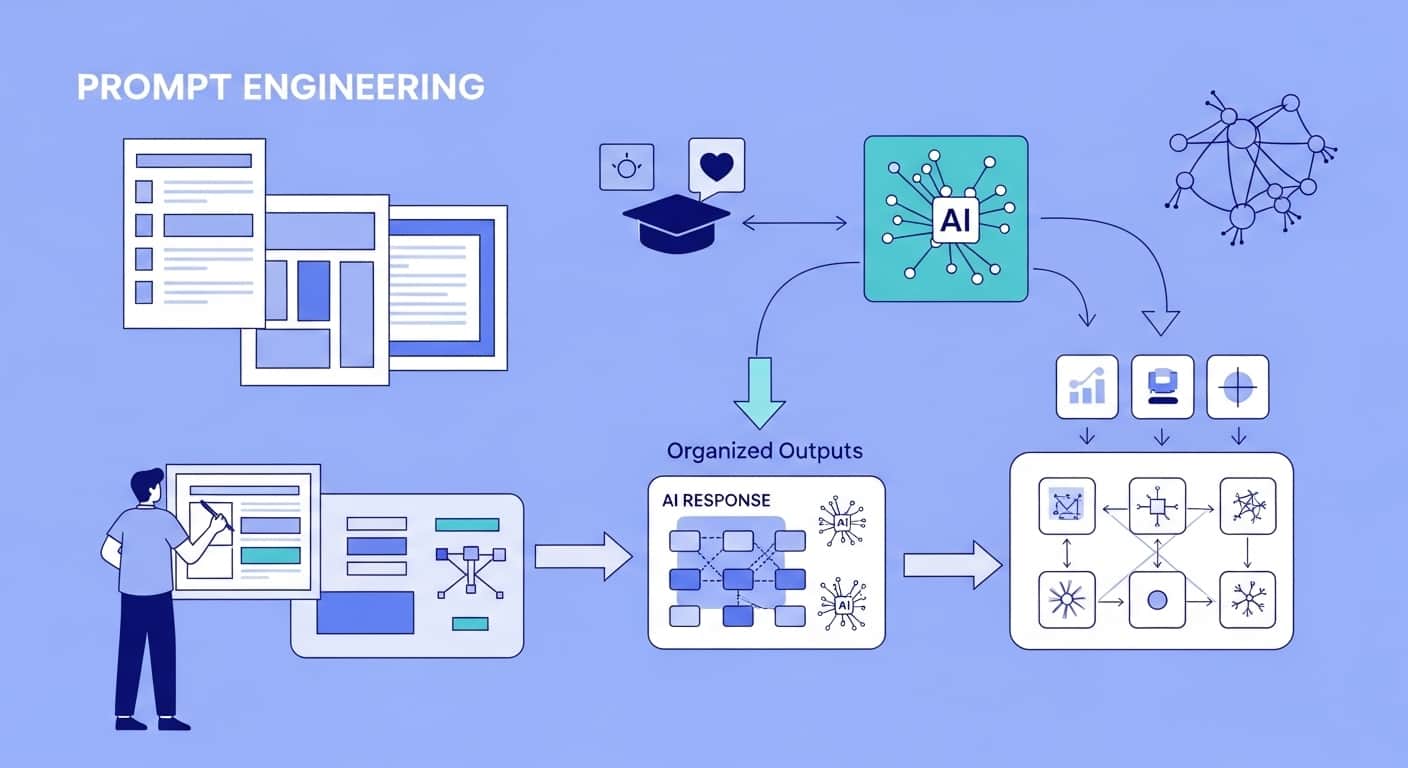
Prompt engineering is the core discipline of designing structured instructions that guide large language models (LLMs) to produce accurate, reliable, and useful responses. The same underlying model can generate a vague, generic answer or an expert-level solution depending entirely on how the prompt is framed. As AI systems become foundational across enterprise and personal workflows, prompt engineering has emerged as an essential skill for developers, writers, marketers, and analysts. This comprehensive guide explores prompt engineering from first principles to advanced production techniques, complete with practical code snippets and strategic frameworks.
What is Prompt Engineering
Prompt engineering is the systematic process of writing instructions that direct an AI model toward a specific objective. A prompt can be a direct question, a command sequence, or a complex task definition. Effective prompts translate abstract human intent into explicit programmatic constraints that models can parse and execute.
Review ChatGPT Prompts Writing GuideRead the TypeScript Development Guide
Why Prompt Engineering Matters
AI models do not possess human cognition; they operate via probabilistic pattern recognition over massive training corpuses, predicting the most statistically likely next tokens. Prompt engineering bridges the cognitive gap between human expectation and machine token prediction, drastically improving output accuracy and eliminating costly trial-and-error iterations.
How AI Models Respond to Prompts
Models evaluate your prompt as a continuous context window. They possess no memory of unstated goals, formatting rules, or implicit preferences unless explicitly defined. Consequently, anything left unstated in the prompt is left entirely to probability.
Basic Prompt Structure
Robust prompts generally adhere to a four-pillar architectural framework to eliminate ambiguity.
- Role: Define the persona or expert identity the AI should adopt
- Task: Clearly state the specific action or objective to be accomplished
- Context: Provide background information, constraints, and target audience data
- Output Format: Specify the exact structure required (bullet points, JSON, Markdown table)
Beginner Prompt Engineering Techniques
Beginners should prioritize clarity, direct phrasing, and single-task execution over complex multi-layered commands.
- Use explicit, direct language rather than vague hints
- Define qualitative metrics rather than relying on subjective words like 'better'
- Break multi-step requests into sequential, single-task prompts
- Specify the target audience and tone of voice upfront
Intermediate Prompt Engineering Techniques
Intermediate methods introduce structural constraints and operational boundaries to ensure repeatable quality.
- Step-by-step instruction ordering to dictate sequential logic flow
- Strict length limits and word count caps
- Rigorous output formatting guidelines (JSON schemas, Markdown headers)
- Zero-shot prompting for standard, well-documented queries
Advanced Prompt Engineering Techniques
Advanced prompt engineering optimizes model reasoning for complex code generation, logical synthesis, and agentic workflows.
- Few-shot prompting: Providing 2–5 input-output examples to establish an exact pattern
- Chain-of-thought prompting: Instructing the model to reason step by step before generating a conclusion
- Role-based persona tuning: Assigning specialized expert profiles to control depth and domain vocabulary
- Prompt chaining: Decomposing monolithic tasks into pipelines where output feeds subsequent inputs
- ReAct-style prompting: Interleaving model reasoning steps with external tool execution
Prompt Engineering Code Examples
The following production-grade prompt examples scale from basic writing tasks to complex system architecture designs.
Writing Prompt Example
Act as a professional content writer.
Write a beginner-friendly explanation of cloud computing (200-250 words).
Use simple language, one real-world analogy, and avoid technical jargon.
Audience: small business owners with no technical background.
Coding Prompt Example
Act as a senior backend developer.
Write a Node.js Express API endpoint for user login using JWT authentication.
Requirements:
- Validate email and password fields
- Hash comparison using bcrypt
- Return a signed JWT on success
Explain each step briefly in inline comments.
Business Prompt Example
Act as a startup consultant.
Create a 3-tier pricing strategy for a SaaS project management tool.
Target audience: small businesses (5-50 employees) in the United States and India.
Include: tier names, monthly price in USD and INR, and 3 key features per tier.
Output as a markdown table.
Advanced System Design Prompt
You are a system architect with 15 years of experience in high-traffic infrastructure.
Design a scalable e-commerce backend for 1 million daily active users.
Include: database selection with architectural justification, caching strategies, API gateway routing, and security considerations.
Think step by step, then present the final answer in bullet points grouped under clear headers.
Model Parameters That Affect Output
Prompt text is paired with execution parameters configured at the API level to govern model generation behavior.
- Temperature: Controls token randomness; lower values yield deterministic, focused outputs
- Max tokens: Enforces hard upper limits on response length
- System prompts: Establishes persistent baseline instructions across chat sessions
- Top-p / Top-k: Alternative statistical sampling filters for controlling creative diversity
Common Prompt Engineering Mistakes
Recognizing common design flaws prevents frustrating iterations and poor model performance.
- Using overly vague descriptors without defining concrete acceptance criteria
- Omitting critical domain context that the model cannot infer
- Overloading a single prompt with multiple conflicting objectives
- Failing to specify output formatting structures, causing parsing errors
- Treating prompt writing as a one-shot process rather than an iterative engineering loop
Real World Use Cases
Organizations embed prompt engineering patterns into production applications across multiple sectors.
- Automated software refactoring and code review pipelines
- Intelligent customer support triage and ticket routing
- Structured financial reporting and contract summarization
- Dynamic educational content generation and personalized tutoring
Best Practices
Institutionalizing professional workflows ensures consistent, enterprise-grade AI utility.
- Always define an authoritative persona when specialized knowledge is required
- Separate system instructions from variable user data clearly
- Maintain prompt version control to track performance changes across model updates
- Test prompts rigorously against adversarial inputs and edge cases
Frequently Asked Questions
What is prompt engineering?
Prompt engineering is the systematic practice of designing and refining instructions, context, and constraints to guide AI models toward precise, reliable outputs.
Is prompt engineering difficult to learn?
No. Effective prompt engineering is grounded in clear communication, logical task decomposition, and structural framing.
Do I need programming skills for prompt engineering?
No. While coding knowledge helps when building automated prompt pipelines, natural language clarity and domain expertise are far more critical.
What is the difference between zero-shot and few-shot prompting?
Zero-shot prompting assigns a task without examples, while few-shot prompting includes 2–3 input-output examples to establish an explicit response pattern.
What is chain-of-thought prompting?
Chain-of-thought prompting prompts the model to output intermediate reasoning steps before arriving at a final conclusion, significantly boosting logic accuracy.