Endpoint Security Technologies: Protecting Devices in the Modern Threat Landscape (2026)
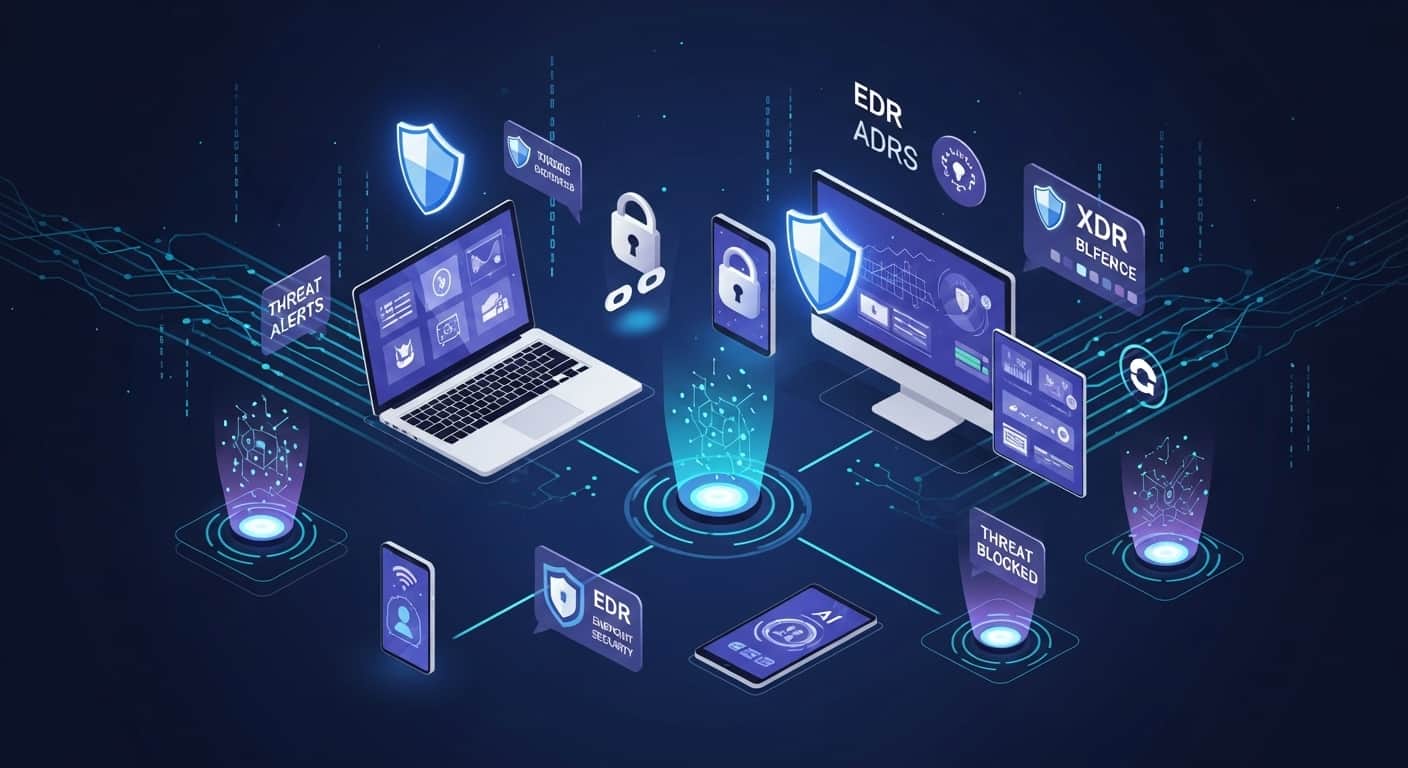
The global endpoint security market crossed $26.72 billion in 2026, driven by an expanding hybrid workforce and sophisticated threat vectors. Within this market, Endpoint Detection and Response (EDR) represents the fastest-growing segment, expanding at a 24.16% CAGR. Multi-million dollar enterprise procurements—such as the US Department of Defense deploying XDR across 500,000 classified endpoints—demonstrate that endpoint security has transitioned from basic antivirus prevention into core security infrastructure.
With ransomware impacting over 80% of small firms and a global deficit of 3 million cybersecurity professionals, organizations are rapidly adopting AI-driven threat detection, Zero Trust Network Access (ZTNA), and Managed Detection and Response (MDR) services to automate threat containment.
Endpoint Security Market Statistics
| Market Metric | 2025–2026 Benchmark Data | Primary Driver / Industry Context |
|---|---|---|
| Global Endpoint Security Market | $26.72 Billion (Projected $48.3B by 2036) | Expanding hybrid endpoints and cloud migration |
| Global EDR Market Size | $5.11B – $5.58B (24.16% CAGR) | Shift from signature blocking to behavioral detection |
| DoD SentinelOne Contract | $180 Million Singularity XDR Deployment | 500,000 classified government endpoints |
| Cisco Secure Endpoint Detection | 98% Detection of Polymorphic Malware | GenAI-powered sandboxing and memory analysis |
| Healthcare EDR Growth Rate | 25.23% Vertical CAGR | Surge in hospital ransomware and emergency diversions |
| BFSI EDR Revenue Share | 25.31% Global EDR Spending | PCI-DSS continuous endpoint monitoring compliance |
| Global Cybersecurity Talent Deficit | 3 Million Unfilled Cyber Roles | Accelerates outsourcing to 24/7 MDR service providers |
What Are Endpoint Security Technologies?
Endpoint security technologies encompass software solutions—increasingly cloud-delivered and AI-driven—that protect laptops, desktops, servers, smartphones, IoT sensors, and point-of-sale terminals. Unlike traditional perimeter firewalls, endpoint protection executes directly on individual devices, ensuring continuous defense whether a device connects from an internal network or an untrusted home Wi-Fi connection.
Core Endpoint Security Technologies Compared
| Technology | Full Name | Primary Protective Mechanism | Best Architectural Fit |
|---|---|---|---|
| AV / AM | Antivirus / Anti-Malware | Signature database matching against known malware hashes | Legacy baseline layer for low-risk environments |
| EPP | Endpoint Protection Platform | Combined prevention: heuristics, device control, local firewalls | Standard preventative suite replacing standalone AV |
| EDR | Endpoint Detection & Response | Continuous behavioral telemetry logging, anomaly detection, automated isolation | Organizations facing advanced persistent threats and ransomware |
| XDR | Extended Detection & Response | Correlates telemetry across endpoints, network, email, identity, and cloud | Complex multi-vector enterprise environments with SOC teams |
| MDR | Managed Detection & Response | Outsourced 24/7 human analyst threat hunting and active remediation | SMBs and enterprises experiencing cybersecurity staffing shortages |
| EPM | Endpoint Privilege Management | Enforces least-privilege administrative access on endpoint devices | Preventing lateral movement and administrative credential escalation |
| ZTNA / SASE | Zero Trust / Secure Access Service Edge | Continuous device posture checks and identity verification before granting access | Replacing legacy VPNs for remote and distributed workforces |
How EDR Operates: Detection to Containment
- Telemetry Collection: Kernel-level sensors continuously record process executions, memory operations, file modifications, and network sockets.
- Behavioral AI Analysis: Machine learning baselines identify abnormal behavior (e.g., a PDF launcher spawning PowerShell scripts to dump credentials).
- Threat Contextualization: Alerts are mapped against the MITRE ATT&CK framework, constructing visual process trees for security analysts.
- Automated Containment: High-confidence threats trigger immediate network isolation, process termination, and automated file rollbacks.
Vendor Landscape in 2026
| Vendor Platform | Core Differentiator | Notable Architectural Update |
|---|---|---|
| CrowdStrike Falcon | AI-native cloud platform & shared threat intelligence | 100% detection rate in enterprise independent EDR testing |
| Microsoft Defender for Endpoint | Deep M365 and Azure Active Directory integration | Agentless VM/container scanning introduced without kernel driver requirement |
| SentinelOne Singularity | Autonomous AI response without mandatory cloud latency | Awarded $180M US DoD contract across 500,000 endpoints |
| Palo Alto Networks Cortex XDR | Native cross-layer network and cloud data correlation | Direct integration with Prisma Access SASE architecture |
| Cisco Secure Endpoint | Network-integrated security across 10M+ global endpoints | GenAI-powered sandboxing achieving 98% polymorphic detection |
Implementation Challenges and Solutions
| Deployment Challenge | Operational Risk | Recommended Mitigation Strategy |
|---|---|---|
| Alert Fatigue | Analysts miss critical breaches amidst high false-positive volumes | Tune detection rules; deploy SOAR playbooks for auto-closure |
| Agent Performance Overhead | Kernel-level sensors cause CPU latency on older devices | Perform phased ring rollouts; deploy lightweight agent variants |
| Security Skills Deficit | Lack of internal staff to conduct 24/7 threat hunting | Partner with an MDR provider for managed 24/7 SOC coverage |
Frequently Asked Questions
What is endpoint security and why does it matter in 2026?+
Endpoint security protects devices (laptops, servers, mobile, IoT) from cyber threats. It is essential in 2026 due to expanded hybrid work environments, AI-generated polymorphic malware, and strict compliance mandates like PCI-DSS and CERT-In.
Is traditional antivirus software still sufficient?+
No. Traditional antivirus relies on static file signatures, failing against zero-day exploits, fileless memory attacks, and polymorphic malware. Organizations require EPP or EDR platforms with behavioral AI analysis.
What is the difference between EDR and XDR?+
EDR focuses specifically on endpoint-level telemetry (processes, files, memory). XDR expands detection by correlating telemetry across endpoints, network traffic, email gateways, identity systems, and cloud workloads.
How does Managed Detection and Response (MDR) help small businesses?+
MDR provides 24/7 threat monitoring and containment delivered by external security experts, allowing SMBs to access enterprise-grade protection without building an expensive in-house Security Operations Center (SOC).