Is a Computer Science Degree Worth It in 2026? Costs, ROI, Alternatives & How to Decide
If you've spent any time on tech Twitter, Reddit, or LinkedIn lately, you've probably seen the debate raging: with layoffs hitting Big Tech, AI writing code, and coding bootcamps promising jobs in twelve weeks, does a traditional computer science degree still make sense? Or is it an expensive four-year detour for something you could learn faster and cheaper on your own? The honest answer is: it depends on what you want out of your career, how much debt you're willing to take on, and how you learn best.
What a Computer Science Degree Actually Teaches You
A CS degree curriculum typically covers a lot more than 'how to code.' You'll usually work through several core areas that form the theoretical foundation for the rest of your career.
- Data Structures and Algorithms: The backbone of technical interviews and efficient software design.
- Computer Architecture and Operating Systems: How machines actually execute your code.
- Discrete Mathematics and Statistics: The theoretical foundation for machine learning, cryptography, and algorithm design.
- Databases and Networking: How large-scale systems store and move data.
- Software Engineering Principles: Version control, testing, and working in teams on large codebases.
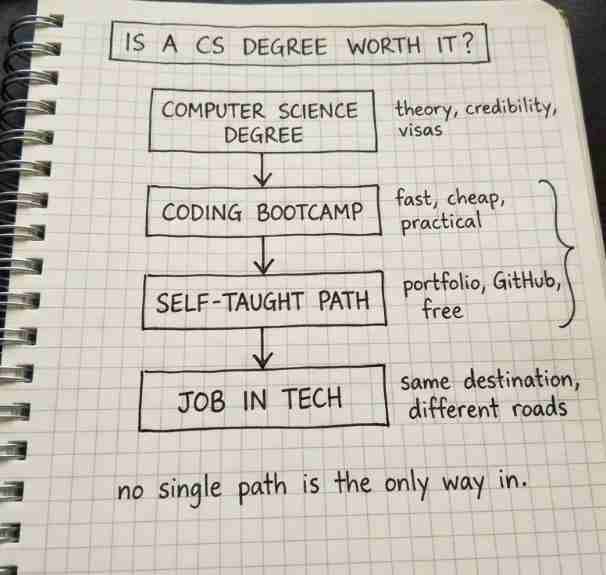
This theoretical grounding is the biggest differentiator between a computer science degree and a coding bootcamp. Bootcamps are excellent at teaching you to build things quickly with a specific stack, but they rarely go deep into computational theory, systems design, or the math that underpins fields like AI and machine learning.
The Case For Getting a Computer Science Degree
1. It Still Opens Doors at Top Companies
Many large tech employers still list a CS degree or equivalent experience as a preferred qualification, especially for entry-level software engineer roles. A degree can serve as a resume filter that gets you past automated applicant tracking systems.
2. Strong Long-Term Salary Potential
Computer science and software engineering consistently rank among the highest-paying degree fields for new graduates. Even with market corrections, the median software developer salary remains well above the national average across most countries.
3. Deeper Understanding for Specialized Fields
If you're aiming for careers in machine learning, artificial intelligence, cybersecurity, cryptography, or systems programming, the theoretical depth of a CS degree becomes genuinely useful, not just for interviews, but for the actual work.
4. Networking, Internships, and Career Services
University career centers, hackathons, and alumni networks can be a major advantage for landing your first internship or job, something self-taught learners have to build from scratch.
5. Signal to Employers and Immigration Systems
In many countries, a recognized degree also matters for work visas and immigration pathways into the tech industry, which self-taught paths can't replicate.
The Case Against a Traditional CS Degree
1. High Cost and Opportunity Cost
Tuition, especially at private universities, can run into six figures. Add in four years of lost income, and the ROI of a computer science degree becomes a genuinely complicated calculation, particularly if you could have been working and building a portfolio during that time.
2. Curriculum Can Lag Behind Industry
Many CS programs are slow to update coursework, meaning you might graduate having barely touched modern tools like cloud infrastructure, containerization, or the latest AI frameworks, skills you'll likely need to learn on the job anyway.
3. The Rise of Alternative Paths
Coding bootcamps, self-taught developers, and online certifications have produced thousands of successful engineers without a four-year degree. Portfolio projects, GitHub contributions, and open-source work increasingly speak louder than a diploma for many employers, especially startups.
4. AI Is Changing What 'Coding' Means
With AI coding assistants becoming standard tools, the bar for entry-level programming tasks is shifting. Employers are placing more weight on problem-solving, system design, and judgment, skills a degree can help build, but doesn't guarantee.
Computer Science Degree vs. Bootcamp vs. Self-Taught
| Path | Typical Cost | Time | Strengths | Weaknesses |
|---|---|---|---|---|
| CS Degree | $40K–$200K+ | 4 years | Deep theory, brand recognition, visa eligibility | Expensive, slower to market |
| Coding Bootcamp | $10K–$20K | 3–6 months | Fast, job-focused, practical stack | Less theory, uneven quality across programs |
| Self-Taught | Low to free | Varies | Flexible, cheap, self-paced | Requires discipline, no formal credential |
Is It Worth It For You? Key Questions to Ask
- Do you want to work at a large, credential-focused company, or a startup that cares mostly about your portfolio?
- Are you interested in research, AI/ML, or other theory-heavy specializations?
- Can you afford the tuition without excessive debt, or do you have access to scholarships and financial aid?
- Do you thrive with structured learning, or are you disciplined enough to self-teach and build projects independently?
- Is a work visa or immigration pathway a factor in your career plans?
Conclusion
A computer science degree isn't a golden ticket, and it's no longer the only path into a tech career, but it also hasn't become irrelevant. It remains one of the most reliable ways to build deep technical fundamentals, access top employers, and future-proof your career against rapidly changing tools and frameworks. The real question isn't 'is a CS degree worth it' in the abstract, it's 'is it worth it for you,' given your goals, finances, and learning style.
Frequently Asked Questions
Is a computer science degree still worth it with AI writing code?+
Yes, for most career paths. AI tools are changing entry-level tasks, but employers still value the problem-solving, system design, and theoretical grounding a CS degree builds, especially for roles beyond basic scripting.
Can I get a software engineering job without a CS degree?+
Yes. Many engineers land jobs through coding bootcamps, self-taught portfolios, and open-source contributions, particularly at startups. Larger companies may still prefer a degree or equivalent demonstrated experience.
Is a coding bootcamp better than a CS degree?+
It depends on your goals. Bootcamps are faster and cheaper for job-ready practical skills, while a CS degree offers deeper theory useful for specialized fields like AI, cybersecurity, or systems programming.
What is the average ROI of a computer science degree?+
Computer science consistently ranks among the highest-paying degree fields, but actual ROI depends heavily on tuition cost, school choice, and how quickly you land a job after graduating.