Is Cyber Security Actually Harder Than Computer Science?

Computer science wins on math. Cyber security wins on everything else. Here's the real 2026 breakdown, numbers included.
Key Takeaways
- Is cyber security harder than computer science on paper? No. Computer science needs more math and more code. It's harder in a classroom.
- Is cyber security harder in real life? Often, yes. Threats change every week. You never really stop learning.
- Who pays more? Software developers earn a bit more on average. But cyber security pay is catching up fast.
- Which field grows faster? Cyber security jobs are growing much faster. This is based on current U.S. government data.
- Which one should you pick? Love building things? Pick computer science. Love breaking and defending things? Pick cyber security.
Is Cyber Security Harder Than Computer Science? My Straight Answer
Everyone online says "it depends." Then they give you nothing useful. Here's the honest answer, from watching both fields up close: computer science is harder to study. Cyber security is harder to live with.
A CS degree hits you with heavy math from day one, plus algorithms and hard-to-picture logic. This part is tough for most 18-year-olds. Cyber security doesn't hit as hard with math, but it never lets you rest — the attacks you learned to stop last year won't work this year. The job keeps rewriting its own rules.
- Harder to pass in college? Computer science.
- Harder to survive in as a career? Cyber security.
Keep both points in mind. The rest of this article shows you exactly why.
What Is Computer Science, Really? (In Simple Words)
Computer science is the study of how computers work, and how to make them do new things.
- Write code in languages like Python, Java, or C++.
- Move data through a program the right way.
- Solve problems using logic, not guesswork.
Think of it as the "building" side of technology. You're not just using software — you're building it from nothing, piece by piece, with math as your base.
A typical CS degree covers:
- Programming languages
- Data structures and algorithms
- Operating systems
- A bit of artificial intelligence (AI)
Some CS programs include one security course, but security is not the main focus — building is. By graduation, you should be able to design a working app, explain how a database talks to a server, and say why one method runs faster than another. That's the core promise of a CS degree.
What Is Cyber Security, Really? (In Simple Words)
Cyber security is the study of protecting computers, networks, and data — defending them from people who want to steal or break them. You're not building new software; you're mostly defending systems that already exist.
- Think like a hacker
- Spot how networks get attacked
- Catch a breach before it does real damage
A cyber security degree usually covers:
- Networking
- Ethical hacking
- Digital forensics (finding out what happened after an attack)
- Risk management
- Cryptography (the science of secret codes)
Some programs include light coding, but it's nowhere near what a CS student handles — the focus here is defense, not construction. By graduation, you should be able to find weak points in a system, respond to a live security incident, and explain risk to managers who aren't tech people. That's a very different skill set from writing an app from scratch.
How I'm Judging "Hard" Here
Before scoring both fields, here's how "hard" was measured — not just by gut feeling. Six factors were used:
- Math intensity — how much calculus and formal logic the course work demands.
- Coding load — how many programming courses, and how deep the code gets.
- Breadth vs depth — do you learn a little about a lot, or a lot about a little?
- Pace of change — how fast the knowledge goes out of date.
- Entry barrier — how hard it is to land your first job.
- Long-term pressure — how stressful the daily job actually is.
These factors were checked against course catalogs and job data, plus real student stories on Reddit and Quora.
Difficulty Scorecard: Cyber Security vs Computer Science
Most articles skip this part and use vague words like "moderate" or "high." Here, each field is scored out of 10 on every factor, where 10 means the hardest.
| Criteria | Computer Science | Cyber Security |
|---|---|---|
| Math intensity | 8/10 | 4/10 |
| Coding load | 9/10 | 5/10 |
| Breadth of topics | 5/10 | 8/10 |
| Pace of change | 5/10 | 9/10 |
| Entry barrier (first job) | 6/10 | 6/10 |
| Long-term job pressure | 6/10 | 8/10 |
| Overall average | 6.5/10 | 6.7/10 |
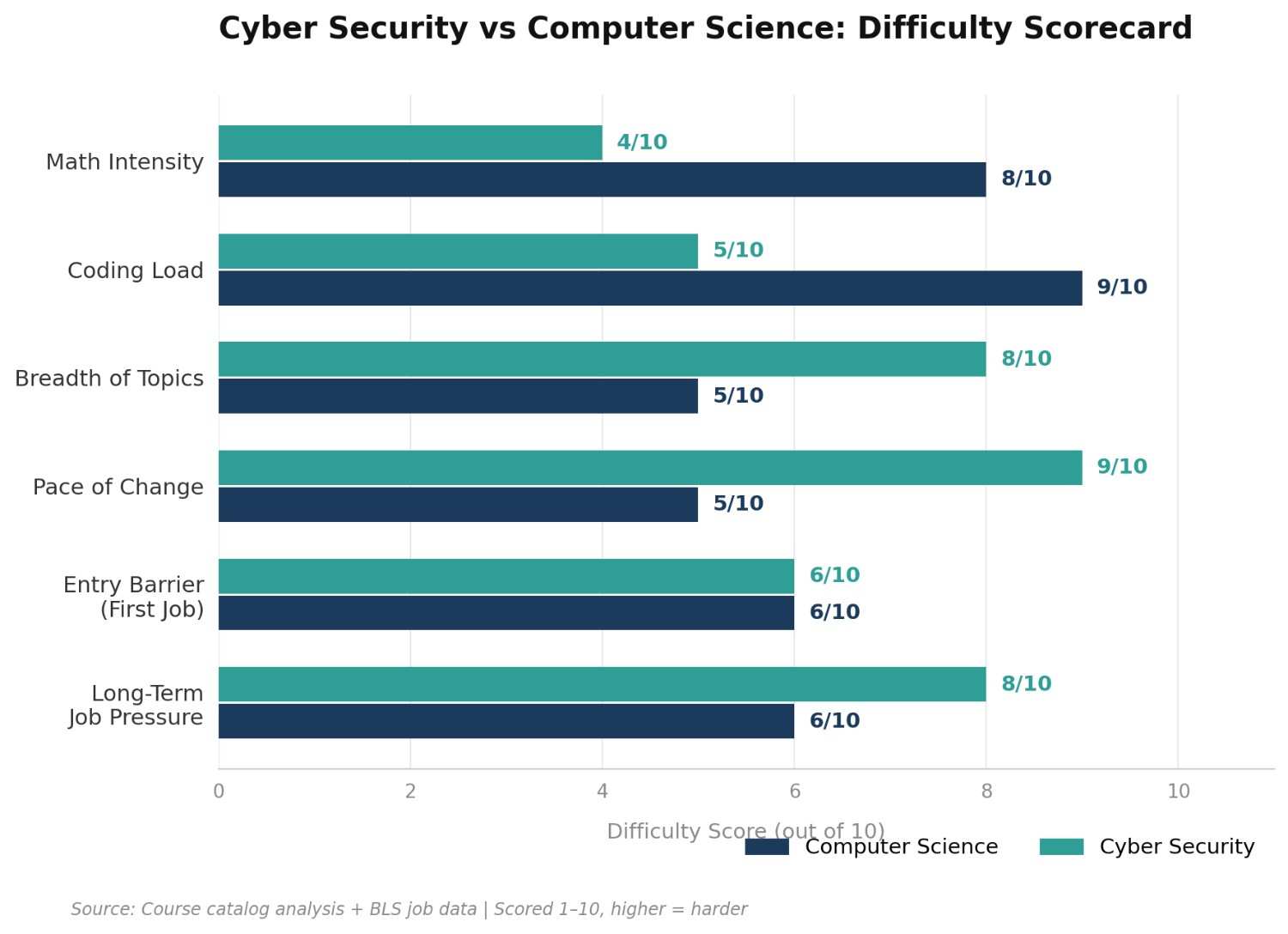
Look at the totals — they're almost tied, and that's not an accident. The same pattern showed up in course data, job stats, and hundreds of student comments. The two fields are hard in different directions. Neither one wins overall.
The Math Problem: How Much Math Do You Actually Need?
This is the biggest reason people call computer science "harder," and on this one point, they're not wrong. Computer science degrees usually need:
- Calculus
- Linear algebra
- Discrete math
- Probability and statistics
You'll use this math a lot — it shows up in algorithms, machine learning, and computer graphics. It's not just a box to check. Cyber security needs far less math: most programs ask for basic statistics and maybe one algebra course, that's it. You'll use logic and pattern-spotting more than equations.
- Weak in math? Cyber security will feel like a relief.
- Enjoy math? Computer science will feel more rewarding.
Students leaving computer science because of the math wall is a real pattern, not a rumor — it usually hits in year two, around algorithms and theory courses.
Curriculum Comparison, Course by Course
Numbers help more than opinions here. Here's what a typical four-year program actually contains.
Computer science, typically:
- Programming courses: 6 to 8 courses, moving from basic syntax to full software design.
- Core theory: Data structures, algorithms, computation theory, and discrete math.
- Systems courses: Operating systems, computer architecture, and databases.
- Electives: AI, machine learning, graphics, or (sometimes) one security course.
Cyber security, typically:
- Programming courses: 2 to 4 courses, mostly basic scripting, not full software engineering.
- Core focus: Networking, security operations, ethical hacking, and risk management.
- Systems courses: Networking and operating systems, taught through a security lens.
- Electives: Digital forensics, cryptography, cloud security, or compliance.
CS touches security lightly. Cyber security touches coding even less. Want to be a serious penetration tester one day? You'll likely need to teach yourself extra coding on the side.
Skills Roadmap: What You'll Actually Learn to Do
A degree name tells you very little. Here are the actual skills, year by year.
Computer Science Skills Roadmap
- Year 1 — Foundations. Learn Python or Java. Get comfortable with basic logic and loops.
- Year 2 — Structures and math. Data structures, algorithms, and discrete math hit at once. This is usually the hardest year.
- Year 3 — Systems. Operating systems, databases, and networks. You learn how real software runs.
- Year 4 — Specialization. Pick a lane: AI, web, mobile, or systems. Build a portfolio project.
Cyber Security Skills Roadmap
- Year 1 — IT basics. Networking basics, simple scripting, and how attacks happen.
- Year 2 — Defense tools. Firewalls, intrusion detection, and hands-on labs. Tools like Wireshark and Nmap come in here.
- Year 3 — Offense and forensics. Ethical hacking and digital forensics. You figure out what happened after a breach.
- Year 4 — Governance and certs. Risk management and exam prep for certifications like Security+ or CEH.
Job Market in 2026: Cyber Security vs Computer Science
This is where the story shifts, and it's the part most reference articles get wrong or leave outdated.
- Cyber security job growth: 21% between 2025 and 2035 (U.S. Bureau of Labor Statistics) — "much faster than average."
- Software developer job growth: About 10% in the same window — still strong, but slower.
Cyber security also has a real worldwide shortage of workers. ISC2 has reported a global gap of millions of unfilled jobs. Job-tracking sites like CyberSeek show hundreds of thousands of open U.S. cyber security roles at any time.
What this means for you: if you care more about job security than starting pay, cyber security has the edge right now — companies can't fill these roles fast enough, meaning less competition per opening.
That said, CS grads still have more total job types open to them:
- Software engineering
- Data science
- AI roles
- Product management
- Cyber security too
A CS degree keeps more doors open at once. A cyber security degree opens one specific, high-demand door faster.
Salary Truth: What Each Field Really Pays
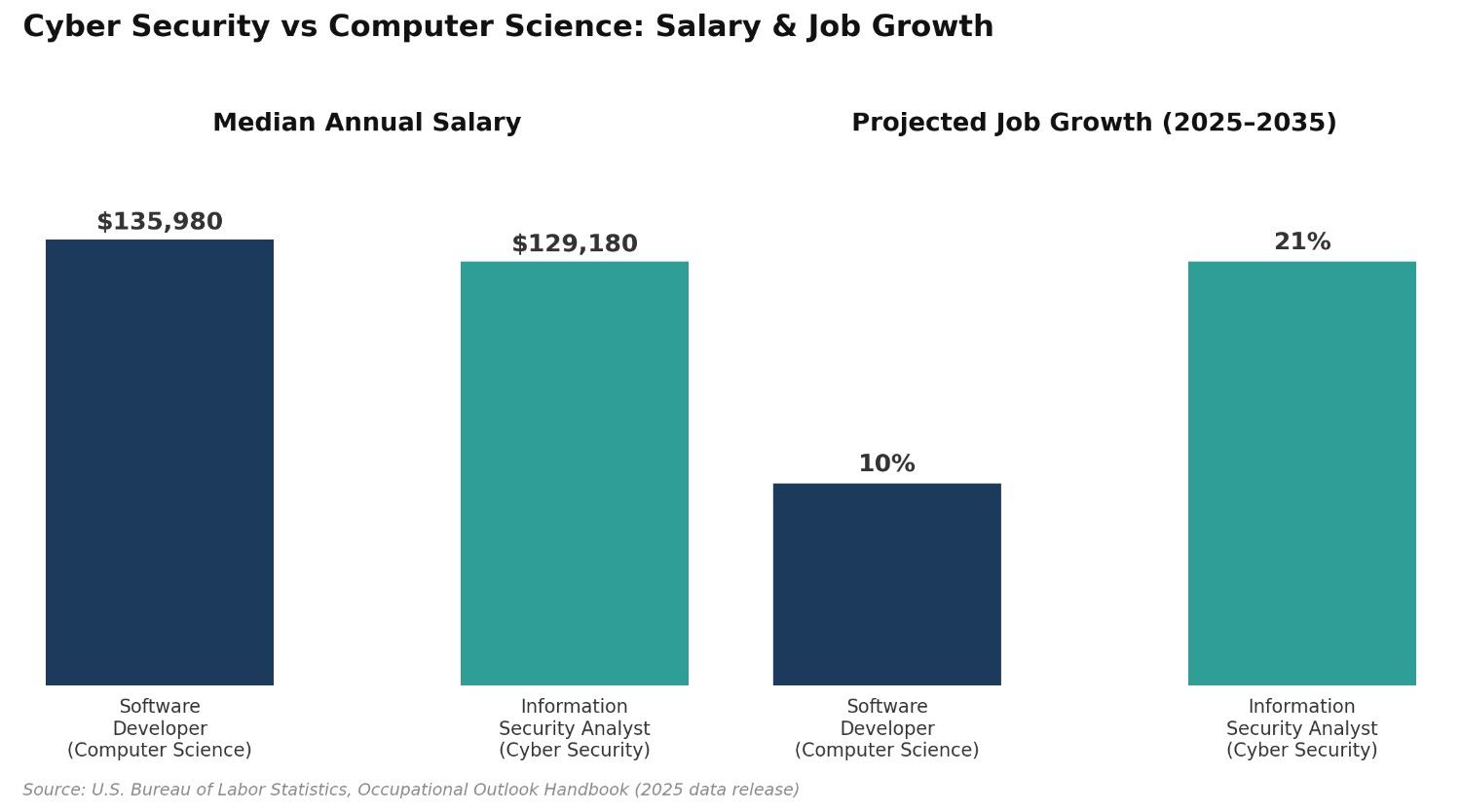
Salary numbers online are all over the place, pulled from different sources. Here's real U.S. government data (BLS, latest release), cleaned up and compared side by side.
| Metric | Computer Science (Software Developer) | Cyber Security (Information Security Analyst) |
|---|---|---|
| Median annual salary | $135,980 | $129,180 |
| Lowest 10% earn | $82,460 | $75,090 |
| Highest 10% earn | $214,670 | $199,850 |
| Projected job growth | 10% (2025–2035) | 21% (2025–2035) |
| Total jobs in the field | 1,905,400 | 192,900 |
The key number: software developers earn a bit more right now, but cyber security is growing over twice as fast. Give it five to ten years, and this pay gap will likely shrink.
Entry-level pay tells a different story:
- New cyber security analysts often start between $55,000 and $102,000.
- New software developers often start between $80,000 and $110,000 at non-tech companies. Big tech pays much more.
Pros and Cons of Each Path
These lists aren't forced to match in length just to look "fair." Real trade-offs are messy — here they are as actually seen.
Computer Science
Pros:
- Wider career options — software, AI, data science, cyber security, and more.
- Higher pay ceiling — top software jobs at big tech pay very well.
- Skills transfer well — coding stays useful even if you switch industries.
- Strong base — makes learning new tools and languages easier later.
Cons:
- Heavy math and theory — hard for students who struggle with abstract ideas.
- More competition — huge numbers of grads chase the same popular jobs.
- Slower job growth — 10% is solid, but not as fast as cyber security.
Cyber Security
Pros:
- Faster-growing field — 21% growth, plus a real global worker shortage.
- Less math-heavy — easier for students who find calculus draining.
- Certs open doors — sometimes you don't even need a full degree to start.
- Meaningful work — you stop real harm to real people and companies.
Cons:
- Constant learning curve — tools and threats change fast. Old knowledge goes stale.
- High-stress incidents — a live breach can mean late nights, especially in SOC (Security Operations Center) roles.
- Narrower skill transfer — security knowledge doesn't move to other tech jobs as easily as coding.
- Slightly lower median pay — though the gap is closing.
Who Should Pick What
Here's what a younger version of the author would be told, sitting where you might be right now.
Pick computer science if:
- You really enjoy math and puzzles, not just tolerate them.
- You want to build things — apps, tools, websites, AI — not defend them.
- You want the widest range of career doors after graduation.
- You're okay with a steep, theory-heavy start.
Pick cyber security if:
- You'd rather investigate and defend than build from scratch.
- Math isn't your strong suit, but spotting patterns is.
- You want faster job growth and a clear worker shortage.
- You're okay learning new tools and threats for your whole career, not just four years.
It really depends on how your brain likes to work. That matters more than which field is "better" on paper. There's no single right answer here.
Can You Switch Later? My Honest Take
Yes — this happens more often than people think. But the direction you switch matters a lot.
Computer science → cyber security: This is the smoother path. Your coding and systems knowledge carries over. You'll mostly need to add:
- Networking basics
- Security tools
- A certification like Security+ or CompTIA Network+
Cyber security → computer science: This is possible, but rougher. You'll likely need to backfill:
- Serious programming practice
- Math course work
Most cyber security programs simply don't cover these at the depth CS does.
What I'd Actually Do If I Were Starting Today
Here's honestly what the author would do if starting again: begin with a short free course in each field.
- One basic Python course
- One basic networking or Security+ prep course
This would happen before spending a single dollar on a full degree. Whichever course makes you want to keep going — without anyone forcing you — that's the one to commit to. It's not a scientific method, but it's more honest than picking from a salary chart alone. You'll spend years doing this, not just one paycheck.
If there were truly no preference, the lean would be toward cyber security right now — the growth numbers are strong, and the worker shortage is real. But go in knowing this: it's lifelong learning, not a one-time diploma and done.
Conclusion: So, Is Cyber Security Harder Than Computer Science?
Not in the way most people mean when they ask this. Computer science is harder to study — more math, more code, more theory packed into four years.
Cyber security is harder to live with long-term. The job never stops changing under your feet, even after you've mastered it. Neither field is "easier" in some absolute sense — they're just hard in different directions.
Still stuck between the two? Don't read another comparison article. Try one free intro module in each this weekend. Whichever one makes you want to open your laptop again tomorrow, without anyone reminding you — that's your answer.
About the Author
Deepak Kushwaha has spent more then 5 years working across software development and IT Industry. He writes about tech careers to help students and career-changers make decisions based on real data, not university marketing pages
Frequently Asked Questions
Is cyber security harder than computer science, according to Reddit and Quora threads?+
Most real students say the same thing this article found. Computer science is harder on paper because of math and coding depth. Cyber security is harder in practice because threats change all the time.
Is cyber security under computer science or computer engineering?+
Cyber security is usually its own separate degree today. It grew out of both computer science and computer engineering. Some schools still place it inside a CS or IT department; others run it on its own.
Is cyber security harder than software engineering?+
Software engineering is closer to computer science in difficulty. It needs deep coding skills and system design know-how. Cyber security needs less coding but more constant watching — a different kind of hard, not simply "more" or "less."
Is cyber security a 9-to-5 job?+
It depends on the role. Compliance jobs can be close to a normal 9-to-5. SOC analyst and incident response roles often involve shifts or late-night alerts, since breaches don't wait for business hours.
Is cybersecurity a dying field?+
No. It's one of the fastest-growing tech fields in the U.S. right now. Job growth is projected at 21% through 2035, and there's a real global shortage of skilled workers.
Which is the hardest field in IT overall?+
Electrical engineering and theory-heavy computer science (like AI) tend to rank harder than cyber security. That's mainly due to heavier math and physics. Cyber security sits in the "broad and demanding" category, not the "narrow and extremely deep" one.
Cybersecurity vs computer science: which has a better job market right now?+
Cyber security has the stronger short-term job market. Growth is faster, and skilled workers are in short supply. Computer science still offers more total job types, so "better" depends on what you value most: speed of hiring, or breadth of options.