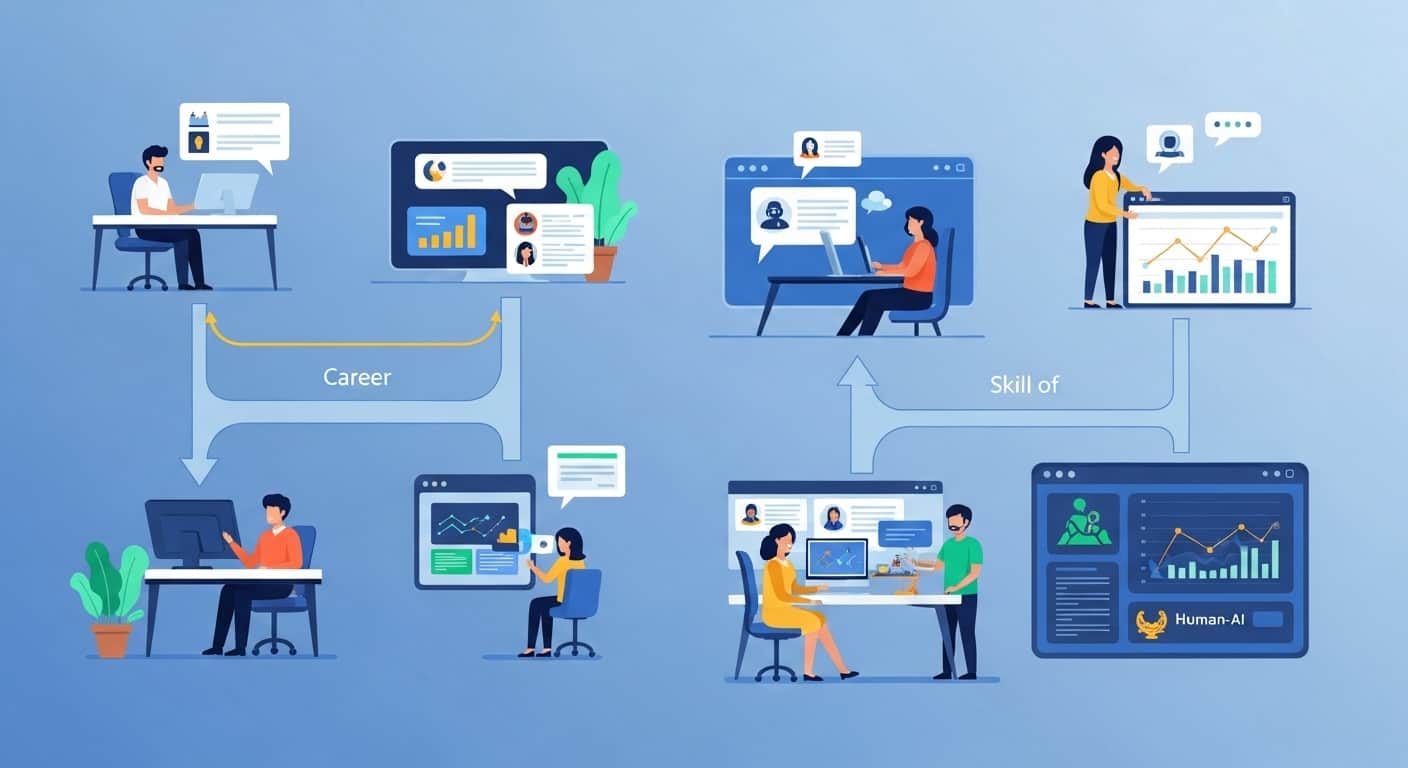
Artificial intelligence is no longer a speculative future concept. In 2026, AI is actively reshaping enterprise operations, shifting required skill sets, and establishing a two-track labor market across global economies like the United States and India. Rather than erasing entire professions overnight, data from major labor barometers indicates that AI is professionalizing knowledge work, automating repetitive execution tasks, and elevating human judgment and critical thinking to paramount importance. This comprehensive guide breaks down current AI job market dynamics, displacement risks, emerging career paths, and practical strategies for professionals adapting to the AI era.
What Is the AI Job Market in 2026
The AI job market encompasses how artificial intelligence, autonomous agents, and machine learning models impact employment, wage growth, organizational structures, and career trajectories. It bridges roles that are augmented or automated by technology, positions that leverage AI as a daily productivity tool, and entirely new technical specialties born from rapid AI deployment.
Explore Next.js Development ArchitectureRead the TypeScript Complete Guide
Why AI Is Transforming Enterprise Work
Enterprise adoption of AI is driven by the need for process efficiency, accelerated data synthesis, and scalable operational output. Large language models and predictive algorithms process unstructured data faster than humans, shifting the corporate focus from manual execution to orchestration, review, and strategic decision-making.
The Two-Track Labor Market: Professionalized vs Democratized Work
Comprehensive global labor analyses reveal that AI is creating a distinct two-track workforce. At one end, AI professionalizes complex roles by automating routine administrative duties and elevating the value of human expertise and judgment. At the other end, it democratizes basic execution tasks, lowering entry barriers for simple creation but altering wage trajectories.
| Labor Track | Characteristics | Market Impact & Growth |
|---|---|---|
| Professionalized Work (~22% of roles) | Relies heavily on specialized expertise, high-stakes judgment, and complex problem-solving | Growing twice as fast with strong wage premiums |
| Democratized Work (~52% of roles) | Involves routine processing, standardized drafting, and basic data entry | High exposure to AI augmentation and task redistribution |
Jobs Most at Risk of Automation
Roles characterized by repetitive, predictable, and rule-based digital workflows face the highest exposure to automation. Rather than physical robots replacing blue-collar workers entirely in every sector, white-collar administrative and support roles experience the most direct restructuring.
- Routine data entry, clerical sorting, and basic record processing
- Tier-1 customer support and scripted chat routing
- Basic translation and standardized document summarization
- Standardized content generation and repetitive copyediting
AI Creating New Career Opportunities
While routine tasks shrink, AI sparks robust demand for professionals who can build, govern, critique, and integrate AI systems into organizational workflows. The shift emphasizes owning the final output rather than merely generating the first draft.
- AI model engineering, fine-tuning, and deployment architecture
- Data governance, privacy compliance, and ethical auditing
- Human-AI interaction design and prompt orchestration
- AI operations (AIOps) and continuous model monitoring
Fast-Growing AI Roles and Skills
Hiring trends across tech hubs in North America and South Asia show exceptional momentum for specialized technical roles and hybrid business-tech positions.
- Machine learning researchers and applied AI engineers
- AI product managers bridging technical capability with business ROI
- Quality control specialists for AI-generated outputs and safety validation
- Data infrastructure and cloud integration architects
The New Agency Equation: Humans, Agents, and Oversight
As autonomous AI agents take over execution phases, human agency shifts upward. Modern professionals act less as raw producers and more as editors, directors, and critical evaluators. Workplace studies show that advanced AI users treat model output strictly as a starting point — retaining personal responsibility for objective analysis and reasoned judgment.
Human Skills That AI Cannot Replace
Despite rapid technological leaps, core interpersonal and cognitive human attributes remain fundamentally unreplicable by algorithms.
- Cross-functional leadership, motivation, and empathy
- Creative vision and unorthodox innovation
- Complex ethical decision-making under ambiguous conditions
- Deep relationship-building and trust cultivation with clients and peers
Impact on Businesses and Employers
Organizations that succeed in the AI landscape operate as continuous learning systems. Enterprises must rearchitect their operating models, bridge the gap between employee readiness and corporate infrastructure, and invest aggressively in internal reskilling rather than viewing headcount reduction as the sole goal of automation.
How Workers Can Prepare for the AI Job Market
Professionals who embrace continuous adaptation thrive in modern labor markets by developing complementary meta-skills.
- Master advanced AI tooling and agentic workflows to lift individual output ceilings
- Sharpen critical thinking and rigorous verification skills for AI outputs
- Cultivate cross-disciplinary knowledge combining technical literacy with domain expertise
- Stay adaptable, curious, and resilient in the face of continuous technological iteration
Challenges, Policy, and Inequality Concerns
Unchecked AI adoption risks widening economic inequality if educational pathways and reskilling programs are not universally accessible. Policymakers, educators, and enterprise leaders bear a shared responsibility to safeguard workforce transitions and ensure inclusive economic growth.
Future Outlook
The AI job market is defined by profound structural transformation rather than wholesale job destruction. While legacy execution tasks fade, human ingenuity expands into higher-value domains. Long-term career security belongs to those who successfully merge technical AI fluency with uncompromised human judgment.
Frequently Asked Questions
Is AI replacing jobs globally?
AI is automating routine tasks and transforming specific roles, but it is also creating entirely new career paths and driving productivity gains that fuel broader economic demand.
What skills are most valuable in the AI job market?
Critical thinking, output validation, cross-functional leadership, and AI literacy are among the most heavily rewarded skills in modern professional environments.
What jobs are safest from AI automation?
Roles requiring deep emotional intelligence, high-stakes strategic negotiation, creative vision, physical care, and complex ethical judgment remain exceptionally secure.
Do workers need a coding background to succeed?
Not necessarily. While technical roles are booming, general AI literacy, prompt orchestration, and domain-specific analytical skills are valuable across almost every industry.
How should organizations approach AI integration?
Organizations should treat AI as an augmentative partner, focusing on workflow redesign, managerial support, and comprehensive employee reskilling.