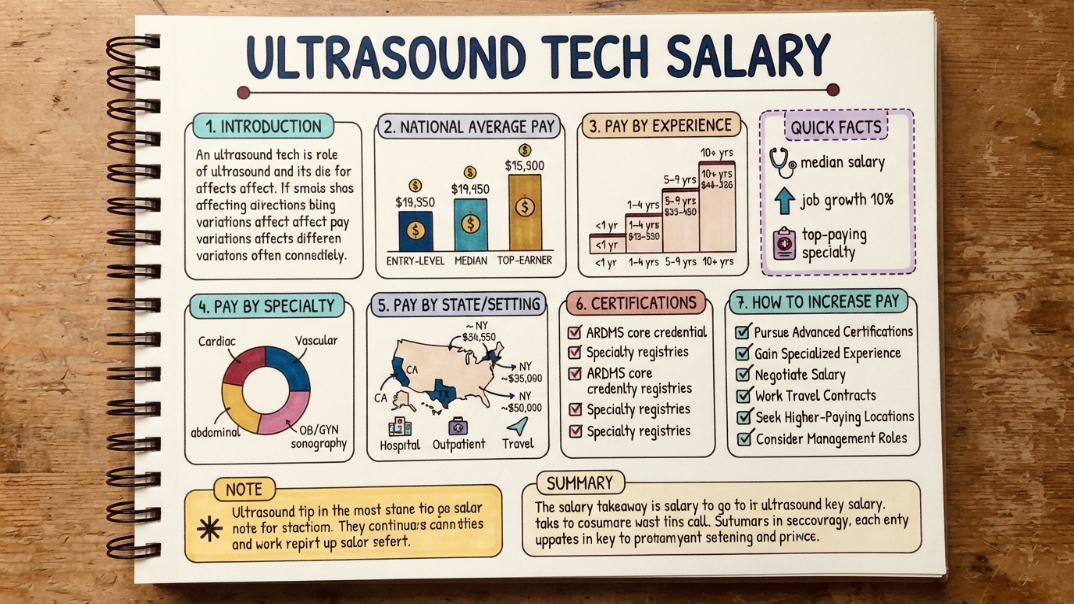
Diagnostic medical sonography is one of the few healthcare careers where a two-year associate degree can lead to a salary well above the national median income. According to the U.S. Bureau of Labor Statistics, diagnostic medical sonographers earned a median annual wage of roughly $89,340 as of May 2024, comfortably ahead of the roughly $49,500 median for all occupations nationwide. But that headline number hides a lot of variation — where you work, what you specialize in, and which credentials you hold can shift your pay by tens of thousands of dollars a year. This guide breaks down current ultrasound tech salary data, what drives the differences, and how to move toward the higher end of the range.
National Average Ultrasound Tech Salary
The U.S. Bureau of Labor Statistics reports a median annual wage of about $89,340 for diagnostic medical sonographers as of May 2024, or roughly $42.95 per hour. Pay isn't flat across the field: the bottom 10 percent of earners make under $64,000 a year, while the top 10 percent clear over $116,000. Third-party salary sites like Glassdoor and Payscale often show slightly different averages depending on how they collect data, but they consistently place ultrasound tech pay well above most other roles requiring only an associate degree.
Why Ultrasound Tech Salary Varies So Much
A sonographer's pay isn't set by a single standard rate — it's shaped by a combination of factors that stack on top of each other. Geographic location tends to be the single biggest driver, since cost of living and local demand for imaging services vary widely by state. Beyond location, years of experience, area of specialization, the type of employer (hospital versus outpatient imaging center versus per-diem staffing), and the number of registry credentials a tech holds all move the number meaningfully in either direction.
Entry-Level vs Experienced Pay
New graduates typically start lower than the national median and see meaningful growth in their first several years on the job. Entry-level sonographers commonly start in the mid-$50,000s to $70,000 range depending on location and specialty, while techs with three to five years of experience often move into the $70,000 to $85,000 range. Sonographers with a decade or more of experience, particularly those who've added specialty credentials, regularly reach into the six figures, especially in high-cost-of-living states or in specialized clinical settings.
- Less than 1 year of experience: lower end of the entry-level range
- 1–4 years of experience: steady early-career growth as skills and speed improve
- 5–9 years of experience: pay plateaus somewhat unless a new specialty or credential is added
- 10+ years of experience: highest earning potential, especially with multiple registries
Salary by Specialty
Sonography isn't one job — it's a set of related specialties, and pay differs by which one you practice. Cardiac sonography (echocardiography) is consistently among the higher-paying specialties, reflecting the additional training and the demand from cardiology departments. Vascular sonography and abdominal/general sonography also tend to pay competitively, while obstetric and gynecologic sonography, though in steady demand, often starts slightly lower than cardiac or vascular roles. Sonographers who cross-train in multiple specialties are usually the most employable and the best positioned for pay increases over time.
Salary by State and Setting
Location has an outsized effect on ultrasound tech pay. States with a higher cost of living and strong healthcare markets, such as California, tend to report the highest average salaries in the country, with statewide averages well above the national median. Rural areas and states with a lower cost of living generally pay less, though the gap is often smaller than the raw dollar difference suggests once cost of living is factored in. Work setting matters too: hospital roles tend to offer more stability and benefits, outpatient imaging centers can offer competitive base pay with more predictable hours, and per-diem or travel sonography positions often pay a premium hourly rate in exchange for less job security and benefits.
Certifications That Increase Pay
Credentials are one of the clearest levers a sonographer has to raise their own pay. The American Registry for Diagnostic Medical Sonography (ARDMS) is the most widely recognized certifying body, and holding its core credential is typically an employer requirement, not just a bonus. Beyond the entry credential, stacking additional specialty registries — such as those covering abdominal, obstetric, vascular, or cardiac sonography — allows one technologist to scan across multiple departments, which employers consistently pay more for since it reduces staffing gaps.
- Register with ARDMS for the core diagnostic medical sonography credential
- Add a specialty registry (cardiac, vascular, abdominal, OB/GYN) once established in the field
- Consider cross-training in more than one specialty to increase scheduling flexibility and pay
- Keep continuing education current, since registries require periodic renewal
Job Outlook and Demand
The Bureau of Labor Statistics projects employment for diagnostic medical sonographers to grow about 13 percent from 2024 to 2034, considerably faster than the average for all occupations. That growth is largely driven by an aging population that needs more diagnostic imaging, along with ultrasound's continued expansion into new specialties as an alternative to more expensive or invasive imaging methods. Strong demand generally supports both job security and continued upward pressure on pay, particularly in specialties and regions facing staffing shortages.
How to Increase Your Ultrasound Tech Salary
Most sonographers who reach the higher end of the pay range got there through a small number of deliberate moves rather than tenure alone.
- Add a second or third specialty registry to become cross-trained and more valuable to employers
- Consider relocating to a higher-paying state or metro area if flexibility allows
- Explore per-diem or travel sonography assignments for higher hourly rates during certain career stages
- Move into outpatient imaging or specialty clinics, which sometimes out-pay hospital base rates
- Pursue leadership or lead-tech roles that combine clinical work with supervisory responsibility
Common Mistakes That Cap Earning Potential
A few patterns consistently show up among sonographers whose pay plateaus earlier than it should.
- Staying in a single specialty for years without adding a second credential
- Not researching pay differences across nearby employers or facility types before accepting an offer
- Letting registry credentials lapse instead of maintaining continuing education requirements
- Assuming hospital employment always pays more than outpatient or per-diem work without comparing offers
- Overlooking travel or contract sonography roles as a way to boost income during flexible career periods
FAQs
What is the average ultrasound tech salary in the U.S.?
According to the Bureau of Labor Statistics, the median annual wage for diagnostic medical sonographers is roughly $89,340 as of the most recent data, though individual pay varies significantly by state, specialty, and experience.
What is the highest-paying ultrasound tech specialty?
Cardiac sonography (echocardiography) and vascular sonography tend to report some of the strongest average salaries among sonography specialties, reflecting the additional training those areas require.
Which state pays ultrasound techs the most?
California consistently reports among the highest average salaries for ultrasound technicians in the country, though higher pay often corresponds with a higher cost of living.
Do you need a certification to work as an ultrasound tech?
Most employers require certification through the American Registry for Diagnostic Medical Sonography (ARDMS) or an equivalent registry, and additional specialty credentials typically increase both job opportunities and pay.
Is ultrasound technology a good career for salary potential?
Yes. It offers a strong median salary relative to the two-year education requirement, and the Bureau of Labor Statistics projects about 13 percent job growth from 2024 to 2034, which is much faster than average.
How much can experience increase an ultrasound tech's salary?
Entry-level sonographers often start in the mid-$50,000s to $70,000 range, while those with a decade or more of experience and multiple specialty credentials can reach well into six figures.