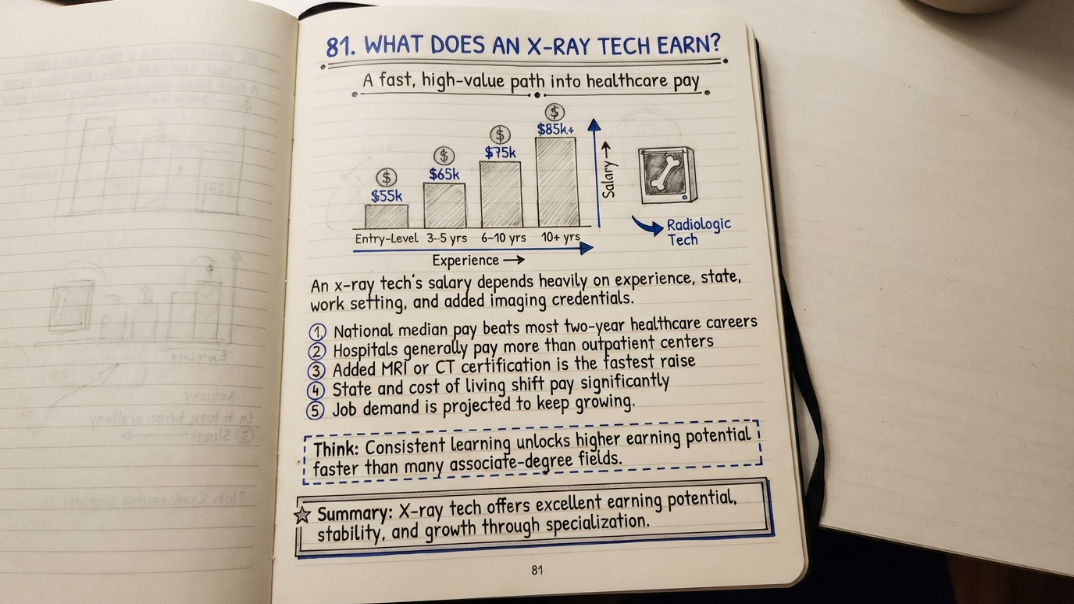
Radiologic technology, commonly called x-ray tech work, is one of the most accessible paths into a solid healthcare salary — most programs take about two years, and the pay comfortably beats the median wage for all U.S. occupations. According to the Bureau of Labor Statistics' Occupational Employment and Wage Statistics, radiologic technologists earned a median annual wage of about $80,110 as of May 2025. But that single number covers a wide range: a new graduate in a rural clinic and an experienced tech with a second imaging credential at a big-city hospital can be tens of thousands of dollars apart. This guide breaks down current x-ray tech salary data, what actually moves the number, and how to work toward the higher end of the range.
National Average X-Ray Tech Salary
The U.S. Bureau of Labor Statistics reports a median annual wage of about $80,110 for radiologic technologists as of May 2025, or roughly $38.52 per hour. Pay isn't flat across the field: the bottom 10 percent of earners make under $56,000 a year, while the top 10 percent clear over $118,000. Third-party salary sites like Glassdoor, Payscale, and various career guides often show slightly different figures depending on how they collect data, but they consistently place x-ray tech pay well above most other roles requiring only a two-year associate degree.
Why X-Ray Tech Salary Varies So Much
An x-ray tech's pay isn't set by a single standard rate — it's shaped by a combination of factors that stack on top of each other. Geographic location tends to be the single biggest driver, since cost of living, union presence, and local demand for imaging services vary widely by state. Beyond location, years of experience, the type of employer (hospital versus outpatient imaging center versus urgent care), shift schedule, and whether the tech holds credentials in additional imaging modalities all move the number meaningfully in either direction.
Entry-Level vs Experienced Pay
New graduates typically start well below the national median and see meaningful growth in their first several years on the job. Entry-level radiologic technologists commonly start in the low-to-mid $50,000s, sometimes as low as $46,000 depending on location and employer, while techs with several years of experience often move into the $65,000 to $80,000 range. Technologists with a decade or more of experience, particularly those who've added a second imaging modality, regularly move into the $90,000-plus range, especially in higher-paying states or academic medical centers.
- 0–2 years of experience: entry-level pay, typically $46,000–$60,000
- 3–5 years of experience: steady early-career growth as speed and scheduling flexibility improve
- 6–10 years of experience: pay often plateaus unless a new modality or leadership role is added
- 10+ years of experience: highest earning potential, especially with multiple credentials
Salary by State
Location has an outsized effect on x-ray tech pay. States with a higher cost of living and strong hospital systems, such as California, tend to report the highest average salaries in the country, with statewide averages reaching well over $100,000. States in the Pacific Northwest and parts of the Northeast also tend to pay above the national median, largely due to cost of living, union presence, and regional demand rather than any difference in the credential itself. Lower cost-of-living states generally pay less in raw dollars, though the gap often narrows once cost of living is factored in.
Salary by Work Setting
Where a technologist works matters almost as much as where they live. Hospital settings generally offer the highest base pay along with shift differentials for evening, night, and weekend work, plus more comprehensive benefits like retirement matching and tuition reimbursement. Outpatient imaging centers often pay slightly less in base salary but typically offer more predictable Monday-through-Friday schedules without overnight shifts. Urgent care clinics and orthopedic offices also employ x-ray techs for point-of-care imaging, usually at a base pay closer to outpatient settings than hospital pay.
Credentials That Increase Pay
Credentials are the clearest lever a radiologic technologist has to raise their own pay. Certification through the American Registry of Radiologic Technologists (ARRT) is the standard entry requirement for the field and is typically non-negotiable with employers. Beyond that base credential, adding a post-primary certification in a higher-paying modality — most commonly MRI or CT, and sometimes mammography or interventional radiology — is the single fastest way to increase pay, since these specialties consistently pay $15,000 to $25,000 more per year than general x-ray work alone.
- Earn the ARRT core credential in radiography, required by virtually all employers
- Add a post-primary ARRT certification in MRI or CT once established in the field
- Consider mammography or interventional radiology credentials for further specialization
- Keep continuing education current, since ARRT certification requires periodic renewal
Job Outlook and Demand
The Bureau of Labor Statistics projects employment for radiologic technologists to grow about 5 percent from 2024 to 2034, faster than the average for all occupations, driven largely by an aging population that needs more diagnostic imaging. While that growth rate is more modest than some other allied health fields, steady demand combined with retirements among the existing workforce continues to create regular job openings, and the clear upgrade path into higher-paying modalities gives the role more long-term earning flexibility than many comparable two-year credentials.
How to Increase Your X-Ray Tech Salary
Most technologists who reach the higher end of the pay range got there through a small number of deliberate moves rather than tenure alone.
- Add a post-primary certification in MRI or CT, which routinely adds $15,000 or more annually
- Consider relocating to a higher-paying state or metro area if flexibility allows
- Pick up evening, weekend, or night shift differentials where available
- Move into a Level I trauma center or academic medical center, which often pays above the local average
- Pursue a lead technologist or supervisory role that combines clinical work with added responsibility
Common Mistakes That Cap Earning Potential
A few patterns consistently show up among x-ray techs whose pay plateaus earlier than it should.
- Staying in general radiography for years without adding a second imaging modality
- Not comparing pay and shift differentials across nearby employers before accepting an offer
- Letting ARRT certification lapse instead of keeping up with continuing education requirements
- Assuming hospital employment always pays more without checking actual local offers
- Overlooking cross-training into MRI or CT as the fastest realistic path to a meaningful raise
FAQs
What is the average x-ray tech salary in the U.S.?
According to the Bureau of Labor Statistics, the median annual wage for radiologic technologists is roughly $80,110 as of May 2025, though individual pay varies significantly by state, experience, and work setting.
How can an x-ray tech increase their salary the fastest?
Adding a post-primary certification in a higher-paying modality such as MRI or CT is typically the fastest way to raise pay, often adding $15,000 to $25,000 annually compared to general radiography alone.
Which state pays x-ray techs the most?
California consistently reports among the highest average salaries for radiologic technologists in the country, though higher pay often corresponds with a higher cost of living.
Do you need certification to work as an x-ray tech?
Yes. Most employers require certification through the American Registry of Radiologic Technologists (ARRT), and additional specialty credentials typically increase both job opportunities and pay.
Is x-ray tech a good career for salary potential?
Yes. It offers a solid median salary relative to the two-year education requirement, and the Bureau of Labor Statistics projects about 5 percent job growth from 2024 to 2034, faster than average, with a clear upgrade path into higher-paying modalities.
How much more do MRI or CT technologists make than x-ray techs?
MRI and CT technologists typically earn $15,000 to $25,000 more annually than general radiologic technologists, reflecting the additional training required for those modalities.