What Can I Do With a Computer Science Degree? (2026)

A CS degree opens 15+ job paths beyond coding — here's every option, real salary numbers, and simple steps to pick one.
Key Takeaways
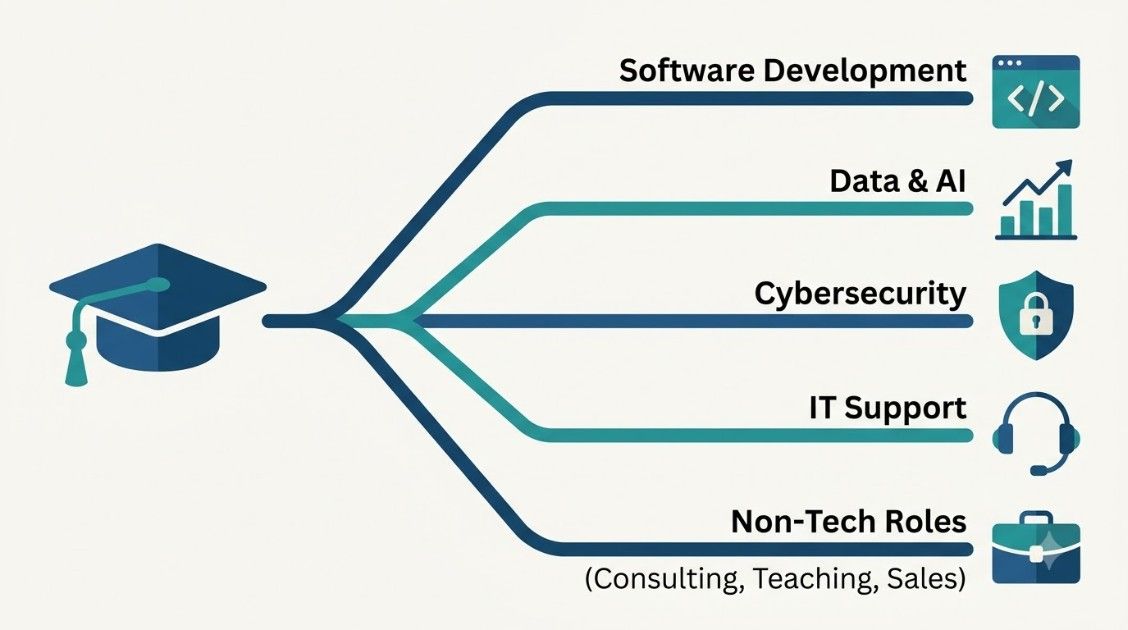
- A CS degree does not lock you into 'coder for life.' You can go into software, data, cybersecurity, product, testing, teaching, sales, or even the military.
- Your degree level changes your options, not your ceiling. An associate degree gets you into support and junior roles. A bachelor's opens most doors. A master's helps for research, AI, and management.
- Skills pay more than degrees. Specialist skills like AI, cloud, and security pay 2-4x more than plain IT support work.
- CS is a tough major, but not the hardest one. It's tough because of math and logic, not because you need a genius-level IQ.
- Stuck on what to do next? Pick one skill area. Build 2-3 real projects in it. That beats collecting certificates.
What Does "What Can I Do With a CS Degree" Really Mean?
I get this question a lot. Most people asking it are scared of one thing: picking the 'wrong' degree.
So let me answer it straight. A computer science degree doesn't hand you one job. It hands you a toolkit. That toolkit has four parts:
- Logic — how to break big problems into small steps.
- Coding — how to build things with that logic.
- Data handling — how to work with large amounts of information.
- Problem-solving — how to fix things when they break.
You can point this toolkit at almost any industry. Software is the obvious use. But banks, hospitals, game studios, armies, and even farming companies hire CS grads too.
Think of your degree as a set of keys, not one door. Some keys open coding jobs. Some open data jobs. Some open non-tech jobs like consulting or teaching, where your tech background is just a strong plus. This article is a map of which key opens which door — and how wide it opens.
What Can You Do With Each Level of CS Degree?
Your degree level changes where you start. It doesn't decide where you end up. Most senior engineers I know started with just a bachelor's. Some didn't even finish it.
Here's how each level plays out in real life.
What Can I Do With an Associate's Degree in Computer Science?
An associate degree takes about 2 years. It's enough to get your foot in the door. But it's a smaller door. You can realistically go for:
- IT support or helpdesk technician — fixing systems, resetting access, basic troubleshooting.
- Junior web developer — building and updating simple websites, often at small agencies.
- QA tester — checking software for bugs before it ships.
- Computer operator or network technician — keeping office systems and networks running.
What Can I Do With a Bachelor's Degree in Computer Science?
This degree opens almost every door in tech. With a bachelor's, you can apply for:
- Software developer or engineer
- Data analyst or junior data scientist
- Cybersecurity analyst
- Systems or network engineer
- Game developer
- Product analyst or associate product manager
- Technical writer or QA automation engineer
Most product companies (Google, Microsoft, Amazon, Flipkart, Zoho) ask for a bachelor's as the minimum. The career guidance site Prospects backs this up. It lists application analyst, cyber security analyst, data analyst, and systems analyst as jobs tied directly to a computing degree.
What Can I Do With a Master's Degree in Computer Science?
You don't need a master's to get a good tech job. I want to be blunt about that. A lot of students over-invest here out of fear.
But a master's genuinely helps for three things:
- Going deep in one area — like AI, cybersecurity, or data science — where a bachelor's only scratches the surface.
- Research roles — at labs, universities, or research teams.
- Faster entry into senior tracks — at some global companies, especially outside your home country.
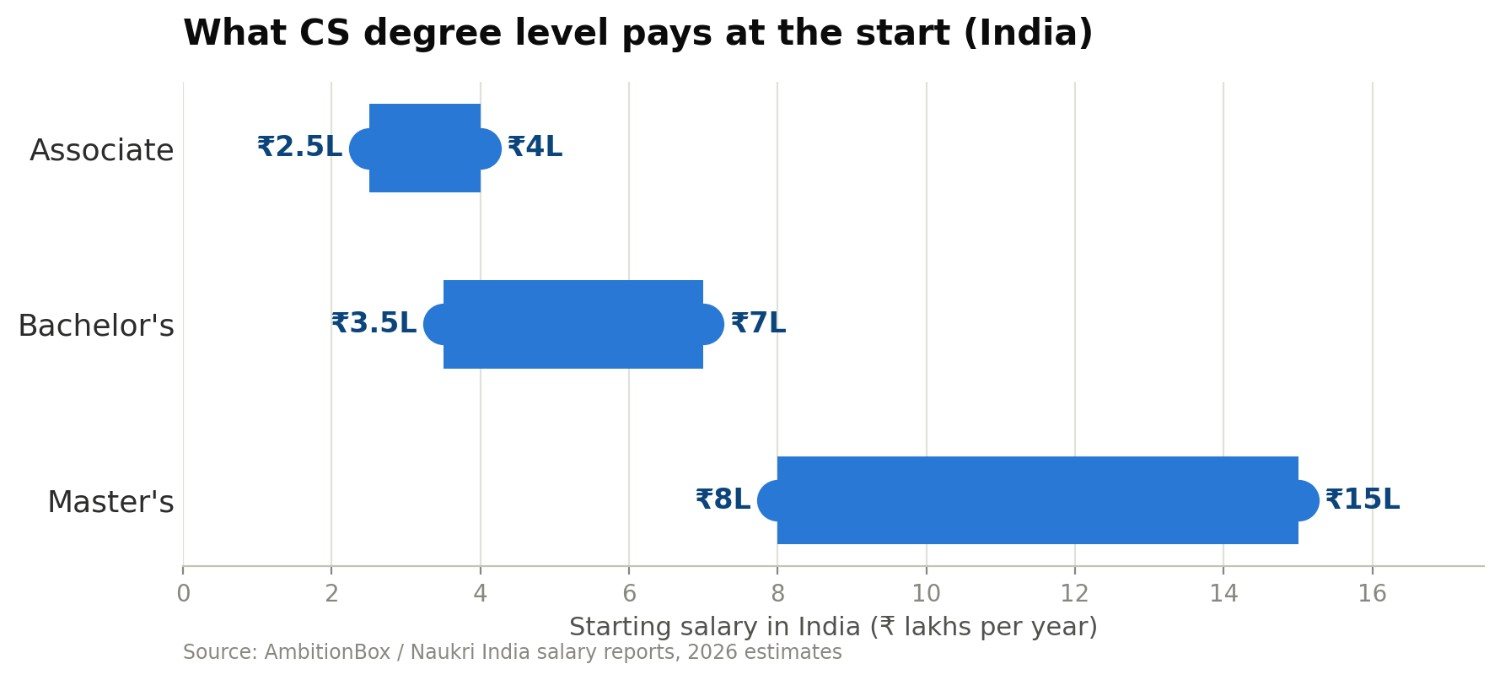
Here's a quick side-by-side so you don't have to scroll back and forth:
| Degree Level | Typical Time | Realistic First Job | Ceiling Without Further Study |
|---|---|---|---|
| Associate | 2 years | IT support, junior QA, junior web dev | Mid-level support or dev roles |
| Bachelor's | 3-4 years | Software dev, data analyst, cybersecurity analyst | Senior engineer, tech lead, manager |
| Master's | +1-2 years | ML engineer, research associate, specialist roles | Principal engineer, architect, research lead |
What Jobs Can I Actually Get With a Computer Science Degree?
Most articles just dump a list of 20 job titles and call it a day. That's not useful. So here, jobs are grouped by what you'd actually do all day. That's what decides if you'll enjoy the job — or burn out in six months.
Jobs If You Like Building Things
- Software Developer or Engineer — writes and maintains apps, websites, or systems.
- Mobile App Developer — builds Android or iOS apps.
- Game Developer — codes gameplay, engines, or graphics for video games.
- DevOps Engineer — automates how software gets built, tested, and shipped.
Jobs If You Like Numbers and Patterns
- Data Analyst — pulls insights from business data using SQL and dashboards.
- Data Scientist — builds models to predict trends or automate decisions.
- Machine Learning Engineer — turns data science models into working products.
Jobs If You Like Protecting Systems
- Cybersecurity Analyst — monitors and defends networks against attacks.
- Penetration Tester — legally hacks systems to find weak spots before criminals do.
- Forensic Computer Analyst — investigates digital crimes and data breaches.
Jobs If You Like People and Process More Than Code
- Business or Systems Analyst — connects tech solutions to real business problems.
- IT Consultant — advises companies on which tech to use and how.
- Product Manager (with tech background) — decides what a software product does next.
- Technical Trainer or Teacher — teaches coding or CS at schools, colleges, or bootcamps.
You're also not boxed into 'tech companies' only. Other UK career bodies list finance, healthcare, telecom, and government as industries where CS skills transfer well. A bank or a hospital chain hires just as many developers as a startup does.
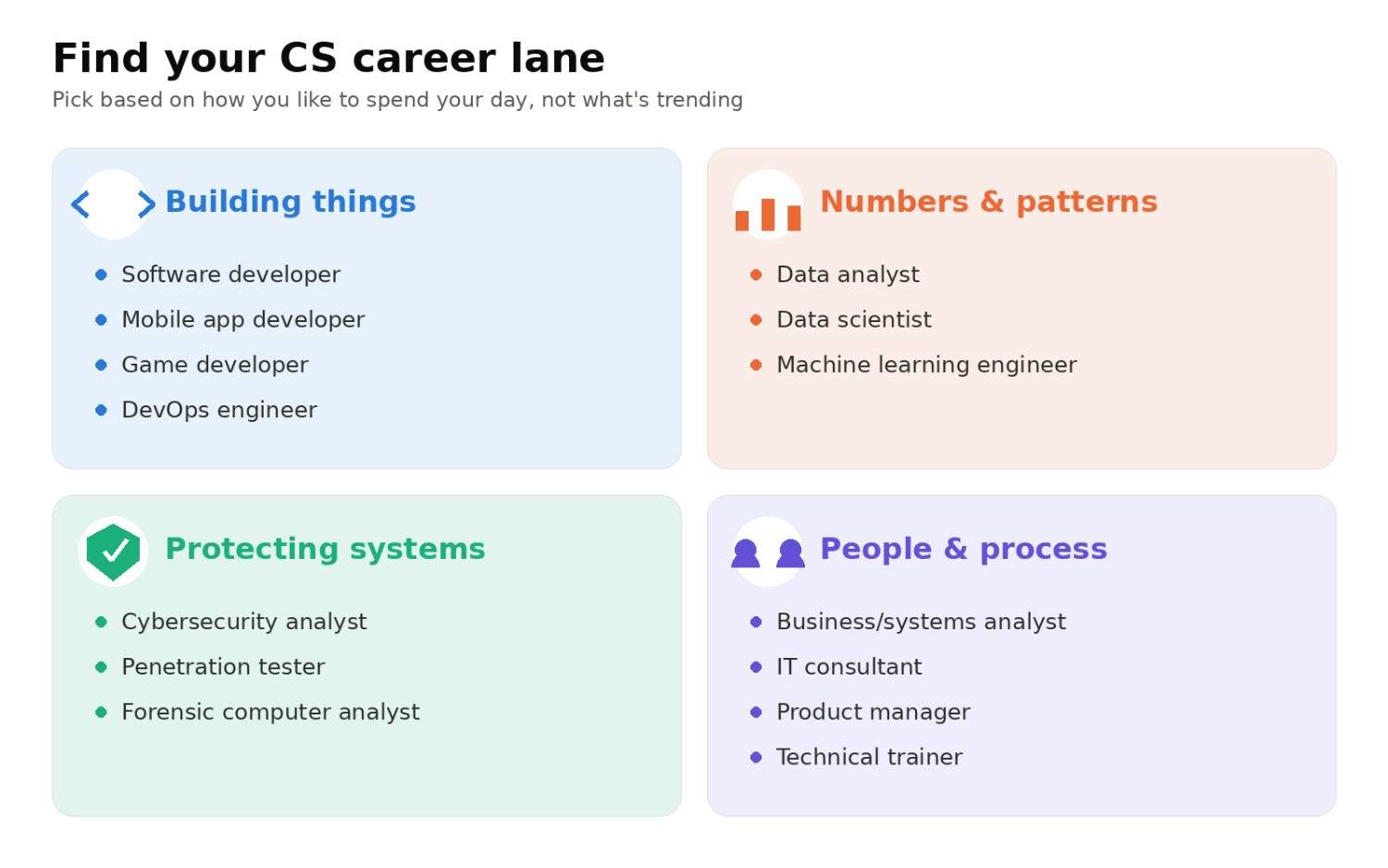
Here's a mistake I see a lot: beginners pick 'software developer' by default, just because it's the most talked-about role. Then two years in, they realize they hate sitting alone writing code all day. Match the job to how you like to spend your time — not to what's trending on LinkedIn.
What Can I Do in the Military With a Computer Science Degree?
This one surprises a lot of students. But it's a real path, and it often pays well. Most militaries — including the US Army, Navy, Air Force, and Indian Armed Forces' technical wings — actively recruit CS graduates.
Common roles include:
- Cyber warfare and defense units — protecting military networks from attacks.
- Signals or communications roles — running secure military communication systems.
- Software and systems engineering — building tools for logistics, defense systems, and simulations.
- Intelligence and data analysis roles — processing large amounts of data for decisions.
In the US, programs like the Army's Cyber Direct Commissioning let CS grads enter as officers, not at the bottom. Your tech skill counts as leadership skill from day one. But the trade-off is real. You sign up for a service commitment and fitness training. You also get less control over where you're posted than a normal job gives you.
Don't want full military service? Most countries also have civilian defense contractor roles. You work for the military as a private company employee. Same skills, no uniform.
What Can I Do With a Computer Science Degree in South Africa?
South Africa's tech scene has grown fast. CS graduates there aren't short on options. Common paths include:
- Software development for local fintech firms — South Africa has a strong fintech and banking-tech scene, think Standard Bank, Capitec, and local startups.
- IT roles in mining and telecom — two industries that dominate the economy and hire CS grads for systems and data work.
- Remote work for international companies — South Africa's timezone sits close to UK/EU hours. That makes it easy to work remotely for European and UK firms, often earning in stronger foreign currency.
- Cybersecurity roles — in short supply locally. That means less competition and decent starting pay.
Here's an honest note from talking to grads there: local salaries in South Africa for junior devs are lower than US/UK numbers, but a lower cost of living makes it work out fine for most people. Remote work for foreign companies is fast becoming the biggest pay boost for South African CS grads.
Is CS a Tough Major? My Honest Take
Yes, it's tough. But not in the way people think. It's not tough because you need to be a genius. It's tough because it stacks math, logic, and constant self-learning on top of each other. There's no coasting through it. Here's what actually makes it hard:
- Math-heavy foundations — subjects like discrete math (logic and number puzzles) and algorithms (step-by-step problem-solving methods) trip up a lot of first-year students.
- Debugging is frustrating by nature — you'll spend hours hunting one missing semicolon. That's normal. It's not a sign you're bad at this.
- The field moves fast — what you learn in year one may feel 'old' by year four, so you're always catching up.
But here's the flip side nobody tells you. CS rewards steady practice more than raw talent. I've watched average students out-earn 'genius' classmates, just because they built projects every semester instead of only passing exams. If you can sit with confusing problems without giving up fast, you'll be fine.
It also depends on your background. Zero coding exposure? Expect the first year to feel like drinking from a firehose. Already dabbled in code? It'll feel more like a steep hill than a wall.
What Pays More: CS or IT?
Short answer: CS-track roles usually pay more than general IT-track roles. But IT can catch up fast if you build one strong skill.
Here's why the gap exists. A general IT support role mostly maintains what already exists — servers, networks, employee laptops. A CS-track role builds or improves something new. Companies pay more for creation than maintenance.
| Track | Entry-Level Focus | Typical Starting Pay (India) | Typical Starting Pay (US) |
|---|---|---|---|
| General IT (support/admin) | Maintaining systems, fixing issues | ₹2.5–4 LPA | $45,000–$55,000 |
| CS/Software Development | Building applications and systems | ₹3.5–7 LPA (₹15–20+ LPA at top firms) | $75,000–$95,000 |
| Specialized IT (cloud, security) | Protecting or growing tech systems | ₹6–11 LPA | $90,000–$120,000 |
That said, this isn't a fixed rule. A cybersecurity specialist — technically an 'IT' role — can out-earn a plain software developer easily. Specialization drives pay, not the CS-versus-IT label. Chasing money? Chase a specific skill, not a broad category.
Top 3 Highest-Paying Jobs in Computer Science
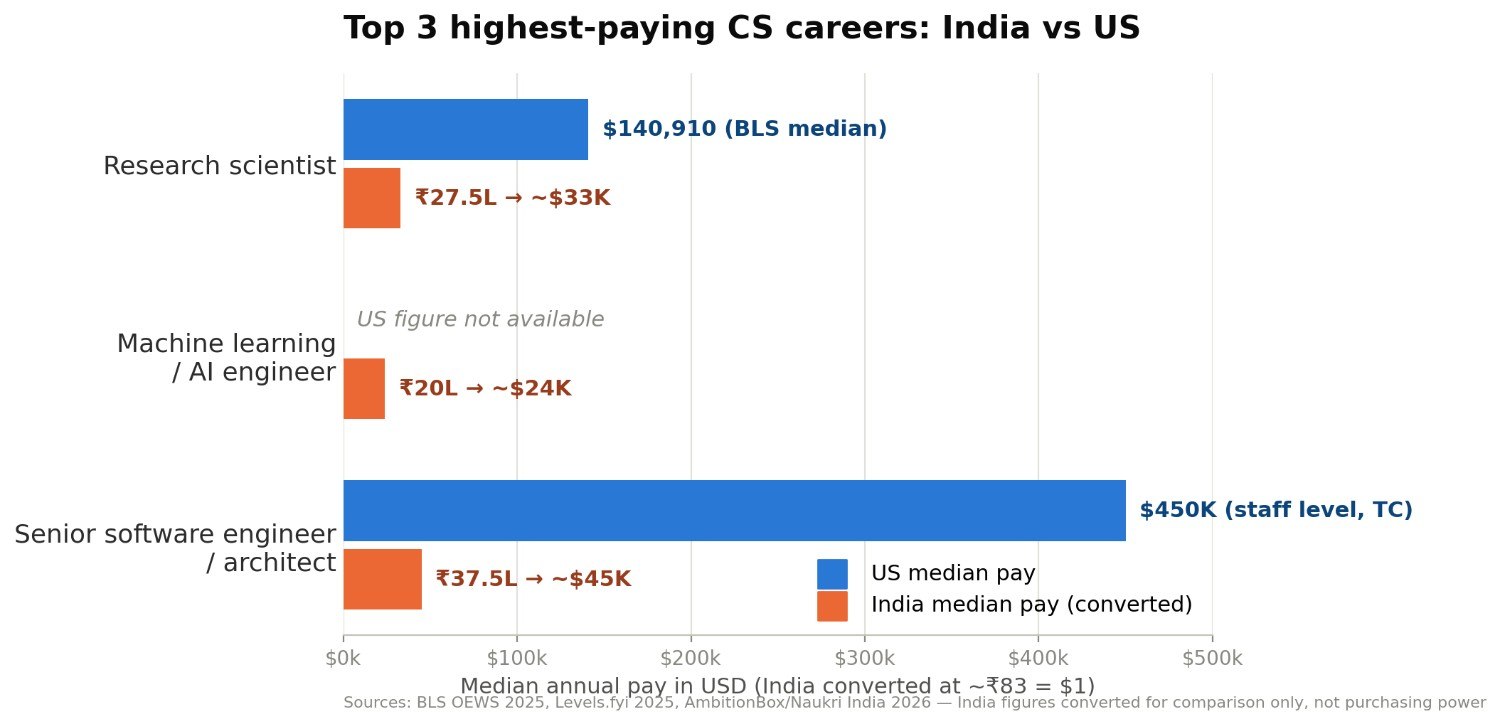
Based on current US Bureau of Labor Statistics data and Indian salary benchmarks, three roles consistently come out on top.
- Computer and Information Research Scientist — works on cutting-edge AI, algorithms, and systems research. According to BLS-based projections reported by IEEE USA, this role is set to grow 19.7% by 2034, driven by more investment in AI. In the US, median pay sits well above $140,000. In India, top AI research roles now cross ₹25-30 LPA at global capability centers.
- Machine Learning or AI Engineer — builds and deploys AI models into real products. This is the fastest-growing specialty inside software roles right now. In India, fresher packages for strong ML candidates touch ₹12–28 LPA at top-tier colleges, based on 2026 placement trends.
- Software Architect or Senior Software Engineer — designs how large systems fit together, not just single features. In the US, senior engineers at big tech firms can earn $400,000-$500,000+ a year in total pay at staff level. In India, senior engineers regularly cross ₹30-45 LPA at product companies.
My honest opinion here: don't chase these three titles straight out of college. They're the result of 3-6 years of focused work, not an entry-level starting point. Chasing the title before you have the skill just leads to rejected applications.
What Can I Do With a CS Degree in 2026 (and Beyond)?
Here's the honest answer for 2026: entry-level hiring is more competitive than five years ago. But overall demand for CS skills is still growing. The US Bureau of Labor Statistics projects software developer jobs to grow 10% from 2025 to 2035. That's much faster than the average for all jobs. About 106,100 openings are expected each year across development, QA, and testing roles.
What's changed is how you get hired, not whether jobs exist. Here's what I'm seeing in real hiring conversations right now:
- AI tools have raised the bar for junior developers. Companies expect you to work alongside AI coding assistants, not compete against them.
- 'Coding only' skills are worth less now. Coding plus one extra skill — security, data, or cloud — beats coding alone.
- Remote and hybrid roles are normal now. You're competing with candidates from other cities and countries, not just your local batch.
- Portfolios and GitHub projects matter more. Companies weigh them heavier than five years ago, because a degree alone doesn't prove you can build something.
A friend who runs hiring for a mid-size product company told me last year: they reject more 'degree-only, project-empty' resumes now than in 2020. The bar for proof-of-skill has quietly gone up, even as total job openings have grown.
Pros and Drawbacks of a Computer Science Degree
Here's the real picture, not a sales pitch.
The Real Benefits
- Wide industry access — banking, healthcare, defense, gaming, e-commerce all need CS grads.
- More remote work options — CS-track jobs offer this more than most other fields.
- Pay grows fast with skill — not just with years of experience, unlike many other careers.
What People Don't Tell You
- The field changes constantly — you'll learn new tools every year, even after 10+ years of experience.
- Entry-level competition is real — especially for 'glamorous' roles like Google or Microsoft-style software engineering.
- Not every CS job pays well — support or maintenance roles pay modestly. The 'CS grads earn six figures' story only fits specific tracks and companies.
It really depends on how much effort you put in after your degree. The degree gets you in the room. Your specific skills decide what happens next.
My Roadmap: What To Actually Do Next
Here's the framework I give every student or career-switcher who asks me this question. Four steps.
- Pick one lane in your first year out. Building, data, security, or people-facing work. Don't try to be good at all four at once.
- Build 2-3 real projects in that lane. Not tutorials you just followed step-by-step. A hiring manager can tell the difference in one conversation.
- Get one trusted certification or internship. Proof matters — AWS/Azure for cloud, a known security cert, or a strong GitHub portfolio for development.
- Apply broadly in your lane for 2-3 months before switching. Most people quit too early and jump lanes out of panic, not out of real fit.
Quick, direct answers to the questions people search alongside this one.
Frequently Asked Questions
What can I do after a computer science degree if I don't want to code?+
You can move into technical writing, IT consulting, business analysis, product management, teaching, or sales engineering. All of these use your CS background without daily coding. Companies value people who understand tech but can also talk to non-technical teams.
Is a computer science degree worth it in 2026?+
Yes, for most people it still is. Long-term demand and salary growth in the field stay strong. The catch: a degree alone isn't enough anymore. You need real projects and one solid skill area.
Can I get a good job with just a computer science degree and no experience?+
It's possible, but harder than before, especially at top companies. Internships, personal projects, and open-source work during your degree make a much bigger difference than the degree alone.
What is the difference between computer science and computer engineering?+
Computer science focuses on software, algorithms, and data. Computer engineering blends software with hardware design, like chips and circuits. Enjoy building physical devices as much as writing code? Computer engineering may fit better.
Do I need to be good at math to succeed in computer science?+
You need comfort with logical thinking more than advanced math. But subjects like discrete math and algorithms do involve real math work. Most students who struggle at first improve a lot with steady practice.
What can I do with a computer science degree besides software development?+
Data analysis, cybersecurity, IT consulting, product management, teaching, technical sales, and game design are all real paths. Your degree is a base skill set, not a fixed job title.
Which pays more long-term: a computer science degree or an MBA after engineering?+
It depends on your CS path versus the role you target with an MBA. A focused CS career — AI or cybersecurity, for example — can match or beat many MBA-track salaries. But an MBA can open management roles faster at some companies.
Final Thoughts
If you take one thing from this article, take this. A computer science degree is a starting toolkit, not a finished career. The people who do best with it aren't the ones with the highest grades. They're the ones who picked a lane early, built real things in it, and stuck with the job search long enough to land the right fit.
Here's what I'd do in your position:
- Pick one lane from the list above this week, not next month.
- Build one real project in that lane over the next 60-90 days.
- Apply to 5-10 relevant roles or internships once it's done.
Moving fast beats overthinking, every time.
Author Bio
Deepak Kushwaha has spent more then 5 years working across software development and IT Industry. He writes about tech careers to help students and career-changers make decisions based on real data, not university marketing pages