What Skills Are Needed to Be a Software Developer: The Complete 2026 Guide (Technical + Soft Skills Breakdown)
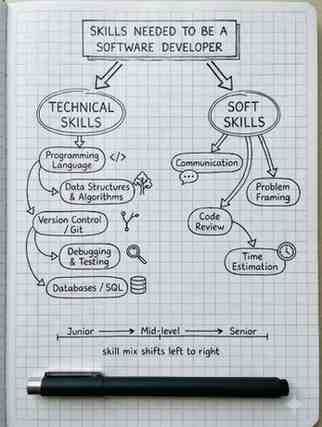
The skills needed to be a software developer split into three distinct categories: core technical proficiencies (a primary programming language, data structures, Git version control, and debugging), supporting engineering proficiencies (testing, database management, and basic system design), and professional soft skills (written technical communication, problem framing, and collaborative code reviews).
In practical implementation, most career guides stop at a surface-level overview without differentiating which abilities get you hired versus which ones ensure long-term survivability on an engineering team. Furthermore, expectations shift dramatically as you transition from a junior individual contributor to a senior architect. This guide examines the exact competencies required across the software development lifecycle, maps how they evolve by seniority and technical domain, and provides actionable frameworks to build them without falling into tutorial loops.
Technical Skills Needed to Be a Software Developer
Programming Language Proficiency
Achieving depth in one language outweighs superficial familiarity across five. When building your foundational stack, aim for idiomatic fluency—understanding how senior developers write clean, maintainable code within that specific ecosystem rather than just producing scripts that compile and run.
Data Structures & Algorithms
While everyday CRUD applications rarely require writing custom sorting algorithms from scratch, data structure fluency underpins technical hiring screens and system efficiency analysis. The objective is developing intuition regarding time and space complexity ($O(n)$ notation) when processing large datasets or managing memory.
Version Control (Git) — A Non-Negotiable Skill
Real-world engineering teams operate entirely on distributed version control workflows. A common mistake among self-taught developers is limiting Git usage to simple local commits. Professional workflows require disciplined branching, rebasing, and collaborative pull request management:
Debugging & Testing
Debugging is a methodical diagnostic science, not a guessing game. Writing unit tests alongside your implementation code isolates edge cases and builds structural confidence before your code faces peer review or production deployment.
| Technical Competency | Operational Value | Required Early-Stage Depth |
|---|---|---|
| Programming language fluency | Baseline requirement for reading and writing production code | One language mastered deeply before expanding breadth |
| Data structures & algorithms | Underpins computational efficiency and technical interview success | Arrays, hash maps, trees, graphs, and Big-O notation |
| Version control (Git) | Enables multi-developer collaboration and code provenance tracking | Branching strategies, conflict resolution, and pull requests |
| Systematic debugging | Resolves production defects and runtime failures efficiently | Isolating state, reading stack traces, and utilizing IDE debuggers |
| Unit testing fundamentals | Prevents regression errors and proves code correctness | Writing assertions and mocking basic dependencies |
| Relational databases & SQL | Handles persistent state storage and retrieval logic | Writing parameterized queries, joins, and indexing basics |
Soft Skills Required for Software Developer Roles
Technical skills get you past the screening gate, but professional soft skills determine your trajectory within an engineering organization.
| Professional Soft Skill | Daily Operational Manifestation | Organizational Impact |
|---|---|---|
| Technical writing & documentation | Drafting precise commit messages, pull request descriptions, and runbooks | Reduces friction in asynchronous, distributed engineering teams |
| Problem framing | Decomposing ambiguous product requirements into scoped technical tasks | Prevents wasting development cycles on misaligned architectural solutions |
| Code review etiquette | Providing objective architectural critique and receiving feedback without ego | Accelerates team velocity and maintains code health across the codebase |
| Realistic estimation | Forecasting engineering timelines with built-in buffer for technical debt | Aligns stakeholder expectations and prevents downstream burnout |
| Strategic inquiry | Balancing independent research with timely escalation during blockers | Demonstrates analytical judgment while respecting senior team members' bandwidth |
How the Required Skill Set Changes by Experience Level
| Seniority Tier | Primary Technical Focus | Key Behavioral & Strategic Additions |
|---|---|---|
| Junior / Entry-Level | Mastering syntax, Git workflows, basic testing, and systematic debugging | Learning codebase navigation, absorbing feedback, and executing scoped tasks |
| Mid-Level | Independent delivery of complex features across multiple system layers | Mentoring junior peers, designing module boundaries, and cross-functional planning |
| Senior | System architecture, risk assessment, and technical trade-off evaluation | Establishing engineering standards, resolving cross-team ambiguity, and aligning technical strategy with business goals |
Technical Competencies by Engineering Specialization
- Full-Stack Web Engineering: Mastery of HTML5/CSS3 semantics, client-side JavaScript runtime environments (or TypeScript), RESTful API/GraphQL backend architecture, and database integration.
- Mobile Application Engineering: Native SDK architecture (Swift/Kotlin) or cross-platform optimization, memory management, and network latency mitigation for mobile constraints.
- Data and Analytics Engineering: Advanced SQL optimization, distributed data processing frameworks, ETL pipeline construction, and data warehouse modeling.
- Cloud & DevOps Infrastructure: Containerization standards (Docker), orchestration layers (Kubernetes), Continuous Integration/Continuous Deployment (CI/CD) pipelines, and Infrastructure as Code (Terraform).
A Practical Roadmap for Building Developer Competence
| Development Stage | Duration | Focus Milestone | Objective Validation Test |
|---|---|---|---|
| 1. Core Syntax & Logic | 1–3 months | Control flow, algorithms, and fundamental data structures | Build a complete command-line utility from a blank text editor without tutorials |
| 2. Engineering Toolchain | 2–4 weeks | Git branching models, unit testing, and IDE debugging tools | Successfully execute a multi-branch feature PR lifecycle on a personal repository |
| 3. Full-Stack Project Execution | 2–4 months | Persistent database integration, API consumption, and error handling | Deploy a functional web application with live user authentication and database storage |
| 4. Collaborative Systems | Ongoing | Code reviews, refactoring legacy codebases, and architectural design | Contribute a bug fix or feature enhancement to an open-source or team repository |
Common Traps That Slow Down Skill Acquisition
- Framework Chasing: Constantly jumping between new JavaScript frameworks or cloud tools before cementing core programming fundamentals and object-oriented/functional design logic.
- Isolating Practice: Writing code exclusively in single-file sandbox environments without ever experiencing version control merge conflicts or collaborative code reviews.
- Neglecting Debugging: Treating errors as terminal failures rather than diagnostic clues; skipping step-through debuggers in favor of random trial-and-error edits.
- Ignoring Written Communication: Failing to practice technical writing, resulting in weak pull request descriptions and unmaintainable repository documentation.
Conclusion
Becoming a professional software developer requires balancing rigorous technical execution with vital collaborative behaviors. By anchoring your growth in programming fundamentals, mastering professional version control workflows, and treating soft skills as core engineering requirements rather than afterthoughts, you position yourself for sustainable, long-term career advancement.
FAQ
Frequently Asked Questions
What core skills are essential to become a software developer?+
Essential skills include deep proficiency in at least one programming language, working knowledge of data structures and algorithms, Git version control fluency, systematic debugging capabilities, and professional soft skills like technical communication and problem framing.
What technical skills do entry-level software developers need?+
Junior roles typically require solid fundamentals in a primary language (such as Python, JavaScript, or Java), familiarity with relational databases or SQL, the ability to write basic unit tests, and comfort collaborating via Git pull requests.
Do I need a computer science degree to acquire software development skills?+
No. The technical proficiencies required for software development can be acquired through self-directed study, bootcamp training, and portfolio project execution. Employers evaluate candidates primarily on proven problem-solving ability and demonstrable code quality.
Why are soft skills important for software engineers?+
Because software engineering is inherently collaborative. Skills like precise technical writing, constructive code review, and accurate task estimation prevent project bottlenecks and enable effective cross-functional teamwork.