On the morning of July 18, 2026, Delhi Police removed Sonam Wangchuk from his protest site at Jantar Mantar and shifted him to Safdarjung Hospital. He had been fasting since June 28 — 21 days without food — and his health had deteriorated significantly. His organisation reported he had lost 8.5 kilograms. The Delhi High Court had directed his removal citing medical advice. CJP founder Abhijit Dipke announced he was beginning his own indefinite hunger strike moments after Wangchuk was taken away. This is not the first time Sonam Wangchuk has put his body on the line for a cause he believes in. It is not even the second or third. Since 2024 alone, he has completed a 21-day climate fast in Leh in sub-zero temperatures, a 16-day fast in Delhi's Ladakh Bhawan, and a hunger strike that continued even while he and 150 Ladakhis were detained at the Singhu border by Delhi Police. But who is Sonam Wangchuk? Most people know the name from the Bollywood film 3 Idiots, where Aamir Khan's character Phunsukh Wangdu was loosely inspired by him. The real man is something more interesting and more complicated than any film character. He is an engineer who never built a conventional career, an educator who redesigned a failing school system, an inventor who built glaciers out of pipes and gravity, and an activist who has spent three decades fighting for the people and environment of Ladakh — often at enormous personal cost. This guide covers everything: his early life, his education and engineering work, SECMOL and Operation New Hope, the Ice Stupa, his awards, the full history of his activism for Ladakh's statehood and Sixth Schedule, the 2026 exam paper leak controversy that sparked his current fast, his hospitalisation today, and what comes next.
Who Is Sonam Wangchuk — At a Glance
Sonam Wangchuk is a 59-year-old Indian engineer, educator, innovator, environmentalist, and civil rights activist from Ladakh. He was born on September 1, 1966, in Alchi — a small village near Leh in what is now the Union Territory of Ladakh. He is best known internationally as the loose inspiration for the character Phunsukh Wangdu played by Aamir Khan in the 2009 Bollywood blockbuster 3 Idiots. But the real Wangchuk's story is both more grounded and more consequential than any film version. He founded SECMOL (Students' Educational and Cultural Movement of Ladakh) in 1988 and led a transformation of Ladakh's failing government school system. He invented the Ice Stupa — an artificial glacier technology that addresses Ladakh's chronic spring water shortage. He won the Ramon Magsaysay Award in 2018, often called Asia's Nobel Prize. He has been on multiple hunger strikes demanding constitutional protections for Ladakh's people, environment, and culture. As of July 18, 2026, he is in Safdarjung Hospital in New Delhi after 21 days of fasting at Jantar Mantar — his latest fast demanding the resignation of India's Education Minister over exam paper leaks that affected millions of students.
| Detail | Information |
|---|---|
| Full Name | Sonam Wangchuk |
| Date of Birth | September 1, 1966 |
| Birthplace | Alchi, near Leh, Ladakh, India |
| Age | 59 (as of 2026) |
| Education | B.Tech Engineering — NIT Srinagar; Earthen Architecture — CRAterre, Grenoble, France (2011) |
| Spouse | Gitanjali J. Angmo |
| Father | Sonam Wangyal (former Ladakh politician) |
| Organisation | SECMOL (Students' Educational and Cultural Movement of Ladakh); HIAL (Himalayan Institute of Alternatives, Ladakh) |
| Known For | Ice Stupa, SECMOL, Operation New Hope, 3 Idiots inspiration, Ladakh activism |
| Major Award | Ramon Magsaysay Award, 2018 |
| Current Status (July 18, 2026) | Hospitalised at Safdarjung Hospital, New Delhi — Day 21 of hunger strike |
Early Life and Education
Sonam Wangchuk grew up in a village with almost no access to formal schooling. Until the age of nine, he was taught at home by his father — Sonam Wangyal, who would later become a politician in Ladakh. This early absence of conventional schooling shaped Wangchuk's lifelong conviction that real education is not about passing examinations — it is about building capacity, confidence, and practical knowledge. His first encounter with the formal education system came when he was sent to Srinagar, then the capital of Jammu and Kashmir, to attend school. The experience was humiliating. In a 2024 BBC interview, he recalled being 'the butt of jokes' in class — a boy from Ladakh who could not speak Hindi or English, surrounded by students who could. 'In Srinagar, I was a dumb boy from Ladakh who could not speak Hindi or English,' he said. That experience of being made to feel incompetent not because he lacked intelligence but because the system was designed without him in mind became the defining insight of his entire career. The Ladakhi children failing government examinations were not failing because they were incapable — they were failing because the examinations tested content in languages they didn't speak, about contexts they had never encountered. He went on to earn a Bachelor of Technology degree from the National Institute of Technology (NIT) Srinagar. While studying engineering, he began tutoring students to finance his own education — and discovered that the tutoring problem was actually a system problem. Students weren't missing specific knowledge; they were missing the foundation that the system had never given them. In 2011, he also studied Earthen Architecture at the CRAterre school in Grenoble, France — a technical qualification that would later inform his sustainable building innovations at SECMOL and beyond.
SECMOL and Operation New Hope: Rebuilding Ladakh's Education
In 1988, immediately after completing his engineering degree, Sonam Wangchuk co-founded SECMOL — the Students' Educational and Cultural Movement of Ladakh — with his brother and five peers. The founding context was stark: 95% of Ladakhi students were failing government examinations. Not because they were less capable than students elsewhere, but because the examination system required proficiency in Hindi and English that rural Ladakhi students had never been given access to. SECMOL's initial approach was coaching and remedial support. But Wangchuk quickly understood that coaching was a symptomatic treatment of a structural disease. What was needed was a reform of the system itself. This led to Operation New Hope — a collaboration between SECMOL and the Ladakh government that began reforming the government school curriculum to include culturally relevant content, local languages, and practical knowledge applicable to Ladakhi life. Teacher training was a central component. The effort took years but produced measurable results: pass rates in government schools improved dramatically over the following decade. In 1998, Wangchuk opened the SECMOL campus as a residential alternative school. It focused on rebuilding the confidence of students who had been failed by conventional schooling, offering courses ranging from leadership training to solar power installation. The campus itself became a model of sustainable architecture — built using rammed earth and passive solar design, it runs entirely on renewable energy and rainwater harvesting. In 2016, the SECMOL 'Big Building' — a rammed earth structure built using traditional techniques combined with passive solar principles — won the International Terra Award for the best building in its category. The Ramon Magsaysay Award Foundation, in its 2018 citation, specifically highlighted SECMOL's role in making education 'meaningful, applicable, and contextual' in the remote Himalayan environment.
The Ice Stupa: An Artificial Glacier That Changed Everything
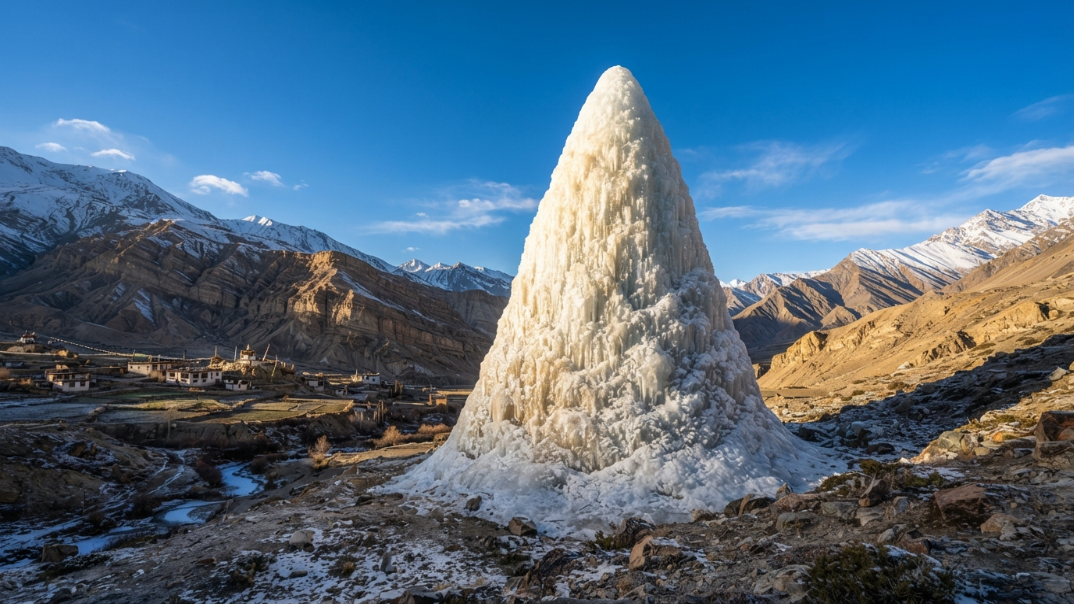
The Ice Stupa is the invention that brought Sonam Wangchuk to international attention — and it is a piece of engineering so elegant in its simplicity that it seems obvious in retrospect, which is the mark of genuine innovation. Ladakh's agricultural communities depend on glacier meltwater for spring irrigation. The problem: glaciers typically begin melting in summer, but crops need water in spring — a gap of weeks during which streams run dry and harvests fail. As climate change accelerates glacier retreat, this gap is widening and the total volume of available meltwater is declining. Wangchuk's solution: build an artificial glacier in the shape of a conical ice stupa that stores winter water and melts gradually in spring — precisely when natural meltwater is not yet available. The mechanism is simple but brilliant. In winter, he pipes water from an upstream source and allows it to flow through a vertical pipe. As the water shoots upward in the cold winter air, it freezes before it falls — building a conical ice structure that can reach 50 meters in height. The cone shape is critical: it minimises the surface area exposed to direct sunlight relative to the volume of ice stored, making the structure melt more slowly and last further into the spring season. The first prototype, built in 2013 at Phyang village near Leh, stored approximately 9,000 cubic meters of water. It worked. Farmers in surrounding areas were able to irrigate their spring crops using meltwater from the stupa. The project has since expanded to multiple sites across Ladakh and attracted international attention — teams in Switzerland, Chile, and other glacially stressed regions have adapted the concept. The Ice Stupa earned Wangchuk the Rolex Award for Enterprise (2016), the Global Award for Sustainable Architecture (2017), and formed part of the body of work recognized by the Ramon Magsaysay Award in 2018.
| Innovation | Problem Solved | How It Works | Impact |
|---|---|---|---|
| Ice Stupa | Spring water shortage for agriculture when natural glaciers haven't begun melting | Pipe water upward in winter; it freezes mid-air into a conical structure that stores 9,000+ cubic meters and melts slowly in spring | Operational in multiple Ladakh villages; adapted internationally in Switzerland and Chile |
| Passive Solar Earth Building (SECMOL campus) | High construction costs and energy dependency in remote high-altitude settings | Rammed earth walls with solar-passive design eliminate need for conventional heating in sub-zero winters | International Terra Award 2016; model for sustainable Himalayan construction |
| SECMOL / Operation New Hope curriculum reform | 95% failure rate of Ladakhi students in government exams due to culturally irrelevant content | Redesigned curriculum to include local languages, practical life skills, and culturally relevant content; teacher retraining | Dramatic improvement in government school pass rates across Ladakh over one decade |
Awards and International Recognition
Sonam Wangchuk has received approximately 15 national and international awards as of 2025. The most significant is the Ramon Magsaysay Award in 2018 — often described as Asia's Nobel Prize, awarded annually to individuals and organisations in Asia who have demonstrated greatness of spirit in service to the peoples of Asia. In his acceptance message for the award, Wangchuk said: 'This award is a recognition to our efforts of the last 30 years to make education meaningful, applicable and contextual in our remote mountains.' He used the platform to argue for a fundamental rethinking of education systems that remain, in his words, 'stuck with a system that is three hundred years old when at the onset of industrial revolution' it was designed to produce factory workers — not thinkers, innovators, or people equipped to solve the problems of their specific communities and environments. Beyond the Ramon Magsaysay Award, his recognition includes the Rolex Award for Enterprise (2016) for the Ice Stupa, the Global Award for Sustainable Architecture (2017), the Fred M. Packard Award (2016), the Ashoka Fellowship for Social Entrepreneurship (2002), and the Real Heroes Award from CNN-IBN (2008). He has also been named an Eminent Technologist of the Himalayan Region by IIT Mandi.
| Award | Year | For |
|---|---|---|
| Ashoka Fellowship for Social Entrepreneurship | 2002 | SECMOL and education reform work |
| Real Heroes Award, CNN-IBN | 2008 | Community service and innovation |
| International Terra Award (SECMOL campus) | 2016 | Best building — rammed earth Big Building |
| Rolex Award for Enterprise | 2016 | Ice Stupa artificial glacier project |
| Fred M. Packard Award | 2016 | Conservation and environment |
| Global Award for Sustainable Architecture | 2017 | Sustainable building and design |
| Ramon Magsaysay Award | 2018 | Education reform and community innovation in Ladakh |
| Eminent Technologist, Himalayan Region — IIT Mandi | 2018 | Engineering innovations in the Himalayan context |
The Fight for Ladakh's Statehood and Sixth Schedule: 2020 to 2025
When Jammu and Kashmir was bifurcated into two Union Territories in August 2019 — Jammu & Kashmir, and Ladakh — Ladakh was granted Union Territory status without a legislature. This means the region is governed directly by a Lieutenant Governor appointed by the central government, with no elected legislative assembly to represent the local population's interests. For Ladakh's approximately 300,000 people, this created an urgent constitutional anxiety: without a legislature, there was no elected body to protect their land rights, cultural identity, environment, or employment from outside interference. The Sixth Schedule of the Indian Constitution provides special protections for tribal areas through autonomous district councils — but Ladakh was not included. Sonam Wangchuk has been at the forefront of the demand for two things: first, full statehood for Ladakh restoring an elected legislature, and second, inclusion of Ladakh under the Sixth Schedule to provide constitutional safeguards for its land, resources, and culture. His activism on this front has included multiple hunger strikes, the 'Delhi Chalo Padyatra' — a month-long march from Leh to Delhi — and direct confrontations with the central government.
| Date | Action | Outcome |
|---|---|---|
| March 6 – March 26, 2024 | 21-day 'climate fast' in Leh in sub-zero temperatures demanding Sixth Schedule and statehood | Ended with a call to continue; talks with government failed to produce concrete outcome |
| September 2024 | 35-day hunger strike demanding early resolution of statehood and Sixth Schedule demands; direct appeal to PM Modi | Government under scrutiny; CBI investigation into alleged FCRA irregularities at SECMOL opened during this period |
| October 1, 2024 | Delhi Chalo Padyatra — month-long march from Leh to Delhi; Wangchuk and 150 Ladakhis detained at Singhu border by Delhi Police | Detention drew national attention; detainees continued fasting at police stations |
| October 6 – October 21, 2024 | 16-day fast at Ladakh Bhawan in Delhi after being denied permission for Jantar Mantar protest | Ended on Day 16 after MHA Joint Secretary provided written assurance of December 3 talks resumption |
| August 2025 | Joined hunger strike in Kargil for Sixth Schedule status; speculation of arrest before arrival | Joined protest amid security concerns; demands for statehood reiterated |
| June 28 – July 18, 2026 (ongoing) | Indefinite hunger strike at Jantar Mantar in solidarity with CJP demanding Education Minister resignation over exam leaks | Hospitalised at Safdarjung Hospital on Day 21 — July 18, 2026 |
The 2026 Exam Paper Leak Crisis: Why Wangchuk Is Fasting Now
The current hunger strike — Wangchuk's most serious to date by health impact — has a different immediate cause from his Ladakh statehood campaigns, though the underlying theme is the same: a powerful system failing the students and young people who depend on it. In May 2026, examination papers for medical and other competitive entrance exams were leaked ahead of the tests, affecting millions of student candidates across India who had spent months or years preparing. The leaks were attributed to systemic failures within the National Testing Agency (NTA) and the examination oversight machinery under Education Minister Dharmendra Pradhan. The Cockroach Janta Party — a Gen Z-led political movement that began as an online satirical response to remarks attributed to a senior judge who reportedly called India's unemployed youth 'cockroaches' and 'parasites' — launched a sit-in protest at Jantar Mantar demanding Pradhan's resignation. Wangchuk, who has spent his entire career fighting for meaningful, fair education that serves all children and not just those born into privilege, joined the fast on June 28 in solidarity. For him, the exam paper leaks represent the same structural failure he has been fighting since 1988: a system that claims to provide equal opportunity while being systematically manipulated to serve those with access and resources, at the expense of millions of students who follow the rules. 'I am weak from the outside but very strong inside,' Wangchuk told fellow protesters on July 16, two days before his hospitalisation. 'I will stay alive till July 20 at any cost. If you don't come and July 20 is not successful, I will come back as a ghost.' He was referring to a planned march to Parliament on July 20.
Current Status: Hospitalised on Day 21 — July 18, 2026
This is a breaking development: on the morning of July 18, 2026 — Day 21 of his indefinite hunger strike — Delhi Police shifted Sonam Wangchuk from the Jantar Mantar protest site to Safdarjung Hospital in New Delhi. The police cited medical advice and a direction from the Delhi High Court as the basis for the removal. As of this writing, Wangchuk's wife has publicly stated he will not accept treatment without his own consent. His condition entering the hospital was described as serious: his organisation reported he had lost 8.5 kilograms of body weight since June 28, and a young co-protester had already fainted and been hospitalised earlier in the week. CJP founder Abhijit Dipke announced he was beginning his own indefinite hunger strike immediately after Wangchuk was taken away. The Cockroach Janta Party posted that the movement would continue and escalated its demands to call for Prime Minister Narendra Modi's resignation — a significant escalation from the earlier demand for the Education Minister's resignation. The Aam Aadmi Party (AAP) launched a sharp attack on the central government, alleging that instead of choosing dialogue to end the peaceful protest, the government chose to forcibly remove a 59-year-old man who had been fasting for 21 days. Opposition leaders, Bollywood stars, and prominent public figures had been visiting Wangchuk at the protest site throughout the preceding days and appealing to him to end the fast. He consistently refused, stating his health condition was secondary to the cause.
Political and Public Response
The response to Wangchuk's 2026 fast has been notably broader than his previous protests, which were primarily understood as a Ladakh regional issue. The exam paper leak controversy has a national constituency — millions of students across India who took or planned to take NTA-conducted examinations, and their families. Several senior opposition leaders visited Wangchuk at Jantar Mantar, combining solidarity with appeals for him to end the fast. Bollywood actors and prominent social media personalities amplified the protest. The fact that a 59-year-old man who had already survived multiple prolonged hunger strikes was now in serious medical distress created a specific kind of moral urgency that previous protests had not achieved. The central government has not responded publicly with a specific offer or statement as of this writing. The silence is politically significant: Dharmendra Pradhan has not resigned, the government has not issued a formal response to the CJP's demands, and no senior minister has visited the protest site. The Delhi High Court's role in directing Wangchuk's removal — on the basis of medical advice — gives the government a procedural shield. The removal can be framed as a court-directed medical intervention rather than a political suppression of protest. Critics, including the AAP, have rejected this framing, arguing that the same government that ignored the protest for 21 days is now using the court's direction to remove the protester without engaging with his demands.
The Cockroach Janta Party and India's Gen Z Protest Movement
The Cockroach Janta Party (CJP) is one of the more unusual political forces in recent Indian history. It began as an online satirical movement in May 2026 — a direct, tongue-in-cheek response to remarks attributed to a senior judge who was widely reported to have called India's unemployed youth 'cockroaches' and 'parasites' during a court hearing. The movement's founders chose to reclaim the slur rather than reject it. Led by Abhijit Dipke, the CJP transitioned from digital satire to real-world protest with the Jantar Mantar sit-in, initially demanding Education Minister Dharmendra Pradhan's resignation over the May 2026 exam paper leaks. The protest is described by Al Jazeera as 'a rare show of defiance against Prime Minister Narendra Modi's 12-year rule.' When Wangchuk — a figure with national credibility, an established activist track record, and the moral capital of the 3 Idiots association — joined the fast on June 28, it transformed the protest's visibility. He brought a different generation and a different kind of public trust to a movement that had been primarily associated with Gen Z online activism. By July 18, 2026, with Wangchuk hospitalised, the CJP has escalated its demands to include a call for Modi's resignation — a move that takes the protest well beyond its origins in exam paper accountability and places it in the territory of broader political opposition.
Analysis: What Wangchuk's Fast Reveals About India in 2026
Sonam Wangchuk's hunger strikes are, at one level, a personal choice by an individual who has repeatedly demonstrated willingness to use his body as a political instrument. But at another level, they reveal something important about the state of democratic redress in India in 2026. The pattern across all of Wangchuk's major protests is consistent: he pursues dialogue first, escalates to public demonstration when dialogue fails, and resorts to hunger strike when both have produced no result. His March 2024 fast began a day after government talks hit a deadlock. His October 2024 Delhi fast began after he was blocked from reaching the designated protest site. His current fast began in solidarity with students whose grievances had been ignored for weeks. The hunger strike as a form of political protest has deep roots in South Asian civil disobedience. It works — when it works — by creating a moral equation that forces a response: either engage with the demands or be seen as complicit in the suffering of someone whose credibility and sincerity are established. Gandhi used it. Irom Sharmila used it for 16 years demanding repeal of AFSPA in Manipur. The mechanism depends on a government that cannot afford the political cost of inaction. What the 2026 protest reveals is a more complex environment. The government's non-response for 21 days — followed by a court-facilitated medical removal — is a strategy that sidesteps the moral equation without engaging it. It neither concedes to demands nor produces the martyr optics of a protester dying at a protest site. It medicalises the protest. For Wangchuk personally, the question after hospitalisation is what comes next. His history suggests he will not consider the matter resolved. Every previous hunger strike ended with either a specific government commitment or a public acknowledgement that the fight continues. The question is whether the government will engage before the situation produces a more serious medical outcome.
Timeline of All Major Hunger Strikes by Sonam Wangchuk
| Date | Location | Duration / Status | Cause | Outcome |
|---|---|---|---|---|
| March 6 – March 26, 2024 | Leh, Ladakh (sub-zero temperatures) | 21 days — ended voluntarily | Sixth Schedule for Ladakh; statehood demand; government talks deadlock | Ended with vow to continue fight; government talks resumed but no resolution |
| September 2024 | Leh, Ladakh | 35-day relay fast (Wangchuk + 15 others including monks) | Statehood for Ladakh; Sixth Schedule; direct appeal to PM Modi | No concrete government concession; CBI inquiry into SECMOL's FCRA compliance opened |
| October 1 – October 5, 2024 | Singhu Border / Delhi Police detention | ~5 days — at police station during detention | Delhi Chalo Padyatra blocked; demanding right to protest in Delhi for Ladakh statehood | Released; continued to Ladakh Bhawan protest |
| October 6 – October 21, 2024 | Ladakh Bhawan, New Delhi | 16 days — ended after MHA assurance | Sixth Schedule and statehood for Ladakh; denied Jantar Mantar permission | Ended Day 16 after MHA Joint Secretary provided written letter committing to December 3 talks |
| August 2025 | Kargil, Ladakh | Duration not confirmed | Sixth Schedule status; solidarity with Kargil Democratic Alliance | Participation amid arrest speculation; demands reiterated |
| June 28 – July 18, 2026 (ongoing at time of writing) | Jantar Mantar, New Delhi | 21 days — hospitalised Day 21 | Solidarity with CJP; demanding resignation of Education Minister Pradhan over May 2026 exam paper leaks | Removed to Safdarjung Hospital July 18 via Delhi High Court direction; protest continues |
Common Misunderstandings About Wangchuk and the Protests
- Assuming Wangchuk's current fast is about Ladakh statehood: His June–July 2026 fast is specifically in solidarity with the Cockroach Janta Party's demand for Education Minister Dharmendra Pradhan's resignation over exam paper leaks. It is separate from his ongoing Ladakh statehood campaign, though both reflect the same underlying concern about systems failing ordinary people.
- Believing 3 Idiots is an accurate biography of Wangchuk: The film's character Phunsukh Wangdu was loosely inspired by Wangchuk, but 3 Idiots is a fictional film. The real Wangchuk's story is more focused on systemic educational reform and Himalayan ecology than on the film's narrative of individual brilliance defying a rigid system.
- Confusing his hospitalisation with withdrawal from the protest: Wangchuk was removed to Safdarjung Hospital on July 18 following a Delhi High Court direction and medical advice. As of this writing, his wife has stated he will not accept treatment without his own consent. His hospitalisation does not mean he has ended the fast or withdrawn from the cause — it reflects the medical consequence of 21 days without food.
- Assuming the CBI investigation into SECMOL proves wrongdoing: The Central Bureau of Investigation opened scrutiny into alleged FCRA irregularities at SECMOL's funding during Wangchuk's September 2024 hunger strike. No charges have been established. Critics of the government argue the timing of the investigation — during an active protest — raises questions about selective enforcement.
- Treating the CJP as a fringe organisation: The Cockroach Janta Party began as satire, but the Jantar Mantar protest it organised drew significant support and is described by Al Jazeera as 'a rare show of defiance against PM Modi's 12-year rule.' Dismissing it as a fringe movement misses its significance as an expression of Gen Z political energy in India.
FAQs
Who is Sonam Wangchuk?
Sonam Wangchuk is a 59-year-old Indian engineer, educator, inventor, environmentalist, and civil rights activist from Ladakh, born on September 1, 1966. He co-founded SECMOL in 1988, transforming Ladakh's failing government school system. He invented the Ice Stupa — an artificial glacier technology — and won the Ramon Magsaysay Award in 2018. He is widely known as the loose inspiration for the Phunsukh Wangdu character in the Bollywood film 3 Idiots. As of July 18, 2026, he has been hospitalised after 21 days of hunger strike at Jantar Mantar, New Delhi.
Why is Sonam Wangchuk on a hunger strike in 2026?
Wangchuk began his current hunger strike on June 28, 2026, at Delhi's Jantar Mantar in solidarity with the Cockroach Janta Party (CJP), a Gen Z-led political movement demanding the resignation of Education Minister Dharmendra Pradhan following major exam paper leaks in May 2026 that affected millions of student candidates. For Wangchuk, the leaks represent a continuation of the same systemic failure he has fought his entire life: an education system that claims to provide equal opportunity while being manipulated to serve the privileged at the expense of ordinary students.
What happened to Sonam Wangchuk on July 18, 2026?
On July 18, 2026 — Day 21 of his hunger strike — Delhi Police removed Sonam Wangchuk from the Jantar Mantar protest site and shifted him to Safdarjung Hospital in New Delhi. The removal was carried out citing medical advice and a direction from the Delhi High Court. As of this writing, his health had deteriorated significantly — his organisation reported he had lost 8.5 kilograms of body weight. His wife publicly stated he would not accept treatment without his own consent. CJP founder Abhijit Dipke announced an indefinite hunger strike immediately after Wangchuk was removed.
What is SECMOL and why is it important?
SECMOL — Students' Educational and Cultural Movement of Ladakh — is an organisation co-founded by Wangchuk in 1988. It began as a response to the 95% failure rate of Ladakhi students in government examinations, which Wangchuk attributed to a curriculum and examination system designed without consideration for Ladakhi students' language context or lived experience. SECMOL led Operation New Hope — a reform of government school curricula in Ladakh — and opened a residential campus in 1998 running entirely on solar power and rainwater harvesting. The campus won the International Terra Award in 2016. SECMOL's FCRA licence was cancelled in 2025 amid controversy over the timing relative to Wangchuk's activism.
What is the Ice Stupa and how does it work?
The Ice Stupa is an artificial glacier invented by Sonam Wangchuk that addresses Ladakh's spring water shortage. Natural glaciers melt in summer, but farmers need irrigation water in spring — before natural meltwater arrives. The Ice Stupa solution: in winter, water is piped upward through a vertical pipe and sprayed into the cold air, where it freezes before falling, building a conical ice structure. The cone shape minimises surface exposure to sunlight relative to volume, making the ice melt slowly into spring. The first prototype in 2013 stored approximately 9,000 cubic meters of water. The technology has since been adopted in Ladakh and adapted internationally.
What is the Sixth Schedule and why does Wangchuk want it for Ladakh?
The Sixth Schedule of the Indian Constitution provides special protections for tribal areas in northeastern India through autonomous district councils — allowing local communities to manage their own affairs, protect their land, and preserve their culture from outside interference. Wangchuk and Ladakh's community leaders have demanded that Ladakh be included under the Sixth Schedule since the region was made a Union Territory in 2019 without a legislature. Without these protections, Ladakh's land, resources, government jobs, and cultural identity are potentially vulnerable to outside interests with no elected local body having the constitutional power to protect them.
What is the Cockroach Janta Party?
The Cockroach Janta Party (CJP) is a Gen Z-led political movement that began in May 2026 as an online satirical response to remarks attributed to a senior Indian judge who reportedly called India's unemployed youth 'cockroaches' and 'parasites.' Led by Abhijit Dipke, it transitioned from digital satire to real-world protest with a sit-in at Jantar Mantar demanding Education Minister Dharmendra Pradhan's resignation over the May 2026 exam paper leaks. It is described by Al Jazeera as representing a rare show of defiance against PM Modi's governance. Following Wangchuk's hospitalisation, the CJP escalated its demands to call for the Prime Minister's resignation.
Is the 3 Idiots character directly based on Sonam Wangchuk?
The character Phunsukh Wangdu, played by Aamir Khan in the 2009 Bollywood blockbuster 3 Idiots, was loosely inspired by Sonam Wangchuk. Both are engineers from Ladakh who challenged conventional education systems and built innovations serving their communities. However, 3 Idiots is a fictional film — Wangchuk has noted the connection publicly but has been measured about it. The real-life Wangchuk's story is rooted in systemic education reform, sustainable architecture, climate adaptation, and civil rights activism — substantially more complex and politically engaged than the film's narrative.
What awards has Sonam Wangchuk won?
Sonam Wangchuk has received approximately 15 national and international awards. The most prestigious is the Ramon Magsaysay Award (2018), often called Asia's Nobel Prize, for his education reform work. Other major awards include the Rolex Award for Enterprise (2016) for the Ice Stupa, the Global Award for Sustainable Architecture (2017), the International Terra Award for the SECMOL Big Building (2016), the Fred M. Packard Award (2016), the Ashoka Fellowship for Social Entrepreneurship (2002), and the Real Heroes Award from CNN-IBN (2008). He has also been named Eminent Technologist of the Himalayan Region by IIT Mandi.
Why did the government block Wangchuk from entering Delhi in 2024?
In October 2024, Sonam Wangchuk led a 'Delhi Chalo Padyatra' — a month-long march from Leh to Delhi — demanding statehood and Sixth Schedule protections for Ladakh. Delhi Police detained Wangchuk and approximately 150 Ladakhi marchers at the Singhu border, preventing them from entering the capital. The group continued fasting even while detained at police stations. The detention drew national attention and criticism from opposition parties and civil society. Wangchuk and the marchers were eventually released and permitted to reach Ladakh Bhawan, where they continued their protest.