CDS Exam 2027: Dates, Syllabus, Eligibility, and Selection

If you've been searching 'CDS exam date 2027' and getting six different half-answers, here's the frustrating part: most of what's online right now either repeats last year's numbers with the date swapped, or gives you the pattern without telling you what score actually gets you selected. The dates below come directly from UPSC's own 2027 Annual Calendar and the real 2025 cutoff data, so you're planning around facts, not guesses.
This article covers everything in one place: the confirmed 2027 dates, academy-by-academy eligibility, the full syllabus, and actual named topper scores from the last cycle, so you know exactly what 'good enough' looks like. Let's start with the dates, since that's what you came here for.
Key Takeaways
- CDS 1 2027 exam date is April 11, 2027, and CDS 2 2027 exam date is September 19, 2027 — both confirmed by UPSC's official Annual Calendar released in May 2026.
- IMA, INA, and AFA candidates write 3 papers (English, GK, Elementary Maths — 300 marks total); OTA candidates write only 2 (English and GK — 200 marks total, no Maths at all).
- Negative marking is 0.33 marks per wrong answer — but correct answers in English and GK are worth 0.833 marks each, not a flat 1 mark, because of how the questions are distributed across the paper.
- A written score alone won't get you in. Real 2025 data shows candidates with just 130–150 written marks still made the final IMA/INA/AFA merit list because of strong SSB scores of 160+.
- CDS 1 2027 notification releases December 2, 2026, with the application window closing around December 22, 2026.
CDS Exam Date 2027: The Full Timeline
The CDS 1 2027 exam is scheduled for April 11, 2027, and the CDS 2 2027 exam is scheduled for September 19, 2027, as confirmed in UPSC's official Annual Calendar released on May 20, 2026. Both cycles follow the same notification-to-result rhythm UPSC has used for years, just shifted to these specific dates.
| Milestone | CDS 1 2027 | CDS 2 2027 |
|---|---|---|
| Notification release | December 2, 2026 | May 12, 2027 |
| Application deadline | ~December 22, 2026 | ~June 1, 2027 |
| Written exam date | April 11, 2027 | September 19, 2027 |
| Admit card release | 10–15 days before exam | 10–15 days before exam |
| Result (written) | 4–6 weeks after exam | 4–6 weeks after exam |
What this means for your planning: if you're aiming for CDS 1 2027, you effectively have from now (August 2026) until April 2027 — about 8 months, which is workable but not generous if you're starting the syllabus from zero. If you're eyeing CDS 2 2027 instead, you get almost a full year, worth considering if your graduation timeline or job commitments make an April exam tight.
A mistake seen constantly: aspirants wait for the notification PDF in December to "officially start" preparing. The notification just confirms vacancies and exact fee/age windows — the syllabus and pattern are already fixed and haven't changed, so there's no reason to wait.
What Is the CDS Exam?
The Combined Defence Services (CDS) Examination is a national-level entrance test conducted twice a year by the Union Public Service Commission (UPSC) to select graduates for officer training in the Indian Armed Forces. It's the main gateway into four academies: the Indian Military Academy (IMA) for the Army, Indian Naval Academy (INA) for the Navy, Air Force Academy (AFA) for the Air Force, and Officers' Training Academy (OTA) for Short Service Commission in the Army.
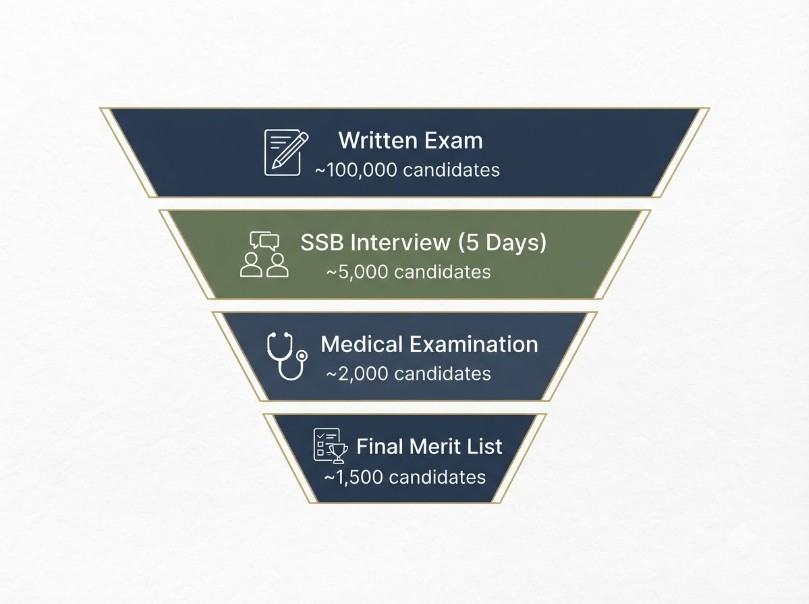
Clearing the written paper is genuinely just stage one. Every candidate who qualifies then goes through a 5-day Services Selection Board (SSB) interview and a medical examination before a final merit list is drawn up — and as the cutoff data further down shows, the SSB stage often decides the outcome more than the written score does.
Academy-Wise Eligibility for CDS 2027
Each of the four academies has its own age limit and degree requirement, and mixing these up is one of the most common — and costly — mistakes aspirants make on the application form.
| Academy | Target Service | Age (Typical Band)* | Degree Requirement | Gender |
|---|---|---|---|---|
| IMA | Indian Army | 19–24 years | Any bachelor's degree | Male only |
| INA | Indian Navy | 19–22 years | B.E./B.Tech (Engineering) | Male only |
| AFA | Indian Air Force | 20–24 years | Physics & Maths at 10+2 + degree, or B.E./B.Tech | Male only |
| OTA | Indian Army (Short Service) | 19–25 years | Any bachelor's degree | Male & Female |
*Exact age brackets and cut-off birth dates are confirmed only in the official notification (December 2, 2026 for CDS 1 2027). The ranges above reflect the consistent pattern from CDS 1 and CDS 2 2026 notifications — always verify your specific eligibility against the official PDF once it's released.
OTA is the only academy currently open to women through CDS, and OTA's Short Service Commission means you serve a fixed tenure rather than a full career — this matters if your goal is a permanent Armed Forces career versus a defined service period. If a permanent commission is your priority, IMA, INA, or AFA are your only routes, and all three currently accept male candidates only under existing notification rules.
CDS 2027 Exam Pattern: Papers, Marks, and Timing
The CDS written exam pattern differs by academy: IMA, INA, and AFA candidates write three papers totaling 300 marks, while OTA candidates write two papers totaling 200 marks, with no Mathematics component at all for OTA.
| Paper | IMA / INA / AFA | OTA | Duration | Approx. Questions |
|---|---|---|---|---|
| English | 100 marks | 100 marks | 2 hours | 120 |
| General Knowledge | 100 marks | 100 marks | 2 hours | 120 |
| Elementary Mathematics | 100 marks | Not applicable | 2 hours | 100 |
| Written Total | 300 marks | 200 marks | — | — |
| SSB Interview | 300 marks | 200 marks | 5 days | — |
All three papers for IMA/INA/AFA candidates are typically held in a single day across three time slots (morning, midday, and afternoon sessions), so stamina and pacing across a full exam day matter as much as subject knowledge. If you're an OTA candidate, your exam day is shorter (roughly 4 hours instead of 6), which changes how you should plan your pre-exam routine, meals, and mental pacing on the day itself.
Understanding CDS Negative Marking
CDS applies a 0.33-mark penalty for every incorrect answer, while unattempted questions carry zero penalty, making selective attempting a genuinely important exam strategy rather than just a rule to know about. A correct answer isn't always worth a flat mark — in the English and GK papers, each correct answer is typically worth close to 0.83 marks once the question count and total marks are worked out, while Elementary Mathematics correct answers are worth close to 1 mark each.
Because Maths questions carry proportionally more value per correct answer than English or GK questions, and because Maths is also where careless calculation errors happen most, being extra disciplined about only attempting Maths questions you're genuinely confident in pays off more than guessing on GK questions where the per-question stakes are slightly lower.
A mistake seen a lot among first-time candidates is treating all three papers with the same guessing threshold, when the actual math of the marking scheme rewards a more selective approach specifically in Mathematics.
Full Syllabus Breakdown by Paper
English (Mandatory for All Academies)
The English paper tests functional grammar, vocabulary, and comprehension at a level most graduates can handle with consistent practice rather than deep specialization. Core areas include spotting errors, sentence improvement, ordering of words and sentences, synonyms and antonyms, fill-in-the-blanks, idioms, and reading comprehension passages.
General Knowledge (Mandatory for All Academies)
The GK paper is genuinely broad, covering Indian History, Geography, Polity, Economics, General Science up to Class 10 level, Environment and Ecology, and current affairs with a defence-specific slant. Current affairs questions frequently draw from recent military exercises, defence acquisitions, and bilateral summits, so relying only on generic current affairs digests without a defence-specific source risks missing 15–20% of scorable GK questions.
Elementary Mathematics (IMA, INA, AFA Only — Not OTA)
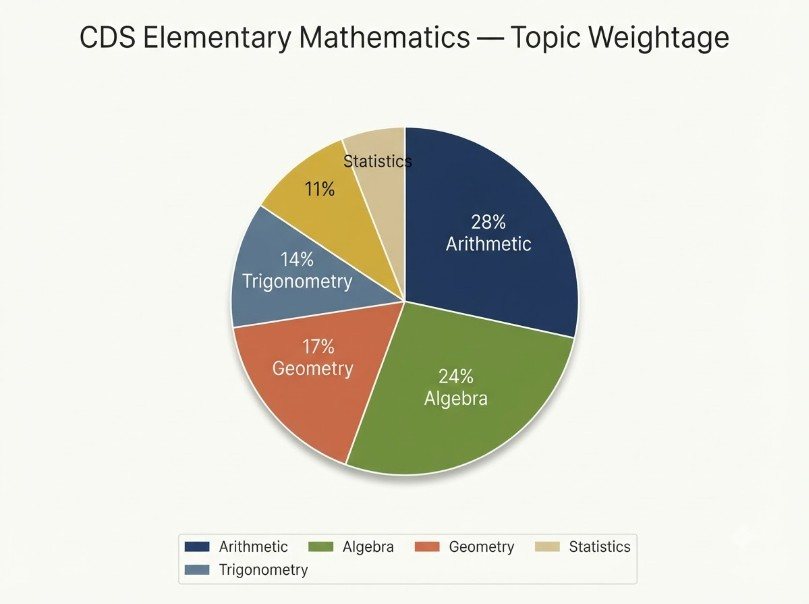
This paper is Class 10 (matriculation) level mathematics, covering arithmetic, algebra, trigonometry, geometry, mensuration, and statistics. Because it's OTA-exempt, this single paper is often the deciding factor in whether a candidate chooses to target OTA specifically — if your Maths is weak but your English and GK are strong, OTA removes your biggest risk factor entirely.
| Topic Area | Key Subtopics |
|---|---|
| Arithmetic | Number system, HCF/LCM, percentages, profit & loss, time & work |
| Algebra | Polynomials, quadratic equations, remainder theorem, simultaneous equations |
| Trigonometry | Sine, cosine, tangent ratios, standard angles, height & distance problems |
| Geometry | Lines, angles, congruent triangles, circle properties |
| Mensuration | Areas and volumes of standard 2D and 3D shapes |
| Statistics | Mean, median, mode, frequency distribution, basic graphs |
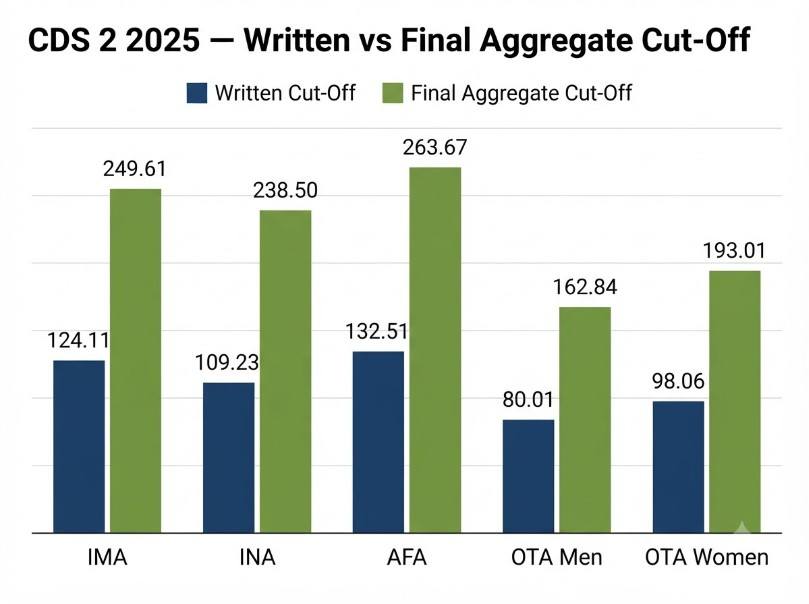
What Cut-Off Should You Actually Target? (Real 2025 Data)
This is genuinely the most useful thing to know before you start preparing: what score actually got people selected last cycle. Based on UPSC's official CDS 1 and CDS 2 2025 released cut-offs, here's exactly where the bar sat.
| Academy | Written Cut-Off (out of total) | Final Aggregate Cut-Off (out of 600, or 400 for OTA) |
|---|---|---|
| AFA (CDS 1 2025) | 128 / 300 | 253 / 600 |
| IMA (CDS 1 2025) | 120 / 300 | 243 / 600 |
| INA (CDS 1 2025) | 104 / 300 | 230 / 600 |
| IMA (CDS 2 2025) | 124.11 / 300 | 249.61 / 600 |
| AFA (CDS 2 2025) | 132.51 / 300 | 263.67 / 600 |
| INA (CDS 2 2025) | 109.23 / 300 | 238.50 / 600 |
| OTA Men (CDS 2 2025) | 80.01 / 200 | 162.84 / 400 |
| OTA Women (CDS 2 2025) | 98.06 / 200 | 193.01 / 400 |
The single most important insight in this data: the highest written score recorded in the IMA CDS 2 2025 list was 183.79 out of 300, but the lowest score that still made the final recommended list was just 124.11 — a gap of nearly 60 marks. What closed that gap was the SSB interview, where the highest scorer for that list hit 177 out of 300. Several candidates with moderate written scores in the 130–150 range made the final IMA, INA, and AFA lists specifically because of strong SSB scores of 160 or more, while some candidates with stronger written performance were placed lower or missed out due to weaker SSB scores.
The SSB Interview: Your Second, Equally Important Exam
The Services Selection Board (SSB) interview is a 5-day evaluation process that assesses Officer-Like Qualities (OLQs) through psychological testing, Group Testing Officer (GTO) outdoor tasks, and a personal interview with the board president. Given that SSB carries 300 marks for IMA/INA/AFA and 200 marks for OTA — equal weight to the entire written exam — and given the cutoff data above, treating SSB prep as an afterthought after clearing the written stage is a genuinely costly mistake.
A mistake seen a lot among aspirants: they start SSB-specific preparation only after receiving their written result, leaving barely 3–4 weeks before their SSB call-up letter. Officer-Like Qualities like structured communication, group decision-making, and composure under pressure take months to build naturally, not weeks.
How to Prepare: A Realistic 8-Month Roadmap
Here's a step-by-step preparation structure built around the actual CDS 1 2027 timeline, assuming you're starting around August 2026.
- Months 1–2 (Foundation): Cover NCERT Class 9-10 Maths fully and build a daily newspaper reading habit for current affairs — don't skip straight to mock tests before your basics are solid.
- Months 3–4 (Syllabus Completion): Finish the complete GK static portion (History, Geography, Polity, Economics) and English grammar rules, while continuing daily Maths practice.
- Months 5–6 (Practice Intensity): Start solving previous years' UPSC CDS papers under timed conditions, and begin basic SSB-oriented practice — group discussions, structured self-introduction, current affairs debates with peers.
- Month 7 (Mock Test Phase): Attempt at least 15-20 full-length mock tests under strict exam conditions, tracking your accuracy and negative-marking losses paper by paper.
- Month 8 (Final Revision): Focus purely on revision, weak-area closure, and 2-3 final mock tests — avoid learning new topics this close to the exam.
Track your Maths accuracy specifically, separate from your GK and English accuracy, because the 0.33 negative marking hits Maths errors hardest given the higher per-question value discussed earlier.
Author Bio
Kush Verma is a Software Engineer, Teacher & Principal Editor, and Researcher at UKTU, with a background in Computer Science Engineering and full-stack development. He writes about software engineering, educational frameworks for readers seeking practical, fact-checked guides, drawing on a strict four-stage editorial process of primary research, technical validation, editorial refinement, and continuous auditing.
Frequently Asked Questions
What is the CDS exam date for 2027?+
CDS 1 2027 is scheduled for April 11, 2027, and CDS 2 2027 is scheduled for September 19, 2027, both confirmed via UPSC's official Annual Calendar released in May 2026.
Is there negative marking in CDS 2027?+
Yes, 0.33 marks are deducted for every incorrect answer across all papers, while unattempted questions carry no penalty. This makes selective attempting, especially in the Elementary Mathematics paper, a genuinely important scoring strategy.
What is the CDS age limit for 2027?+
Exact age brackets are confirmed only in the official notification releasing December 2, 2026, but based on recent notification patterns, IMA typically requires 19-24 years, INA 19-22 years, AFA 20-24 years, and OTA 19-25 years. Always verify against the official PDF once released, since these bands can shift slightly year to year.
Can women apply for CDS 2027?+
Yes, women are eligible to apply for the Officers' Training Academy (OTA) through CDS for Short Service Commission. IMA, INA, and AFA currently remain restricted to male candidates under existing notification rules.
Is Mathematics compulsory for all CDS academies?+
No, Elementary Mathematics is required only for IMA, INA, and AFA candidates. OTA candidates write only English and General Knowledge, with no Mathematics paper at all.
How many attempts are allowed for CDS?+
There is no maximum attempt limit for CDS — you can appear for any cycle as long as you meet the age and educational eligibility criteria for that specific notification. This differs from some other government exams that cap attempts by category.
What is a safe score to aim for in CDS 2027?+
Based on CDS 2025 data, aim for at least 140+ out of 300 for IMA, 115+ for INA, and 145+ for AFA in the written exam to sit comfortably above recent cut-offs, alongside strong, dedicated SSB preparation. The written score alone doesn't guarantee selection — several 2025 candidates with moderate written scores made the final list purely on strong SSB performance.