How to Educate the Poor: A Simple, Honest Guide for 2026
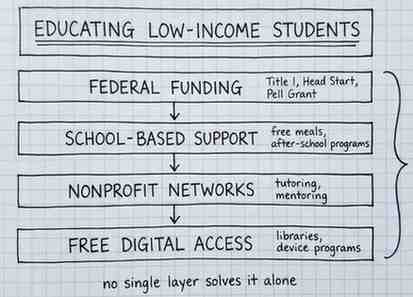
Educating the poor takes more than free schools — here's what actually works, explained in plain, simple language.
Key Takeaways
- Educating the poor isn't one action, it's several small actions working together — money for school alone won't fix it if a child is hungry or has no light to study by at night.
- You don't need to be rich or a trained teacher to help. Volunteering an hour a week, donating old books, or simply talking to a struggling student can genuinely change their path.
- As a school or college student, you have more power to help than you think — peer tutoring and mentoring are proven to work, and they cost nothing but time.
- NGOs like Teach For India, Pratham, and Nanhi Kali already run structured programs — joining one is often more effective than starting from scratch alone.
- The biggest mistake people make is picking one fix (like free books) and ignoring the rest — real help usually means food, study material, and encouragement together.
Why This Question Matters
When the I first started writing about this topic, I thought 'educating the poor' meant building more schools. I was wrong, or at least, only half right.
A child in a slum near Mumbai and a child in a remote village in Bihar are both 'poor' on paper, but their actual problems are completely different — one might have a school five minutes away but no light at home to study after dark, the other might not have a school for miles. Before discussing how to help, it's important to understand what's actually being fixed.
What Poverty Actually Does to a Child's Education
India has almost achieved full primary school enrolment — meaning most kids are technically registered in a school. The real problem isn't getting kids into school. It's keeping them there and making sure they actually learn something once inside.
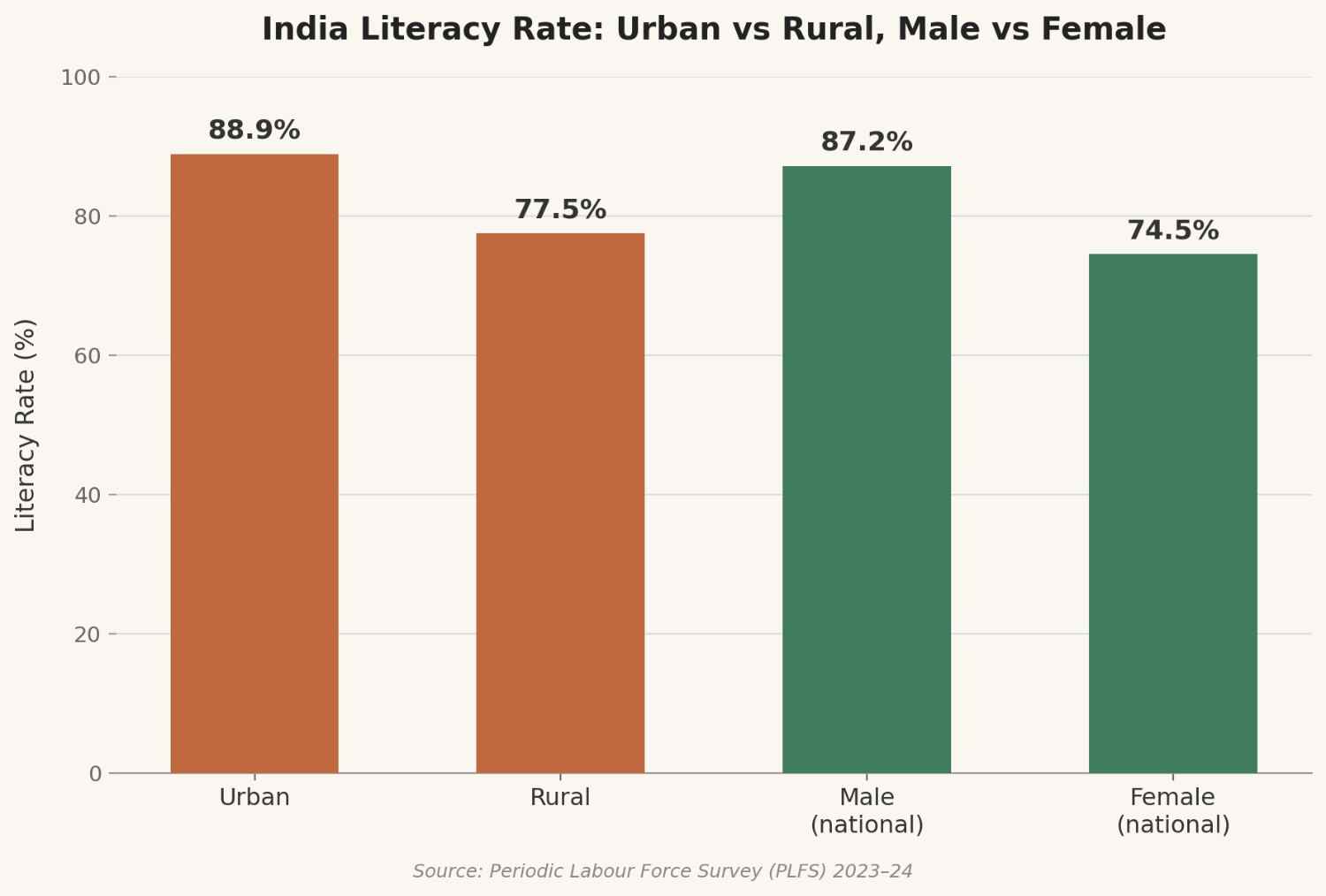
India's national literacy rate stands at around 80.9%, but that number hides a big gap — urban literacy sits close to 88.9%, while rural areas lag behind at roughly 77.5%. The gender gap is even sharper: male literacy is around 87.2%, compared to about 74.5% for females, and in some states like Rajasthan, rural female literacy can drop as low as 61.8%.
So what's actually going on behind these numbers? It breaks down into three simple buckets, the same way development workers describe it:
- Money problems: Families need their kids to work, fetch water, or care for siblings instead of studying. Roughly 10 million children in India are estimated to be in child labour instead of school.
- Missing basics: Around a third of schools in India still lack basic facilities like clean toilets or drinking water — and this alone pushes many girls to drop out once they hit their teenage years.
- No support at home: Many parents never got the chance to study themselves (illiteracy affects roughly 36% of rural adults), so there's nobody at home to help with homework or push a child to keep going.
How Can I Help the Poor? (The Direct Answer)
The honest, first answer is always: start small, start local, and start with your time before your money.
Money is useful, but it's the easiest thing to give and, sadly, the easiest thing to misuse if it doesn't go through the right hands. Time — teaching a child to read, sitting with them for an hour a week, explaining a maths problem three different ways until it clicks — is much harder to waste.
10 Real Ways I Can Help Educate the Poor
These are organised from 'needs almost no money' to 'needs a bit of planning,' so pick whichever fits your current situation.
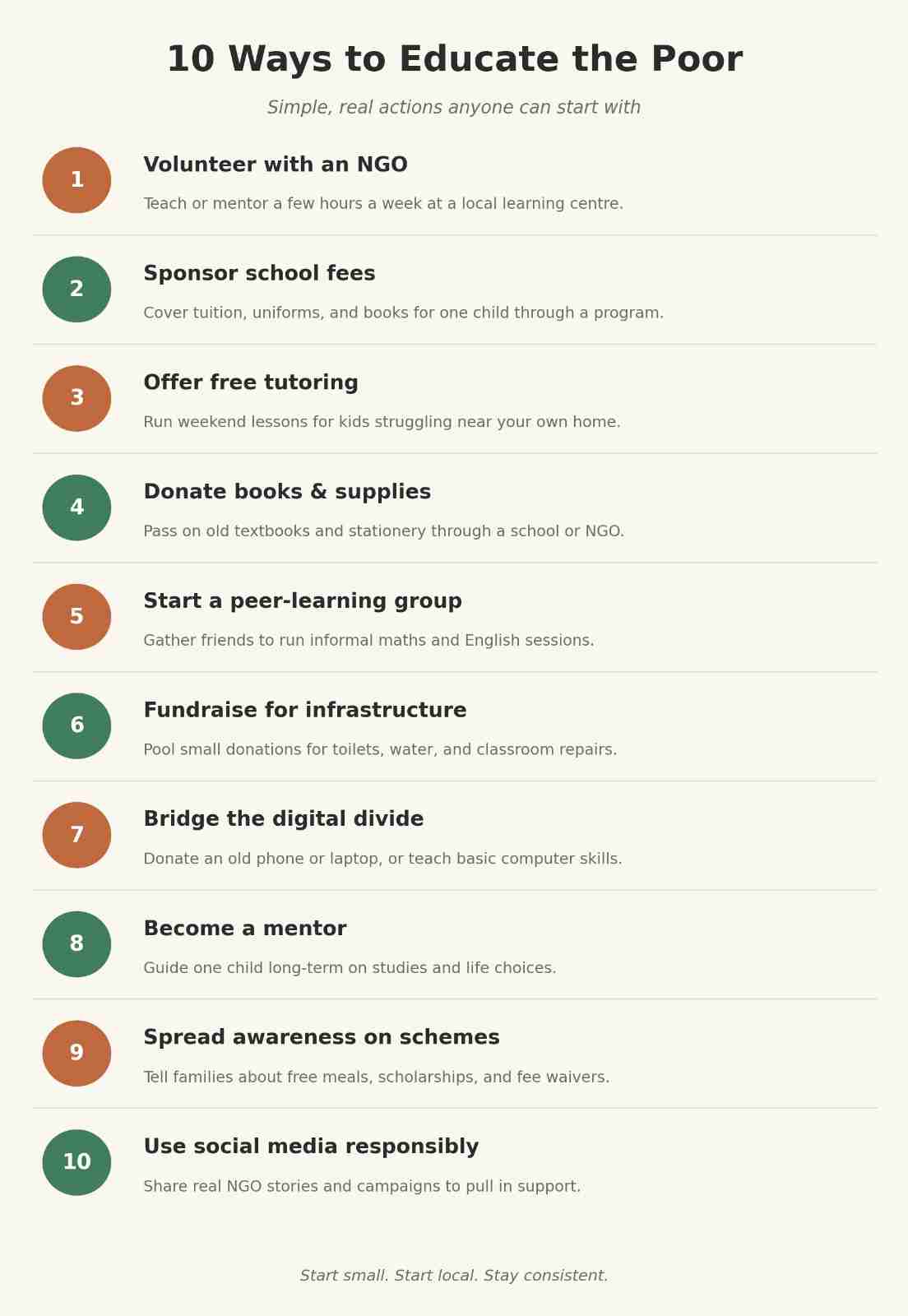
- Volunteer with a local education NGO. Even two hours a week teaching or mentoring at a nearby learning centre adds up over months, and most NGOs will train you — no teaching degree required.
- Sponsor a child's school fees. Many NGOs run child-sponsorship programs where a monthly contribution covers tuition, uniforms, and books for one specific child, often with progress updates.
- Offer free tutoring near your own home. A weekend tutoring session under a tree or in someone's courtyard genuinely works — it can grow into full community study circles.
- Donate books and school supplies. Old textbooks, notebooks, and pencils can open up learning for a child who has none, as long as they're routed through a school or NGO instead of left at random.
- Start a small peer-to-peer learning group. Gather two or three friends and run informal sessions on basic maths, English, or science for younger kids in your area.
- Fundraise for a low-income school's infrastructure. Clean toilets, drinking water, working fans — small pooled donations can fund things individual families never could.
- Bridge the digital divide. Donate an old phone or laptop, or teach a child how to use one safely — digital skills are becoming as essential as reading and writing.
- Become a long-term mentor, not just a tutor. Regular check-ins with just one child can genuinely reshape their path on career choices or life decisions.
- Spread awareness about government schemes. Many families don't know they qualify for free meals, scholarships, or fee waivers — telling them and helping with paperwork removes a real barrier.
- Use social media the right way. Sharing a genuine NGO's campaign, or a real story (with permission), can pull in donations and volunteers you'd never reach on your own.
How to Educate the Poor as a Student (Yes, You Can Help Too)
If you're reading this in 10th or 12th class yourself: a struggling 6th grader doesn't need a PhD to explain fractions to them. They need someone patient, close to their own age, who remembers what it's like to be confused in class. That's exactly what you are right now.
- Teach for one hour a week. Pick one subject you're strong in and offer to help a younger student nearby who's struggling.
- Join your school's community service club. Many schools already run outreach programs to nearby government schools.
- Collect and pass on old books. At the end of every academic year, students throw away or resell books that could genuinely help a child with none.
- Start small, stay consistent. One hour every Sunday for six months does more than one big burst of effort that fizzles out after two weeks.
Ways of Helping Poor Students in School
For teachers, school administrators, or parents involved in their child's school, there are specific things that work inside the classroom itself, not just outside it.
- Buddy systems: Pair a stronger student with a weaker one for regular study sessions — both benefit, and it costs the school nothing.
- Flexible attendance support: For children who miss school due to chores or seasonal farm work, short catch-up sessions after they return prevent them from falling permanently behind.
- Nutrition alongside lessons: Schools that provide a proper mid-day meal see real jumps in both attendance and focus.
- Involve parents, even illiterate ones: Simple workshops that show parents why attendance matters, without requiring them to read or write themselves, measurably reduce dropout rates.
- Recognise silent strugglers early: A child who goes quiet in class is often more at risk than one who acts out — regular one-on-one check-ins catch this before it becomes a dropout.
How to Teach a Very Weak Student
This is one of the most searched questions on this topic. 'Weak' is often the wrong word for what's usually happening — no child is actually weak; they're often just learning at a different pace, or carrying stress you can't see.
- Break everything into tiny pieces. Don't teach a whole chapter at once — master one small idea completely before moving to the next.
- Never call them 'weak,' even privately. Say 'let's take this at your pace' instead — labels stick in a child's mind far longer than any lesson does.
- Use their senses, not just their eyes. Let them touch, count, or say things out loud — multisensory learning helps struggling students retain far more than reading alone.
- Give small, specific praise. 'You got that fraction right' works better than a vague 'good job.'
- Test in small chunks, often. Quick, low-pressure quizzes after two or three topics help both teacher and student see progress in real time.
- Protect them from classroom teasing. A single moment of public embarrassment can undo weeks of confidence-building.
Programs and Organisations Already Doing This Work
You don't always have to build something from scratch. A lot of smart, tested programs already exist — joining one is often faster and more effective than starting alone.
| Organisation/Program | What It Does | Who It's Best For |
|---|---|---|
| Teach For India | Places young graduates and professionals as full-time teachers in low-income schools for two years | Recent graduates wanting a deep, structured commitment |
| Pratham | Runs remedial reading and maths programs across India, known for its ASER learning survey | Volunteers who want to help with basic literacy and numeracy |
| Nanhi Kali | Focuses specifically on girls' education through material support and academic help | Anyone who wants to support girls staying in school |
| PM POSHAN (Mid-Day Meal Scheme) | Government scheme providing free daily meals to lakhs of school children | Families and schools needing nutrition support |
| Local grassroots NGOs (city-specific) | Community tutoring, mobile learning vans, parent workshops | Anyone wanting hands-on, local involvement |
The honest evaluation criteria for picking one of these: how close the work gets you to the actual child (not just paperwork), how transparent they are about where funds go, and whether they'll let you volunteer directly rather than only accepting donations. Teach For India wins on depth of commitment; Pratham wins on scale and measurable results; a small local NGO often wins on how quickly you can start.
Free Resources You Can Point Families Toward
If you know a family that can't afford tuition or private coaching, here's what genuinely costs nothing:
- Public libraries and municipal computer centres — many offer free workstations and internet access.
- Government digital learning platforms (like DIKSHA) — free video lessons aligned with the school curriculum, available even in local languages.
- Device-lending pools run by some schools and municipal offices — worth a direct phone call to ask, since these aren't always advertised.
- Community learning centres run by NGOs — usually free, and often the fastest way to get a struggling child extra help without waiting for government paperwork.
The 7 Life Skills Every Child Needs Alongside Books
This one's slightly different from the rest of this article, but it comes up so often alongside 'educating the poor' that it's worth answering properly — textbook learning alone doesn't prepare a child for real life. The seven commonly taught life skills are:
- Communication — expressing thoughts clearly, both speaking and listening.
- Critical thinking — questioning and reasoning through problems, not just memorising answers.
- Decision-making — weighing options and understanding consequences.
- Problem-solving — working through obstacles step by step instead of giving up.
- Self-awareness — understanding one's own emotions and strengths.
- Empathy — understanding how others feel, which matters enormously in mixed-income classrooms.
- Coping with stress and emotions — especially important for children facing financial hardship at home.
For underprivileged children specifically, decision-making and coping with stress deserve extra focus, since these children often face adult-level pressures — money worries, family responsibility — far earlier than their peers.
My Honest Opinion: What Actually Moves the Needle
One-on-one or small-group tutoring, done consistently over months, beats almost every other single intervention. It's not flashy, it doesn't photograph as well as a school-building ribbon-cutting, but it's the thing that actually moves a child from 'can't read' to 'can read' in a measurable way.
Donating supplies without follow-up, or one-time fundraisers that never check in on long-term results, feel good in the moment but rarely change a child's trajectory by themselves. Not everyone can commit to weekly tutoring, and that's fine — but between a single big donation and a smaller, steady commitment, steady wins every time.
Common Mistakes People Make While Trying to Help
- Assuming poverty means low ability. A child who's behind in class because of hunger or missed school is not less capable.
- Fixing only one problem. Free books alone won't help a child who's too hungry to concentrate, or too tired from farm work to focus.
- Donating through unverified channels. Always check a school's or NGO's actual wish list rather than dropping off random items that may not match what's needed.
- Giving up after one session. A single tutoring visit rarely changes anything — the real impact comes from showing up again and again.
- Ignoring nearby free resources. Public libraries and government digital platforms often go completely unused simply because nobody told the family they existed.
Final Word
If you take away just one thing from this article, let it be this: educating the poor isn't a single act you complete once and move on from. It's a habit — showing up week after week, whether that means tutoring one child, donating supplies through the right channel, or simply telling a struggling family about a scheme they didn't know existed.
You don't need to be wealthy, and you don't need a teaching degree. You need consistency, a bit of patience, and the willingness to start small. If you're a student reading this, start with one hour this weekend — that's genuinely enough to begin.
About the Author
Kush Verma is an Engineer, Teacher & Principal Editor at UKTU, with a background in Computer Science Engineering and full-stack development. He writes about software engineering, educational frameworks for readers seeking practical, fact-checked guides, drawing on a strict four-stage editorial process of primary research, technical validation, editorial refinement, and continuous auditing.
Frequently Asked Questions
What are 10 ways I can help the poor?+
Volunteering with an NGO, sponsoring school fees, free tutoring, donating books, starting peer-learning groups, fundraising for school infrastructure, bridging the digital divide, mentoring, spreading awareness about government schemes, and using social media responsibly are all proven ways to help.
What are the 7 life skills?+
The seven commonly taught life skills are communication, critical thinking, decision-making, problem-solving, self-awareness, empathy, and coping with stress — all of which matter as much as academic subjects for a child's long-term success.
How can I help the poor?+
Start with your time before your money — tutoring, mentoring, or simply spreading awareness about available schemes usually creates more lasting change than a one-time donation, especially when you stay consistent over months rather than doing it once.
How to teach a very weak student?+
Break lessons into small steps, avoid labelling them as 'weak,' use hands-on and spoken learning instead of just reading, and give specific praise — consistency and belief in the student matter more than any single teaching trick.
How to educate the poor as a student?+
Even as a school or college student, you can tutor a younger child for an hour a week, join your school's outreach club, or pass on old books and notes — small, consistent effort works better than waiting until you're 'old enough' to make a bigger difference.
Is there a good essay format for 'How to Educate the Poor'?+
A strong essay usually opens with the scale of the problem (enrolment vs. actual learning gaps), explains root causes like poverty and infrastructure, lists concrete solutions such as NGOs and government schemes, and ends with the reader's own role in helping.
What is Teach For India and how can I join it?+
Teach For India places young graduates and professionals as full-time teachers in low-income schools for a two-year fellowship, and applications typically open through their official website with defined eligibility criteria around age and educational background.