How to Become a CEO Young: Here's How I'd Start
You can become a CEO at a young age either by starting your own company early or by climbing fast in a growing business through skills, results, and smart risk-taking.
Key Takeaways
- There are two real routes to becoming a young CEO: start your own company (fastest route) or rise quickly inside an existing company through results (slower but more stable).
- You don't need a specific degree to become a CEO, but business knowledge, an MBA, or hands-on experience makes the climb faster and easier.
- Age is genuinely not a legal barrier after 18, and even before 18 you can run a small business with a parent or guardian's support.
- CEO salary varies massively — from under ₹1 lakh a month for early-stage startup founders to several crores a month for CEOs of big listed companies.
- The youngest "CEO" titles you'll read about online are mostly kids running small ventures, not legally registered companies — I'll explain that difference clearly in this guide.
I remember being a teenager and seeing headlines about 17-year-old CEOs and thinking, "Wait, how is that even allowed?" So I actually dug into this — read up on real young CEOs, checked how companies are legally registered, and looked at what actually separates a "young CEO" story from just a good school project.
This guide is going to walk you through the real path, not the inspirational-quote version of it. I'll cover every age group people search for — 13, 15, 18, 20, 25 — plus salary numbers, real examples, and my honest opinion on whether chasing this title early is even a good idea.
Let's start with the most basic question first.
Can You Really Become a CEO at a Young Age?
Yes, you can genuinely become a CEO at a young age, and it happens in two very different ways. The first way is starting your own company, where you can call yourself CEO from day one, even with just one employee — that's you. The second way is joining a company and rising through the ranks fast enough to take the top seat while still young, which is rarer and usually takes at least a decade of strong performance.
Here's the thing most articles don't explain clearly: the title "CEO" isn't awarded by an exam or a government body the way "doctor" or "judge" is. Anyone can register a company and legally call themselves CEO of it, even a one-person business. That's exactly why you see so many "18-year-old CEO" and "20-year-old CEO" stories — most of them started their own venture rather than climbing someone else's ladder.
So when people ask "how to become a CEO at a young age," the honest first step isn't a course or a degree — it's deciding which of these two paths actually fits your situation.
What You Actually Need to Start
Before you plan years ahead, check what you genuinely need right now. I've seen students overthink this and delay starting for years over things that don't actually matter yet.
- A real problem you want to solve, or a skill you're genuinely good at. Every young CEO story I've read starts here, not with "I want to be a CEO."
- Basic business understanding. You don't need an MBA on day one, but you should understand profit, loss, customers, and cash flow before you register anything.
- Some starting capital or a low-cost idea. Not every business needs lakhs of rupees — many young founders start with a laptop and an internet connection.
- Support from a parent or guardian if you're under 18. Legally, most countries require an adult to be involved in company registration for minors.
- Patience for a multi-year journey. Even the "overnight success" young CEOs you read about usually worked on their idea quietly for 1-3 years before anyone noticed.
Step-by-Step: The Real Path to Becoming a Young CEO
I'll break this into a simple checklist, because that's what actually helped me understand this the first time.
- Pick your path first — founder or climber. Founders build their own company; climbers rise inside someone else's company. Both can lead to a CEO title, but the steps are different.
- Build one real skill deeply — coding, sales, design, finance, or operations. Every young CEO I've studied was genuinely excellent at one thing before they tried to manage everything.
- Start small and real, not big and imaginary. A small paying customer base teaches you more than a perfect business plan sitting in a notebook.
- Get formal education if it fits your path. A business degree, commerce background, or even a short online leadership course helps you understand strategy, finance, and management basics (source: Emeritus).
- Take on leadership roles early, even small ones. Leading a college club, a school event, or a small team at your first job all count as real leadership practice.
- Build a network deliberately. Talk to other young entrepreneurs and business owners — a lot of opportunities in business come from people who already know your work.
- Register your business properly once it's real, or, if you're climbing inside a company, consistently deliver measurable results that get noticed by leadership.
- Keep learning as the business grows. The skills that get you started are rarely the same skills that keep a company running once it has real employees and customers.
- Step into the CEO role formally, either by officially registering as founder-CEO, or through being promoted after proving yourself over several years.
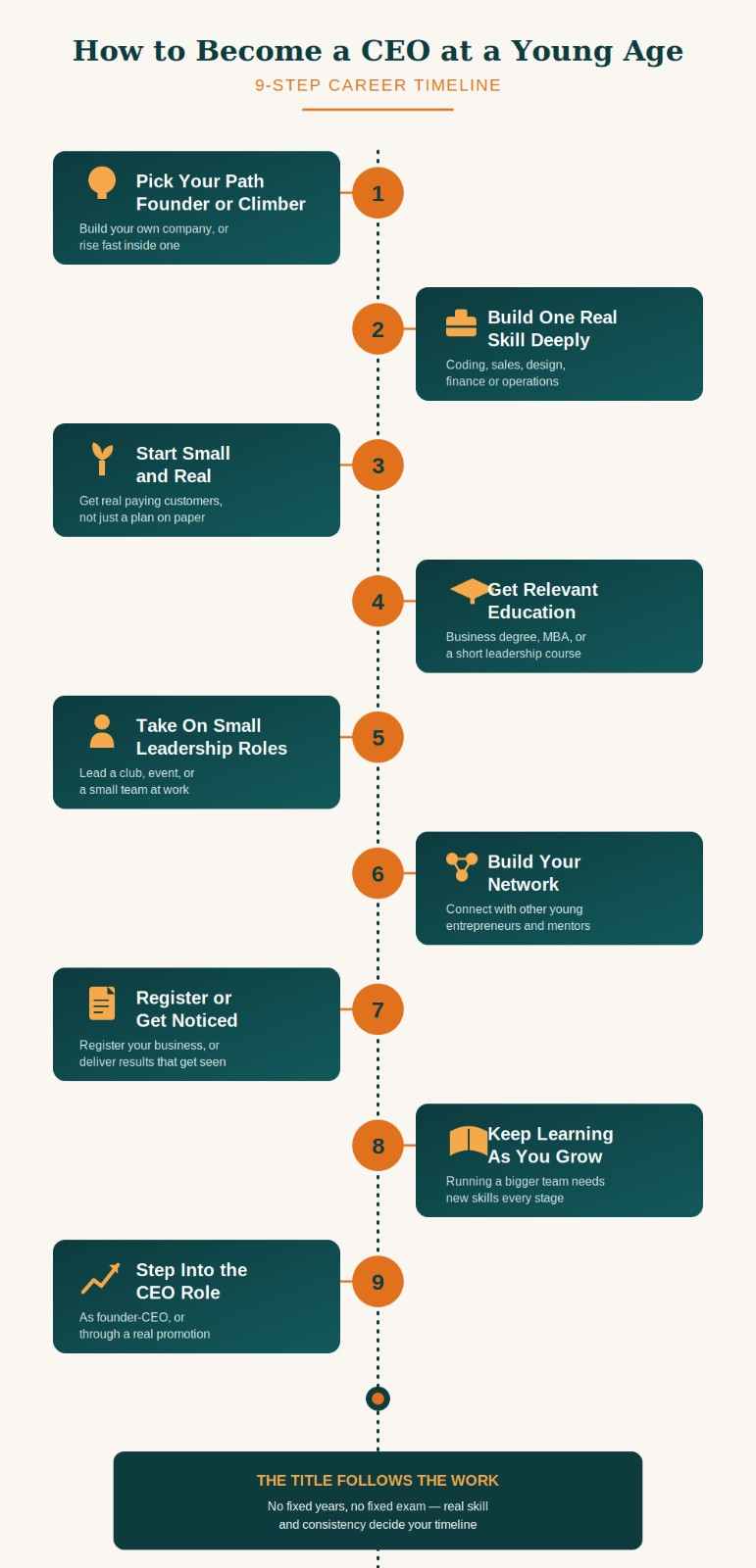
Notice something here — none of these steps mention age at all. That's genuinely the point. The steps are the same whether you're 16 or 26; only the starting point and speed change.
Can I Become a CEO After 10th or 12th?
Yes, you can technically become a CEO right after 10th or 12th by starting a small business, though most people build real business skills through a degree first. This is one of the most searched questions, so let me be very direct.
Here's the honest difference between the two:
- After 10th: You're usually too young to sign legal business documents alone, so any venture needs a parent or guardian involved. This stage is best used to build skills — coding, writing, design, basic finance — not to chase the CEO title itself.
- After 12th: You can legally start registering a business in most cases (usually 18+), and this is genuinely when serious young founders begin. You can also pursue a business-related degree if you want the "climber" path instead of the founder path.
I've noticed a pattern here — the students who search "CEO after 10th" are usually excited but not ready with an actual idea yet, and that's completely normal. My honest advice: use 10th and 12th to get good at one real skill, then decide your path once you have something solid to build on.
How to Become a CEO at 18
Becoming a CEO at 18 is realistic mainly through the founder path — start a registered company right after turning 18, ideally in a field where you already have a skill or head start. This is actually one of the more achievable young-CEO ages, and I'll explain why.
At 18, you can legally sign documents, open a business bank account, and register a company in your own name in most countries. A mistake I see a lot of beginners make at this age is trying to build a huge, complicated business idea instead of a small, focused one that actually works. Start with a narrow problem you can solve for a small group of paying customers, then grow the business slowly as you learn what actually works.
Ritesh Agarwal from India is a strong real example here — he started building his business idea around age 17-18 and became a well-known startup CEO by his early twenties (source: Ameet Parekh). What this actually means for you: it's rare, but the timeline of "start at 18, real traction by early twenties" is genuinely achievable if you pick a focused idea and stay consistent.
Can You Become a CEO at 13 or 15?
You can run a small business or online venture at 13 or 15, but you generally can't legally register a company or hold the formal CEO title until you're an adult in most countries. I want to be completely honest here instead of feeding you an inspirational half-truth.
Most "CEO at 13" or "CEO at 15" stories you find online fall into one of these categories:
- A school or hobby business run informally with a parent's help, like selling handmade products or running a small online shop.
- A media label, where journalists or the child's own family call them "CEO" for a passion project, even without a legally registered company.
- A genuine registered company where a parent or guardian is legally listed alongside the child as required by law.
Harli Jordean, called the "world's youngest CEO" at age 8 for his marble-selling website, is a good example of this last category — his mother helped set up and run the actual business side while he led the product and passion behind it (source: World Record Academy). So if you're 13 or 15 and dreaming of this, my honest suggestion is: build the skill and the small venture now, and treat the official "CEO" title as something that comes later once you're old enough to register it properly.
How to Become a CEO at 20 or 25
Becoming a CEO at 20 or 25 is genuinely more common than at 13-18, because by this age you likely have some real work experience, a completed degree, or at least 2-3 years of running your own venture. This is where a lot of the well-known young CEO stories actually cluster.
Here's what tends to separate people who reach CEO by 20-25 from those who don't, in my experience:
- They started building skills or a small venture years earlier, so by 20-25 they already have traction, not a fresh idea.
- They picked a fast-moving industry like technology, e-commerce, or social apps, where companies can scale quickly with a small, young team.
- They took a real financial or career risk — leaving a stable job, or delaying further studies, to focus fully on the business.
Evan Spiegel co-founded Snap Inc. and became CEO at 25, which is a widely known example in this age bracket (source: The Middle). What this means for you practically: 20-25 is a very realistic target if you start building real skills and a real project from your late teens, rather than waiting until you've "figured everything out."
How to Become a CEO at a Young Age Online
You can build the foundation for becoming a young CEO entirely online, through online businesses, remote skill-building, and digital-first companies, without ever needing a physical office. This is genuinely one of the biggest shifts from even 10 years ago.
Some realistic online-first paths:
- E-commerce or dropshipping stores, where you can start with very little capital and manage everything from a laptop.
- Content or app-based businesses, like YouTube channels, online courses, or small mobile apps that generate revenue.
- Freelance-to-founder transition, where you first build client work experience, then convert that into your own agency or product business.
- Online business and leadership courses, which can genuinely speed up your learning on strategy, finance, and management basics without a full-time degree.
I've noticed something interesting here — a lot of the students who ask about becoming a CEO "online" actually just want to avoid the traditional college-to-corporate-job route entirely, and that's a completely valid goal. Just remember: an online business still needs real customers and real revenue to call yourself a genuine CEO, not just a website with no sales.
How to Become a CEO as a Woman
Women can become CEOs through the exact same two paths — founding a company or climbing inside one — though the honest reality is that networks and funding access can be harder to build, which makes deliberate effort even more important. I want to answer this directly instead of giving a vague, feel-good non-answer.
A few things that genuinely help based on real examples I've studied:
- Seek out women-focused founder networks and mentorship programs, since these directly address the network gap that often works against women in business.
- Don't wait for "permission" to start small. Mikaila Ulmer founded her lemonade business, Me & the Bees, at just 11 years old and grew it into a real, retail-stocked brand over the following years (source: CEO Today Magazine).
- Target industries where you already have an edge or interest, rather than only chasing industries seen as "typical" for young founders.
- Build a track record of results early, since results tend to speak louder than credentials when convincing investors or a board to trust you with leadership.
Falguni Nayar founded Nykaa after leaving a long corporate career and built it into one of India's most recognized listed companies, which shows this path isn't only for very young founders either — starting later with strong experience works too. It genuinely depends on your starting point — a woman starting very young will lean more on skill-building and small wins, while a woman starting after some corporate experience can lean more on her existing network and credibility.
Common Mistakes Young CEOs Make
Let me save you some real pain here, because these three mistakes show up again and again in young founder stories.
- Calling yourself "CEO" before there's a real business. A mistake I see a lot of beginners make is putting the title on their Instagram bio with zero customers or revenue behind it — this actually hurts your credibility later.
- Trying to do everything alone for too long. Even the youngest successful CEOs eventually bring in mentors, co-founders, or advisors — trying to be a solo genius usually slows growth down.
- Chasing funding before proving the idea works. Many young founders spend more energy pitching investors than actually talking to customers, which usually backfires.
What Is CEO Salary Per Month?
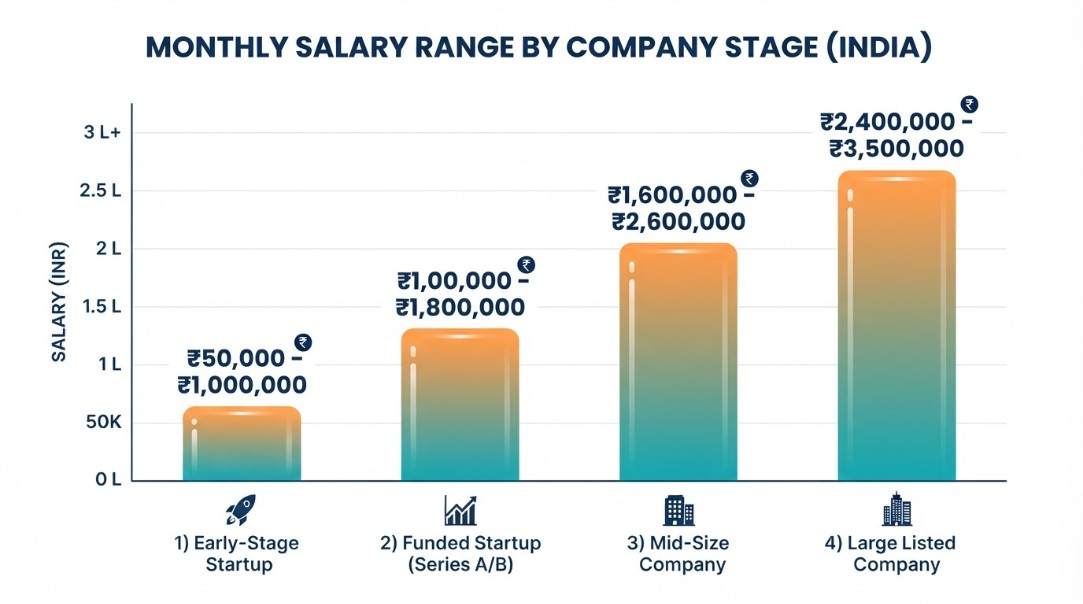
A CEO's salary per month in India can range from as low as ₹40,000-₹80,000 for a very early-stage startup founder to several crores per month for CEOs of large listed companies. This is one of the widest salary ranges of any job title, and the number depends almost entirely on company size and stage.
Here's how it actually breaks down so you can set realistic expectations:
| CEO Stage | Approximate Monthly Salary (India, 2026) |
|---|---|
| Early-stage startup founder (pre-funding) | Often under ₹1,00,000, sometimes ₹0 while bootstrapping |
| Funded startup CEO (Series A/B) | ₹1,00,000 – ₹3,00,000 |
| Mid-size company CEO | ₹3,00,000 – ₹12,00,000 |
| Large listed company CEO | ₹15,00,000 – ₹2,00,00,000+ |
What this actually means for you: most young founders you read about are not making huge salaries at all in their first few years — a lot of their real wealth, if it comes, is tied up in the value of the company itself (called equity), not their monthly paycheck (source: AP Startup). One founder running a funded agritech startup in Jaipur reportedly drew a salary of just ₹40,000 a month even after his company had raised ₹12 crore — because in early-stage companies, cash gets reinvested into the business, not paid out to the founder.
What Is the Youngest CEO Ever?
The title of "world's youngest CEO ever" is genuinely contested, since it depends on whether you count informal ventures or only legally registered companies. Different sources give different answers depending on this exact distinction, so let me walk you through the honest picture.
Harli Jordean from London was widely reported as the world's youngest CEO at age 8, after building a marble-selling website with his mother's help around age 6 (source: World Record Academy). On the more formal, legally-registered-company side, Suhas Gopinath from India is a widely cited example — he founded Globals Inc., a web development and IT solutions company, at age 17, and continued running it into his late thirties (source: CEO Today Magazine).
I share both examples deliberately, because they show the two different meanings of "youngest CEO ever" that most articles blur together. If you're chasing a Guinness-style record, that's about a specific, verifiable claim tied to one company. If you're chasing genuine business success at a young age, Suhas Gopinath's kind of story — a real company, real revenue, sustained over years — matters far more than the record itself.
What Is the Youngest Age to Be a CEO?
There's no single legal "youngest age" to be a CEO — it depends entirely on your country's business registration laws, which usually set the minimum age at 18, with informal or parent-assisted ventures possible earlier. This is different from the judiciary or medical fields, where a fixed minimum age is set by law.
Here's the realistic breakdown by age group, based on everything covered in this guide:
- Under 13: Only informal, parent-run ventures where a child leads the product or passion side.
- 13-17: Small businesses or online ventures, usually still requiring a parent or guardian for legal and financial matters.
- 18-19: The earliest realistic age for a fully self-registered, legally independent company in most countries.
- 20-25: The age range where most well-known "young CEO" success stories actually solidify into real, sustainable businesses.
So if someone asks you the "youngest age to be a CEO," the honest answer is: 18 is the earliest fully independent age in most places, but the groundwork for it usually starts years earlier.
My Honest Opinion: Should You Chase This at a Young Age?
I'll be straight with you: chasing the CEO title itself at a young age is the wrong goal — chasing a real skill or a real problem worth solving is the right one, and the title follows naturally if you succeed. If your main motivation is the label "CEO" for your bio or resume, that motivation usually runs out before the business does.
But if you genuinely enjoy building things, solving problems, and taking responsibility earlier than your peers, I think starting young gives you a real compounding advantage — more years of learning from mistakes while the stakes are still relatively low. Where it gets tricky is the financial pressure, especially if you're supporting yourself; a lot of young founders underestimate how long it takes before a business pays a real, livable salary.
It genuinely depends on your risk tolerance and support system — someone with family financial support can experiment longer than someone who needs steady income immediately, and that's a completely fair thing to factor into your decision.
What to Do Next
If you're still in school, don't wait for the "perfect business idea" — spend the next year genuinely mastering one real skill, whether that's coding, sales, writing, or design. If you already have a small venture running, focus on getting real paying customers before worrying about titles, funding, or big growth plans.
Whatever stage you're at, the path stays the same: build a real skill, build something small and real, then grow it with patience.
Frequently Asked Questions
What is a CEO's salary per month in India?+
It ranges widely — from under ₹1 lakh a month for early-stage startup founders to several crores a month for CEOs of large listed companies. Most young founders earn modest salaries early on and rely on the company's long-term value instead.
What is the youngest CEO ever recorded?+
Harli Jordean from the UK was widely reported as the world's youngest CEO at age 8, for a marble-selling website he ran with his mother's help. On the fully independent business side, Suhas Gopinath from India founded a registered IT company at age 17.
Can I become a CEO right after 12th?+
Yes, you can legally register your own company after turning 18, which most students reach around or shortly after 12th. Before that, you can build skills and a small venture, but you'll usually need a parent or guardian involved legally.
What is the youngest age to become a CEO?+
Most countries set 18 as the minimum age to independently register and legally run a company. Younger "CEOs" you see in the news are usually running informal or parent-assisted ventures.
Is the path to becoming a CEO different for women?+
The core steps are the same, but access to funding and founder networks can be harder for women, based on real founder experiences. Deliberately seeking mentorship and women-focused founder communities can help close that gap.
Can I become a CEO without a college degree?+
Yes, especially through the founder path — many successful young CEOs skipped or paused formal education to focus on their business. A degree isn't mandatory, but business knowledge from courses, mentors, or hands-on experience still matters a lot.
How long does it usually take to become a CEO?+
For founders, it can happen almost immediately after registering a company, though building a real, sustainable business usually takes several years. For those climbing inside an existing company, it typically takes at least 10-15 years of strong performance.