How to Become a Data Analyst After 12th (2026 Guide)
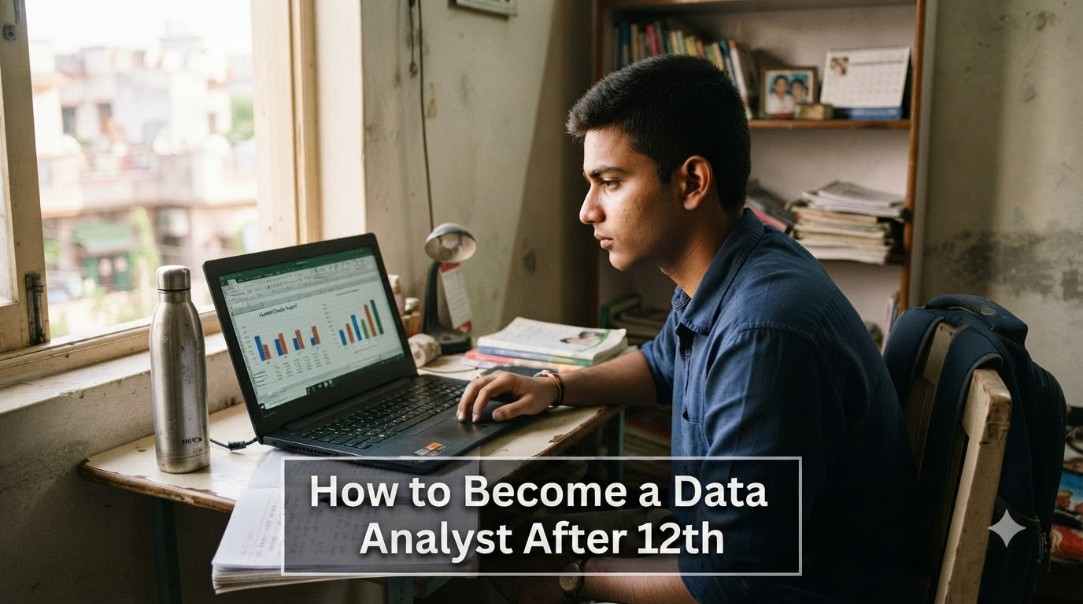
Yes, you can become a data analyst after 12th from any stream. Here's the exact roadmap, skills, courses, and real salary numbers for 2026.
Key Takeaways
- Can I become a data analyst after 12th? Yes. Any stream works — science, commerce, or arts — as long as you're okay with basic maths and logical thinking.
- Do I need a degree? Not always, but a BSc, BCA, or BTech in a related field makes hiring much easier. A 12th-pass student can enter through certifications, but it's a harder, slower road.
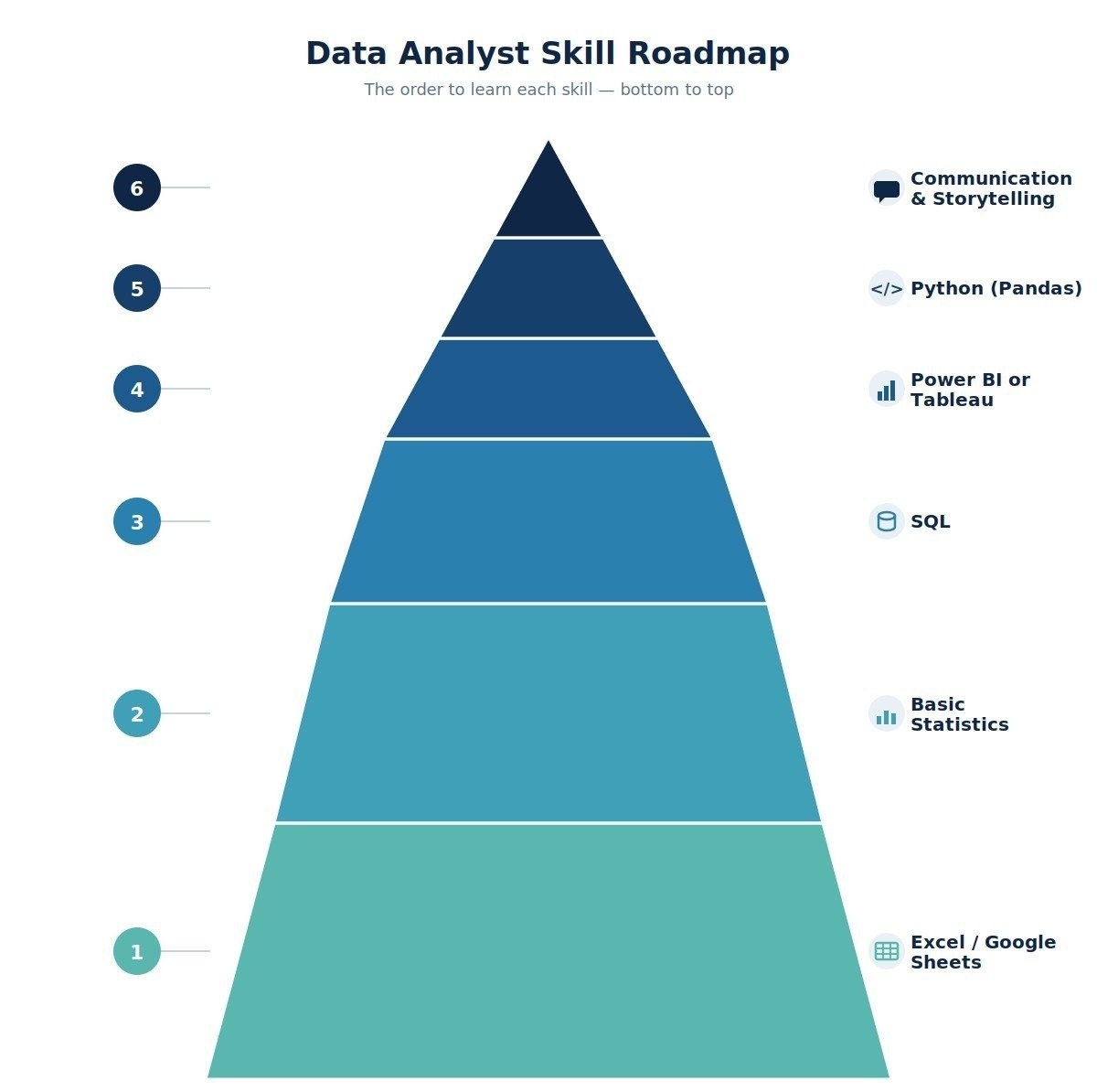
- What should I learn first? Excel, then SQL, then a BI tool like Power BI or Tableau, then Python. In that order, not all at once.
- How much does a data analyst earn in India? Freshers earn around ₹3.5–6 LPA, and this can cross ₹10 LPA within 4–5 years with the right skills (Source: GUVI, 2026).
- How long does it take? With focused effort, you can be job-ready in 12–18 months — faster if you skip a full degree and go straight for certifications plus projects.
Can You Become a Data Analyst After 12th?
Yes, you can start working toward becoming a data analyst right after your 12th board results — no engineering degree needed, no fixed stream required.
I recall a message from my neighbor's son two years back, who had just cleared his 12th commerce exams, was scared of coding, and asked: "Bhaiya, can a commerce student even become a data analyst?"
I told him the truth — yes, he could — and today that student is working as a junior data analyst at an insurance firm in Pune, two years later.
That's the thing about this career. It doesn't care which subjects you took in school. It cares whether you can look at a pile of numbers and pull out something useful from it — and that skill can be built from zero, at any age, from any background.
A data analyst is someone who collects data, cleans it up, finds patterns in it, and turns those patterns into simple reports that help a company make decisions. Think of it like this: if a company's sales dropped in December, a data analyst is the person who digs through the numbers and tells the boss why.
So what's the fastest path? Pick a stream you're comfortable with → learn Excel and SQL first → add a BI tool like Power BI → pursue a relevant degree or certification alongside → build 3–4 real projects → apply for internships. Each of these steps is broken down in detail below.
Which Stream Is Best for Data Analyst After 12th?
Science with Maths (PCM) gives you the smoothest start, but commerce and arts students do just as well once they put in the extra effort with numbers.
Here's the honest breakdown, stream by stream:
| Stream | How Easy Is the Start? | What You'll Need to Add |
|---|---|---|
| Science (PCM) | Easiest | Nothing extra — your maths base is already strong |
| Science (PCB/Biology) | Moderate | A refresher in basic maths and statistics |
| Commerce (with Maths) | Easy | SQL logic and business analytics basics |
| Commerce (without Maths) | Moderate | Statistics fundamentals, since some colleges ask for 12th Maths |
| Arts / Humanities | Harder, but doable | Basic maths, statistics, and extra self-study time |
I have trained students from all five of these backgrounds, and my honest opinion is: your stream decides how fast you start, not whether you can succeed. A commerce student who's serious about learning SQL for six months will beat a science student who's lazy about it, every single time.
Step-by-Step Roadmap to Become a Data Analyst After 12th
Here's the exact sequence the author gives every student who messages him right after their board results. Follow it in order — don't jump around.
- Finish 12th with any stream, focus on basic maths. You don't need to top your class in maths, but you do need to be comfortable with percentages, averages, and simple graphs.
- Pick your path: degree or certification-first. A BSc/BCA/BTech gives you a stronger resume; a certification path gets you job-ready faster but needs more hustle to prove yourself.
- Learn Excel properly — not just the basics. Pivot tables, VLOOKUP, XLOOKUP, and conditional formatting are non-negotiable; almost every entry-level job posting still asks for this (Source: Kaashiv Infotech, 2026).
- Move to SQL once Excel feels comfortable. SQL is how you pull data out of a company's database, and it shows up in roughly 80% of data analyst job postings (Source: PowerBI Studio, 2026).
- Learn one visualization tool — Power BI or Tableau. This is where you turn boring spreadsheets into dashboards that a manager can actually understand in ten seconds.
- Add Python only after Excel and SQL feel solid. Python (with Pandas library) helps automate tasks that would take hours in Excel — but it's the fourth tool you learn, not the first.
- Build 3–5 real projects and put them on GitHub or LinkedIn. A recruiter trusts a project you built over a certificate you just downloaded, every time.
- Apply for internships before you apply for full-time jobs. Even an unpaid or low-paid 2-month internship gives you the one thing certificates can't: real company data to work with.
- Polish your resume around outcomes, not tools. Don't write "I know Excel" — write "I built a sales dashboard that helped identify a 12% dip in one region."
Step 7 is the one students skip most, and it's the one that actually gets you hired. A finished project you can talk about in an interview beats five half-done online courses sitting in your certificate folder.
Skills You Actually Need (And in What Order)
A lot of blogs will throw ten tools at you at once and call it a roadmap. That's not how the author would teach his own younger sibling, so here's the real order, with why each one matters.
1. Excel or Google Sheets
This is where every data analyst starts, no exceptions. You'll use formulas like SUM, AVERAGE, COUNTIF, and IF, and you'll build pivot tables to summarize huge amounts of data in seconds.
Excel isn't "basic" or "beginner stuff" that you outgrow. Even senior analysts open Excel daily because it's still the fastest way to check a quick number before building something fancier.
2. Basic Statistics
You need to understand mean, median, percentage change, and correlation — not calculus, not complicated formulas. If you can explain "our sales grew 15% this quarter compared to last quarter," you already understand the statistics that matter for this job.
3. SQL (Structured Query Language)
SQL is the language you use to "ask questions" to a company's database — things like "show me all customers who bought something in the last 30 days." This single skill appears in the vast majority of data analyst job postings, which makes it the highest-priority skill after Excel (Source: PowerBI Studio, 2026).
4. Power BI or Tableau
Once you can pull the right data, you need to show it clearly. These tools turn raw numbers into charts and interactive dashboards that a non-technical manager can actually understand at a glance.
5. Python (with Pandas)
Python comes in fourth, and only once you're comfortable with the first three. It's mainly used to automate repetitive data-cleaning work and handle datasets too large for Excel to manage smoothly.
6. Communication and Storytelling
This one surprises most students, but it might be the most underrated skill on this list. A dashboard nobody understands is useless — your job is to explain "why" in plain language, not just show a chart.
Degree Courses to Pursue After 12th
If you want a stronger, more "official" path into this field, here's what a proper degree route looks like.
| Course | Duration | Best For |
|---|---|---|
| BSc in Data Science / Statistics | 3 years | Students who enjoy numbers and structured learning |
| BCA with Data Science specialization | 3 years | Students who like coding plus analytics together |
| BTech in Computer Science / Data Science / IT | 4 years | Students aiming for higher-paying, tech-heavy roles later |
| BA in Economics or Mathematics | 3 years | Arts/commerce students who want an analytical degree without heavy coding |
| BCom with Data Analytics electives | 3 years | Commerce students who want to stay close to business + finance |
Most colleges ask for a minimum of 50–60% in 12th (Source: Jain University career guide, 2026), and some BTech seats need entrance exams like JEE or a university-specific test. If you're from commerce or arts and worried about eligibility, plenty of BCA and BSc Statistics programs accept any stream, as long as you've studied Maths at some point in your schooling.
Short-Term Certifications (If You Don't Want a Full Degree)
Not every student wants to spend three or four years in college before starting work. If that's you, here's the fast-track option.
| Certification | Time Required | What It Covers |
|---|---|---|
| Google Data Analytics Certificate | 3–6 months | Full beginner-to-job-ready path, including SQL and Tableau |
| Microsoft Power BI Data Analyst (PL-300) | 2–4 months | Deep dive into Power BI dashboards and DAX |
| IBM Data Analyst Professional Certificate | 3–6 months | Excel, SQL, and Python basics with hands-on projects |
| SQL-focused short course | 1–3 months | Fast entry point if you want to test the waters first |
A word of caution from experience: a certificate alone won't get you hired. The author has seen students collect five certificates and still get rejected in interviews because they couldn't explain a single real project.
Pair every certification with at least one project built on real (or realistic) data — that combination is what actually gets you shortlisted.
Data Analyst Salary After 12th in India (2026)
A fresher data analyst in India earns roughly ₹3.5–6 LPA in 2026, and this typically grows to ₹8–14 LPA by the 3–5 year mark with the right skills (Source: GrowAI, 2026; GUVI, 2026).
| Experience Level | Annual Salary (LPA) | Monthly Take-Home (approx.) |
|---|---|---|
| Fresher (0–1 year) | ₹3.5 – 6 LPA | ₹24,000 – 42,000 |
| Junior (1–3 years) | ₹5 – 8 LPA | ₹35,000 – 56,000 |
| Mid-level (3–5 years) | ₹8 – 14 LPA | ₹56,000 – 95,000 |
| Senior (5–8 years) | ₹14 – 22 LPA | ₹95,000 – 1.45 lakh |
| Lead / Manager (8+ years) | ₹22 – 35 LPA | ₹1.45 – 2.2 lakh |
(Source: AppWars Technologies salary report, 2026)
Does city matter?
It does, and more than most freshers expect. Bangalore and Hyderabad tend to pay 15–20% above the national average, while smaller cities usually sit below it.
| City | Fresher Salary Range |
|---|---|
| Bangalore | ₹4 – 7 LPA |
| Hyderabad | ₹4 – 6.5 LPA |
| Mumbai | ₹4 – 7 LPA |
| Delhi NCR | ₹4 – 7 LPA |
| Pune | ₹3.5 – 5.5 LPA |
| Chennai | ₹4 – 6 LPA |
Your first salary depends far less on your degree's brand name than on whether you can show real Excel, SQL, and Power BI skills in an interview. The author has personally seen tier-2 college graduates out-earn tier-1 grads within two years, purely because they built stronger portfolios early.
How to Become a Data Analyst After 12th Commerce
Commerce students actually have a natural edge here, because you already understand business numbers like profit, margin, and growth percentages.
If you're from commerce, here's your specific path:
- With Maths: Go for BCA, BSc Statistics, or BCom with Data Analytics electives — your maths background makes SQL logic much easier to pick up.
- Without Maths: You can still enter through BCA (many colleges accept commerce-without-maths students) or a certification-first path, but plan for extra time on statistics fundamentals.
- Your natural advantage: Business analytics and finance-related data roles (like FP&A analyst or business analyst) often prefer candidates who already understand commerce concepts like revenue, ROI, and balance sheets.
If you're commerce-without-maths, don't let that scare you off. Spend two focused months on basic statistics before touching SQL, and you'll close that gap faster than you think.
How to Become a Data Analyst After 12th Arts
Yes, arts students can become data analysts too — it just needs a bit more self-discipline in the maths and statistics department early on.
Here's what the author would tell an arts student walking into this field:
- Start with a short online statistics refresher before touching SQL or Excel formulas — this closes most of the early gap.
- Pick BCA or a data-focused BA (Economics/Statistics) if you want a degree route; both accept most arts students with 10+2 from a recognized board.
- Lean into your strength: arts students are often better storytellers, and storytelling is exactly what turns a boring chart into a report a manager actually reads.
A student of the author's from a pure arts background (Political Science major) landed her first data analyst internship 14 months after 12th — not because she was a maths genius, but because she wrote the clearest, simplest dashboard explanations he'd seen from any batch that year.
How to Become a Data Analyst After 12th PCB / Biology
PCB (Physics, Chemistry, Biology) and pure biology students can absolutely become data analysts, especially if healthcare or pharma data interests you.
A few things worth knowing if this is your background:
- Your science foundation actually helps — you're used to structured, evidence-based thinking, which transfers well into analytics.
- Healthcare analytics, clinical data analysis, and pharma reporting are growing fields where a biology background is genuinely an advantage, not a weakness.
- You'll need to build maths and stats skills from a slightly earlier point than a PCM student, so budget an extra month or two for that foundation.
If you were originally aiming for medical college and didn't get through, or simply changed your mind, this is one of the smoothest "Plan B" careers for a PCB background — and healthcare data roles specifically value people who already understand medical terminology.
Real Story: A 15-Month Journey From Zero to Offer Letter
This story is walked through in full, since it explains this career path better than any list of steps.
A student named Aditya came to the author right after 12th (commerce, no maths in his final two years). He was scared he'd "wasted" his chance at anything data-related by dropping maths early.
They started slow — two months of just statistics basics and Excel, nothing else. By month four, he was comfortable enough in SQL to write basic queries without help, and by month seven, he'd built his first Power BI dashboard using a public retail dataset he found online.
The turning point came at month ten, when he landed a two-month unpaid internship at a small e-commerce startup, purely by messaging their founder on LinkedIn with his dashboard attached. Fifteen months after his 12th results, he had a full-time offer as a junior data analyst at ₹4.2 LPA — not a huge number, but a real start, and a number that's already grown since.
Common Mistakes 12th Pass Students Make
Here are the mistakes the author sees over and over after watching enough students go through this journey.
- Learning tools in the wrong order. Jumping straight to Python before Excel and SQL feel solid usually backfires and burns motivation fast.
- Collecting certificates instead of building projects. A stack of certificates with zero real projects behind them rarely convinces an interviewer.
- Waiting to "finish learning" before applying anywhere. You will never feel 100% ready — apply for internships once you know Excel, SQL, and one BI tool reasonably well.
- Copying tutorial projects word-for-word. Recruiters can tell instantly when a "project" is just a copied YouTube tutorial with zero original thinking added.
- Ignoring communication skills. A brilliant dashboard that nobody can understand in a meeting isn't actually doing its job.
Pros and Cons of Becoming a Data Analyst After 12th
Here's an honest, balanced take, based on watching hundreds of students go through this path.
Pros:
- Any stream welcome: science, commerce, and arts students all have a real shot at this career.
- Strong demand: India's data analytics job market is growing fast, with reports pointing to over 11 million data-related job openings expected by 2026 and a persistent talent shortage (Source: SPARC Academy, 2026).
- Decent starting pay: ₹3.5–6 LPA as a fresher is genuinely solid for a role you can enter without an engineering degree.
- Remote-friendly: many data analyst roles, especially at startups, offer partial or full remote work.
Cons:
- You do need consistent self-study, especially if you skip a formal degree — this path rewards discipline more than talent.
- Entry-level competition is real, since so many students are entering the field at once right now.
- The tools keep evolving, so you can't just learn once and stop — expect to keep upskilling every couple of years.
It depends on how you like to work. If you enjoy sitting with numbers and finding patterns, this career will feel rewarding fast; if you find spreadsheets boring even in small doses, it's worth trying a short free course first before committing years to it.
Frequently Asked Questions
How to become a data scientist after 12th — is it different from a data analyst?+
Yes, they're related but not the same. A data scientist builds predictive models and usually needs deeper maths, statistics, and machine learning knowledge, while a data analyst focuses more on reporting and explaining existing data — most students find the data analyst path faster to enter after 12th.
Which stream is best for data analyst after 12th?+
Science (PCM) gives the smoothest start because of the maths foundation, but commerce and arts students succeed just as often with a bit of extra statistics self-study early on.
What is the data analyst course fee after 12th?+
Full degree programs like BSc or BCA typically cost anywhere from ₹50,000 to ₹3 lakh per year depending on the college, while short certifications range from free to around ₹15,000–₹40,000 total.
Can I become a data analyst after 12th without maths?+
Yes, though you'll need to build basic statistics knowledge separately, since most data analyst work relies on percentages, averages, and simple probability rather than advanced maths.
How long does it take to become a data analyst after 12th?+
Most focused students become job-ready in 12–18 months if they follow a clear roadmap and build real projects alongside their learning, rather than studying tools in isolation.
Is data analytics a good career choice after 12th in India?+
Yes — with over 11 million projected data-related job openings and a persistent talent shortage in India, demand is expected to stay strong well beyond 2026 (Source: Analytics Insight, 2026).
Data analyst salary after 12th — what can I realistically expect as a fresher?+
Most freshers in India start around ₹3.5–6 LPA, with city, company type, and skillset (especially SQL and Power BI) making the biggest difference to that starting number.
My Final Take (And What I'd Do If I Were You)
If you're a 12th-pass student reading this, here's what the author would actually tell you to do this week: pick Excel as your starting point, spend 30 days getting genuinely comfortable with it, and only then move to SQL.
Don't wait for the "perfect" degree decision before you start — most of the real skill-building happens outside a classroom anyway, through projects and practice. Your stream matters far less than your consistency over the next 12 months.
Pick one small project this week — even something as simple as analyzing your own monthly expenses in Excel — and just start. That first messy spreadsheet is how every data analyst the author knows, including himself, actually began.
About the Author
Kush Verma is a Engineer, Teacher & Principal Editor, and Researcher at UKTU, with a background in Computer Science Engineering and full-stack development. He writes about software engineering, educational frameworks for readers seeking practical, fact-checked guides, drawing on a strict four-stage editorial process of primary research, technical validation, editorial refinement, and continuous auditing.