What After MA? Your Full Roadmap to Jobs, Skills & Salary

What after MA? Here's the real answer — jobs, exams, PhD, skill courses, and salary numbers, explained simply, path by path.
What Does "What After MA" Actually Mean?
I'll be honest with you. When I finished my MA, I typed the same thing into Google that probably brought you here — "what after MA" — at 1 AM, half-panicking.
Quick basics first, in case you need them: MA stands for Master of Arts, a postgraduate degree in humanities and social science subjects like English, History, Economics, or Psychology.
There's no single answer to "what after MA." There are six real paths, and which one is right for you depends on your subject, your money situation, and how much time you can wait before you start earning.
Most guides stop at two vague lines here — "pursue further studies or get a job." I'm not doing that. This is the full roadmap, with real numbers.
MA Course Quick Facts (Before We Get to "What's Next")
Quick reference table before we go deep — useful if you're still finalising your MA itself.
| Detail | Info |
|---|---|
| Full Form | Master of Arts |
| Duration | 2 years (4 semesters) |
| Eligibility | Bachelor's degree, usually 50–60% aggregate (relaxation for reserved categories) |
| Common Entrance Exams | CUET PG, IPU CET, AP PGECET, university-specific tests |
| Approx. Fees | ₹12,000–₹20,000/year at government universities, up to ₹1–2 lakh/year at private ones |
| Popular Specializations | English, History, Economics, Political Science, Psychology, Sociology, Hindi |
This guide walks through all six, with real numbers, not vague motivational talk.
Key Takeaways
- You don't need another degree to start earning. Most MA graduates can get a job within 2–4 months if they pick up one practical skill alongside their degree.
- Government jobs don't need an MA — a bachelor's degree is enough for UPSC, so don't wait on your MA if that's your only plan.
- UGC NET is the real gatekeeper for teaching and research jobs, and you can attempt it while doing your MA final year.
- A PhD only makes sense if you actually want to teach or research — not as a way to "delay" the job hunt.
- Salary after MA ranges roughly from ₹2.5 LPA to ₹15 LPA, and the gap almost always comes down to skills, not the subject you studied.
Is MA Done After 12th?
No — an MA is not done right after 12th. You first need a bachelor's degree (BA, or sometimes any graduation degree, usually 3 years), and only after that can you join an MA program, which itself takes 2 years in most Indian universities.
So the full timeline looks like this: 12th → Bachelor's degree (3 years) → MA (2 years). Some universities now offer a 4-year integrated BA-MA, which shaves off a year — worth checking if you're still early in your journey.
Path 1: Get a Job Right Away
This is the fastest path, and honestly, it's the one most MA graduates end up choosing whether they planned it or not. Your MA subject opens certain doors and closes others, so let's go subject by subject.
MA English: You've got strong writing and comprehension skills, which map directly to content writing, editing, and corporate communications roles. People with an MA in English pick up solid communication, writing, and thinking skills, which opens doors in schools, media, and other sectors.
A closer breakdown, since "content writer" undersells what's actually available:
| Job Title | What You'd Actually Do | Rough Salary |
|---|---|---|
| Web Content Writer | Blog posts, website copy, SEO articles | ₹3–4.5 LPA |
| Editor / Assistant Editor | Reviewing and refining others' writing | ₹3.5–5 LPA |
| Academic Writer | Research papers, reports, SOPs | ₹2.5–5 LPA |
| Translator | Converting documents between languages | ₹4–6 LPA |
| School/College Teacher | Teaching, usually needs B.Ed or NET | ₹3.5–6 LPA |
MA Economics: This one has real analytical weight behind it. Graduates commonly move into data analyst, research analyst, or banking analyst roles, along with government positions like the Indian Economic Service and RBI Grade B. This is one of the more "employable" MA subjects on the market right now.
MA Political Science / Public Administration: Strong fit for policy research, journalism, and — obviously — civil services prep. Political Science graduates often move toward civil services, public policy work, or research analyst roles.
MA Sociology / Psychology: These open up HR, counselling, and NGO-sector roles. Psychology graduates commonly work as counsellors, HR professionals, or organisational psychologists.
MA History: Smaller job pool, but real options exist beyond teaching. Besides teaching, MA History graduates find roles as archivists, museum curators, heritage consultants, and historical content creators.
Quick table — subject to job title:
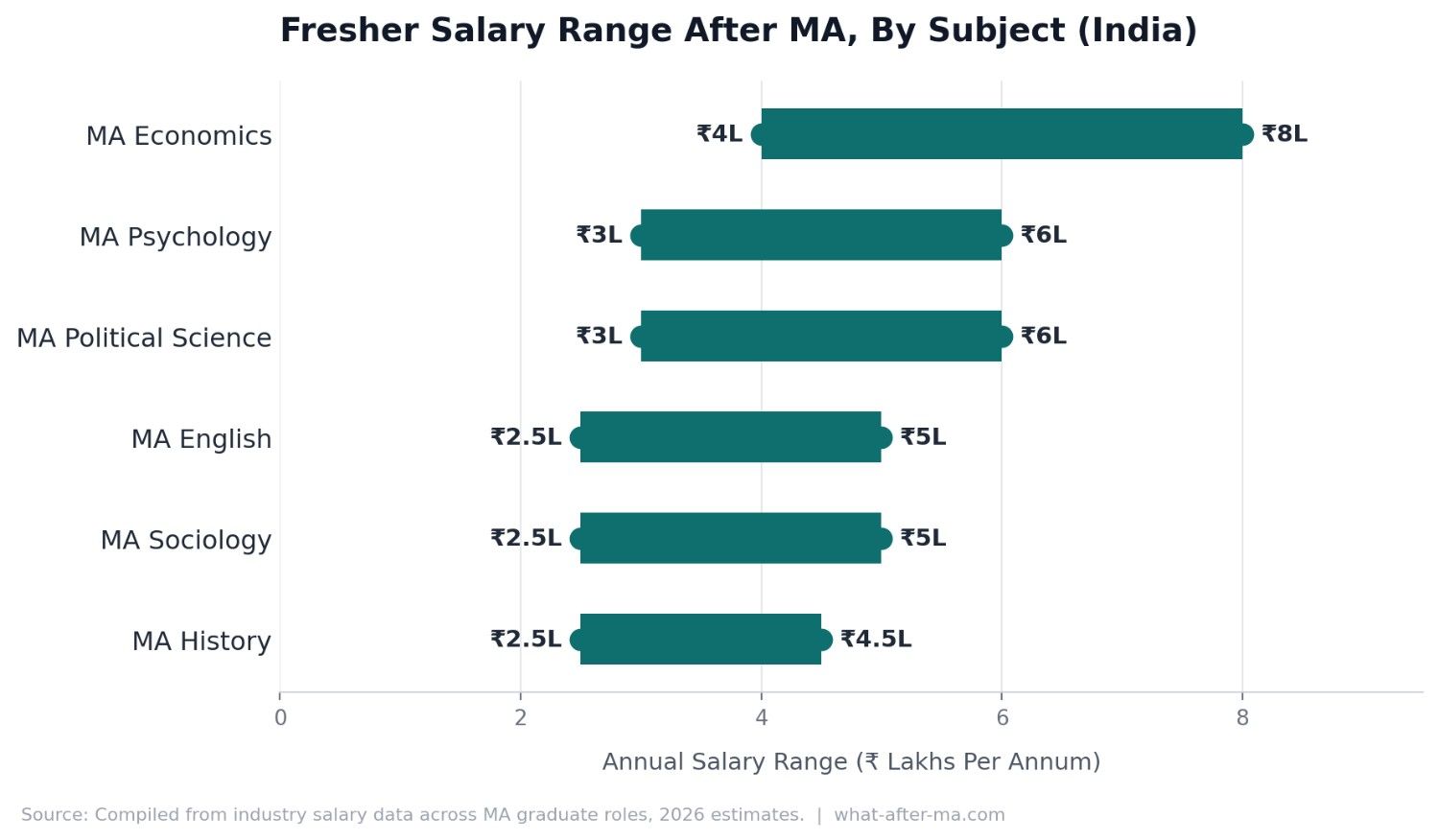
| MA Subject | Realistic First Job Title | Rough Fresher Salary |
|---|---|---|
| English | Content Writer / Editor | ₹2.5–5 LPA |
| Economics | Junior Data/Research Analyst | ₹4–8 LPA |
| Political Science | Research Associate / Policy Intern | ₹3–6 LPA |
| Psychology | HR Executive / Counsellor Trainee | ₹3–6 LPA |
| Sociology | NGO Program Coordinator | ₹2.5–5 LPA |
| History | Content Researcher / Archivist Trainee | ₹2.5–4.5 LPA |
Path 2: Government Exams (UPSC, SSC, State PSC)
Here's something a lot of MA students don't realise, and it genuinely surprised me when I first checked it. You don't need an MA to sit for UPSC Civil Services. The educational qualification required is a bachelor's degree from a recognised university, in any discipline — the UPSC does not prescribe a specific field of study.
So if UPSC is your only goal, your MA isn't a requirement — it's a bonus. It does help though, especially if your optional subject matches your MA (Political Science, History, Sociology, and Public Administration are common picks). BA-style subjects like Political Science, Sociology, and History map closely onto the UPSC syllabus, which is a real advantage when picking an optional.
Beyond UPSC, there's SSC CGL, State PSC exams, and banking exams (IBPS, RBI). These generally need a bachelor's degree too, not specifically an MA. An MA mainly helps here with subject depth for interviews and mains-level essay writing — not eligibility.
Here's the thing: don't sit around "waiting to finish MA" before you start UPSC prep. Start prelims-level reading in your MA's first year itself if this is your target.
Path 3: UGC NET / JRF — Become a Lecturer or Researcher
If teaching or research is genuinely your goal, this is the exam that actually matters — not a PhD by itself. You must have secured at least 55% marks in your Master's degree (50% for reserved categories) from a UGC-recognised university to sit for UGC NET.
And yes — you can attempt it before your MA result is even out. If you're in the final year of your Master's programme, you can appear for UGC NET by selecting "Appearing" as your qualification status, but you'll need to complete your degree with the required percentage within two years.
The exam itself isn't as scary as people make it sound. It's a 300-mark exam split across Paper I and Paper II, with no negative marking — so you can attempt every question without fear of losing marks for a wrong guess.
What NET actually gets you:
- JRF (Junior Research Fellowship): A fellowship paying roughly ₹37,000–₹42,000 per month while you pursue a PhD.
- Assistant Professor eligibility: Lets you apply for teaching posts, where starting salaries run from around ₹68,000 per month upward in many colleges.
- PhD-only qualification: A newer category exists purely to get you into a PhD program without needing JRF or teaching eligibility.
If you even slightly think you want to teach at college level someday, start NET prep alongside your MA. Don't wait till after graduation to "figure it out."
Path 4: PhD — Is It Actually Worth It?
A PhD is worth it only if you want to teach, research, or work in a field that specifically demands a doctorate — think academia, certain policy think-tanks, or research-heavy corporate roles.
If you're doing a PhD because you're scared of the job market or don't know what else to do, that's worth pushing back on. It's 3–6 years of low income (even with JRF's stipend), and it doesn't automatically translate into a high-paying job outside academia.
Ask yourself these before applying:
- Am I okay with 4-6 years on a JRF-level stipend, not a full salary?
- Do I actually enjoy research, or do I just enjoy the idea of being called "Doctor"?
- Is there a specific university or professor I want to work under, or am I applying anywhere?
- Have I checked how many assistant professor vacancies actually exist in my subject right now?
If you answered honestly and you're still in, go for it — a PhD combined with NET/JRF is genuinely one of the most stable long-term paths for people who love their subject.
Path 5: Skill Courses That Get You Hired Fast
This is the path recommended to most MA graduates who need to start earning soon and don't have a fixed government-job target. Popular add-on courses for MA graduates include UI/UX design, Digital Marketing, Web Development, Data Science, Video Editing, and Photography.
Here's why this works: your MA already gave you the "soft" skills — writing, research, presentation, critical thinking. A 3–6 month skill course adds the "hard" skill employers actually screen for on a resume.
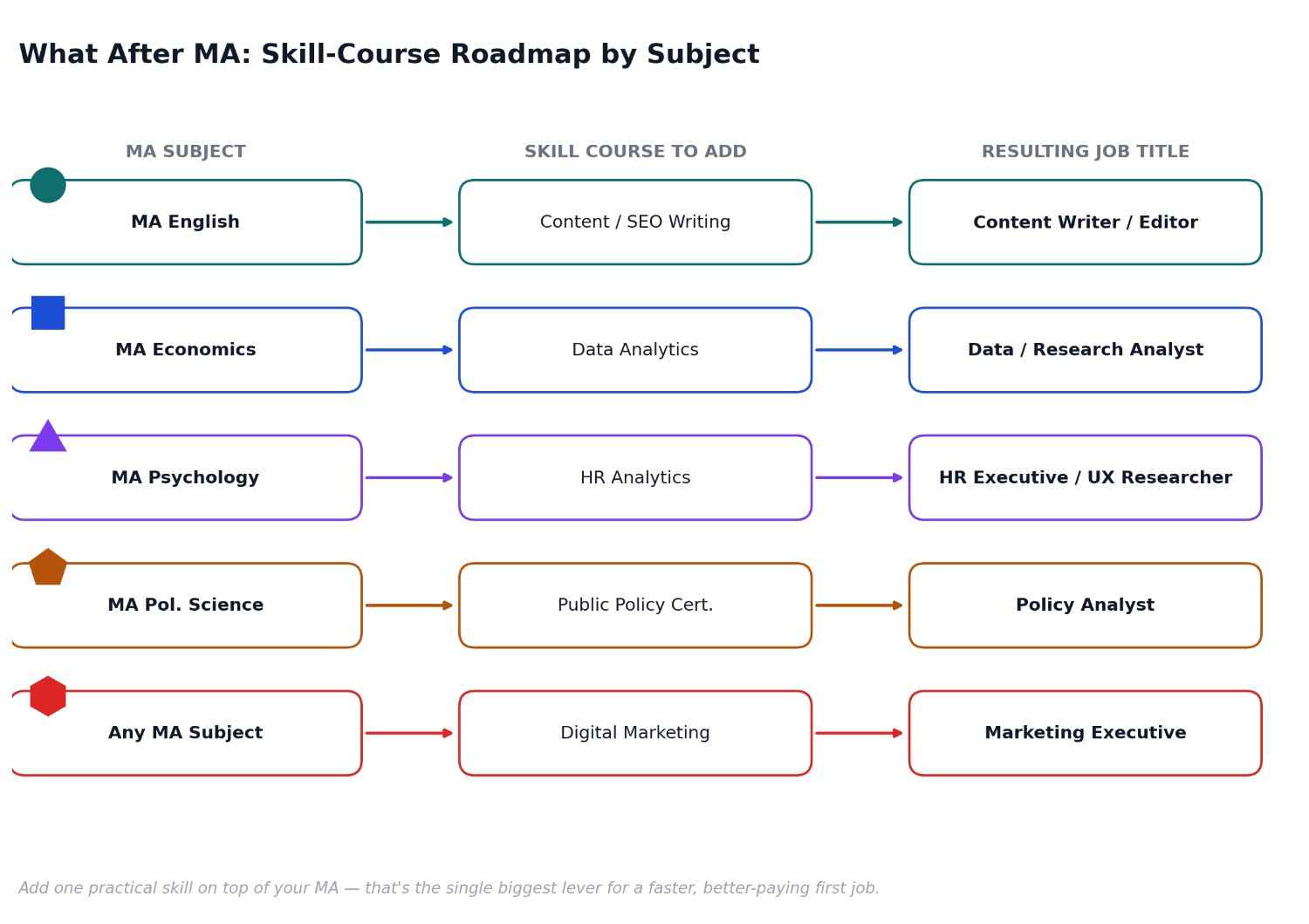
Which skill course fits which MA subject:
- MA English / Journalism → Content writing, SEO writing, copywriting
- MA Economics / Statistics → Data analytics, Excel + SQL, business analysis
- MA Psychology / Sociology → HR analytics, UX research, organisational development
- MA Political Science / History → Public policy certifications, GIS/archival digitisation tools
- Any MA subject → Digital marketing (genuinely subject-agnostic, and always in demand)
Path 6: MBA or a Second Master's Degree
Some MA graduates go for an MBA to pivot into management or business roles — this works especially well for MA Economics and MA Psychology graduates aiming for HR, marketing, or consulting. It's a real investment though, both in time (1–2 years) and fees (anywhere from ₹1 lakh to ₹25+ lakh depending on the institute).
A second MA — say, moving from MA Sociology to MA Social Work (MSW) — makes sense only if it's genuinely required for your target job, like clinical social work or certain NGO leadership roles. Otherwise, stacking degrees just to "feel more qualified" isn't recommended. Employers care about skills and portfolio far more than a second postgrad certificate.
Which MA Is Most in Demand?
Right now, MA Economics and MA Psychology are pulling ahead of most other MA subjects in terms of direct job demand, because both feed into fast-growing sectors — data/analytics for Economics, and HR/wellness/UX research for Psychology.
MA English still holds strong demand too, but mainly when paired with a content or digital skill, not on its own. MA Political Science and MA History have a smaller direct job market but stay solid choices if you're targeting government exams or academia specifically.
It depends on your end goal, honestly — "most in demand" for a corporate job looks completely different from "most in demand" for a government exam.
MA or MSc — Which Degree Is Better?
Neither is "better" in general — they're built for different outcomes, and mixing them up is a common confusion. MA (Master of Arts) covers humanities and social sciences — English, History, Economics, Psychology, Sociology, Political Science. MSc (Master of Science) covers science-based subjects — Physics, Chemistry, Statistics, Environmental Science, and increasingly, Psychology and Economics too at some universities.
If your subject is offered as both (Economics and Psychology often are), the MSc version usually leans more statistical and lab/data-heavy, while the MA version leans more theoretical and qualitative. Pick based on whether you enjoy numbers-heavy analysis (MSc) or reading, theory, and writing (MA) — not based on which sounds more "impressive."
Salary After MA in India (Real Numbers)
Let's talk money directly, since this is probably why you scrolled this far. Salary after MA in India roughly ranges from ₹2.5 LPA for entry-level roles to ₹15 LPA and beyond for specialised, experienced positions — and the subject matters less than you'd think.
| Role | Average Salary (India) |
|---|---|
| Data Analyst (MA Economics) | ₹5–10 LPA |
| Economist / Research Analyst | ₹4–15 LPA |
| Content Writer / Editor (MA English) | ₹2.5–6 LPA |
| HR Executive (MA Psychology) | ₹3–7 LPA |
| Assistant Professor (post-NET) | ₹68,000+ per month |
| JRF Stipend (during PhD) | ₹37,000–₹42,000 per month |
| Policy/Research Associate | ₹4–8 LPA |
| Digital Marketing Executive | ₹3–6 LPA |
These figures generally increase significantly with experience and additional skills — so treat this table as your starting point, not your ceiling. As of 2026, the single biggest salary lever isn't your MA subject at all — it's whether you've added one practical, in-demand skill on top of it.
My 90-Day Roadmap After MA
If I were sitting where you're sitting right now, here's exactly what I'd do, week by week.
- Week 1–2: Pick your primary path (job, exam, NET, or PhD) — don't chase all four at once.
- Week 3–6: If it's a job, start one skill course (digital marketing, content writing, or data analytics) alongside applications.
- Week 3–6 (alt): If it's an exam, lock in your syllabus and start a fixed daily study block — even 3 hours consistently beats 8 hours occasionally.
- Week 7–10: Build a small portfolio — 3–5 writing samples, a mini data project, or mock test scores, depending on your path.
- Week 11–12: Start applying or attempt your first mock exam, and treat rejections/low scores as data, not verdicts.
- Ongoing: Revisit your choice every 90 days — it's fine to switch paths once you've actually tried one seriously.
Mistakes I See MA Graduates Make
- Waiting for "the perfect plan" before starting anything. So many MA graduates spend 6 months "researching" instead of applying — apply first, refine later.
- Assuming an MA alone guarantees a good salary. It doesn't, and that's worth knowing clearly instead of assuming it.
- Preparing for UPSC and NET at the same time without a real plan. Both are demanding exams — pick a primary and a backup, don't split focus evenly across four things.
Frequently Asked Questions
Which degree is best, MA or MSc?+
Neither is universally "best" — MA suits people who prefer theory, reading, and writing, while MSc suits people who prefer numbers, labs, and statistical analysis. Pick based on the subject and your natural strength, not general reputation.
Is MA done after 12th?+
No, you need a bachelor's degree first, which takes about 3 years after 12th. MA itself follows after that and usually takes another 2 years.
What job can I get after MA History?+
Common options include content researcher, archivist, museum curator, heritage consultant, and teaching roles after B.Ed or NET. Government and policy research roles are also realistic with the right exam prep.
Do I need an MA for UPSC?+
No — a bachelor's degree in any subject is enough to sit for UPSC Civil Services. An MA can help with your optional subject and mains-level depth, but it isn't a requirement.
Can I do a job and PhD together after MA?+
It's possible but genuinely tough, since PhD research needs consistent time and university presence in most programs. Part-time PhD options exist in some universities if this is a real constraint for you.
How much does an MA course cost in India?+
Fees vary a lot — government universities can cost as little as ₹5,000–₹20,000 a year, while private universities can go up to ₹1–2 lakh a year. Always check the specific university's fee structure, since this range shifts often.
What is B.Ed, and do I need it after MA?+
B.Ed stands for Bachelor of Education, a professional teaching degree, and you'll need it if you want to teach at school level (not college). For college-level teaching, UGC NET matters more than B.Ed.
What is the full form of MA?+
MA stands for Master of Arts, a two-year postgraduate degree in humanities and social science subjects. It follows a bachelor's degree and is offered in subjects like English, History, Economics, Political Science, and Psychology.
What subjects are covered in MA English?+
MA English typically covers British and American literature, literary theory and criticism, Indian writing in English, and linguistics, spread across four semesters. Some universities also include electives like creative writing or translation studies, which can help if you're eyeing content or editorial roles.
Conclusion
So — what after MA, really? It's not one answer, it's a decision you make based on how much time you can wait and what kind of work you actually enjoy doing.
If you need income soon, go job-hunting with one added skill. If academia genuinely excites you, start NET prep today, not "eventually." And if you're still unsure, that's fine too — pick one path, give it 90 real days, and adjust from there.