How to Become a Judge After 12th: Real Path Explained

You can become a judge after 12th by doing a 5-year law course, then clearing your state's Judicial Services Exam around age 23–24.
Key Takeaways
- You can start right after 12th. You don't need to wait for graduation — you can join a 5-year law course like BA LLB straight after 12th.
- CLAT is not compulsory. It helps you get into a good law college, but you can also become a judge through state law entrance tests or even direct admission.
- The real exam is the Judicial Services Exam, not CLAT. This is what actually makes you a judge, and you can only give it after finishing your LLB.
- Total time is usually 6 to 7 years from 12th to your first day as a judge — 5 years of law plus 1–2 years to prepare and clear the judiciary exam.
- Starting salary is around ₹77,840 per month (basic pay), and it goes up a lot as you get promoted.
I still remember sitting in my 12th class, confused about what "become a judge" even meant as a career path. Everyone talked about becoming a doctor or engineer, but almost nobody explained how judges are actually made. So I dug into this properly, spoke to people who cleared judicial exams, and I'm writing this the way I wish someone had explained it to me back then.
This guide covers everything — the courses, the exams, the age limits, the salary, the mistakes people make, and what I'd genuinely do if I were 17 and wanted this career. No jargon, no confusing legal terms. Just plain talk. So let's start with the question everyone types into Google first.
Can You Really Become a Judge Right After 12th?
No, you cannot become a judge immediately after 12th, but you can start your judge journey right after 12th by joining a law course. There's no shortcut where you finish 12th and walk into a courtroom as a judge. What you can do after 12th is join a 5-year integrated law degree, and that degree is your entry ticket into the whole process.
Think of it like becoming a doctor. You don't become a doctor right after 12th either — you first do MBBS, then internship, then you practice. Becoming a judge works the same way: 12th gets you into law college, law college gets you eligible for the judiciary exam, and clearing that exam is what actually makes you a judge.
Here's the thing that surprised me the most when I researched this: a judge in India is not "appointed" the way you imagine. Except for a small number of senior posts, almost every judge in the lower and district courts got there by clearing a competitive written exam, just like UPSC or a bank exam. So really, becoming a judge after 12th is about picking the right exam-focused path early, not about knowing someone or getting a government "posting."
What You Actually Need to Start
Before you plan five years ahead, check if you even meet the basic starting requirements. I've seen students waste a year because nobody told them this simple stuff early.
- Class 12th pass, any stream. Arts, Commerce, or Science — it genuinely doesn't matter. I know Science students who topped judiciary exams and Arts students too.
- Minimum marks around 45–50% for most law colleges (some top colleges ask for 60%, especially through entrance exams like CLAT).
- Age is usually not a barrier at 12th level — you can join a 5-year law course as soon as you finish school, generally by 17–18 years old.
- Basic English and reading habit. Law is reading-heavy. If you avoid reading, this path will feel painful — I won't sugarcoat that.
- Patience for a long-term goal. This is not a 1-year plan. It's a 6-7 year commitment, and you need to be okay with that from day one.
Step-by-Step: The Full Path From 12th to Judge
I'll lay this out exactly like a checklist because that's what helped me understand it the fastest.
- Finish 12th in any stream. Focus on scoring decently — some good colleges do look at 12th marks along with entrance scores.
- Prepare for and take a law entrance exam. The big one is CLAT (Common Law Admission Test), but there are others too like AILET, LSAT-India, and state-level law entrance tests.
- Join a 5-year integrated law course. Common options are BA LLB, BBA LLB, BCom LLB, and BSc LLB. Candidates from any stream can enroll, though BA LLB is often recommended for judiciary aspirants because subjects like History, Sociology, and English help with judiciary exam preparation later.
- Study hard for 5 years and don't just "pass." Your law degree marks and your understanding of subjects like Criminal Law, Civil Procedure, and Evidence Act directly help you in the judiciary exam later.
- Register with the Bar Council after finishing your LLB — this is mandatory paperwork, not optional.
- Start preparing for the Judicial Services Exam ideally during your final year of LLB itself, not after. This exam is also called PCS-J (Provincial Civil Service – Judicial) and is conducted separately by every state.
- Clear all three stages: Preliminary, Mains, and Interview. Once you qualify all three, you're formally appointed as a Civil Judge (Junior Division). (Source: PW Judiciary)
- Get appointed as Civil Judge (Junior Division). This is your official first day as a judge.
- Grow through promotions — from Junior Division to Senior Division, then District Judge, and for a rare few, eventually High Court.
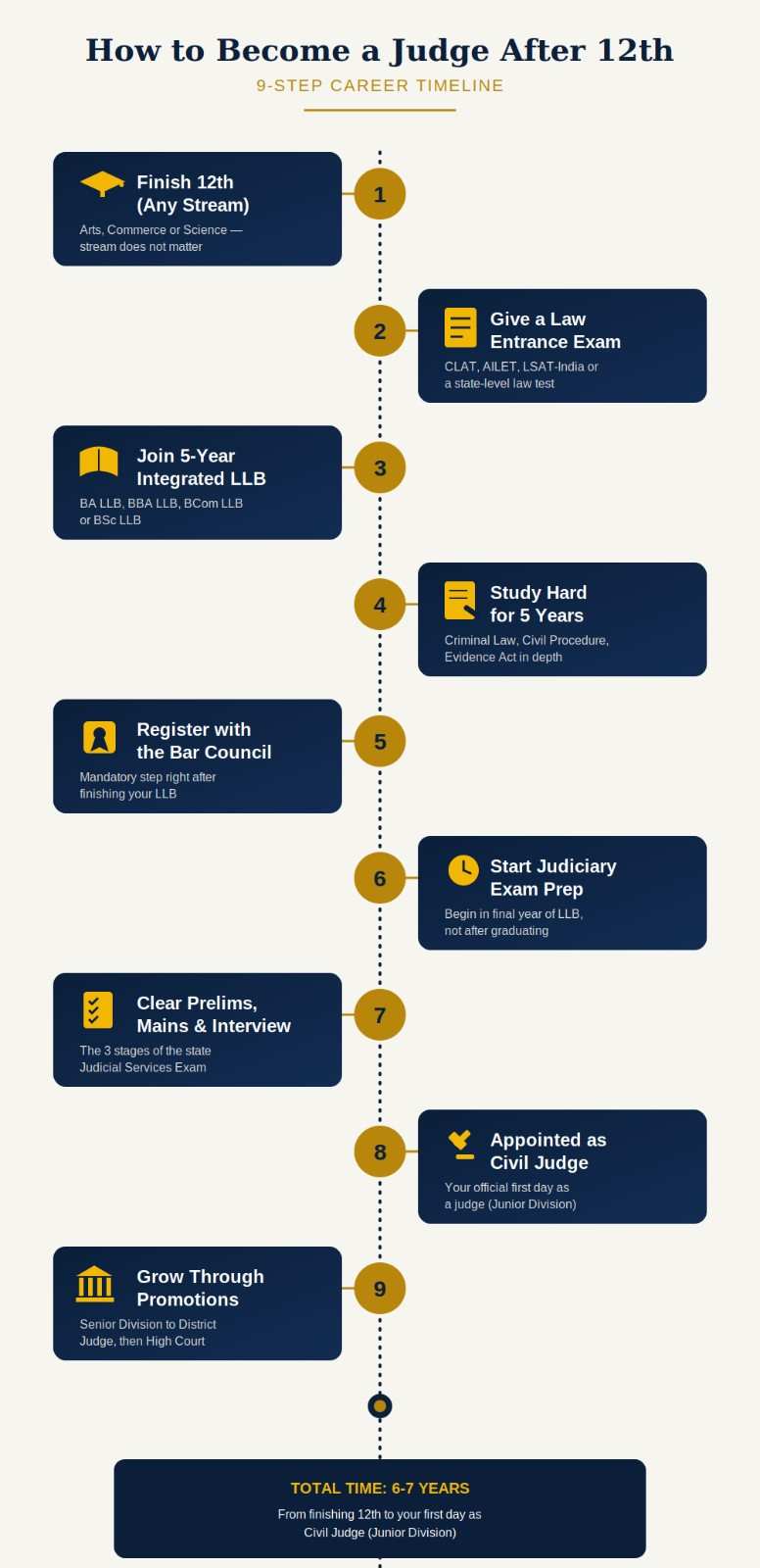
Notice something here — there's no step where anyone "selects" you personally. Every single stage is either an entrance exam or a competitive exam. That's actually good news, because it means your background, city, or contacts don't matter. Your preparation does.
Which Stream Is Best After 10th or 12th for Judge
There is no compulsory stream for becoming a judge — Arts, Commerce, and Science students are all equally eligible. I get asked this constantly by 10th and 11th students, and I understand the worry, but this is one of the few careers where your stream choice barely matters. That said, here's my honest take based on what I've seen work better in practice:
- Arts/Humanities: Slightly easier transition because subjects like Political Science, History, and Sociology overlap with law topics. A mistake I see a lot of beginners make is assuming Arts is "less serious" — in judiciary prep, it's actually a head start.
- Commerce: Good if you're also interested in corporate law or tax law later, since you already understand accounts and business basics.
- Science: No disadvantage at all. Mayank Pratap Singh, who became one of India's youngest judges, was actually a Science student in Class 12 before switching fully into law. He had taken the science stream in Class XII, but decided not to follow the common path of preparing for engineering entrance exams instead.
So if you're in Class 10 or 11 wondering "which stream is best for judge," my honest answer is: pick the stream you'll actually enjoy studying for two more years, because burning out before you even reach law college helps nobody.
How Many Years Does It Take to Become a Judge After 12th
It takes about 6 to 7 years to become a judge after 12th, on average. Here's how that breaks down so you can actually plan around it instead of guessing.
| Stage | Typical Duration | What Happens |
|---|---|---|
| 5-year Law Degree (BA LLB etc.) | 5 years | Core legal education, moot courts, internships |
| Judicial Exam Preparation | 1–2 years (can overlap with final year of LLB) | Preparing for Prelims, Mains, Interview |
| Judicial Services Exam Process | 6–10 months per attempt | Prelims → Mains → Interview → Result |
| Total (realistic average) | 6–7 years from 12th | Appointment as Civil Judge (Junior Division) |
Of course, this can stretch longer. Judiciary exams aren't guaranteed on the first try — many toppers I've read about cleared it on their second or third attempt after some years of practicing law. So treat 6-7 years as the fastest realistic case, not a guarantee.
How to Become a Judge After 12th Without CLAT
Yes, you can become a judge without ever giving CLAT. CLAT is not mandatory — it simply helps you gain admission to reputed National Law Universities, which can strengthen your foundation before appearing for judicial exams.
Here's what most articles don't explain clearly: CLAT is only a college entrance exam. The actual "judge-making" exam is the Judicial Services Exam, and it has absolutely nothing to do with whether you gave CLAT or not. Your alternate routes into a law degree without CLAT:
- State-level law entrance exams run by individual universities.
- Direct merit-based admission in many private and state law colleges based on your 12th marks.
- LSAT-India or AILET, if you want another national-level option besides CLAT.
In my experience, CLAT mainly matters if your dream is a top-5 National Law University for the brand name and campus placements. For becoming a judge specifically, a solid law college with good faculty and a serious judiciary coaching culture around it can honestly work just as well.
How to Become a High Court Judge After 12th
You cannot become a High Court judge directly — it requires years of experience first, either as a practicing advocate or as a lower court judge. This is where a lot of student confusion happens, so let me be very direct about it. There are two real routes to the High Court bench:
- Through judicial service promotion: You join as Civil Judge (Junior Division) after clearing the state judiciary exam, then get promoted over 15-20+ years through Senior Division, District Judge, and finally recommended for High Court.
- Through the Bar (as a practicing advocate): Aspiring judges enroll with the Bar Council of India and gain significant advocacy experience, generally more than 7 years, to be eligible for the Higher Judicial Services examination, and highly experienced senior advocates (often 10+ years) can be directly recommended as High Court judges by the Collegium system.
So if someone tells you "I'll become a High Court judge after 12th in 5 years," that's simply not accurate, and I'd rather tell you that now than have you feel misled later. What you can do after 12th is start the exact path that eventually leads there — it just takes decades, not years, to reach the High Court seat.
How to Become a Judge After Graduation Instead of After 12th
If you've already finished a regular graduation degree like BA, BCom, or BSc, you can still become a judge by doing a 3-year LLB course instead of the 5-year one. This is actually a very common route, and honestly, it has its own advantages. Here's a quick comparison so you can decide which fits your situation:
| Factor | 5-Year LLB (After 12th) | 3-Year LLB (After Graduation) |
|---|---|---|
| Total time to LLB | 5 years | 3 years (after your existing degree) |
| Total time from 12th | 5 years | 6+ years (3 years graduation + 3 years LLB) |
| Best for | Students sure about law early | Students who explored another degree first |
| Maturity for judiciary exam | Slightly less by graduation | Generally more mature, better exam discipline |
| Entrance exams | CLAT, AILET, state law tests | CLAT-PG route not needed; separate 3-year LLB entrance tests |
I've noticed something interesting here — people who come through the 3-year LLB after graduation sometimes clear judiciary exams faster because they already have stronger study discipline from their first degree. So if you're a graduate reading this wondering if you're "too late," you're genuinely not.
Common Mistakes Students Make
Let me save you some pain here, because I've watched these same three mistakes repeat over and over.
- Starting judiciary exam prep only after finishing LLB. By then you've forgotten half of first-year subjects. Start revising judiciary-relevant subjects from your 3rd year itself.
- Ignoring the state you're preparing for. Every state's Judicial Services Exam has a different syllabus, different local language paper, and different cutoffs. Don't prepare generically — pick your target state early.
- Treating CLAT as the finish line. I've seen bright students celebrate hard after clearing CLAT and then lose momentum for the next four-plus years. CLAT is step one of nine, not the goal itself.
What Is the Salary of a Judge in India
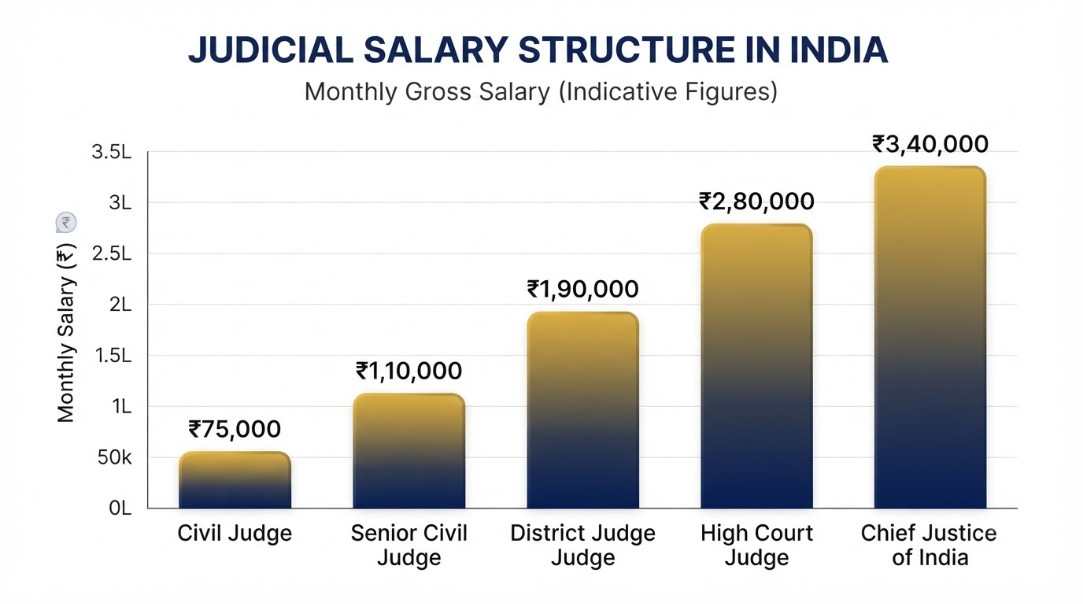
A newly appointed Civil Judge in India earns a basic pay of about ₹77,840 per month, which goes up significantly with allowances and promotions. This basic pay is set under the Second National Judicial Pay Commission, and with dearness allowance included, the gross salary is roughly ₹1.13 lakh, with in-hand pay of approximately ₹90,000-₹95,000 per month depending on the state. (Source: Toprankers PCS-J Salary Guide, 2026)
| Position | Approximate Monthly Salary (2026) |
|---|---|
| Civil Judge (Junior Division) — entry level | ₹77,840 – ₹1,36,520 (basic pay) |
| Civil Judge (Senior Division) | ₹1,00,000 – ₹1,40,000 (in-hand) |
| District Judge | ₹1,44,840 to approximately ₹1,94,660, rising up to ₹2,24,100 with seniority |
| High Court Judge | Around ₹2,25,000 |
| Chief Justice of India | Around ₹2,80,000 |
What this actually means for you: even the entry-level salary of a fresh Civil Judge is higher than what most fresh graduates earn in their first private-sector job in India. And on top of the basic pay, judges usually get government housing, a vehicle, and strong job security — benefits that don't show up in the salary number itself but matter a lot in real life.
What Is the Youngest Age to Become a Judge
The youngest age to become a judge in India is around 21-22 years old, though most judges are appointed between 23-27. The record example I always mention to students is Mayank Pratap Singh from Rajasthan.
Mayank Pratap Singh cracked the Rajasthan judicial services 2018 exam at just 21 years of age, making him the youngest person to become a judge in the country. What made this possible was a rule change — the original age requirement for appearing in the judicial services exam was 23 years, but it was reduced to 21 years by the Rajasthan High Court that year. (Source: News Mobile) He had enrolled in the five-year LLB course in 2014, which lines up almost exactly with the "5-year law course after 12th" path described earlier in this guide.
I share this example not to set unrealistic expectations, but to show you the math actually works: 12th at 17-18, finish 5-year LLB by 22-23, clear the judiciary exam around the same time. It's rare to be the youngest in your entire state, but reaching your first judgeship by your mid-20s is genuinely realistic if you stay consistent.
Do keep in mind that the minimum age for judicial services exams varies by state — some states set it at 21, others at 22 or 23, so always check your target state's official notification before assuming you're eligible.
Is the Judge Exam Tough
Yes, the Judicial Services Exam is genuinely tough, with typically only 1-3% of applicants clearing it in a given year. I won't lie to you here just to make this career sound easier than it is. Here's why it's hard, in plain words:
- Huge syllabus: You're tested on Constitutional Law, Criminal Law, Civil Law, Procedure Codes, Evidence Act, and often a local language paper too.
- Three separate stages: candidates need a minimum of 55% in law subjects just to be eligible to sit the exam, and then they still need to clear Prelims, Mains, and a personal Interview.
- High competition, limited seats: Lakhs of law graduates across each state compete for a few hundred vacancies most years.
- Qualifying cutoffs are strict. Most states require a minimum 60% in the preliminary examination, with reserved category candidates needing 55%.
But here's the thing — "tough" doesn't mean "impossible," and I want to be balanced about this, not dramatic. It depends on how early you start and how consistently you study, not on some rare natural talent. Students who start serious preparation from their 3rd year of LLB, rather than cramming after graduation, clear it far more often than those who wing it last minute.
My Honest Opinion: Is This Path Worth It
I'll be straight with you: it depends on whether you actually enjoy reading and reasoning through problems, not just whether you want the "judge" title. If long reading, detailed rule-based thinking, and years of exam prep sound exhausting to you, this path will feel like a grind rather than a calling.
But if you genuinely like figuring out "who's right and why" in an argument, and you don't mind a 6-7 year runway before your first real paycheck as a judge, I think it's one of the most stable and respected careers available in India today. The job security, the social respect, and the salary progression are hard to match once you're in.
Where it gets tricky is the years in between — you'll watch friends in shorter courses start earning while you're still studying or preparing. That's the real trade-off, and it depends entirely on how much you value long-term stability over short-term income.
What to Do Next
If you're in 11th or 12th right now, don't wait for "the right time" to start — pick your law entrance exam and start basic prep this year itself. If you're already in law college, start reading judiciary-focused subjects seriously from your 3rd year onward, not your final year.
Whatever stage you're at, the path is clear even if it's long: law degree, judicial exam, appointment, promotion.
Author Bio
Kush Verma is a Software Engineer, Teacher & Principal Editor, and Researcher at UKTU, with a background in Computer Science Engineering and full-stack development. He writes about software engineering, educational frameworks for readers seeking practical, fact-checked guides, drawing on a strict four-stage editorial process of primary research, technical validation, editorial refinement, and continuous auditing.
Frequently Asked Questions
How can I study to become a judge right after my 12th board exams?+
Join a 5-year integrated law course like BA LLB straight after 12th, in any stream. Focus on strong reading habits and constitutional law basics early. Later, prepare specifically for your state's Judicial Services Exam during your final LLB years.
Can I become a judge after 10th standard directly?+
No, you cannot become a judge after 10th — you must first complete your 12th in any stream. After 12th, you become eligible for law entrance exams and a 5-year law degree, which is the real starting point for a judiciary career.
Which stream should I take in 11th if I want to be a judge later?+
Any stream works fine — Arts, Commerce, or Science all lead to law eligibility equally. Arts subjects like History and Political Science can give a slight head start for judiciary exam topics later on.
Do I need to clear CLAT to become a judge?+
No, CLAT is optional and only helps you enter top National Law Universities. You can still become a judge through state law entrance exams or direct admission, as long as you eventually clear the Judicial Services Exam.
How many attempts are usually needed to clear the Judicial Services Exam?+
There's no fixed number, and many candidates clear it in their second or third attempt after gaining more practical law knowledge. Some toppers do clear it on the first attempt with early, focused preparation starting in law college itself.
What subjects are most important for the judiciary exam?+
Constitutional Law, Indian Penal Code, Criminal Procedure Code, Civil Procedure Code, and the Evidence Act carry the most weight across almost every state's syllabus. Many states also test a local/regional language paper, so check your target state's syllabus specifically.
Is there an age limit to give the Judicial Services Exam?+
Yes, most states set a minimum age between 21 and 23 years, with an upper age limit that varies by state and category. Always check the official notification of your target state, since these limits are revised from time to time.