How to Become a Dentist After 12th: Roadmap & Salary
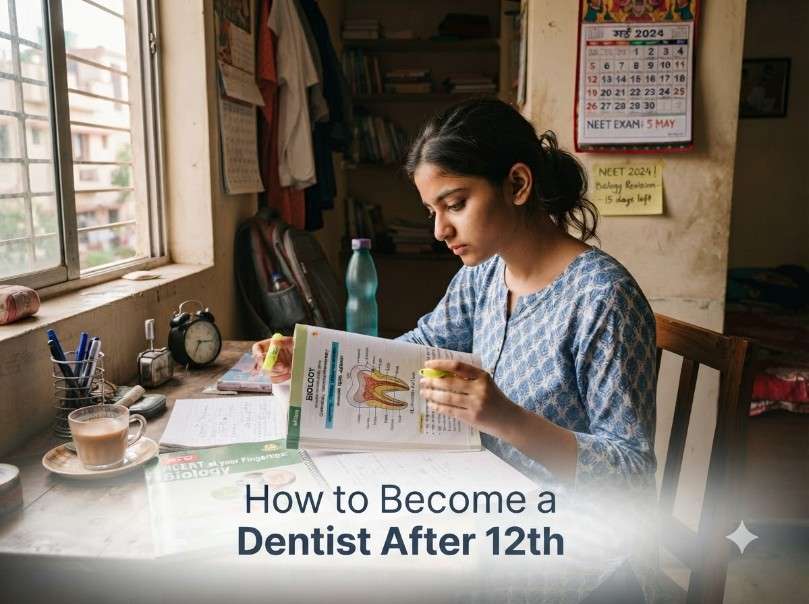
Want to know how to become a dentist after 12th? Here's the real roadmap — NEET, BDS, internship, fees, and what you'll actually earn.
Key Takeaways
- You need PCB in 12th (Physics, Chemistry, Biology) and a valid NEET-UG score to get into any BDS course in India — there's no legal way around NEET for a dental seat in an Indian college.
- The full path takes 5 to 6 years after 12th: 4 years of BDS classes + 1 year compulsory internship, then you can start practising.
- Government BDS fees are shockingly low — often ₹15,000 to ₹60,000 a year — while private colleges can charge ₹2 lakh to ₹10+ lakh a year.
- Fresher dentist salary is modest (₹15,000–₹35,000/month in a private clinic), but income jumps a lot once you specialise (MDS) or open your own clinic.
- If you skip NEET, you cannot become a licensed dentist in India — no shortcut, no backdoor, no exception, whatever any random YouTube video tells you.
Who Is a Dentist and What Do They Actually Do?
A dentist is a doctor who treats problems related to your teeth, gums, and mouth — from a simple cavity to a full root canal. I know that sounds like a textbook line, so let me put it in plain words: if your tooth hurts, bleeds, or looks wrong, a dentist is the person who fixes it. They use tools like X-ray machines, drills, scalers, and lasers to diagnose and treat oral problems.
But a dentist's job isn't only about drilling teeth. A big part of the job is prevention — teaching people how to brush properly, catching gum disease early, and doing regular checkups before a small problem becomes a root canal. In my experience talking to dental students, most of a dentist's early career is actually about patient trust, not just clinical skill.
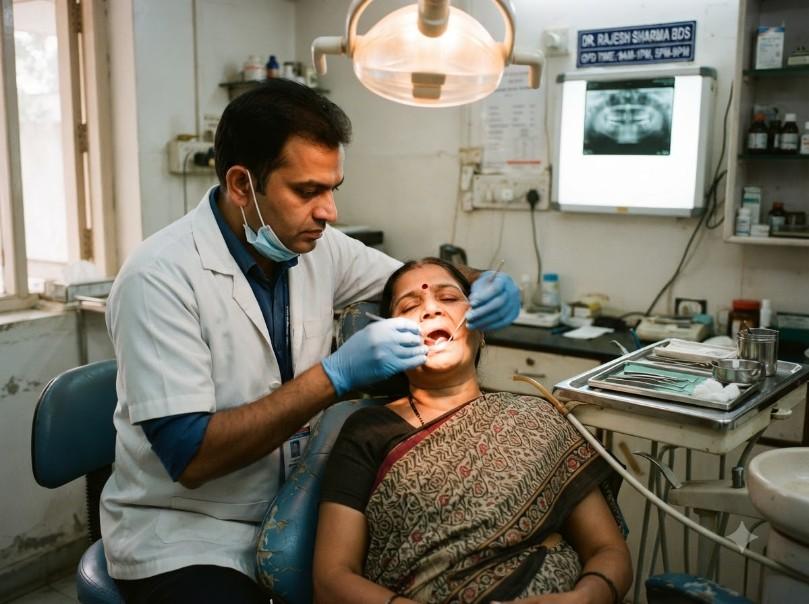
A dentist's day usually mixes routine work (checkups, cleaning, fillings) with occasional complex cases (root canals, extractions, minor surgery). Some dentists work purely as general practitioners, treating whatever walks through the clinic door, while others specialise later into a specific branch like orthodontics or oral surgery. Either way, the core of the job stays the same — you're solving a physical problem inside someone's mouth, often while they're anxious and in some pain.
I remember a cousin of mine who joined a private dental clinic straight after her internship. Her first three months were mostly extractions and fillings, nothing glamorous, but she told me the real skill she built wasn't drilling technique — it was learning to calm down a scared patient in under two minutes before starting any procedure. That's the side of dentistry nobody puts in a brochure.
How to Become a Dentist After 12th: The Short Answer
Becoming a dentist after 12th means clearing NEET-UG with Physics, Chemistry, and Biology, then completing a 5-year BDS (Bachelor of Dental Surgery) degree from a Dental Council approved college. After that, you register with your State Dental Council and you're legally allowed to practise as a dentist in India.
Here's the quick roadmap so you have the full picture before we go deep into each step:
- Study PCB in class 11 and 12 with English as a compulsory subject.
- Score at least 50% in PCB (40% for reserved categories) in your board exam.
- Appear for NEET-UG, the only entrance exam accepted for dental admissions in India.
- Get a BDS seat through NEET counselling (government or private college).
- Complete 4 years of BDS coursework plus a compulsory 1-year rotating internship.
- Register with your State Dental Council to legally practise.
- Optional: Pursue MDS (3 years) if you want to specialise and earn more.
Dentistry vs MBBS: A Quick Reality Check
A lot of 12th-grade students land on dentistry almost by accident, after telling themselves "MBBS is too competitive, let me try BDS instead." That's not wrong exactly, but it's worth understanding the real differences before you commit years of your life to it.
| Factor | MBBS (Doctor) | BDS (Dentist) |
|---|---|---|
| Course duration | 5.5 years (incl. internship) | 5 years (incl. internship) |
| NEET score needed (govt seat) | Very high (600+ typically) | Comparatively lower (500-570) |
| Government college fees | Low | Even lower in most states |
| Starting salary | Usually higher | Usually lower initially |
| Work hours | Often includes night duty, emergencies | More predictable, clinic-hour based |
| Long-term scope | Hospital, private practice, specialisation | Private clinic, specialisation, cosmetic dentistry |
Neither path is "better" in an absolute sense — it genuinely depends on what kind of work-life balance and patient interaction style suits you. I'd only suggest picking dentistry as a genuine first choice, not a fallback, because a half-hearted BDS student really does struggle once clinical years begin.
Step 1: Pick the Right Subjects in 11th and 12th
You must take Physics, Chemistry, and Biology (PCB) as your core subjects in class 11 and 12 — this is non-negotiable if dentistry is your goal. English is also compulsory alongside PCB because NEET tests comprehension skills through it too.
Some students ask me whether they should also keep Maths along with PCB (making it PCMB). Honestly, unless you're also keeping engineering as a backup option, you don't need Maths — it just adds extra pressure without helping your NEET score. Focus your energy on Biology, since it carries the highest weight in the NEET exam.
A mistake I see a lot of students make: they treat Physics and Chemistry as "just enough to pass" subjects and pour all their energy into Biology. That backfires in NEET, because Physics and Chemistry together carry 50% of the total marks, and a weak Physics score alone can knock you out of a good college.
Step 2: Meet the Eligibility Criteria for BDS Admission
To be eligible for BDS admission in India, you need a 10+2 certificate with Physics, Chemistry, Biology, and English from a recognised board, along with a qualifying NEET-UG score. Here's the eligibility broken down clearly:
| Requirement | Details |
|---|---|
| Subjects in 12th | Physics, Chemistry, Biology/Biotechnology, English |
| Minimum marks (General) | 50% aggregate in PCB |
| Minimum marks (OBC/SC/ST) | 40% aggregate in PCB |
| Minimum marks (PwD) | 45% aggregate in PCB |
| Minimum age | 17 years by December 31 of the admission year |
| Upper age limit | None — candidates of any age above the minimum can apply for the exam |
| Entrance exam | NEET-UG (compulsory) |
I know the "no upper age limit" part surprises a lot of people. If you're a dropper or someone switching careers late, this is genuinely good news — the National Medical Commission removed the upper age cap back in 2022, so age is not something that will stop you.
Step 3: Crack NEET-UG (Your Only Entry Ticket)
NEET-UG (National Eligibility cum Entrance Test) is the single entrance exam that decides your admission to every BDS seat in India, whether government or private. There's no separate dental entrance exam anymore — MBBS, BDS, BAMS, BHMS, all of them run through this one exam.
Exam pattern: NEET has three sections — Physics, Chemistry, and Biology (Botany + Zoology) — with 50 questions each, and the exam runs on a strict pen-and-paper format with no calculators allowed. The marking scheme gives +4 for every correct answer and -1 for every wrong one, so guessing carelessly can actually hurt your score.
When is it held: NEET is usually conducted on the first Sunday of May each year, and NEET UG 2026 is tentatively expected to follow the same pattern seen in 2024 and 2025. Registration usually opens in January-February through the official NTA site, neet.nta.nic.in.
Here's the part students underestimate: how many marks you need for BDS is a lot lower than what you need for MBBS. This is genuinely good news if your target is dentistry and not medicine.
What NEET Score Do You Need for a BDS Seat?
| Score Range | What It Gets You |
|---|---|
| 600+ | Top government colleges like MAIDS Delhi, GDC Mumbai under All India Quota |
| 550–599 | Strong chance at government colleges, both AIQ and state quota |
| 500–549 | Mid-tier government colleges and reputed private colleges |
| 450–499 | State quota seats, private colleges in tier-2 cities |
| Below 450 | Private colleges remain accessible, government colleges become tough |
For government dental colleges specifically, general category candidates should aim for scores generally starting from around 550 marks and above. If you're from OBC, SC, or ST category, the required marks drop noticeably — the NEET BDS cutoff for OBC candidates typically ranges between 520-540 marks, while SC candidates need around 380-420 marks and ST candidates around 350-380 marks.
A Simple NEET Preparation Approach That Actually Works
I'm not a NEET coach, so take this as practical guidance, not a magic formula — but here's what I've seen consistently separate students who clear a good BDS-worthy score from those who don't.
- Master NCERT Biology cover to cover before touching any reference book. Biology alone carries close to half the total NEET marks, so this single step matters more than any other prep decision.
- Treat Chemistry as two separate subjects — Organic/Inorganic vs Physical Chemistry — and revise them on different schedules, since they need different study styles.
- Don't skip Physics numericals out of fear. Even scoring moderately in Physics protects your overall rank far more than students expect.
- Take full-length mock tests from class 12 itself, not just in your final revision months, so exam-day time pressure feels familiar rather than shocking.
- Track your BDS-target score, not a vague "good NEET score." If you're not aiming for MBBS, studying with a 550-570 mark target instead of chasing 650+ can genuinely reduce unnecessary pressure.
Here's the thing that gives most students hope: you don't need a 650+ score like MBBS aspirants do. India has close to 3,958 BDS seats spread across 60 government dental colleges, and thousands more in private and deemed institutions, so a decent-but-not-perfect NEET score can still land you a real dental seat.
Step 4: Get Into a BDS College Through Counselling
Once your NEET result is out, admission happens through a counselling process, not a direct walk-in application. There are two main routes:
- All India Quota (AIQ) — 15% of seats: Counselled by the Medical Counselling Committee (MCC), open to candidates from any state.
- State Quota — 85% of seats: Counselled by your own state's authority, usually needs domicile proof.
Here's my honest advice on choice filling: don't just chase the "top" colleges by name. A government college in your own state, where you'll get state quota benefit and lower fees, is often a smarter pick than a private college in another state that costs five times more for a similar degree.
BDS admissions in India are entirely based on your NEET rank, and with over 28,000 BDS seats across government and private dental colleges, this is not a scarce-seat situation like MBBS. So don't panic if your first score isn't spectacular — options genuinely exist.
Top BDS Colleges in India (Government and Private)
Here's a quick reference list to give you a sense of the landscape — both government and well-known private options across regions.
| College | Type | Location | Typical NEET Score Needed (General) |
|---|---|---|---|
| Maulana Azad Institute of Dental Sciences (MAIDS) | Government | Delhi | 570+ |
| Government Dental College, Mumbai | Government | Maharashtra | 560+ |
| Nair Hospital Dental College | Government | Mumbai | 550+ |
| Dr. R. Ahmed Dental College | Government | Kolkata | 500+ |
| Manipal College of Dental Sciences | Private/Deemed | Manipal, Karnataka | 450+ |
| Dr. D.Y. Patil Dental College | Private/Deemed | Pune | 400+ |
| Sri Ramachandra Dental College | Private/Deemed | Chennai | 400+ |
A quick note on "dental colleges near me" searches: the honest answer is that your state quota seat, if you get one, is almost always going to be the most affordable route in your own state's government dental college. Before looking at private colleges nationally, it's worth checking your own state's counselling authority website for the full list of government colleges you're eligible for under domicile-based state quota.
Step 5: Study the 5-Year BDS Course
BDS stands for Bachelor of Dental Surgery, and it's the only recognised undergraduate dental degree in India. The course runs for 5 years total — 4 years of classroom and clinical training, plus 1 year of compulsory rotating internship.
Here's roughly what you study, year by year:
- Year 1: Human Anatomy, Physiology, Biochemistry — basically your foundation in how the body works.
- Year 2: General Pathology, Pharmacology, Microbiology, Dental Materials.
- Year 3: Oral Pathology, General Medicine, General Surgery, Periodontics basics.
- Year 4: Oral Surgery, Orthodontics, Prosthodontics, Conservative Dentistry, Pedodontics — this is where real clinical training kicks in.
I remember talking to a final-year BDS student who said the shift from theory to hands-on patient treatment in year 3-4 is where most people either fall in love with dentistry or realise it's not for them. That's actually a healthy filter — better to find out in college than after you've opened a clinic.
Here's a rough weekly rhythm for a BDS student, so you know what you're signing up for beyond just subject names. Mornings are usually lectures and lab work, afternoons shift into clinical postings once you hit year 3, and evenings are for study and case write-ups. It's not a light course load — expect long days, especially in your clinical years, and don't assume BDS is an "easier" degree just because its NEET cutoff is lower than MBBS.
A friend from my writing work interviewed a BDS graduate from a Karnataka college who said the biggest shock wasn't the syllabus, it was the sheer number of patient case files she had to complete before her college would even let her sit her final exams. Every dental college has a minimum "case requirement" — a set number of extractions, fillings, or root canals you must personally complete under supervision. If you're someone who learns by doing rather than by reading, this part of BDS will genuinely suit you well.
Step 6: Complete Your Mandatory 1-Year Internship
Every BDS graduate must complete a 1-year rotating internship before they're allowed to register as a licensed dentist. During this year, you rotate through different departments — oral surgery, orthodontics, prosthodontics, and more — treating real patients under supervision.
Here's something that matters practically: most colleges pay a stipend during this internship year. Students typically receive a monthly stipend of around ₹15,000 to ₹40,000 depending on the college, so it's not entirely unpaid work — a genuine relief for students still depending on family support.
Step 7: Register With the State Dental Council
After finishing your internship, you must register with the Dental Council of your state to legally practise as a dentist anywhere in India. This registration is what makes you a licensed professional, not just a degree holder.
Without this registration, you cannot legally treat patients, prescribe medicines, or open a clinic, even with a completed BDS degree. Think of it like a driving license — passing the driving test (BDS) isn't the same as being allowed on the road (registration).
The registration process itself is fairly simple on paper: submit your BDS degree certificate, internship completion certificate, and identity proof to your State Dental Council, pay the registration fee, and you'll receive your registration number. This number is what you'll quote on prescriptions, clinic boards, and any official dental documentation for the rest of your career, so keep the certificate safe.
Step 8 (Optional): Do an MDS for Specialisation
MDS (Master of Dental Surgery) is a 3-year postgraduate course that lets you specialise in a specific branch of dentistry — Orthodontics, Prosthodontics, Oral Surgery, Periodontics, Endodontics, and more. It's not compulsory, and plenty of dentists build successful careers with just a BDS.
That said, here's my honest opinion: if you can manage the extra 3 years and the entrance prep for NEET-MDS, specialising genuinely changes your income ceiling. A general BDS dentist earning ₹8-10 lakh a year isn't rare, but MDS specialists in high-demand fields like orthodontics or implantology routinely cross that within a few years of practice.
Which MDS Specialisation Should You Pick?
If you do decide to go for MDS, the specialisation you choose matters a lot for both your day-to-day work and your income ceiling. Here's a quick, honest snapshot of the popular ones.
- Orthodontics: High demand thanks to braces and clear aligners becoming mainstream cosmetic choices — strong earning potential, but entrance competition is tough.
- Oral and Maxillofacial Surgery: The most surgery-heavy specialisation, closer to a surgeon's lifestyle than a typical dentist's — demanding but well-paying.
- Prosthodontics: Crowns, bridges, implants, and dentures — growing fast because of rising implant demand among older and cosmetic-conscious patients.
- Periodontics: Gum disease treatment — steady demand, often works alongside general dentists through referrals rather than standalone walk-ins.
- Pedodontics: Dentistry for children — needs a specific temperament (patience with kids), smaller but loyal patient base once established.
- Endodontics: Root canal specialists — consistently in demand since root canals are one of the most common dental procedures overall.
My honest advice here: don't pick a specialisation purely because it's "trending" on social media right now. Talk to a few working specialists in that field first, because the day-to-day reality (patient types, procedure frequency, physical demands) varies a lot more than the Instagram version suggests.
How Many Years Does It Take to Become a Dentist After 12th?
It takes 5 to 6 years after 12th to become a licensed dentist in India — that's 4 years of BDS classes plus 1 year of compulsory internship. If you count NEET preparation time (usually 1-2 years after 12th before you clear the exam with a good score), the realistic total can stretch to 6-8 years.
Here's a simple breakdown so there's no confusion:
| Stage | Duration |
|---|---|
| NEET preparation (varies per student) | 1–2 years |
| BDS academic years | 4 years |
| Compulsory rotating internship | 1 year |
| Total after 12th (excluding drop years) | 5 years minimum |
| MDS (if you choose to specialise) | +3 years |
The BDS program is a 5-year undergraduate degree involving 4 years of academic study plus 1 year of internship, and this is the same duration whether you study in a government or private college.
How to Become a Dentist After 12th Without NEET
I'll be straight with you here: there is no legal way to become a practising dentist in India without clearing NEET. Any website, agent, or video claiming a "NEET-free dental admission" in an Indian college is either lying to you or talking about something that isn't a real dentistry degree.
NEET became compulsory for all dental and medical admissions in India from 2017 onwards, and it applies to government colleges, private colleges, and even deemed universities equally. So can you get BDS without NEET? No — not through any Indian college, not through management quota, not through NRI quota either.
What people actually mean when they ask this question is usually one of these three things, so let me answer each honestly:
- "I have a low NEET score — can I still get BDS?" Yes, absolutely. Private colleges and state quota seats accept much lower scores than government AIQ seats (as discussed earlier under NEET score requirements).
- "Can I study BDS abroad without NEET?" Some countries technically don't require NEET to enrol, but you'll still need a valid NEET qualifying score to get your foreign degree recognised for practice in India.
- "Can I become a dental hygienist or dental assistant without NEET?" Yes — these are diploma-level roles, not doctor-level roles, and they don't need NEET.
If your NEET score genuinely isn't clearing any dental seat even after multiple attempts, related paramedical dental careers like Dental Hygienist or Dental Assistant are worth looking at — they don't need NEET and still keep you in the dental field.
How to Become a Dentist After 12th With Commerce or Arts
If you're currently in Commerce or Arts stream, you cannot become a dentist directly — you first need to switch to Science with PCB before you can even sit for NEET. This isn't a rule anyone made up to discourage you; it's simply that NEET tests Physics, Chemistry, and Biology content that Commerce and Arts subjects don't cover.
Here's what's actually possible if you're currently in Commerce or Arts and serious about dentistry:
- Switch streams before 11th if you haven't started yet — this is by far the cleanest path with zero time lost.
- Repeat 11th and 12th in Science if you're already deep into Commerce/Arts — yes, it costs you 2 extra years, but it's the only real route.
- Give NIOS (National Institute of Open Schooling) exams in Science subjects alongside your regular studies, which some students use to save a year.
I won't sugarcoat this — switching from Commerce or Arts to a Science-based medical career is genuinely one of the harder pivots, and it needs real commitment, not a passing interest. If you're only 90% sure dentistry is what you want, it's worth spending real time reflecting before committing 2+ extra years to the switch.
How to Become a Dentist After 10th (Planning Early)
You can't become a dentist directly after 10th — dentistry always starts with choosing PCB in 11th, right after your 10th board results. But if you're asking this question in class 9 or 10, that actually puts you in a great position, because it means you have time to prepare properly instead of rushing later.
Here's what I'd tell a 10th-grade student aiming for dentistry:
- Build a strong Biology and Chemistry foundation now — NEET rewards conceptual clarity built over years, not last-minute cramming.
- Choose Science with PCB confidently after your board results, without second-guessing based on "trends" or peer pressure.
- Start light NEET-oriented reading (NCERT books mainly) from class 11 itself instead of waiting till class 12.
One thing I'd genuinely caution against: don't let coaching institutes pressure you into starting "NEET-level" problem solving in class 9 or 10. At that stage, a strong grip on your school syllabus and genuine curiosity about how the human body works matters far more than solving NEET-pattern MCQs three years too early. Burnout before you've even chosen your stream is a real risk I've seen play out with younger students pushed too hard, too soon.
BDS Course Fees: Government vs Private Colleges (2026)
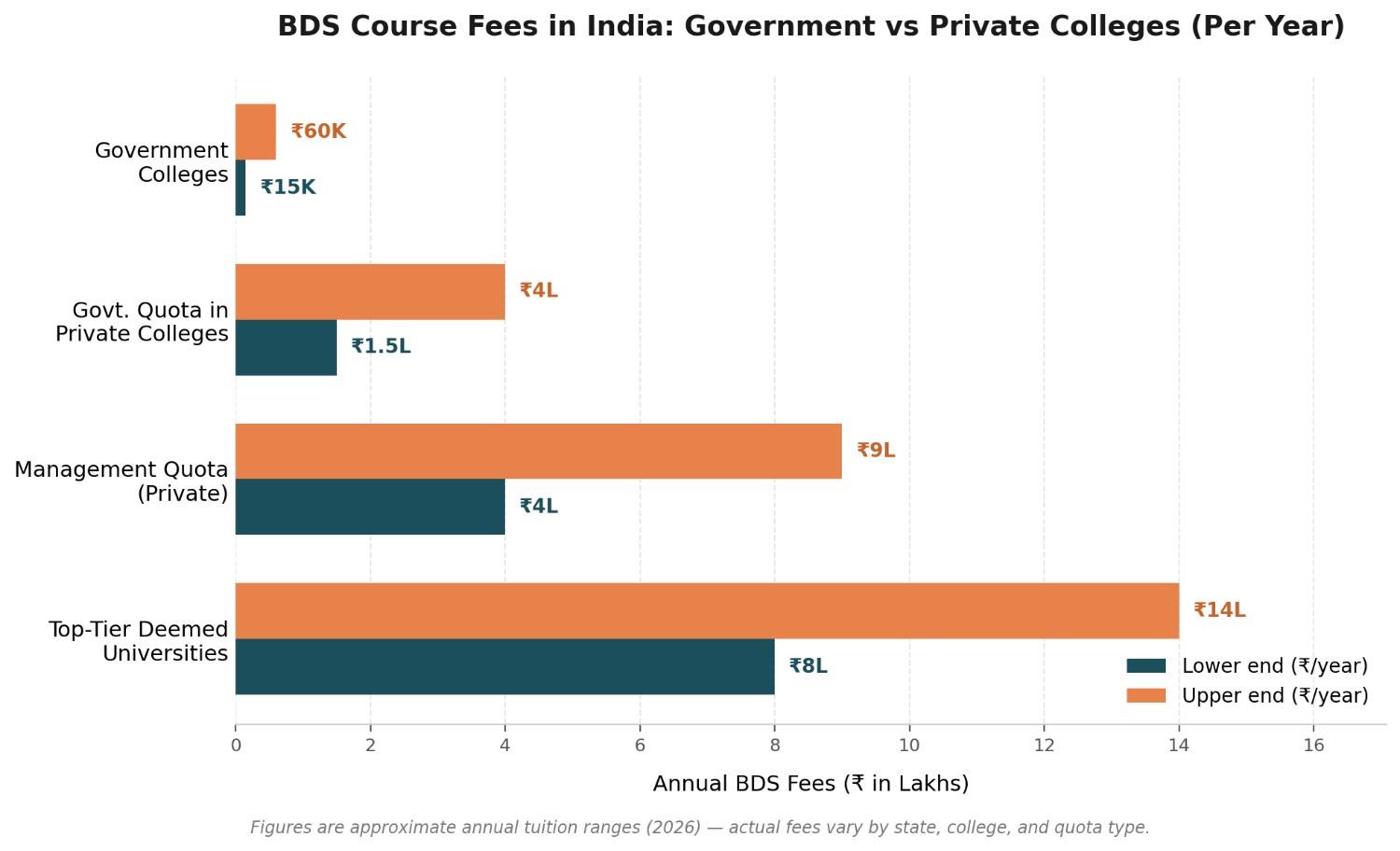
BDS fees in India vary massively depending on whether you get a government seat, a state quota seat in a private college, or a management quota seat. Here's the real breakdown so you can plan your budget realistically.
| College Type | Fees Per Year | Total (5 Years, Approx.) |
|---|---|---|
| Government colleges | ₹15,000 – ₹60,000 | ₹1 lakh – ₹3 lakh |
| Government quota in private colleges | ₹1.5 lakh – ₹4 lakh | ₹8 lakh – ₹20 lakh |
| Management quota (private) | ₹4 lakh – ₹9 lakh+ | ₹20 lakh – ₹45 lakh |
| Top-tier deemed universities | ₹8 lakh – ₹14 lakh | ₹40 lakh – ₹75 lakh |
Government dental colleges remain the most preferred choice because they offer high clinical exposure with minimal tuition, which is exactly why NEET score matters so much — a good score can literally save you 10-15 lakh rupees over 5 years. Private BDS college annual fees, on the other hand, can range from ₹4 lakh to ₹14 lakh per year, pushing total costs including hostel to ₹25-75 lakh.
Here's the thing about education loans: most nationalised and private banks offer education loans covering up to 100% of fees for recognised colleges, so a high private fee shouldn't automatically rule out dentistry for you. Just factor in the loan repayment against your expected starting salary before signing up for a very expensive private seat.
I spoke to a student (through a parent I know) who took a ₹35 lakh loan for a management quota BDS seat in a deemed university, expecting to clear it easily once she started earning. Five years later, between a modest starting salary and loan EMIs, she told me she genuinely regrets not pushing harder for one more NEET attempt to land a government seat instead. That's not meant to scare you away from private colleges entirely — plenty of students manage it fine — but it's a real example of why the fee-to-salary math needs to happen before admission, not after.
Beyond tuition, don't forget hidden costs that catch students off guard: hostel fees, mess charges, instrument kits (dental students need to buy their own tool sets, which isn't cheap), and exam fees each year. Budget an extra ₹50,000 to ₹1.5 lakh per year for these beyond the tuition figures in the table above, especially from second year onwards when clinical instruments become necessary.
Which Course Is Best for Dentist After 12th?
BDS (Bachelor of Dental Surgery) is the only recognised course that lets you become a full dentist in India — there's no alternative degree that gives you the same legal right to practise. But depending on your NEET score and goals, there are a few paths within the dental field worth knowing about.
- BDS (Bachelor of Dental Surgery): The main and only path to becoming a licensed dentist — 5 years including internship, requires NEET.
- MDS (Master of Dental Surgery): For after BDS, if you want to specialise and earn more — 3 years, requires NEET-MDS.
- Diploma in Dental Hygiene / Dental Mechanics: 2-year diploma courses for supporting roles like dental hygienist — doesn't need NEET, lower entry barrier.
- BSc in relevant sciences: Not a direct route to dentistry, but sometimes chosen by students unsure about NEET as a backup academic path.
If someone asks me "which course is best," my honest answer depends on your NEET score reality, not on what sounds prestigious. A BDS from a solid government college beats an expensive private BDS in almost every case I've seen, purely because of the debt-to-income ratio after graduation.
Skills You Actually Need to Become a Dentist
Good grades get you into BDS, but they don't automatically make you a good dentist — that needs a specific set of practical and people skills. Here's what actually matters once you're treating real patients.
- Steady hands (manual dexterity): You're working in a tiny space (someone's mouth) with sharp instruments, so precision matters more than speed.
- Patience: Dental patients are often anxious or in pain, and rushing them makes everything worse for both of you.
- Clear communication: Explaining a treatment plan in simple words builds trust — most patients are scared of jargon, not procedures.
- Attention to detail: Missing a small crack or early decay sign can turn into a much bigger problem for the patient later.
- Physical stamina: Standing and leaning over patients for hours daily is more physically demanding than most people expect.
- Basic business sense: If you plan to run your own clinic eventually, understanding costs, staffing, and patient management matters as much as clinical skill.
I've noticed that students who assume dentistry is "just science and grades" are often the ones who struggle most in year 3-4 clinical rotations. The technical stuff can be learned; the patience and steady-hands part is something you genuinely have to build over time.
A quick way to test if you'd enjoy dentistry: spend a day shadowing a local dentist, even just observing at a family clinic if you know one. If watching close-up dental procedures for a few hours feels interesting rather than uncomfortable, that's actually a meaningful signal — a lot more useful than any personality quiz you'll find online.
How to Build These Skills Before You Even Reach BDS
You don't have to wait until college to start developing dentist-relevant skills. Here are a few things that genuinely help, based on what dental students have told me over the years.
- Practice fine motor skills through hobbies like drawing, embroidery, or building models — anything that trains hand steadiness and precision.
- Volunteer or shadow at local health camps if your school or city organises any, even in a non-clinical support role.
- Work on public speaking or explaining concepts simply — tuition teaching a younger student is a surprisingly good way to build the "explain clearly" muscle you'll need with patients.
- Read general biology and health articles beyond your textbook to build genuine curiosity, not just exam-focused knowledge.
Dentist Salary in India: What You'll Really Earn
Let's talk numbers honestly, because this is probably the question on your mind even if you didn't type it directly. Dentist salary in India varies hugely based on whether you work in a private clinic, government hospital, or run your own practice — and the range is genuinely wide.
| Career Stage | Monthly Salary (Approx.) | Annual Salary (Approx.) |
|---|---|---|
| Fresher (private clinic) | ₹15,000 – ₹35,000 | ₹2.8 lakh – ₹4 lakh |
| 1–4 years experience | ₹25,000 – ₹50,000 | ₹4 lakh – ₹6 lakh |
| Government dentist | ₹40,000 – ₹70,000 | ₹6 lakh – ₹9 lakh (plus benefits) |
| MDS specialist (private) | ₹50,000 – ₹1.5 lakh+ | ₹8 lakh – ₹18 lakh |
| Own successful clinic | ₹1 lakh – ₹5 lakh | Highly variable, location-dependent |
Here's the honest reality behind these numbers: a fresh BDS graduate's salary is genuinely modest, and a fresher dentist typically earns around ₹15,000 to ₹30,000 a month depending on the clinic or hospital they join. This surprises a lot of 12th-grade students who assume "doctor = big money from day one" — that's just not how dentistry works in the early years.
What actually changes the income picture is specialisation and experience. BDS graduates who put in 3-5 years of experience typically move up to earning between ₹6-8 lakh annually, sometimes more, and orthodontists, implantologists, and cosmetic dentistry specialists earn noticeably higher than general practitioners. City also matters a lot — metro cities like Mumbai, Delhi, and Bangalore offer higher income because of larger patient volume and demand for premium cosmetic dentistry.
Here's what I'd tell someone purely chasing the salary number: dentistry is not a "get rich fast" career in your first 3-5 years. If you're comparing it to engineering or an MBA salary trajectory, don't — dentistry rewards patience, reputation-building, and eventually your own clinic or specialisation, not a fast corporate salary jump.
Career Options After BDS or MDS
Dentistry isn't limited to "opening your own clinic" — there are several genuine career paths once you finish BDS or MDS. Here are the main ones worth knowing about.
- General Dental Practice: Working in or owning a private clinic, treating everyday dental problems — the most common path for BDS graduates.
- Government Dentist: Working in government hospitals or Primary Health Centres, offering more job security and pension benefits than private practice.
- Dental Surgeon: Focused on surgical procedures like extractions and oral surgery, usually needs MDS for advanced roles.
- Orthodontist: Specialises in braces, aligners, and jaw alignment — one of the highest-earning MDS specialisations right now.
- Prosthodontist: Handles crowns, bridges, dentures, and implants — a growing field thanks to rising cosmetic dentistry demand.
- Periodontist: Treats gum disease and related tissue problems, often working alongside general dentists on referrals.
- Academics/Teaching: Teaching in dental colleges, usually requires an MDS and comes with more stable working hours.
- Research and Public Health Dentistry: Working with health organisations on oral health programs and awareness — less clinical, more policy-driven.
A career I don't see mentioned enough is dental research combined with public health work — it's less flashy than clinical practice, but if you like the science side of dentistry more than daily patient handling, it's worth exploring seriously.
Beyond Traditional Practice: Newer Options Worth Knowing
Dentistry has quietly expanded beyond the clinic in the last few years, and I think this is genuinely underreported in most career guides. A few paths worth knowing about if traditional clinical practice doesn't fully excite you:
- Cosmetic and aesthetic dentistry consulting: Working with cosmetic clinics on smile design and aesthetic procedures, a fast-growing urban demand area.
- Dental content and patient education: Some dentists now build a genuine income stream through YouTube channels or Instagram pages explaining oral health simply — not a replacement for practice, but a real supplementary path.
- Dental product and equipment consulting: Companies making dental tools, materials, or software often hire practising dentists as consultants or trainers.
- Corporate dental chains: Organised dental chains (similar to how optical chains work) are expanding in Indian metros and hiring salaried dentists with fixed hours — a genuinely good option if you want predictable income without clinic setup costs.
I'd still say clinical practice remains the core of a dentist's career for most people, but it's worth knowing these paths exist rather than assuming your only options are "government job" or "own clinic."
Pros and Cons of Becoming a Dentist
Every career has trade-offs, and dentistry is no exception — here's a genuinely balanced look, not a sales pitch.
What works in dentistry's favour:
- Respected profession with a clear, structured career path.
- Lower BDS fees compared to MBBS in most government colleges.
- Flexibility to open your own clinic and be your own boss eventually.
- Fewer emergency night shifts compared to general medicine, which matters a lot for work-life balance.
- Growing demand for cosmetic and specialised dental care in urban India.
What genuinely makes dentistry harder than it looks:
- Slow income growth in the first few years — this catches a lot of students off guard.
- High setup cost if you want your own clinic with modern equipment.
- Physically repetitive work that can strain your back, neck, and eyes over years.
- Private colleges can be very expensive, and not every student ends up in a government seat.
- Constant patient anxiety management — dealing with scared or difficult patients daily isn't for everyone.
It depends on what you personally value more — stability and structure, or fast income growth. If it's the second one, I'd honestly tell you to look at other NEET-based options or non-medical careers instead, because dentistry rewards patience over speed.
Mistakes Students Make While Planning This Career
I've seen the same handful of mistakes repeat across students planning a dental career, so let me flag them clearly.
- Choosing dentistry only because MBBS seemed "too hard": This is probably the most common mistake — dentistry as a backup plan without real interest often leads to burnout in year 3-4 clinical rotations.
- Ignoring Physics and Chemistry while over-focusing on Biology: NEET's total score depends on all three subjects equally, and a weak PCM score alone can cost you a government seat.
- Taking an expensive private seat without checking the return on investment: A ₹40 lakh BDS degree with a ₹3-4 lakh starting salary needs serious financial planning, not an emotional decision.
- Assuming BDS alone guarantees a high salary: As covered above, real income growth mostly comes after MDS or years of clinic-building, not immediately after graduation.
- Skipping internship seriousness because "it's just a formality": Your internship year is where you actually build hands-on skill — treating it casually shows up later in your clinical confidence.
- Not researching a college's actual clinical exposure before joining: Some private colleges look impressive on brochures but have low real patient footfall, which means fewer hands-on cases during your degree. Ask current students or alumni about actual patient volume before you commit, not just the campus photos.
- Underestimating the physical toll of the profession: Dentistry involves long hours bent over a patient's mouth, and posture-related back and neck problems are common among practising dentists. Building good ergonomic habits from your BDS years itself — proper chair height, regular stretching — saves you real pain later in your career.
My Honest Take: Is Dentistry Worth It in 2026?
If you genuinely enjoy detailed, hands-on work and don't mind a slower income curve in your first 3-5 years, dentistry is still a solid, respected career choice in 2026. It's not the flashy, fast-money path some coaching institute ads make it look like, but it offers something a lot of careers don't — long-term stability, flexibility, and the option to eventually be your own boss.
Where I'd push back on the hype is the assumption that "any dentist automatically earns well." That's simply not true in the first few years, and I think students deserve to know that before signing up for a ₹30-40 lakh private BDS degree on pure optimism. My honest recommendation: aim hard for a government seat through NEET, keep your fees low, and treat specialisation (MDS) as your real income lever, not the BDS degree alone.
I'd also say this: dentistry rewards people who play a long game. The dentist who's earning ₹3-4 lakh a year in her clinic's first year and the same dentist ten years later, with a loyal patient base, a good local reputation, and maybe a second chair hired under her, are two completely different income pictures. If you're looking for a career where year one tells you nothing about year ten, dentistry fits that description well — but only if you go in with realistic expectations about the early years, not the inflated ones social media sometimes sells.
Frequently Asked Questions
Is NEET required for dentist?+
Yes, NEET-UG is compulsory for admission into any BDS course in a Dental Council recognised college in India. There is no exception for government, private, or deemed university seats — every dental admission runs through NEET counselling.
What is the BDS salary in India?+
A fresh BDS graduate typically earns between ₹15,000 to ₹35,000 per month in a private clinic, while government dentist salaries range from ₹40,000 to ₹70,000 monthly including benefits. Income rises significantly with experience, specialisation (MDS), or running your own practice.
Can I get BDS without NEET?+
No, you cannot get admission into any Indian BDS course without a valid NEET-UG qualifying score. This applies equally to management quota, NRI quota, and private college seats — NEET is the single entrance test for all dental admissions.
Which course is best for dentist after 12th?+
BDS (Bachelor of Dental Surgery) is the only course that makes you a licensed dentist in India, so it's the essential choice, not really an "option" among many. After BDS, MDS is the best follow-up course if you want to specialise and increase your earning potential.
How many years does it take to become a dentist after 12th?+
It takes 5 years after 12th to complete a BDS degree, including 4 years of coursework and 1 compulsory year of internship. If you also do an MDS for specialisation, add 3 more years to that total.
How to become a dentist after 12th without NEET?+
There is no legal path to becoming a licensed dentist in an Indian college without clearing NEET-UG. If your goal is a NEET-free dental-related career, look at diploma courses like Dental Hygienist or Dental Assistant instead, which don't require NEET.
How to become a dentist after 12th in commerce or biology stream?+
If you're in Biology stream (PCB), you're already eligible to prepare for NEET and pursue BDS directly. If you're in Commerce, you'll need to switch to Science with PCB first, which typically means repeating 11th and 12th in the Science stream.
Is dentistry a good career option after 12th in India?+
Dentistry is a stable, respected career with lower entry fees than MBBS in government colleges, but income growth is slower in the first few years compared to what most students expect. It suits students who genuinely enjoy detailed, hands-on clinical work and are okay building income gradually through experience or specialisation.
What is the BDS course duration and internship stipend?+
The BDS course runs for 5 years total — 4 years of academic study followed by a compulsory 1-year rotating internship. Most colleges pay a monthly stipend of roughly ₹15,000 to ₹40,000 during this internship year, though the exact amount depends on the college.
Conclusion
Becoming a dentist after 12th isn't complicated once you break it down — PCB in 12th, a solid NEET-UG score, 5 years of BDS, and registration with your state dental council is the entire journey. The part that actually needs real thought isn't the roadmap; it's being honest with yourself about whether you want steady, patient-focused clinical work over fast income in your first few years.
If I were advising a 12th-grade student today, I'd say this: chase a government BDS seat hard through NEET prep, don't take on unnecessary private college debt, and think of MDS as your real career accelerator once you know which specialisation genuinely interests you. That's a realistic, sustainable path — not a shortcut, but a solid one.
Next step: if you're still in 11th or 12th, start structured NEET Biology and Chemistry prep now instead of waiting for the final year — that head start matters more than any last-minute strategy.
About the Author
Kush Verma is a Engineer, Teacher & Principal Editor, and Researcher at UKTU, with a background in Computer Science Engineering and full-stack development. He writes about software engineering, educational frameworks for readers seeking practical, fact-checked guides, drawing on a strict four-stage editorial process of primary research, technical validation, editorial refinement, and continuous auditing.